


















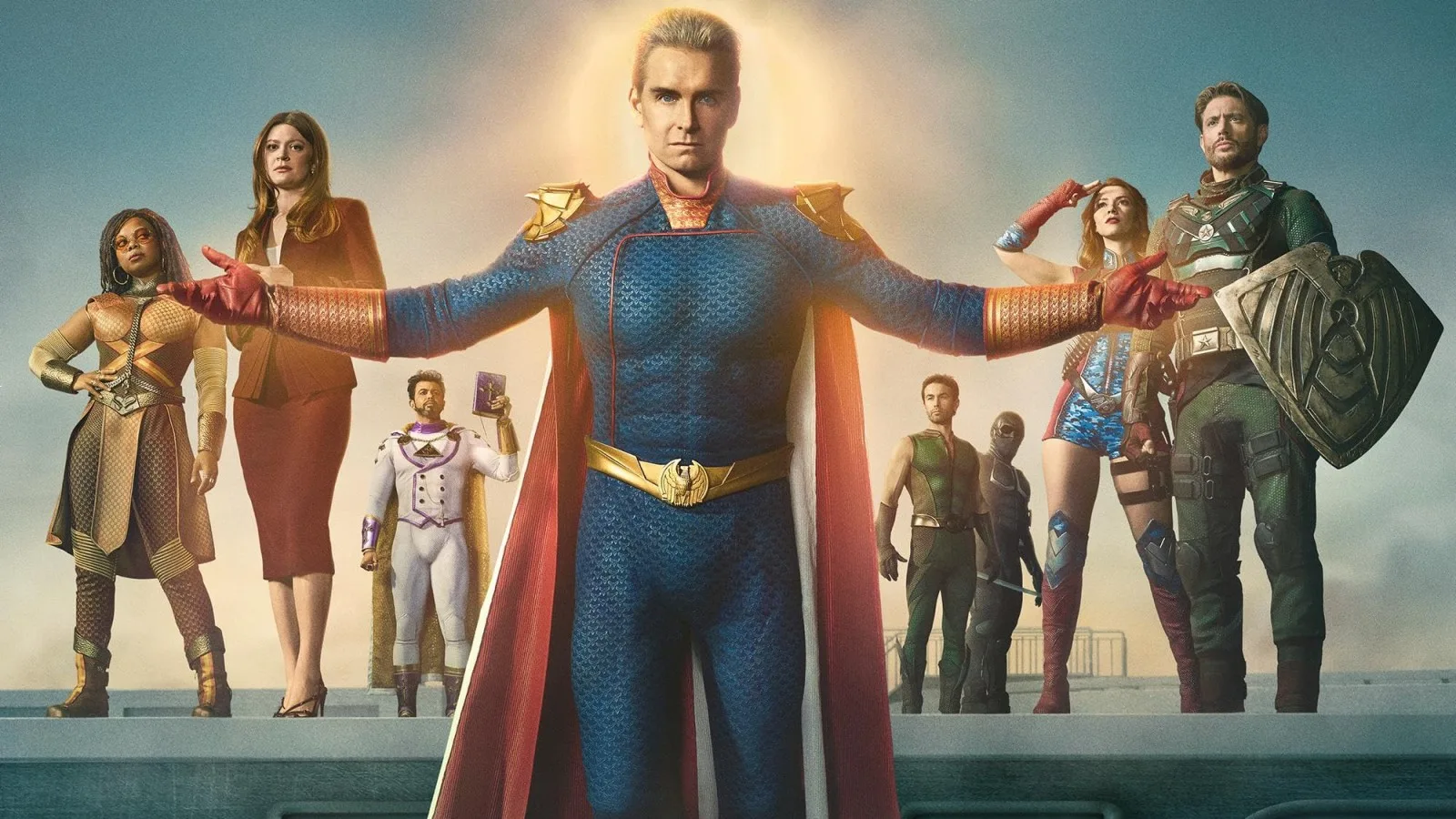

The fifth season of The Boys signals a shift from the boardroom to the bunker. The barrier between corporate branding and state authority has vanished. Homelander wields the President like a stage prop, establishing a regime that treats dissent as a felony. It hunts the Starlighter movement with state-sanctioned precision. A broken resistance searches for a biological solution to the supe problem. The atmosphere feels heavy. It trades the neon of Vought Tower for the cold gray of detention centers. This is “State-Voughtism” (a term for the absolute fusion of marketing and bayonets).
The arrival of Oh Father and the return of Soldier Boy expand the field of play. It feels less like a comic book and more like a historical documentary from a future we are actively building. This narrative approach reflects a grim realism. The series maintains its commitment to graphic violence while centering on the ideological war for the soul of the country. This season focuses on the internal decay of its characters. The corruption of power is absolute.
Infrastructure of the Total State
The show moves past simple satire. We see the birth of a total state. Ashley Barrett occupies the Vice Presidency. This places Vought’s interests directly inside the West Wing. Freedom Camp 47 serves as the physical manifestation of this new order. It is a place for the inconvenient (a euphemism for political enemies). Firecracker uses her platform, The Truthbomb, to execute the death of objective reality. She dismisses the Flight 37 footage as a deepfake. This strategy relies on the weaponization of uncertainty. AI becomes the ultimate shield for the powerful.
Oh Father brings a different energy. He leads the Democratic Church of America. This adds a divine seal to Homelander’s madness. It turns a celebrity into a god. The masses are primed for worship through song and dance. It is “hymn-washing” at its most cynical. This religious influence makes the regime feel ancient and modern simultaneously. It bypasses logic and speaks to the primal need for a savior.
Sister Sage remains the silent hand. She is the architect. Her plan for martial law shifts the stakes from public relations to military occupation. She views Homelander as a useful figurehead. Her presence suggests that the smartest person in the room is often the most dangerous. She does not care for the spotlight. She cares for the infrastructure of control. The threat she poses is intellectual and structural.
The show mirrors the real world where disinformation is a commodity. It suggests that once a society loses its grip on shared facts, the camp is only a few laws away. The architecture of power here is built on fear and the erasure of history. It is a terrifying evolution for the series.
The Anatomy of Moral Decay
Butcher is a ghost. His focus on the virus has stripped away his remaining humanity. He relies on Compound V while his soul rots. He is “vengeance-locked” (stuck in a cycle of hatred that excludes his own team). His dog, Terror, offers the only glimpse of his former self. It is a grim sight. He has become the very thing he sought to destroy. His detachment is a tactical asset and a personal tragedy.
Homelander is a house of cards. His power is absolute, yet his ego is fragile. He brings Soldier Boy back to find a father figure. He finds a mirror instead. Soldier Boy does not care for his son’s needs. This rejection fuels Homelander’s volatility. He wants to be a god because he cannot handle being a man. His insecurity is the most dangerous weapon in America.
A-Train’s path is the most surprising. He moves from corporate sycophant to a man of principle. His choice at the internment camp is a literal and figurative slowdown of his life. He stops running away from his mistakes. He runs toward his end. It is a full circle moment. He avoids the tragedy of the pilot episode by saving a life. This act of defiance is the season’s strongest emotional beat.
Kimiko and Hughie represent the two ends of the emotional spectrum. Kimiko speaks now. She uses therapy and social media to process her past. Her voice is unpolished. It sounds like a person discovering their own existence. Hughie keeps his optimism. He believes in kindness in a world of gore. He is the heart. He is also a target. Their survival is the only metric of success left for the heroes.
The Visual Language of the Internment Age
The visual language has changed. We see the “Homelander Youth.” The camps look utilitarian and cold. The cinematography abandons the saturated colors of earlier seasons. It feels claustrophobic. The script repeats certain phrases. This repetition feels like the fatigue of a long war. It mirrors the exhaustion of the audience in a cycle of constant crises.
The show balances gore with silence. One moment we see a body explode. The next involves a quiet talk between couples. These shifts can be jarring. They reflect the chaotic nature of life under a regime. The inclusion of Gen V characters adds scale. It adds complexity. Marie Moreau appears, bringing her own history into this final struggle. It creates a sense of a world that is too large to fully save.
The production design for the detention centers is haunting. It uses the aesthetics of efficiency to hide the reality of cruelty. The contrast between the bright, televised lies of Firecracker and the dim reality of the camps is stark. The show uses shock value to remind us that violence is never clean. It is a cynical and absurdist approach that remains effective. The pacing reflects the urgency of an ending that no one is truly ready for.
The Final Biological Equation
The virus is the ultimate question. It is a bioweapon designed to kill every supe. This includes Annie. This includes Kimiko. Butcher does not care. He sees it as a necessary cost. The resistance is split. They are fighting for a future that might not have a place for them. This creates a moral vacuum. It asks if a clean slate is worth the lives of the few good people left.
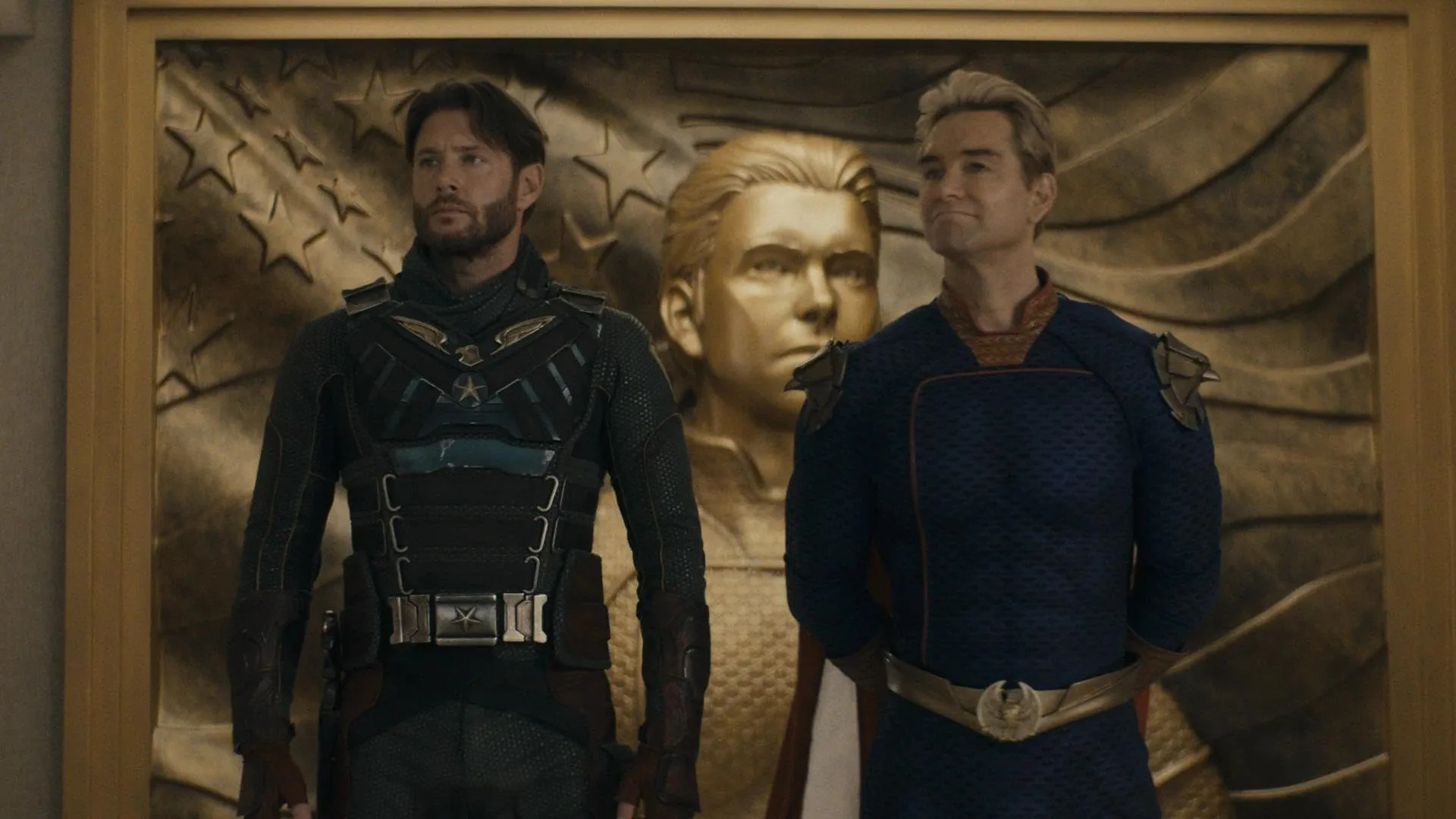
Soldier Boy is a wildcard. Jensen Ackles brings a cold magnetism to the role. He disrupts the binary conflict between Butcher and Homelander. He is a relic of a different kind of violence. He rejects the emotional weight of his legacy. His presence ensures that the final battle will be unpredictable and brutal. He represents the cyclical nature of American aggression.
The “Starlighters” represent a radicalized youth. They suggest that the current system cannot be repaired. It must be replaced. This is a heavy theme for a show that started as a parody. It moves into the territory of political philosophy. The resistance is no longer about saving the day. It is about surviving the collapse.
The tone is somber. The jokes are drier. The violence is meaner. This is not a celebration of heroics. It is an autopsy of a society. The show suggests that some consequences are permanent. The final battle will not be a clean victory. It will be a messy survival. The ending feels earned because it refuses to offer easy comfort. It leaves the viewer with the realization that the heroes are as broken as the world they are trying to fix.
The Boys Season 5 premiered on April 8, 2026, marking the beginning of the end for the critically acclaimed satirical superhero series. As the final chapter in the saga, this season raises the stakes higher than ever as the titular team makes their last stand against Homelander and the corrupt corporate machine of Vought International. You can watch the series exclusively on Amazon Prime Video, where new episodes are released weekly following the two-episode season premiere.
Where to Watch The Boys Season 5 Online







Full Credits
Title: The Boys Season 5
Distributor: Amazon Prime Video
Release date: April 8, 2026
Rating: TV-MA
Running time: Approximately 60 minutes per episode
Director: Phil Sgriccia, Eric Kripke
Writers: Eric Kripke, Paul Grellong, Ellie Monahan, Geoff Aull, Judalina Neira, David Reed, Anslem Richardson
Producers and Executive Producers: Eric Kripke, Seth Rogen, Evan Goldberg, James Weaver, Neal H. Moritz, Pavun Shetty, Ori Marmur, Ken Levin, Jason Netter
Cast: Karl Urban, Jack Quaid, Antony Starr, Erin Moriarty, Jessie T. Usher, Laz Alonso, Chace Crawford, Tomer Capone, Karen Fukuhara, Nathan Mitchell, Colby Minifie, Susan Heyward, Valorie Curry, Daveed Diggs, Cameron Crovetti, Jeffrey Dean Morgan, Jensen Ackles, Jared Padalecki
Director of Photography (Cinematographer): Dan Stoloff, Dylan Macleod
Editors: David Aldenti, Cedric Shumo, Anthony Pinker
Composer: Christopher Lennertz
The Review
The Boys Season 5
Season 5 marks a transition from corporate mockery to a chilling study of state-sanctioned terror. It abandons the safety of satire for a heavy, realistic confrontation with authoritarian mechanics. While the pacing occasionally stumbles under the weight of its own expanded universe, the character deconstructions (specifically A-Train and Homelander) provide a significant emotional anchor. The gore remains. The true horror lies in the erasure of truth through AI and dogma. It is a cynical, necessary autopsy of power.
PROS
- The transformation of A-Train from corporate asset to defiant human.
- Sophisticated focus on how disinformation erodes collective reality.
- Jensen Ackles provides a perfect, cold counterpoint to Homelander’s volatility.
- Bold shift in tone that reflects the permanence of death.
CONS
- Scripting choices include repetitive phrases that weaken the impact.
- Plot sprawl makes the inclusion of secondary characters feel forced.
- Jarring transitions between graphic spectacle and quiet character beats.