

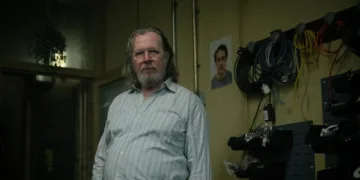



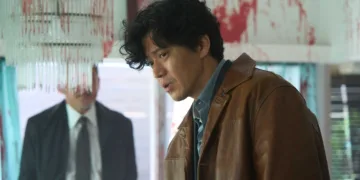

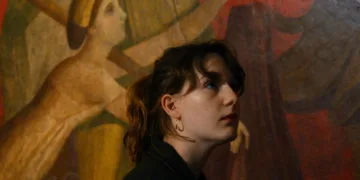












The school year at Godolkin University begins under a suffocating new reality. Homelander’s tyrannical ascent has cast a long shadow across the country, and on campus, the atmosphere is thick with fear and fanaticism. This darker, more volatile stage is set for the return of our protagonists, whose lives have been irrevocably altered.
Marie, Jordan, and Emma re-enter the hallowed halls not as students but as pariahs, fresh from a traumatic stay in a Vought facility. Their former friends, Cate and Sam, are now celebrated as the “Guardians of Godolkin,” their treachery repackaged as heroism for public consumption.
This fractured dynamic is immediately complicated by two new forces: the arrival of Dean Cipher, a mysterious and manipulative new administrator, and the escalating tension between Supes and humans that threatens to ignite into open war. The season quickly sheds the campus antics of its predecessor, adopting a heavier, more somber tone for a direct confrontation with loss, political turmoil, and difficult moral compromises.
Navigating a Fractured Narrative and Real-World Loss
Gen V’s second season is shaped profoundly by a real-world tragedy, and its response is woven into the very fabric of the narrative. The show handles the passing of actor Chance Perdomo with immense respect and care, a choice that speaks to a shifting industry standard that prioritizes people over production convenience.
After an opening dedication, the story reveals that his character, Andre Anderson, died during a failed escape attempt from Vought’s prison. This decision avoids the awkwardness of a recast and transforms a devastating loss into a meaningful plot driver. Andre’s absence becomes a palpable force, an emotional catalyst that propels other characters forward and informs the season’s mournful tone.
His father, Polarity, arrives at Godolkin seeking answers, and his investigation serves as a critique of Vought’s cold calculus, which treats its Supes as disposable assets. His friend Emma is left to navigate a deep well of grief, a journey that forces her character into a more mature, somber space. The writers turned an impossible situation into a poignant exploration of loss that resonates throughout the eight episodes.
The season’s narrative architecture is less elegant. The initial episodes rely on some slightly awkward plot justifications to return the protagonists to the familiar Godolkin campus, a necessary narrative contrivance common to serialized streaming shows needing to reset the board after a dramatic cliffhanger.
This leads to a slower start, with the story taking its time to re-ground the audience in the college setting before launching into the high-stakes conspiracy. This pacing choice mirrors the characters’ own disorientation, but it may test the patience of some viewers. The central mystery revolves around “Project Odessa,” a clandestine Vought program connected to the university’s founding and, specifically, to Marie’s immense potential.
The project is a thematic successor to Season One’s “The Woods,” but it operates on a grander scale, tying directly into the franchise’s core mythology about Supe origins and control. Once this mystery takes hold, the season accelerates into a chaotic second half. This frenetic pace successfully conveys the characters’ escalating panic, but it comes at a cost, sidelining certain subplots and leaving some emotional beats feeling underdeveloped.
Character Arcs and Defining Performances
At the center of the storm is Marie Moreau, whose evolution anchors the season. Jaz Sinclair delivers a commanding performance, portraying Marie’s internal conflict with her immense power, an ability tied to the trauma of her parents’ death. Her journey is a twisted hero’s arc, one that moves from fear to control under the manipulative guidance of Vought’s agenda.

Sinclair masterfully communicates Marie’s internal struggle through subtle expressions and quiet intensity. Another standout is Lizze Broadway as Emma Meyer. Her storyline offers a powerful commentary on mental health, explicitly connecting her shrinking ability to her eating disorder and body dysmorphia. Broadway masterfully navigates Emma’s grief over Andre’s death and her personal battles, making her journey one of the most emotionally resonant parts of the season.
The arcs for Cate Dunlap and Sam Riordan, the newly minted “heroes of Godolkin,” feel less complete. They are trapped by a Vought-spun narrative, making them symbols of how dissent can be co-opted and neutralized by powerful corporations. Their story is a critique of performative heroism, and their visible discomfort with their new roles adds a layer of tragic irony.
The writing for Jordan Li also feels inconsistent; the character is often stuck in a cycle of resentment and doubt that makes their arc feel repetitive. While the dual performances of London Thor and Derek Luh remain strong, the material doesn’t always serve the character’s potential as an exploration of fluid identity.
The season’s new additions, however, are exceptional. Hamish Linklater joins the cast as Dean Cipher and immediately establishes himself as a top-tier villain in The Boys universe. Linklater portrays the dean as a charismatic, sociopathic manipulator, a product of Vought’s corporate culture who sees students as data points on a spreadsheet. He chews scenery with a delightful precision that is both charming and chilling, a perfect representation of institutional evil in a well-tailored suit.
Alongside him, Sean Patrick Thomas is given an expanded role as Polarity. His raw, emotional portrayal of a grieving father searching for justice provides the season with a powerful gravity. Thomas depicts a man stripped of both his Supe abilities and his paternal identity, forced to find a new purpose. This subplot adds a crucial generational layer to the story, contrasting the rebellious youth with a father radicalized by loss.
Satire, Style, and Franchise Convergence
Gen V continues its parent show’s tradition of holding up an unsubtle mirror to society. Its satire remains as blunt as a brick, taking aim at influencer culture, weaponized identity politics, and the creeping authoritarianism of our time. Where The Boys often targets national politics, Gen V scales this down to the “educational-industrial complex,” critiquing how ideology is packaged and sold to the next generation.

A class on “influencer fluency” is a perfect example of this, satirizing how modern education is being reshaped by corporate and social media demands. Project Odessa is the ultimate extension of this idea: a curriculum designed by Vought to produce not thinkers, but weapons. The show’s lack of subtlety is a deliberate choice, reflecting a political climate where dog whistles have been replaced by bullhorns. The satire feels less shocking than that of The Boys, but perhaps more depressingly familiar.
Visually, the season is darker, cloaked in a dreary, almost oppressive aesthetic that matches its somber tone. This muted color palette makes the requisite explosions of blood and gore feel even more pronounced. The violence is plentiful, yet the show struggles to create a truly shocking set piece to rival the memorable moments of its first season.
This arguably reflects a culture saturated with violent imagery, asking if the audience is becoming as desensitized as the show’s characters. This season also signals a significant trend in franchise storytelling: convergence.
The narrative is now deeply intertwined with The Boys, with guest appearances serving critical plot functions. This business model ensures audience retention across multiple properties and creates a more cohesive fictional universe. The risk, however, is that it diminishes Gen V’s distinct identity, shifting its role from a standalone spinoff to essential homework for the main show’s final act.
An Essential, If Uneven, Chapter
This season’s greatest strengths lie in its powerful character work, particularly for Marie and Emma, and in its phenomenal new villain. Dean Cipher is an unforgettable antagonist, and the show’s thoughtful handling of a real-world tragedy is a testament to its creators’ integrity. These considerable triumphs are offset by some notable weaknesses.

The season suffers from inconsistent pacing that hobbles its narrative momentum, a handful of underdeveloped supporting characters, and a central plot that sometimes feels less innovative than its predecessor.
Ultimately, Gen V Season 2 succeeds as a crucial, if imperfect, bridge in the franchise’s overarching story. It effectively tells a compelling tale of a generation being radicalized by the very corrupt system that made them. Despite its flaws, it stands as an important chapter that skillfully sets the stage for the violent, chaotic endgame of The Boys.
The second season of the series, a spin-off from The Boys, is set to premiere on Prime Video on September 17, 2025. The first three episodes will be released on that date, with new episodes airing weekly until the season finale on October 22, 2025. It is set after the events of the fourth season of The Boys, with the students returning to Godolkin University.
Full Credits
Director: Steve Boyum
Writers: Michele Fazekas, Craig Rosenberg, Evan Goldberg, Eric Kripke, Ellie Monahan, Jessica Chou, Cameron Squires, Brant Englestein, Chris Dingess, Lauren Greer, Chelsea Grate, Thomas Schnauz, Justine Ferrara
Producers and Executive Producers: Michele Fazekas, Tara Butters, Eric Kripke, Seth Rogen, Evan Goldberg, James Weaver, Neal H. Moritz, Ori Marmur, Pavun Shetty, Ken Levin, Jason Netter, Garth Ennis, Darick Robertson, Craig Rosenberg, Zak Schwartz, Erica Rosbe, Michaela Starr, Brant Engelstein
Cast: Jaz Sinclair, Lizze Broadway, Maddie Phillips, London Thor, Derek Luh, Asa Germann, Hamish Linklater, Sean Patrick Thomas, Chance Perdomo, Shelley Conn, Patrick Schwarzenegger, Marco Pigossi, Keeya King, Stephen Kalyn, Julia Knope, Stacey McGunnigle, Tait Fletcher, Wyatt Dorion, Georgie Murphy
Director of Photography (Cinematographer): Michael Marshall
Composer: Matt Bowen, Christopher Lennertz
The Review
Gen V Season 2
Gen V Season 2 is an essential, if uneven, chapter in the franchise. While hampered by inconsistent pacing and some underdeveloped characters, the season soars on the strength of its lead performances and a truly magnetic villain in Hamish Linklater’s Dean Cipher. It navigates a real-world tragedy with grace and effectively sets the stage for the endgame of The Boys, making its darker, more somber journey a necessary one.
PROS
- An exceptional and memorable new villain in Dean Cipher.
- Emotionally resonant performances from Jaz Sinclair and Lizze Broadway.
- A respectful and poignant handling of Chance Perdomo's passing.
- Raises the stakes by successfully integrating with the main plot of The Boys.
CONS
- Inconsistent pacing, with a slow start followed by a rushed second half.
- Some supporting character arcs feel underdeveloped or repetitive.
- Loses some of its unique campus-life identity as it merges with the parent show.
- The social satire occasionally feels less sharp than in the previous season.