
















![Kingdom Hearts Collection [I-III] Review](https://gazettely.com/wp-content/uploads/2026/10/Kingdom-Hearts-Collection-I-III-1-360x180.webp "Kingdom Hearts Collection [I-III] Review: KHII Holds Steady as Newer Entries Fluctuate 40")
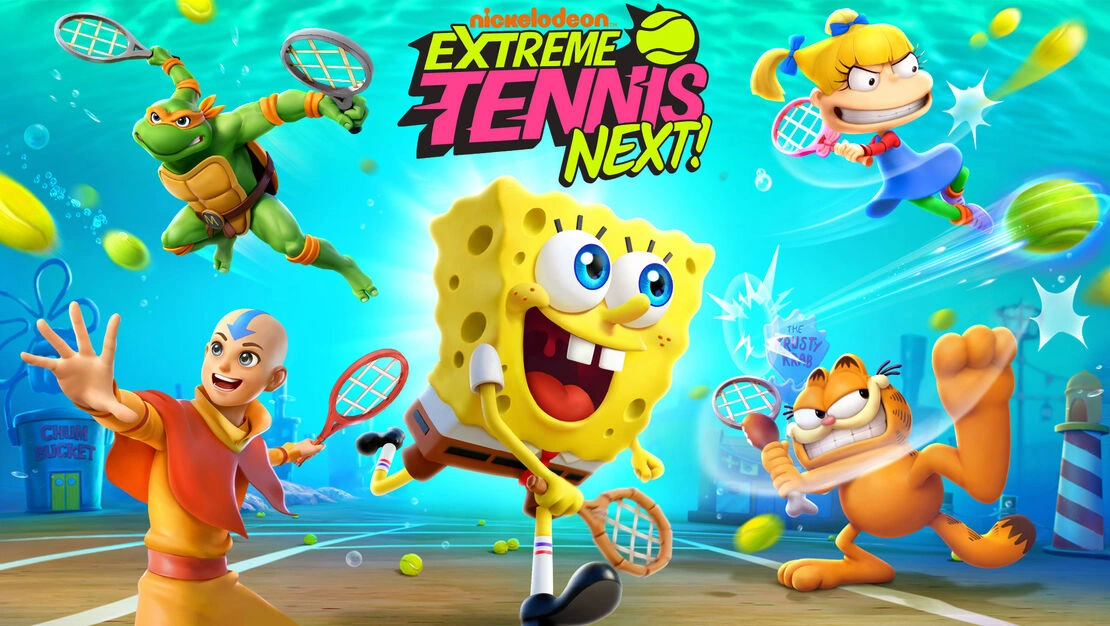

Nickelodeon Extreme Tennis: Next! comes from Old Skull Games and Gameloft, arriving on consoles and PC after its Apple Arcade version, and that lineage matters. This is a mobile-born arcade tennis game wearing a bigger platform outfit. Sometimes the fit is surprisingly neat. Sometimes the sleeves are too short.
The setup is easy to grasp. SpongeBob, Aang, Garfield, CatDog, Zim, Mikey, Arnold, Timmy Turner, Rugrats characters, Danny Phantom, Rocko, and several other Nickelodeon faces trade rallies across themed courts with power-ups, special moves, and cosmetic unlocks layered over the tennis.
Anyone coming from TopSpin will bounce off the cartoon physics fast. Anyone coming from Mario Tennis will understand the intended family tree immediately: quick points, exaggerated abilities, and a sport treated as a delivery system for character chaos.
The Rally Has Skill, Then Trips Over Its Timing
The basic tennis works because it starts simple. You have standard shot types, including lobs, slices, drop shots, and stronger returns, plus a dash that spends energy to reach balls that would otherwise pass you. Clean timing creates perfect shots, and that small timing window gives rallies a skill check beyond simply running to the marker and pressing a button.
The match format helps. Points come quickly, so the game fits short play sessions better than long solo grinds. You can play a few rounds, unlock something, laugh at CatDog wearing absurd gear, and leave before the repetition starts leaning on the doorbell.
The issue is rhythm. When the ball approaches, the game slows the action to help the player react. On a phone screen, that makes sense. On a controller, it leaves the return game feeling strangely stiff, as if every volley briefly asks permission to continue.
A good arcade tennis game needs flow. Mario Tennis builds that flow through clean positioning and shot anticipation. Nickelodeon Extreme Tennis: Next! keeps interrupting its own rallies with a mechanic that still remembers being touch-controlled.
The energy system fares better. Spending one bar on a dash can save a point, while saving the full meter gives access to a cinematic ultimate. That creates a readable tactical choice: survive this rally now, or hold the meter for a bigger swing later. The game is at its sharpest when both players are hovering near full energy and one mistimed return can trigger a special attack.
Power-Ups Bring the Nickelodeon Mess
The power-ups are the part of Nickelodeon Extreme Tennis: Next! that most clearly separates it from a plain licensed sports game. Hit a question-mark bubble and the court can turn hostile. Slime can trap an opponent. Ice can freeze movement. Size boosts can turn a character into a racket-swinging wall. Rubber balls can bounce into play and stun anyone unlucky enough to stand in the wrong spot.
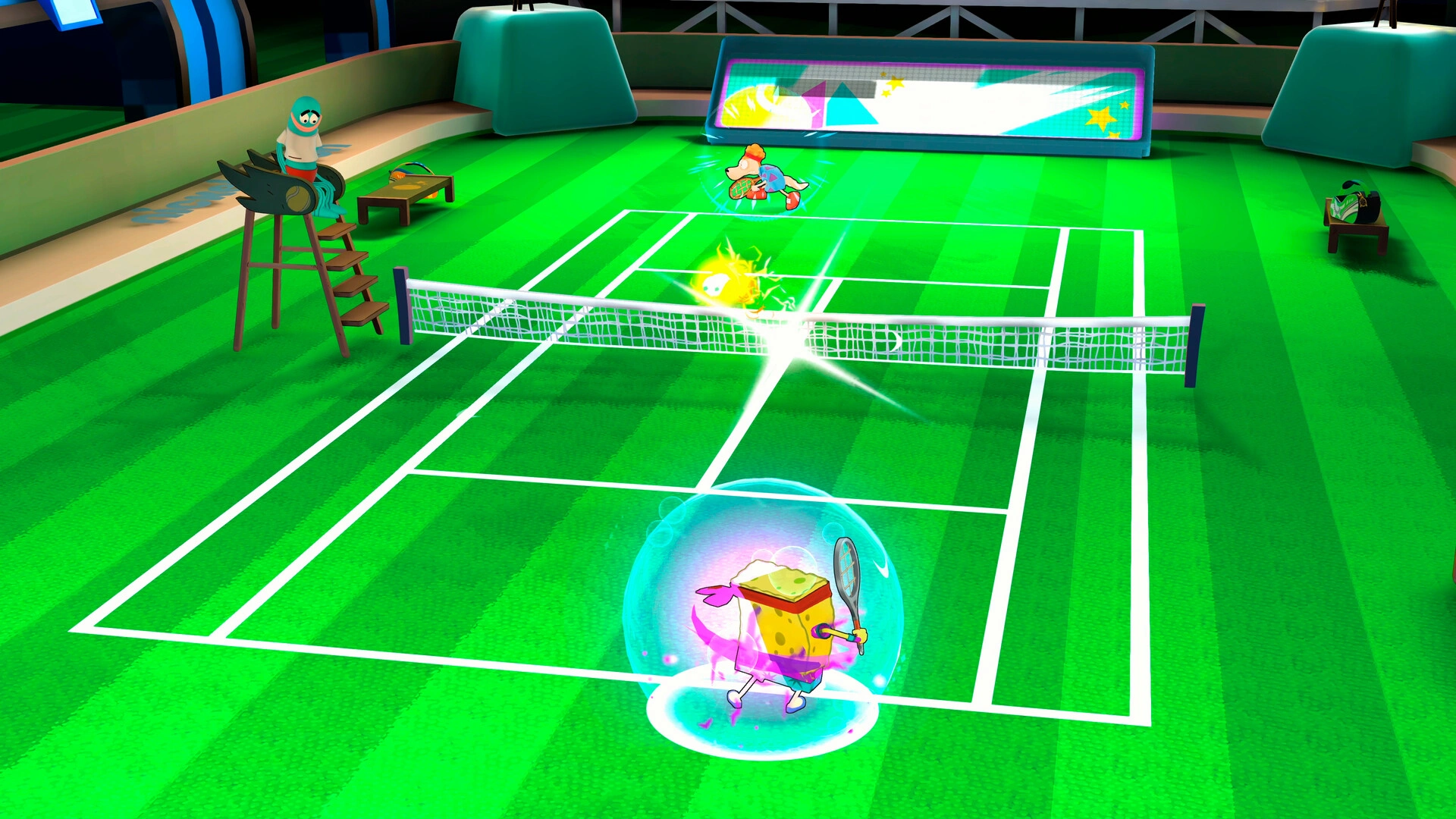
That last example shows the difference between party-game chaos and cheap frustration. A slime trap works because the player can see the hazard and react. Rubber balls that appear underfoot during a Story Mode objective feel less like a joke and closer to a coin toss with branding.
Character specials give the roster some needed identity. Aang’s elemental attacks fit the Avatar side of the cast, SpongeBob brings the appropriate underwater nonsense, Mikey can drop manhole covers, Zim’s speed boost changes his court coverage, and CatDog’s ability to carry extra power-up pressure gives that character a mechanical gag that actually belongs to the design. These are small distinctions, but they matter in a crossover game. The roster should play with personality, not simply look different on the character select screen.
Balance is looser. Some ultimates swing points so hard that rallies can become special-move exchanges. That is fine in local play, where shouting at the screen is part of the match. Against AI, the same structure can feel mechanical. The computer becomes a delivery device for the next stun, freeze, or cinematic attack.
Story Mode Is a Checklist in Costume
Story Mode uses each character as a short path through match challenges. There is no grand Nickelodeon crossover plot here, just brief dialogue, star objectives, unlocks, and a steady run of tennis matches. For this genre, that structure is reasonable. The arcade mode in a fighting game does similar work: pick a character, move through a themed ladder, earn rewards, repeat with someone else.
The problem is how quickly those paths start to resemble each other. Objectives ask you to win, use specific shot types, dash a certain number of times, or trigger power-ups. Those goals do push players toward the full moveset, which is useful. Still, the match-first structure rarely changes enough from SpongeBob to Arnold to Zim. The reward loop depends heavily on your attachment to the characters and cosmetics.
Tournament Mode and Mini-Games add some variety, but local 1v1 is clearly the main event. This is where the game’s unevenness becomes easier to forgive. A weirdly strong ultimate, a slime trap at the worst possible second, a desperate dash return across the court: those moments land better when another person is on the couch. The missing online multiplayer is a serious gap because the game’s best mode requires someone physically nearby.
The Courts Carry the Cartoon Identity
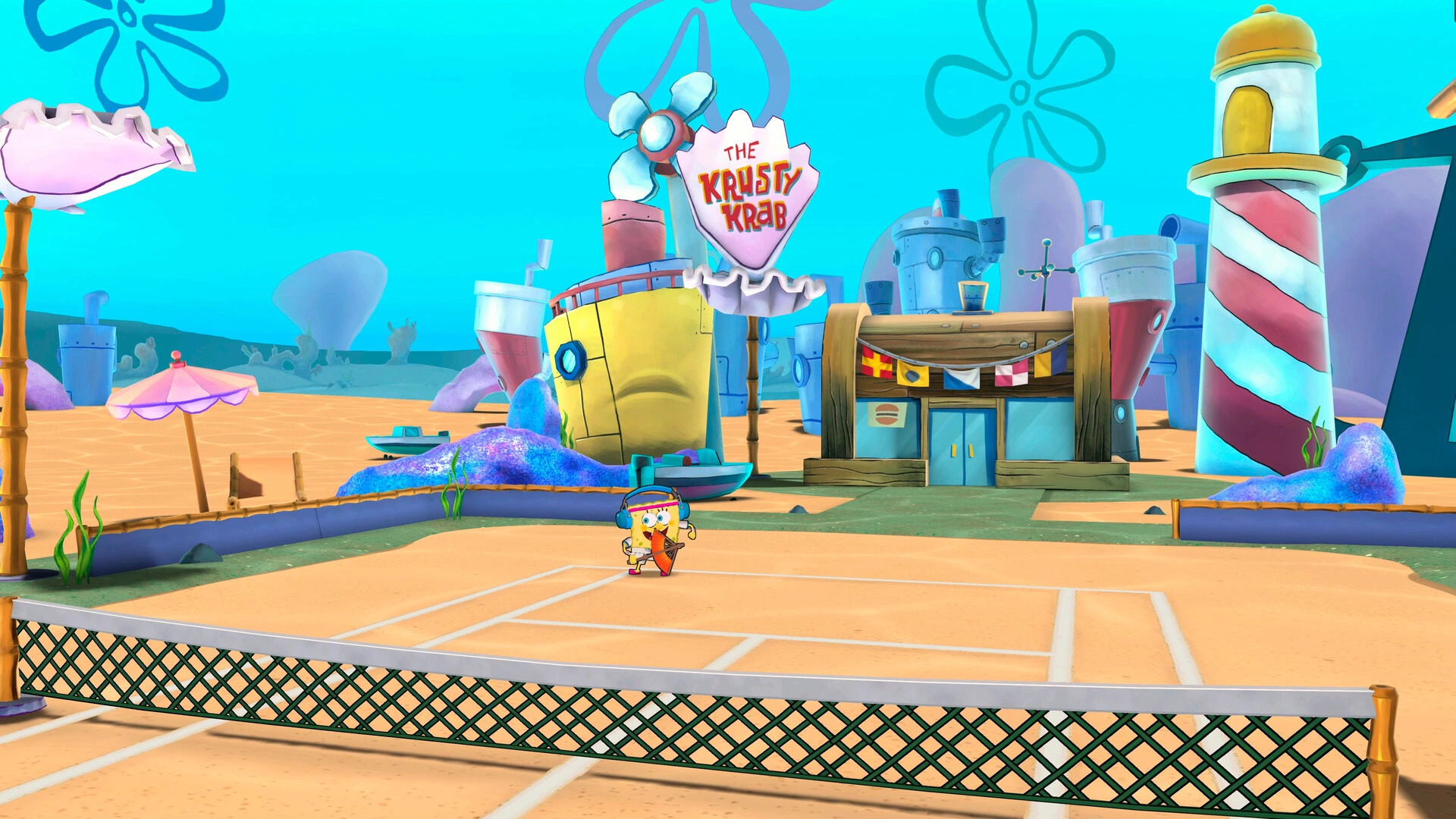
The environments do a lot of heavy lifting. Arnold’s Court uses streetlamps and hanging laundry to evoke Hey Arnold! without needing a lecture on nostalgia. Bikini Bottom brings in bright undersea details and background landmarks like the Krusty Krab. The Wild Thornberrys-inspired Savanna Court uses cel-shaded scenery that gives the stage a stronger sense of place than a generic tennis arena ever could.
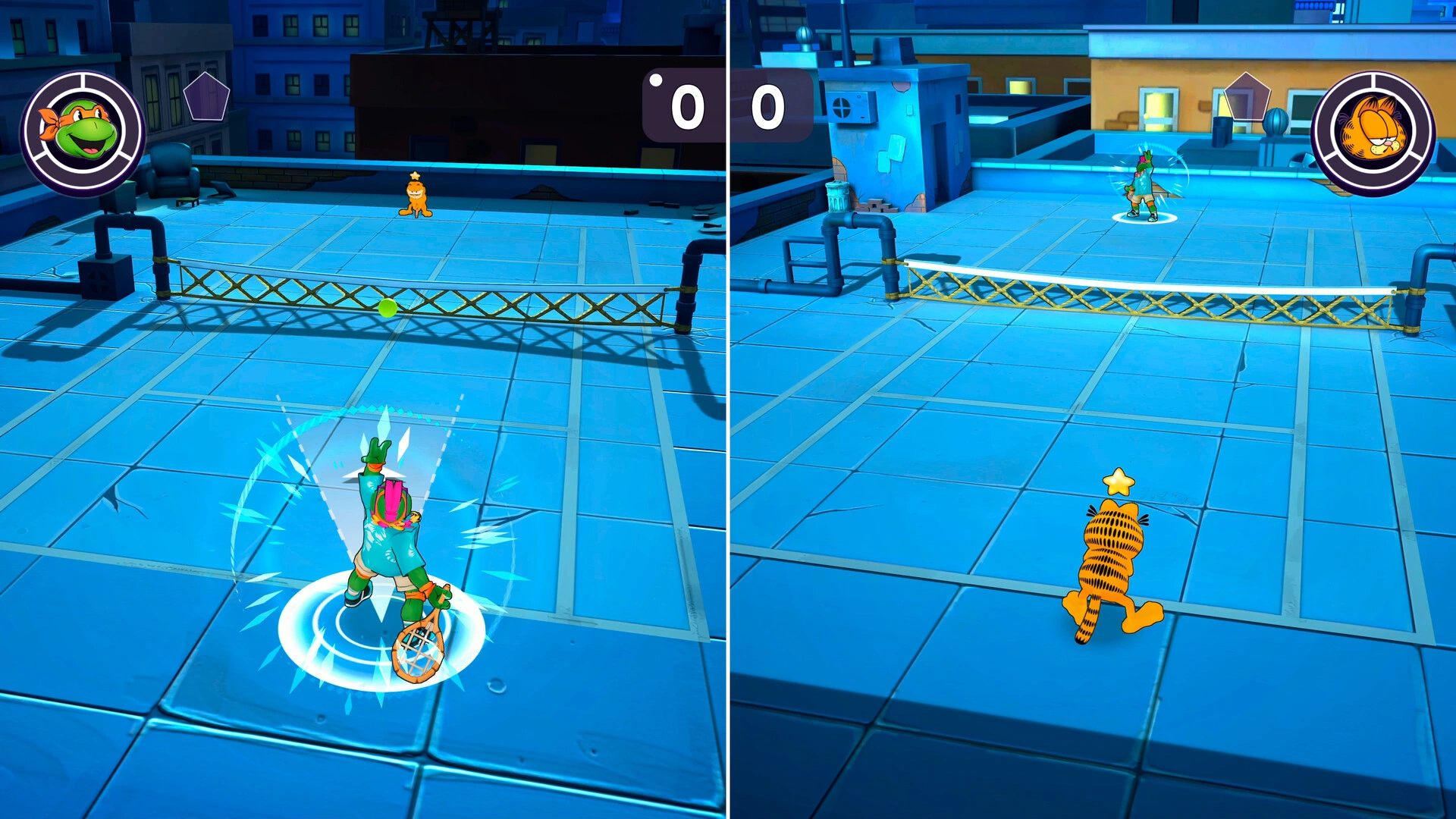
The character models are less consistent. SpongeBob and Aang transfer cleanly into 3D because their shapes already suit exaggerated game animation. Timmy Turner’s head and eyes look odd in motion, Arnold’s football-head silhouette becomes slightly uncanny, and CatDog’s eyes are best approached with caution. This is the usual problem with Nickelodeon crossovers: these characters were drawn for different visual languages, then asked to share one court.
Customization softens that issue. Hundreds of costumes and accessories let the game turn visual mismatch into part of the joke. Aang’s nation outfits, tennis gear, and show-specific costume pieces give players a reason to keep unlocking items after the match structure starts repeating.
The voice acting helps sell the roster, even with repeated lines. The music has less luck. Short loops become grating during longer Story Mode runs, which is exactly where the game already needs the most support from its presentation.
The Review
Nickelodeon Extreme Tennis: Next!
Nickelodeon Extreme Tennis: Next! has the roster, courts, and arcade ideas to work as a light Nickelodeon sports crossover, especially in local 1v1. Its best moments come from power-ups, character specials, and short matches that understand the party-game lane. The problem is endurance. The mobile-born slowdown, repetitive Story Mode paths, grating music, and lack of online play keep it below the Mario Tennis standard it clearly admires. Fun with the right person beside you, thin without one.
PROS
- Fun local 1v1 play
- Strong themed courts
- Distinct character specials
- Plenty of cosmetics
- Easy arcade controls
CONS
- No online multiplayer
- Repetitive Story Mode
- Awkward slowdown effect
- Irritating music loops
- Uneven 3D models