









In the fields of North Macedonia, history is measured in harvests and folklore is carried on the wing. It is a place where white storks, traditionally the harbingers of new life, share the sky with the ghosts of old myths. Here we find Nikola, a farmer whose sixty years are etched into his hands and his land. He is a man tethered to his patch of earth by a generational gravity.
Director Tamara Kotevska frames him against this backdrop, a figure of steadfast tradition in a world losing its memory. The film takes its name from a grim local fable about a boy cursed into the form of a stork, doomed to migrate eternally. This choice is no mere flourish. It announces the film’s intent to view the brutal mechanics of modern economics through the lens of ancient tragedy, transforming one man’s story into a poetic, observational study of a world coming undone. The camera watches, patient and unforgiving.
An Invisible Hand, A Visible Rot
The film’s central conflict is not driven by a villain but by an abstraction: the market. An invisible hand lowers crop prices below the point of survival, and the idyllic harmony of the opening scenes curdles into a quiet apocalypse. Kotevska’s camera documents the farmers’ protest not with the chaos of a handheld news report, but with a composed, almost funereal distance. Tractors crush mounds of unsold watermelons, the red pulp bleeding across the asphalt in a display of spectacular futility.

Their agency is an illusion. The economic pressure acts as a centrifugal force, flinging Nikola’s family to Germany. His wife Jana eventually follows, leaving him in a house hollowed out by silence. Here, the cinematography shifts toward the expressionistic. Doorways and windows frame Nikola in tight, isolating compositions, the deep shadows of his empty home creating a prison of memory.
His new job driving a bulldozer in a landfill completes the descent into a modern underworld. The light there is harsh, the air thick with dust, the landscape a monochromatic monument to waste. He has gone from cultivating the earth to burying its refuse, a potent symbol of a life cycle thrown violently into reverse. The storks that once followed his plow now pick through mountains of trash, nature’s scavengers in a man-made hell.
The Curse Reversed
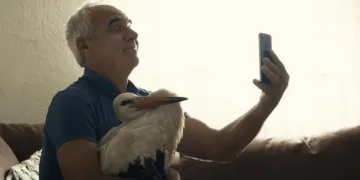
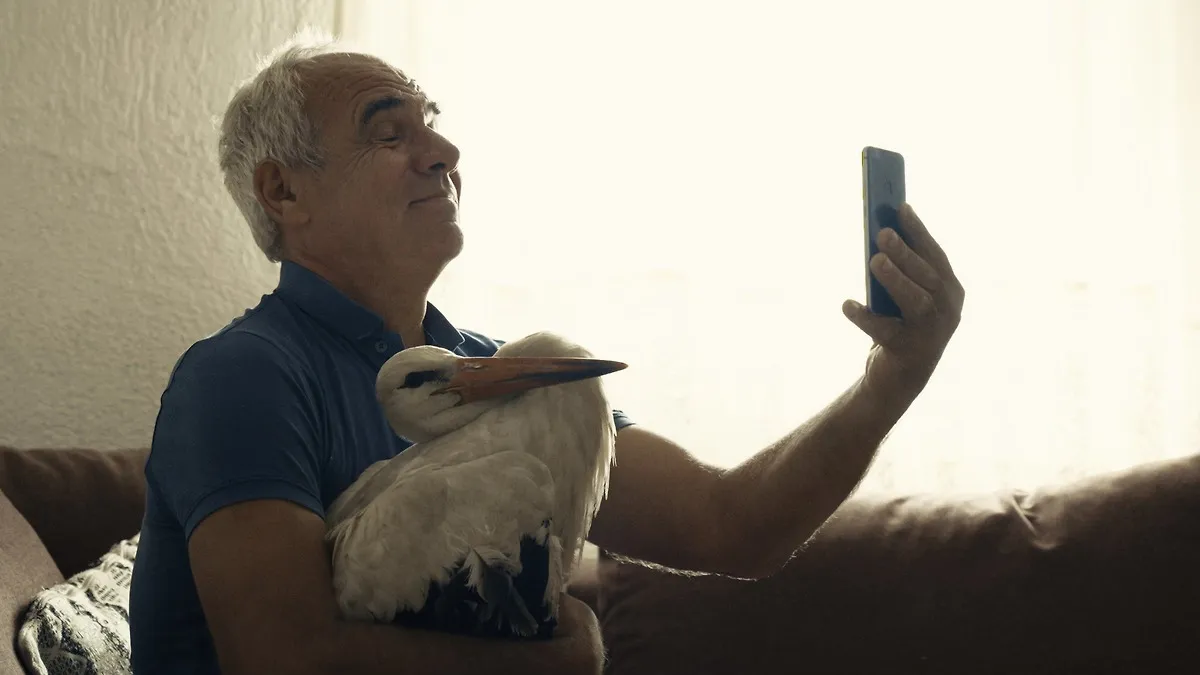
The Silyan folktale, whispered by a narrator throughout the film, posits a father’s curse as the source of exile. In Nikola’s life, the curse is economic, but its effect is the same. He is a man unmoored. Then, myth perforates reality. Nikola finds an injured stork at the landfill, a broken creature amidst the waste, and takes it home. The documentary pivots into allegory. He names the bird Silyan.

This act of compassion is also an act of profound self-interest, a desperate attempt to exert control over one small life when his entire world has spiraled away from him. Kotevska captures their burgeoning relationship with startling intimacy, using a shallow depth of field to blur out the decaying world and lock our focus on man and bird. The lighting inside his home softens, focused pools of warmth in the chiaroscuro gloom. In nursing Silyan, Nikola seems to be nursing his own wounded spirit.
The relationship becomes a complex reclamation of his paternal identity, an attempt to reverse the fable’s tragedy. A visit to the vet provides a moment of wry, grounding humor. The veterinarian, faced with a mythic patient, offers the deadpan advice that it probably just does not like cat food. For his part, the stork seems blissfully unaware of his symbolic weight, accepting Nikola’s care with an animal’s simple pragmatism.
A Polished Despair
The film’s construction is its most remarkable and debatable quality. Cinematographer Jean Dakar does not capture reality; he composes it. Every frame is a painterly arrangement, resembling the melancholic realism of an Andrew Wyeth painting.
A static, deep-focus shot of Nikola’s tractor moving slowly across the horizon, bisected by a stark “For Sale” sign in the foreground, is a masterpiece of visual storytelling. This aesthetic precision lends the film its immense power, yet it also creates a distance. The story feels less discovered than artfully arranged, a docu-fable that leans heavily on the fable.
One begins to suspect the reality it purports to document. Joe Wilson Davies and Hun Oukpark’s orchestral score swells with tragic grandeur, while the percussive, diegetic clacking of stork beaks provides a constant, unsettling rhythm. The film’s polished despair is both its greatest strength and its potential weakness.
By presenting a human crisis with a beauty so profound it borders on the hyperreal, Kotevska forces the viewer to confront the very act of watching suffering as art. It finds a strange, difficult hope in the bond between a man and a bird, a small act of connection against a backdrop of systemic dissolution.
The Tale of Silyan is a 2025 documentary film from North Macedonia. The film had its world premiere out of competition at the 82nd Venice International Film Festival on August 29, 2025. It was also screened at the 2025 Toronto International Film Festival on September 10, 2025. The film is not yet available for streaming.
Full Credits
The Review
The Tale of Silyan
The Tale of Silyan is a visually breathtaking docu-fable that achieves a rare poetic power. Its meticulous composition is both its greatest asset and a source of clinical distance, transforming a raw human story into an almost impossibly beautiful, and slightly remote, work of art. Kotevska's film is a profound meditation on loss, though its flawless despair may leave some viewers admiring its craft more than feeling its pain.
PROS
- Every frame is composed with the precision and beauty of a classical painting.
- The blend of documentary realism with ancient folklore is effective and memorable.
- The central relationship between Nikola and the stork provides a deeply moving anchor to the story.
- It offers a potent commentary on economic displacement, loneliness, and environmental decay.
CONS
- The film's extreme polish and visual perfection can sometimes create an emotional distance, making it feel more constructed than observed.
- The storytelling is very direct, leaving little room for viewer interpretation.