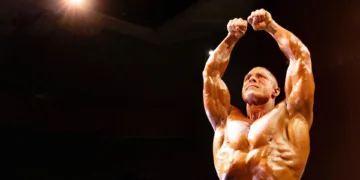


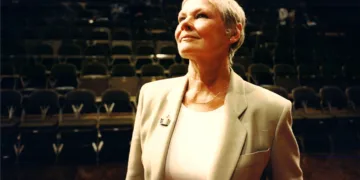








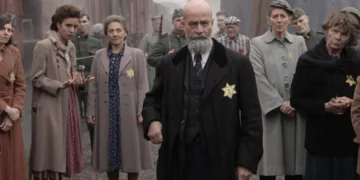







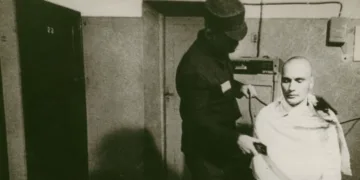









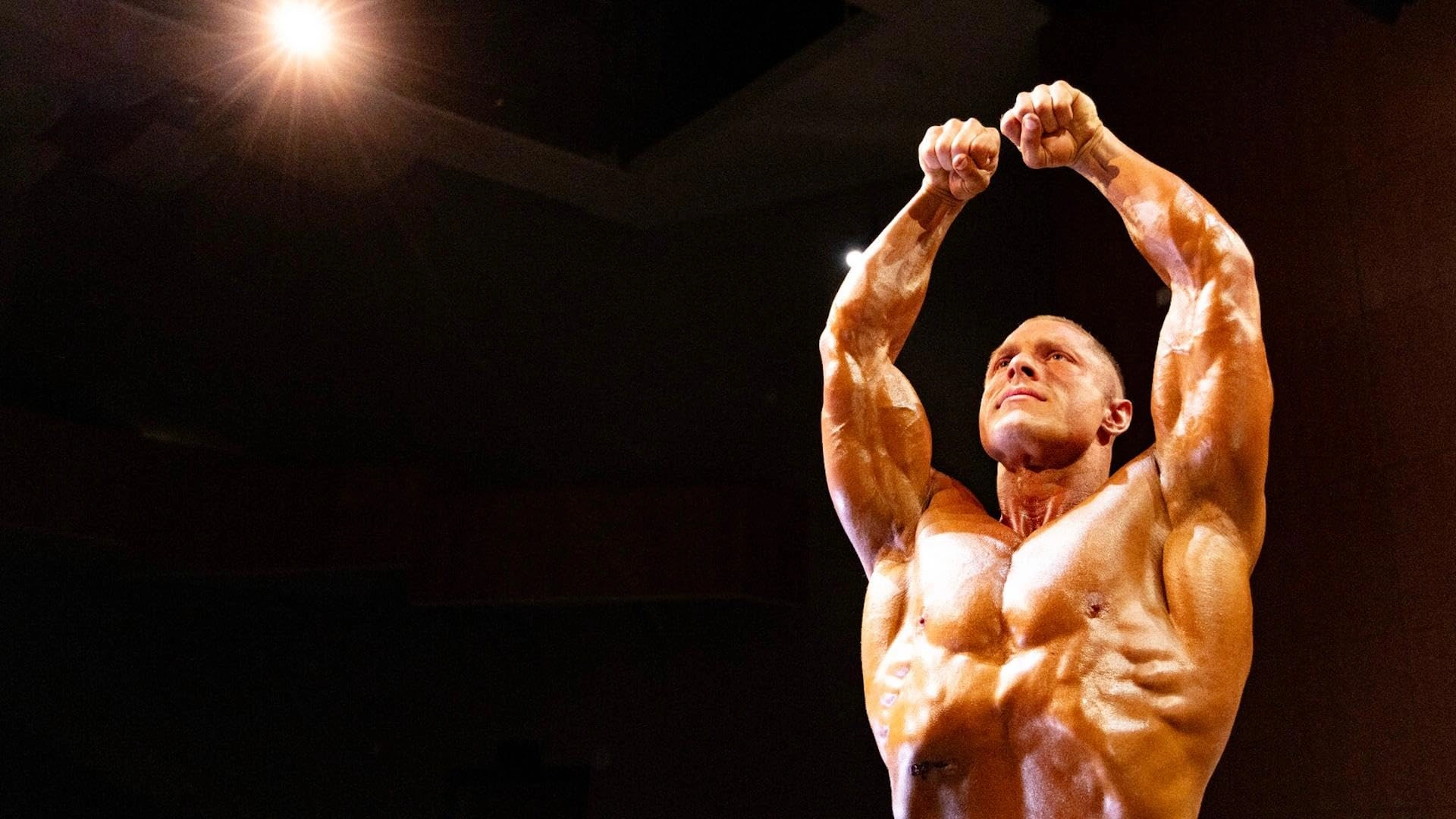

Eddie Owens enters the film already varnished for judgment, his mother smoothing spray tan over a body built to be seen and a life designed to stay hidden. The image is funny for about half a second. Then it curdles. Joanne, played with raw, hazardous warmth by Tammy Blanchard, is helping her son prepare for a bodybuilding competition while he stands near-naked in a posing sock, and Sam McConnell lets the scene sit long enough for its affection to become claustrophobic.
Test, directed by McConnell and written by star Brock Yurich, treats bodybuilding as a visual system before it treats it as a sport. Eddie’s body is labor, spectacle, fantasy, disguise, and evidence. He waits tables at a barbecue joint to fund the dream, poses naked online for tips through a site called “Midwest Muscle,” and chases professional legitimacy through local competitions that reduce years of discipline to stage light, oil, and placement. The camera understands the cruelty of that arrangement. Every muscle is clear. The man inside it is less readable.
The Prison of Strength
Yurich’s performance is built on a striking contradiction: Eddie is massive, yet he often moves like someone expecting a blow. His shoulders carry power, but his face carries apology. That split gives the film its best tension. In competition, he can flex on command. In life, he has no such control.
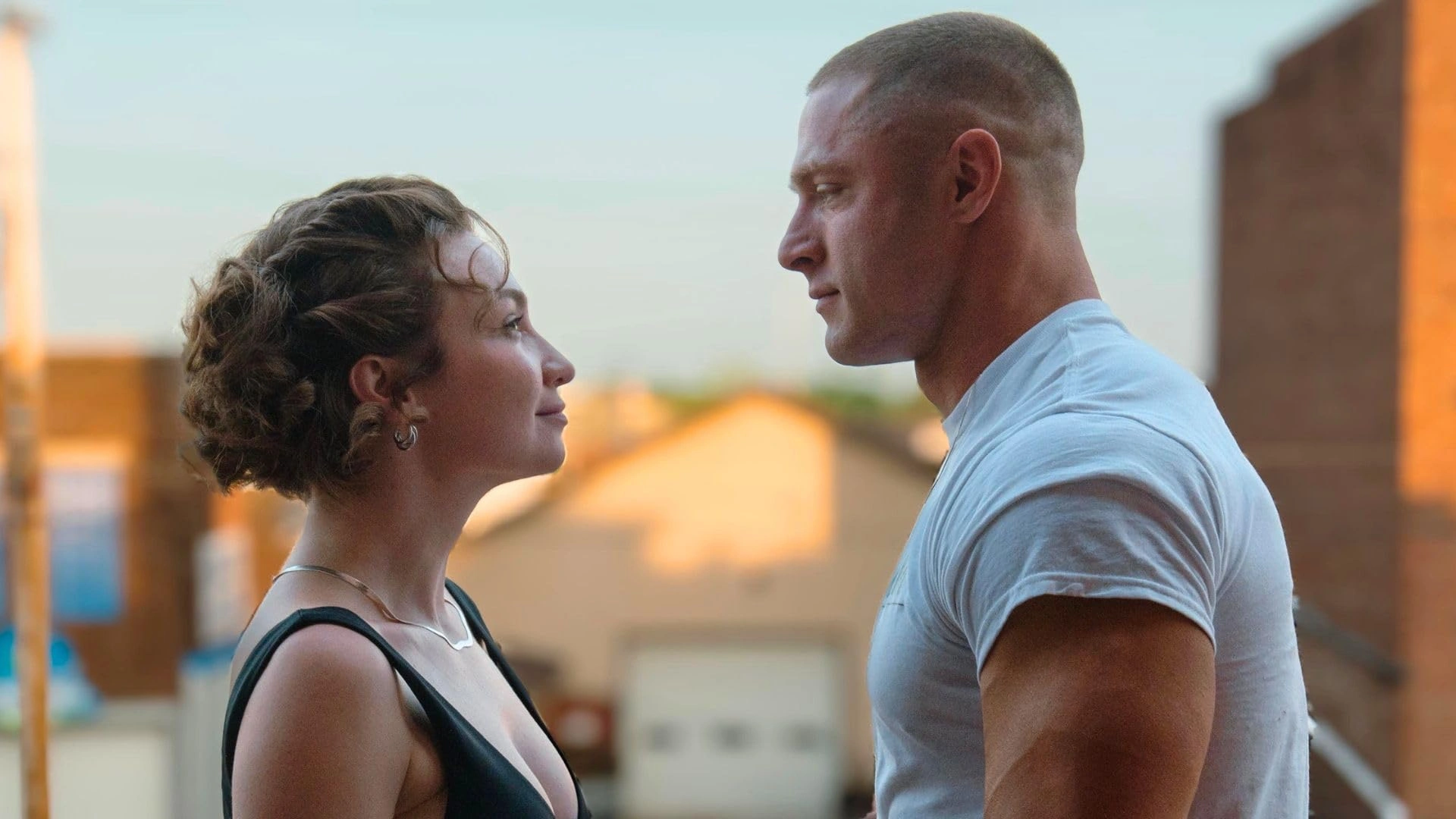
After a disappointing third-place finish, Eddie turns to Mike Reed, a former bodybuilder and coach played by Mike Edward with the right mix of authority and rot. Mike sees what Joanne cannot bear to see: Eddie is talented, hungry, and trapped inside a home where love has become a management structure.
He drives Eddie harder in the gym, replaces his drug regimen, and introduces insulin into the routine. The choice gives the training scenes a low-grade dread. Every rep now has a shadow. The body that Eddie treats as armor begins to look like a crime scene in progress.
McConnell’s direction is strongest in these physical spaces. The gym has no glamour. It is a room of exertion, correction, and appetite. Mike’s blunt instructions slice through Eddie’s uncertainty, and the film understands why that kind of attention can feel like salvation to a young man starved for permission. It also understands the trap. Mike is mentor, lover, and warning sign, sometimes within the same scene.
Desire Under Bad Light
The film’s queer drama is most effective because it refuses to place all danger outside Eddie. The church can reject him. Joanne can panic. The town can whisper. None of that is treated as harmless, but Eddie’s deepest antagonist is the shame he has learned to mistake for conscience.
His relationship with Mike begins as discipline and slides into desire with a grim inevitability. Their kiss does not play like liberation. It plays like a door opening into a darker room. The secrecy that follows gives the affair an erotic charge, then slowly drains it of safety. Mike’s past with his estranged son Cody hangs over him like a missing reel from a noir investigation: something happened, someone left, and nobody wants to turn on the light.
Abby, Eddie’s former girlfriend, gives the film a cleaner moral temperature. Paloma Garcia-Lee plays her without sainthood, which saves the role. She teaches Eddie basic ballet to fix the stiffness in his posing, and those scenes are among the film’s most delicate.
He can lift, cut, bulk, tan, and perform, yet he has to be taught grace in a family dance studio by a woman he once tried to love in the expected way. Her description of him as “a little boy who’s really fucking scared” lands because the film has already shown us the boy through posture, silence, and recoil.
Joanne’s discovery of Eddie’s cam work triggers one of the film’s sharpest moral injuries. She goes to Pastor Greg believing she is protecting him, which makes the damage worse. Blanchard plays Joanne as someone capable of tenderness and betrayal in the same breath. Her faith is not a flat villain. It is a language she uses because she has no better one, and the film is smart enough to show how poor language can still destroy.
Bodies, Rooms, and Stage Light
Ava Benjamin Shorr’s cinematography gives Test its ethical grammar. Eddie’s everyday world sits in washed-out shades, a drained Ohio palette of work, kitchen light, church rooms, and bedrooms where secrecy pings in small cash tips. Then the competition stage turns him gold against darkness. The shift is beautiful and damning. In that light, Eddie becomes an idol to discipline and denial, polished until he almost stops looking human.
That visual contrast matters because the script can feel crowded. It takes on bodybuilding drugs, cam labor, maternal dependence, church rejection, Mike’s damaged family history, Abby’s return from New York, and Eddie’s sexual self-erasure.
Some strands needed sharper pruning. Cody’s reappearance, for instance, carries narrative weight without enough dramatic oxygen around it. The film can seem overpacked, as if Yurich has lived with the material so long that he cannot bear to leave any bruise off the body.
Still, the best scenes keep finding the line between flesh and spirit without preaching. The competition routine set to “The Swan” from Saint-Saëns’ Carnival of the Animals gives Eddie a moment of movement that feels earned precisely because it is imperfect. He folds Abby’s lessons into the rigid theatre of bodybuilding, and the stage briefly becomes something stranger: a chapel, a cage, a confession booth with better lighting.
The final act risks excess as Eddie’s control fractures and self-harm enters the frame. McConnell does not turn the pain into spectacle, which is no small mercy in a film so preoccupied with being looked at. The ending offers victory with a wound still open. Eddie may have found a way to stand in his body truthfully, but the film refuses to pretend that truth arrives clean, painless, or on schedule. Grace appears here as a flicker across muscle, then disappears back into shadow.
The sports drama film Test premiered on June 3, 2026, at the SXSW London film festival, where it was introduced to international audiences before continuing its run at summer festivals like Frameline and the Provincetown International Film Festival. The story follows a small-town Ohio bodybuilder chasing his professional card who must reconcile his rigid ambitions and religious upbringing with an unexpected awakening of same-sex attraction. While availability varies by region following its mid-2026 festival circuit debut, distribution is handled via Bridge Independent and Tandem Pictures.
Full Credits
Title: Test
Distributor: Bridge Independent, Tandem Pictures
Release date: June 3, 2026
Rating: 18 / TV-MA
Running time: 113 minutes
Director: Sam McConnell
Writers: Brock Yurich
Producers and Executive Producers: Julie Christeas, Daryl Freimark, Brock Yurich, Jim McCauley, Sam McConnell
Cast: Brock Yurich, Matthew Morrison, Tammy Blanchard, Paloma Garcia-Lee, Mike Edward, Evan Hall
Director of Photography (Cinematographer): Ava Benjamin Shorr
Editors: Jon Higgins
Composer: Ronen Landa
The Review
Test
Test finds its strongest language in bodies under pressure: Eddie’s flexed frame, Joanne’s anxious touch, Mike’s predatory discipline, Abby’s patient correction. The film’s script carries too many bruises at once, and a few threads fade before they can cut deep. Yet Brock Yurich’s performance and Ava Benjamin Shorr’s stage-lit imagery give the drama a moral charge that lingers. This is a queer bodybuilding film about shame, spectacle, and the terrible cost of being seen clearly.
PROS
- Brock Yurich’s raw lead performance
- Striking stage-light cinematography
- Tammy Blanchard’s volatile Joanne
- Strong body-as-armor imagery
- Abby’s ballet scenes
CONS
- Overcrowded script
- Cody thread feels thin
- Some ideas need sharper focus
- Final act risks excess