

















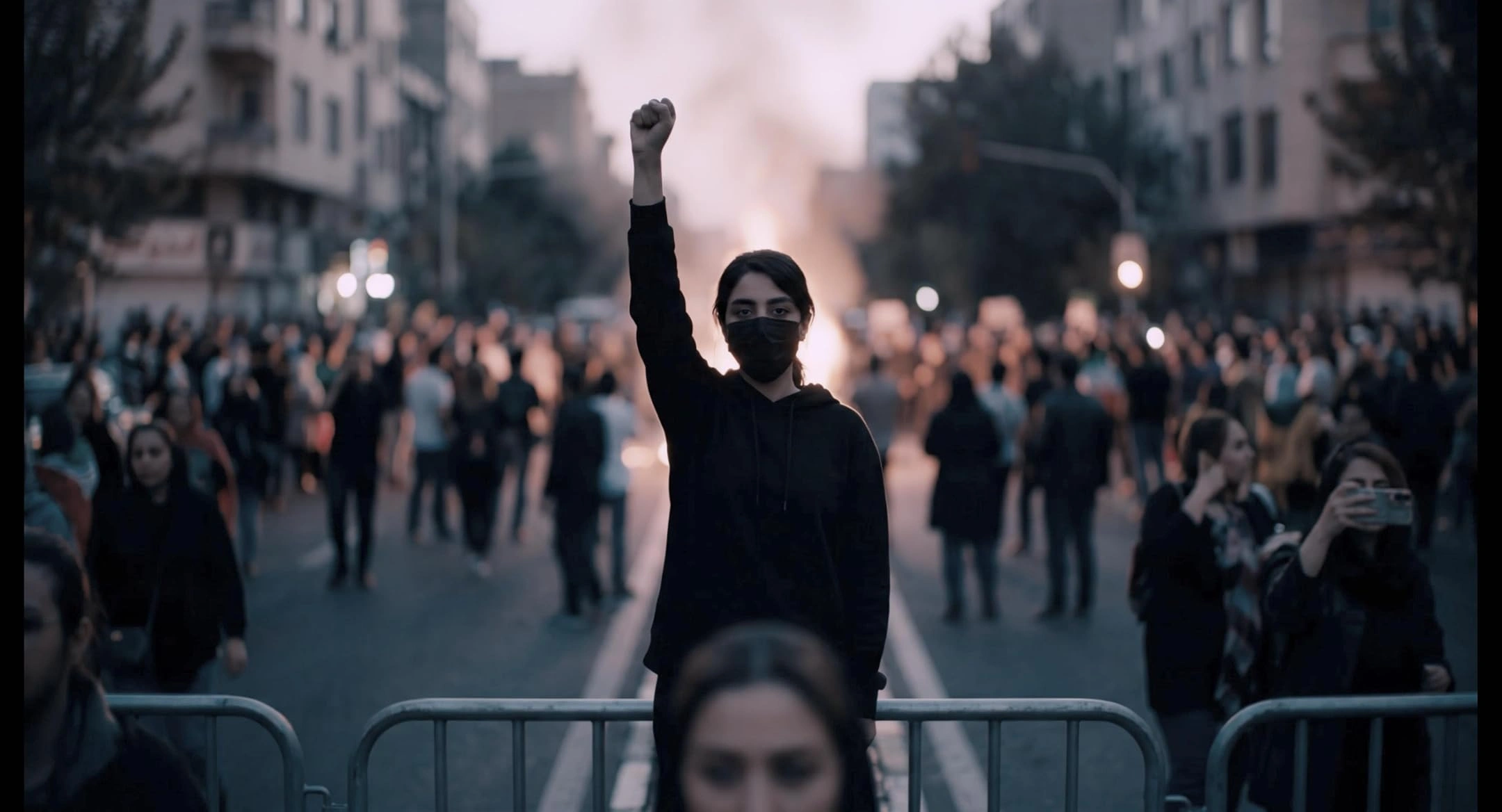

A boy in a wheelchair watching Tehran burn from behind glass gives Ash Koosha the image he needs and the character he never quite writes. That problem runs through Dreams of Violets, a 75-minute AI-generated docudrama about January protests in Iran and the regime violence that followed. The image is loaded. The story around it is barely assembled.
Koosha, working from exile with his brother Pooya, has made a film that would be difficult to separate from its production method. No actors, no sets, no cameras, a reported budget of roughly $2,000, and a world built through generative AI.
The premise carries genuine force: when a state cuts off information, suppresses evidence, and makes documentary access dangerous, synthetic reconstruction becomes a tempting artistic tool. The trouble is that reconstruction still needs dramatic architecture. Here, the scaffolding keeps showing.
Fragments Without a Spine
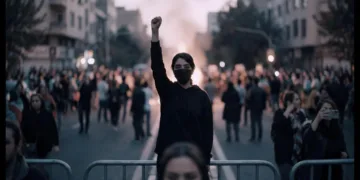
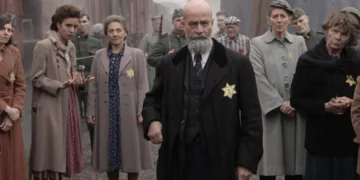
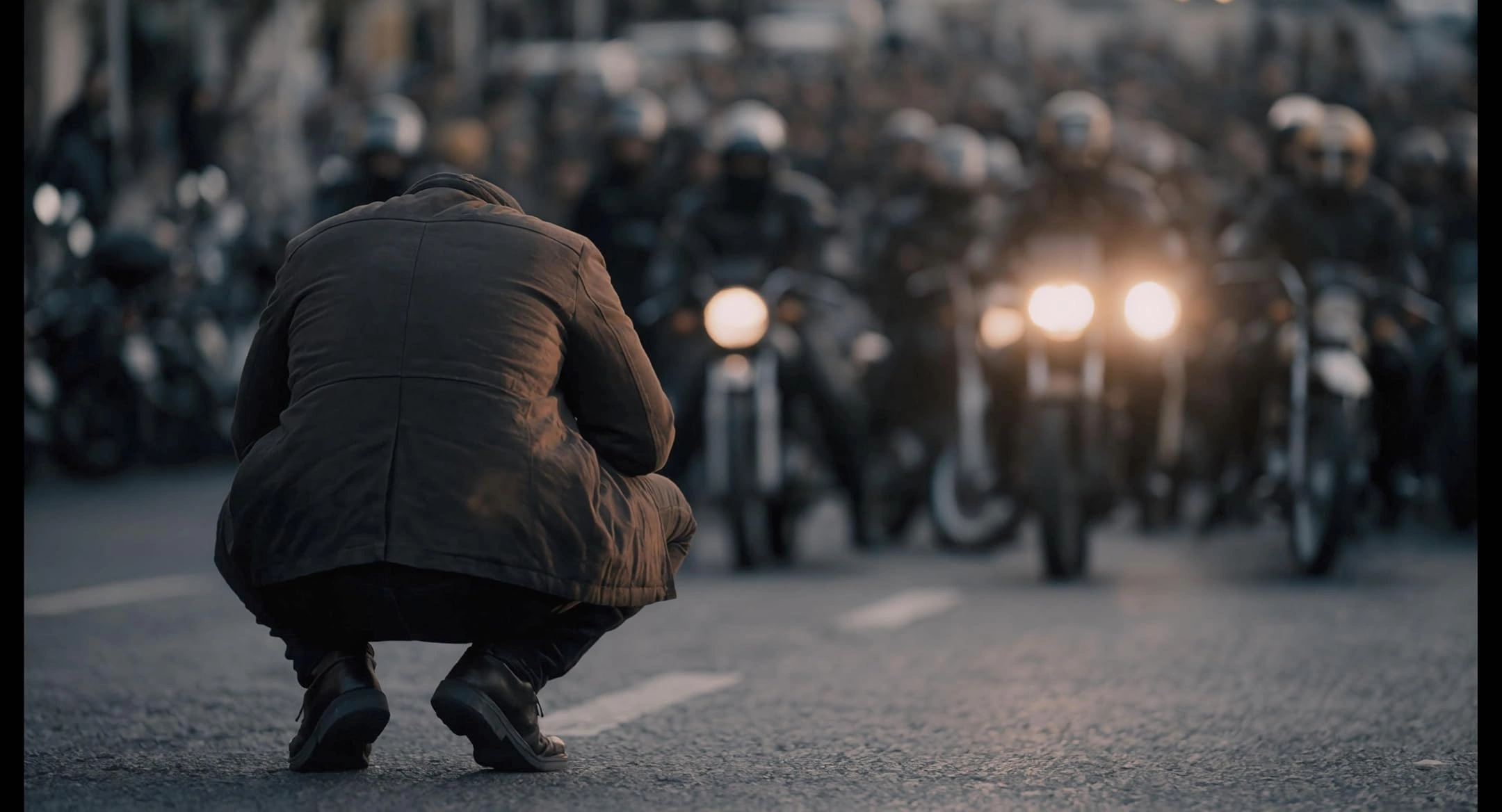
The film moves through Tehran after the protests have been contained, when the police and security forces are carrying out their cleanup operation. Civilians are forced into vans. Bodies appear in black bags. Soldiers fire into streets where panic has already done half the work for them. The setting suggests a pressure cooker, yet the screenplay keeps releasing pressure before it can build.
Koosha organizes the film around a handful of figures: a doctor confronted while treating a protester, a young pianist clinging to music, an older woman recalling a freer life, and the wheelchair-bound boy with his caretaker brother. These are strong entry points.
Each could anchor a clear chapter. The doctor’s scene has an obvious moral dilemma: treat the wounded and risk punishment, or submit to the state’s logic of fear. The pianist’s line about having nothing except music aims for defiance through art. The older woman’s memories create a bridge between private loss and national erasure.
The film rarely turns those ideas into scenes. Characters speak, suffer, and fade from view. The boy at the window sees brutality that should reshape the film’s emotional grammar, yet he functions closer to a witness symbol than a person. His brother is sketched through concern and caretaking, then left at that. The writing mistakes placement for development. Put someone near tragedy, and the film assumes the audience will complete the character.
That can work in documentary, where a face carries the charge of reality. In staged docudrama, the burden shifts back to writing. Dreams of Violets wants the blunt force of recorded atrocity, but it gives us fictionalized figures who do not have enough behavioral detail to carry that force. The result is an unusual structural failure: the film has plenty of incidents and very few dramatic beats.
The Machine Can Render Panic
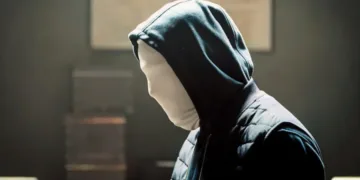
The AI imagery is stronger than some viewers may expect. Tehran’s streets at sunset have texture. Fires burn against dusty roads. Security forces move through crowds with a convincing sense of momentum. A wide shot of civilians scattering as soldiers close in has the cheap, startling effectiveness of a nightmare built from news footage. For a film made from a London apartment, that is no small thing.
The faces are another matter. Many have the polished vacancy familiar from AI portraiture: clear skin, wet eyes, expression without interior motion. Koosha often cuts to close-ups of tears, lashes, and trembling mouths, as though detail can substitute for performance. It cannot. Acting is timing, resistance, hesitation, a glance that arrives half a second too late because the character is trying to hide what the body has already admitted. The people here display grief. They rarely process it.
The edits appear designed to avoid letting shots breathe long enough for the illusion to crack. Quick cuts cover stiffness in the bodies. Dialogue lands with a muddy distance from the image, partly because Koosha reportedly performed the voices himself and altered them through AI. That choice creates a strange sameness beneath the different ages and genders. The film is full of people, yet it often sounds like one consciousness wearing several masks.
There are moments where the technology creates accidental absurdity. A loaf of bread falling in slow motion wobbles with the wrong kind of significance. A replay of the boy’s parents dying in a car accident, with the vehicle flying off a cliff, pushes tragedy toward melodramatic illustration. These are storytelling errors before they are technical errors. The AI exposes them, but it did not invent them.
Memorial, Showreel, Warning Sign
The film’s dedication to Sarina Esmailzadeh, Mahsa Amini, Armita Garavand, and the thousands killed by the regime clarifies Koosha’s intent. Dreams of Violets is trying to be a memorial made against silence. That intent matters. It also raises the standard. A film about state murder cannot rely on the moral weight of its subject and call the job done.
The ethical tension sits in nearly every scene. AI allows Koosha to visualize abuses that might otherwise remain hidden or inaccessible. It also risks homogenizing the dead and the living into a shared synthetic sorrow. A sea of black body bags should be devastating. Here, it is powerful as an idea and oddly thin as an image. The film knows what horror it wants to name, but it keeps reaching for the easiest visual shorthand: the gunshot, the tear, the body, the scream.
The $2,000 figure may become the film’s most discussed detail, and for good reason. It changes the conversation around independent production, labor, authorship, and access. A filmmaker with limited resources can now stage urban unrest, crowd movement, period detail, and political violence at feature length. That is liberating for artists outside traditional systems. It is also terrifying for anyone whose work has been treated as an expendable line item by studios already addicted to cheaper methods.
Dreams of Violets is most valuable when viewed as a rough draft of a new problem. AI can now generate the surface of cinema with alarming speed. It can provide smoke, streets, soldiers, tears, and corpses. What it cannot provide for Koosha is structure, character pressure, or the small human contradiction that makes a scene hurt after the image has passed. The camera has been replaced here. The dramaturgy has not.
The fully AI-generated docudrama film Dreams of Violets made history when it premiered at the Tribeca Festival on June 10, 2026. Made entirely without cameras, physical sets, or human actors, the landmark project is a fictionalized dramatization of the January 2026 massacre of Iranian civilians, brought to life through the perspectives of five strangers trapped in a dead-end alley during a regime crackdown. Following its festival screening, distribution details remain tightly tied to its festival run, though you can explore production insights and reviews on mainstream entertainment news platforms and YouTube coverage.
Full Credits
Title: Dreams of Violets
Distributor: Tribeca Festival
Release date: June 10, 2026
Running time: 75 minutes
Director: Ash Koosha
Writers: Ash Koosha
Producers and Executive Producers: Ash Koosha, Pooya Koosha
Cast: Artificial Intelligence Generated Characters
Editors: Ash Koosha
Composer: Ash Koosha
The Review
Dreams of Violets
Dreams of Violets is a landmark production experiment trapped inside a weak dramatic structure. Ash Koosha’s AI-generated Tehran can produce smoke, fire, panic, and bodies in the street, yet the film rarely turns those images into shaped scenes or believable inner lives. Its political purpose carries weight, and its $2,000 budget sends a chill through the industry. As cinema, though, it has a missing spine. The machine renders the wound. The writing fails to make it bleed.
PROS
- Striking Tehran street imagery
- Urgent political intent
- Historic production milestone
- Strong premise for exile-made testimony
CONS
- Thin character writing
- Stiff AI-generated performances
- Muddy voice work
- Fragmented dramatic structure
- Some clumsy symbolic moments