

























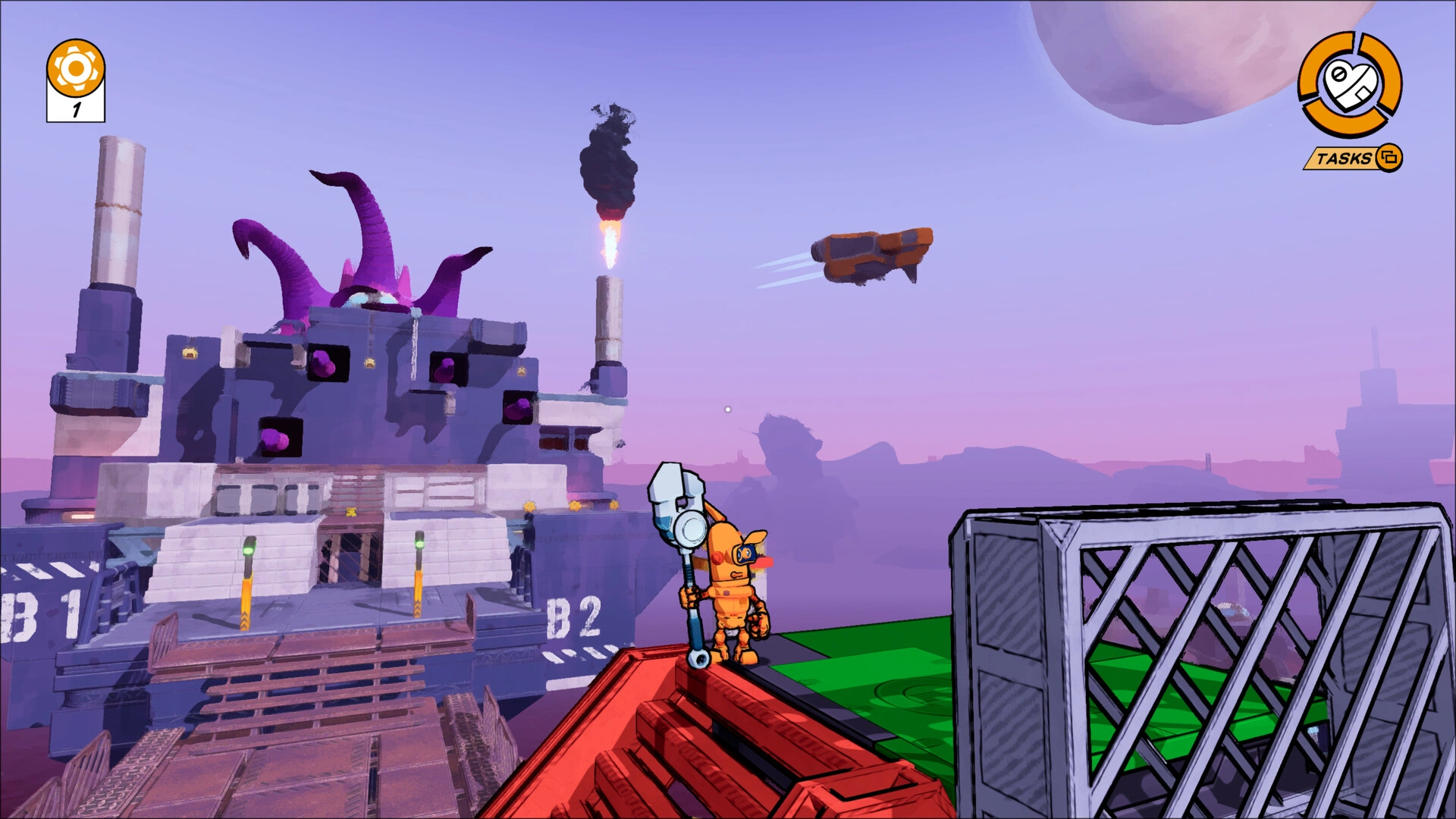

Junkster has the clean shape of a classic 3D platformer: a small hero, a colorful world, collectible clutter, simple enemies, and a string of self-contained stages built around movement and discovery. Stormcloud Games gives that familiar frame a playful junkyard sci-fi identity through UM-13, a construction robot who crash-lands on a dangerous scrap planet and has to recover ship parts, lost cargo, and strange human artifacts before returning to space.
The premise is deliberately light. UM-13 does not need grand lore or a cast of chatty companions to make an impression. His charm comes from slapstick animation, clumsy landings, expressive movement, and the cheerful absurdity of a tiny robot treating toilets, arcade machines, telephone boxes, and other human objects like priceless treasures.
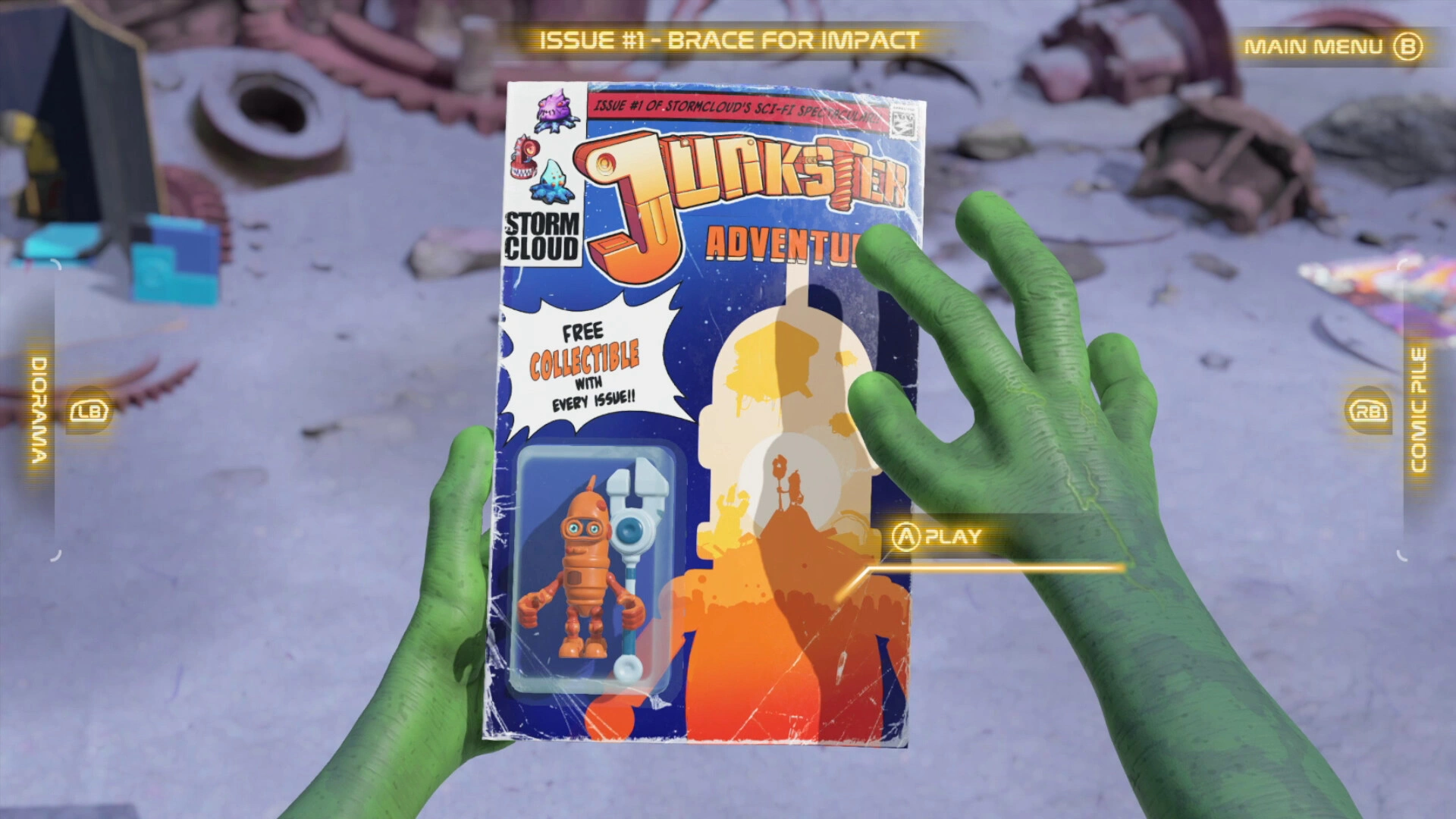
The game’s 1980s and 1990s comic-book styling gives the adventure its main personality. Each level is framed like an issue in UM-13’s ongoing series, which turns a simple mission-based structure into something closer to a toybox serial.
Comic Panels, Toy Shelves, and a Cheerful Trash Planet
The best thing about Junkster at first sight is how hard it commits to its visual framing. The cel-shaded presentation uses thick outlines, bright colors, comic-style menus, issue covers, and punchy onomatopoeia to make a planet of junk feel lively rather than grimy. Enemy takedowns gain extra flavor from comic-page impact effects, with “BOOM” energy that fits the game’s Saturday-morning tone.
That comic-book idea reaches beyond surface decoration. Stages feel like collectible issues, each tied to a recovered artifact and a small toy reward that fills out an in-game diorama. It is a smart detail because it gives progress a physical, tactile quality. Instead of simply ticking missions off a list, the player gradually builds a miniature shelf of odd treasures. It fits the game’s fascination with discarded objects being given new purpose.
The collectathon layer is familiar, with cogs, stickers, hidden secrets, and stage rewards spread across the 20 missions. Some items sit in plain sight, while others ask the player to poke around corners, revisit routes, or use construction tools with a little imagination. The sticker book also supports the comic theme, turning collectibles into play materials rather than plain completion fodder.
The art direction is not equally strong in every area. Some spaces look nicely composed, with good color separation and readable layouts. Others can feel sparse, with scenery and set dressing that do not always carry the same handmade charm. Still, the presentation gives Junkster a clear identity, which matters in a genre crowded with cute mascots and nostalgic callbacks.
Platforming That Finds Its Hook Through Construction
Underneath the comic wrapper, Junkster plays like a forgiving 3D platformer with an added construction system doing most of the heavy lifting. UM-13 can jump, double jump, explore compact stages, smash enemies with a wrench, collect cogs, and chase secrets across a sequence of missions. The basic movement is approachable, closer to a relaxed collectathon than a precision platformer. Combat follows that same philosophy. Enemies are there to keep levels active, not to test mastery.
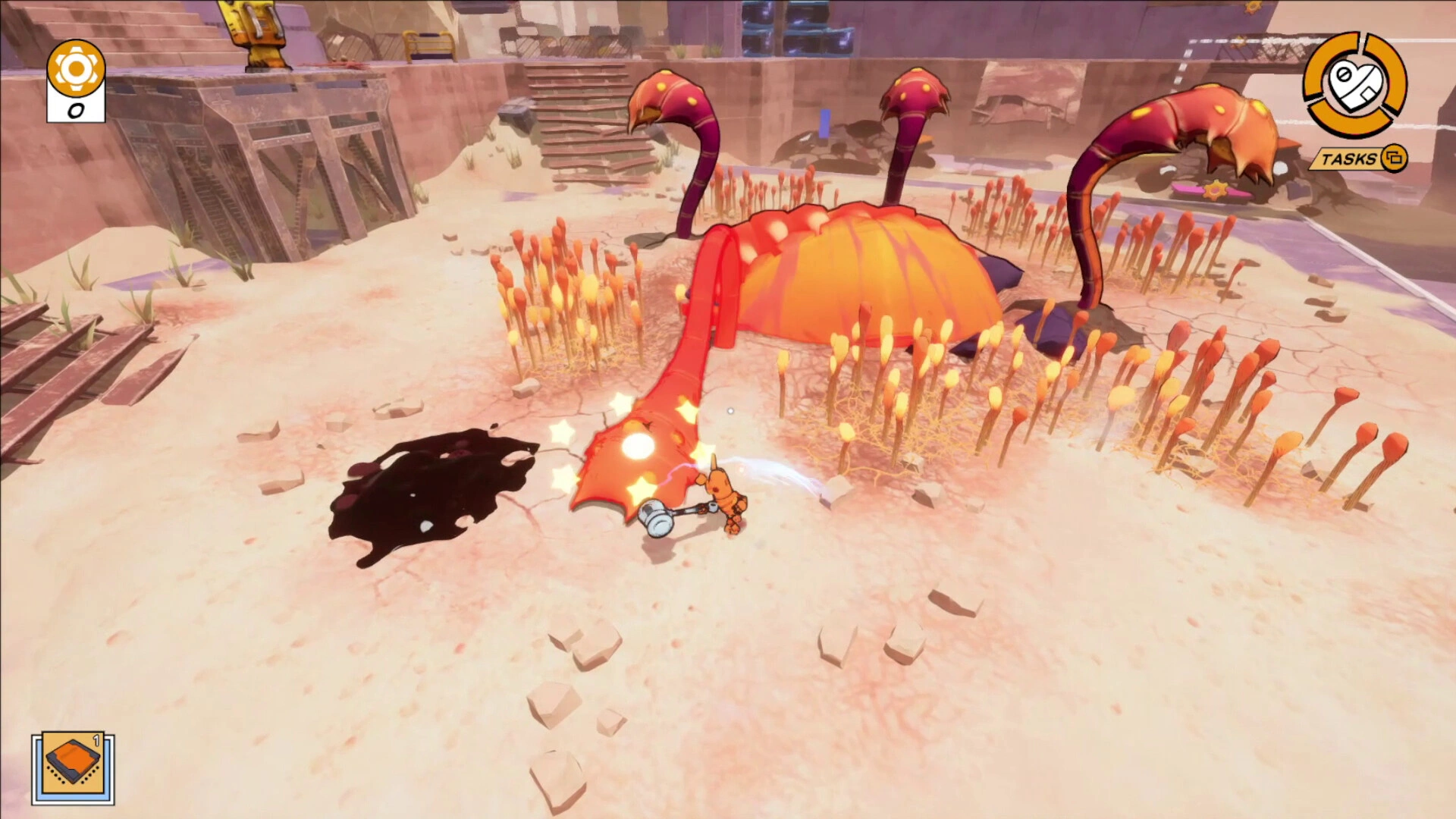
The construction mechanic is where the game develops its own rhythm. UM-13 gathers scrap pieces, blocks, and machine parts from the environment, then uses them in designated building zones to solve spatial problems. A gap might need a bridge. A high ledge might need a stack of platforms. A hazard might call for a vehicle. Some stages ask the player to guide machines through a route, while others allow the creation of helper robots or combat-focused contraptions.
The comparison to The Legend of Zelda: Tears of the Kingdom is hard to avoid, since both games build play around attaching parts into functional objects. Junkster works on a far smaller and tighter scale. It is not a sandbox, and that turns out to be one of its better decisions. The game usually gives the player the parts needed for a specific stage and marks the spaces where construction matters. That structure keeps puzzles readable. You know the game wants you to build, then the question becomes how neatly or creatively you can solve the problem.
This is where Junkster becomes satisfying. A bridge does not need to be elegant to work. A tower can look ridiculous and still carry UM-13 to the next platform. Pieces can be rotated, stacked, attached, and repurposed in ways that create small moments of improvisation. It gives the levels a handmade quality. You are not simply following a path laid out by the designer; you are helping assemble parts of that path yourself.
The system has friction. Building mode can feel awkward before it settles into muscle memory, and the camera sometimes becomes the real opponent, especially near walls, corners, and raised structures. Placing pieces at the exact angle you want can take longer than the puzzle idea deserves. Signposting also has rough patches. Some interactions are introduced with too little guidance, which can leave players searching for a switch, target, or route when the answer is tied to a floor prompt or a mechanic the game has not clearly taught.
These issues matter because construction is the game’s defining feature. A few rough inputs or vague hints can make a clever puzzle feel clumsier than intended. The stronger levels survive that friction through good problem design, gradual mechanical variety, and a friendly difficulty curve that invites experimentation rather than punishing failed attempts.
A Relaxed Collectathon for Builders, Kids, and Weekend Players
Junkster is built for comfort. Its enemies have readable behaviors, its boss encounters rarely demand intense execution, and its resource economy is generous enough that players are unlikely to ruin a puzzle through wasteful building. This makes the game especially suitable for younger players or for anyone who likes 3D platformers but does not want the sharper challenge of something like Crash Bandicoot 4 or the denser collectible mapping of larger mascot adventures.
The 20-level structure helps keep the pacing clean. Some missions are brisk, built around jumping, collecting, and light combat. Others slow down for construction puzzles, vehicle sequences, or path-building challenges. That variation prevents the campaign from feeling like a single idea stretched thin. It also makes replaying stages for missed cogs, stickers, artifacts, and toy rewards feel manageable.
Audio supports the game’s mechanical personality nicely. UM-13’s world is full of clunks, beeps, bumps, wrench impacts, and small robot noises that give the scrap-built setting a pleasant physical texture. The score leans into a light futuristic tone, supporting the comic-book energy without crowding the action.
Performance is also important here because the game often places multiple movable objects, blocks, vehicles, and physics pieces on screen. The experience appears stable, which helps the building system feel dependable even when the camera or placement controls create small headaches.
For players raised on mascot platformers, Junkster offers a gentler, more construction-focused variation on a familiar formula. For kids, it has a bright hero, simple combat, readable goals, and plenty of silly physical humor. For completionists, it has enough hidden objects to justify return visits without turning the campaign into a grind. Its best moments come from the small pleasure of looking at a pile of junk, seeing a possible route inside it, and making that messy idea stand upright long enough for UM-13 to climb.
The Review
Junkster
Junkster is a cheerful, compact 3D platformer with a clever construction hook, bright comic-book styling, and enough collectible variety to keep its 20 stages engaging. Its story stays thin and the building tools can feel fiddly, especially when the camera resists precise placement, but the game’s puzzle design, playful tone, and forgiving structure make it easy to enjoy. It works best as a relaxed weekend platformer with genuine creative spark.
PROS
- Charming comic-book art direction
- Fun construction-based puzzle design
- Approachable platforming and combat
- Good collectible tracking and replay value
- UM-13 has strong visual personality
CONS
- Story is very minimal
- Building controls can feel awkward
- Camera sometimes gets in the way
- Some mechanics need clearer signposting
- A few environments feel sparse