




















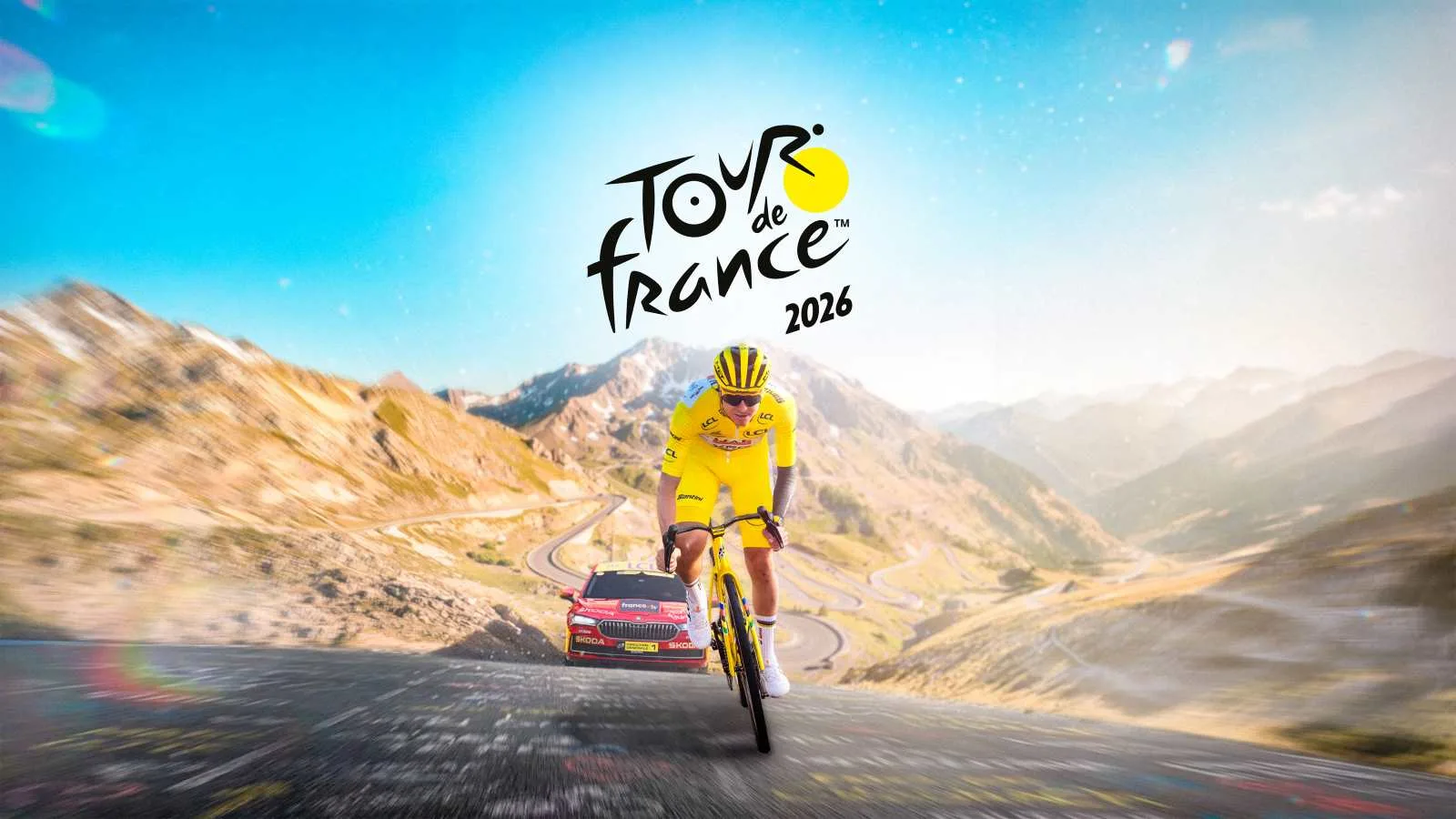

Tour de France 2026 arrives from Cyanide Studio and NACON on the same calendar rhythm the series has followed for years, landing in stores just ahead of the actual race it simulates. This is the second outing built on Unreal Engine 5, the engine switch having done its heavy lifting last year, which leaves this edition to answer a quieter question: what do you do with a new engine once the novelty of having one has worn off? The answer, this time, is weather.
Rain, wind, and shifting temperatures move from background texture to a functioning system, reshaping how a descent or a cobbled sector plays out mid-stage. The licensed Tour route returns in full, opening in Barcelona and closing through Montmartre, joined by smaller official races and a scattering of fictional ones that round out a season. None of this is a reinvention. It’s a cycling simulator that has spent years building its own grammar of effort and positioning, and 2026 spends its energy refining that grammar rather than replacing it.
Three Bars, One Decision Every Second
Cycling games live or die on how they translate an endurance sport into something you can actually feel through a controller, and Tour de France 2026 keeps the system the franchise has used for several years running: three gauges, yellow for current output, blue for total stamina, red for a reserve you spend only when a race demands it. Burn through the red bar chasing a breakaway on a flat stage and you’ll watch the peloton swallow you back up a kilometer later. Hold it in reserve through a mountain stage like Alpe d’Huez and you’ll have something left for the final kilometer when riders rated higher than you start cracking.
The actual pedaling is handled through triggers rather than a stick, holding one to ride and the other to brake, with the X button doing double duty as a standing sprint and a desperate, last-ditch acceleration. It’s a scheme that draws from stamina-management games as much as traditional racers, and longtime players of the series will recognize it instantly. New riders will need a stage or two to understand that pedaling downhill at the wrong moment puts you on the ground rather than ahead of the field.
The time trial position is the franchise’s most distinctive wrinkle, and it returns unchanged in concept if sharper in feel. Tucking into the TT crouch buys speed and costs you the ability to corner cleanly, so a rider taking a technical individual time trial has to learn exactly which bends demand sitting up and which can be carried through in the tuck. Get it wrong on a wet hairpin and the cost is steep, which connects directly to this year’s headline system.
Drafting and attacking work the way they have for several editions: hold a button to tuck into another rider’s slipstream, hammer X to launch an attack and watch your radar blip pull away from a group that can’t immediately answer. Veterans of Tour de France 2025 will find breakaways exactly as stubborn to execute here as they were last year, one of the few mechanical threads the studio left completely alone.
What is genuinely new sits in two places. The Team Time Trial event finally gives players a relay order to set and a leader to protect, turning what used to be four or five riders mashing the same input into an actual coordination puzzle. And a new agility attribute quietly reshapes every rider’s profile, mattering in a way it never did in earlier entries, because for the first time it interacts with conditions outside anyone’s control.
When the Sky Decides the Stage
Weather is the system Cyanide built this entire release around, and it earns the attention. A stage that starts under clear skies can turn to rain by the second hour with no warning, and the road itself changes underneath you. Wet asphalt brings locked wheels and slides into corners that were routine an hour earlier, and braking late on a rain-soaked switchback can send a rider into a guardrail rather than around it. One descent produces exactly the kind of moment the system was designed for: a sudden downpour mid-stage causes a multi-rider crash that shreds the front of the peloton, and a rider willing to take the risk and brake later than the pack can open a gap that simply would not exist in dry conditions.

This changes how a descent functions across the whole game. In earlier editions, going downhill was a chance to recover stamina while the bike did the work. Here it’s a calculated risk every time, and the new agility stat becomes the difference between a rider who threads a wet corner and one who slides across it. Crosswinds, a feature the series has carried for a few years now, stack with the new wet-road mechanics to create stages where two separate environmental threats work against you at once, something no prior Tour de France game has asked players to track simultaneously.
The presentation keeps pace. Rain affects what riders are wearing, switching kits between short sleeves and full wet gear depending on conditions, and the puddle reflections and cloud formations look sharper than anything the series has rendered before. Layered against the existing soundscape of wheels, breathing, and crowd noise, a rainstorm changes the texture of a stage as much as it changes the racing.
Here’s the catch, and it’s one worth sitting with: weather is the only major system this release adds. Breakaway difficulty, AI behavior, team radio, all of it carries over from 2025 untouched. For a series with this much history behind it, asking one weather system to carry the entire argument for buying a new copy is a tall order, even when that system performs as well as this one does.
Pro Leader, Pro Team, and the Rest of the Field
Pro Leader puts you through the character creator first: name, nation, jersey, equipment, then the rider-specific sliders for age, height, weight, cadence, and specialization, climber or sprinter or one of several flatter profiles. Ten avatars cover hairstyles and beard options, though you can’t push past that into deeper customization. What happens after creation is the part returning players will recognize with a wince. Your created rider starts with terrible stats and a team that can’t qualify for most of the calendar, which means the opening season offers maybe three or four races you can actually play before the rest gets simulated past you. This has been true of Pro Leader for several years running, and 2026 does nothing to soften it.
The practical answer, and the one the game itself seems to expect, is to start on Amateur or Professional, clear the early progression challenges, and only step up to Champion or Legend once your rider’s overall rating has climbed. Those challenges, things like joining a set number of breakaways or chasing a mountain classification, raise your stats when completed, but the game still won’t show you which ones are active or how close you are to finishing them, a complaint that has followed the series since at least the last two installments.
Pro Team sidesteps the worst of this. Managing a full roster, building a calendar, handling transfers, gives you a much faster route to competing for results across every race type rather than waiting on one underpowered rider to catch up. The tradeoff that has dogged the franchise remains in place here too: riders neither age nor retire across multiple seasons, so a five-year save looks almost identical to a one-year save, same names, same faces, every January. A series this committed to simulating effort and weather hasn’t found a way to simulate a roster aging out, and that gap stands out more with every passing year it goes unaddressed.
Club Tour rounds out the package with two scoring modes, Race for ranked finishes across rotating challenges and Descent for timed runs down a mountain, both tracked across current, monthly, and annual leaderboards. Criterium pushes further into actual head-to-head play, up to six players each fielding multiple specialized squads, mountain, flat, hills, though the random assignment to terrain means your climbing team can just as easily get handed a sprint finish. Four difficulty settings, Amateur through Legend, frame all of it, and Legend remains exactly as punishing as its name suggests.
The Engine Upgrade Nobody Asked to Repeat
The route work is where this game still earns its license fee. The Grand Départ rolls out of Barcelona under the Sagrada Família, the Tour climbs Alpe d’Huez twice across the season, and the Paris finale threads through Montmartre and past the Sacré-Cœur for a finish that feels like an event rather than a formality. This year adds the Muscat Classic, all desert roads and palm trees and double-digit gradients, and the muddy unpaved sectors of Paris-Tours, both genuinely new additions to a calendar that otherwise leans on the same fictional fillers, the Euro Tour and Circuit Grand Est among them, that have padded the season for a few editions running now.
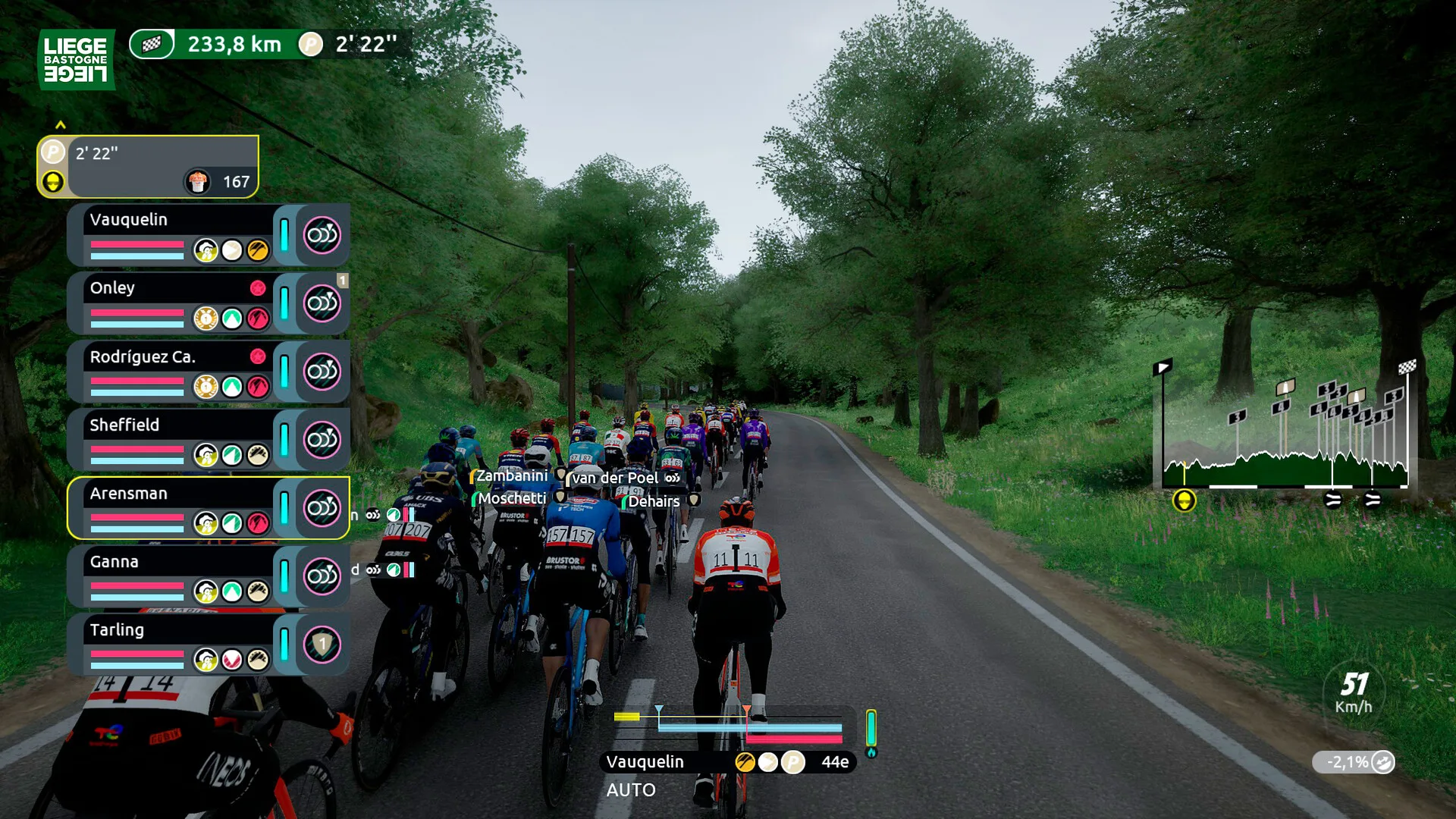
Visually the upgrade from last year’s engine switch is holding up, with stronger water reflections, denser crowds along the barriers, and weather effects that look better than anything the series has shown before. The cracks are still there if you’re looking. Anti-aliasing shimmers on distant scenery, pop-in appears on longer straights, and spectators occasionally clip into the road as a rider passes through them, the kind of rough edge that’s been a known issue across at least the last couple of releases. Rider models and animations remain stiffer than the environments around them, a gap the engine switch hasn’t closed.
The commentary track adds new lines this year, which helps, but it’s still prone to discussing leaders the player can’t see while a rider stuck mid-pack gets almost nothing relevant said about them, a complaint that has trailed the series’ broadcast presentation for a while. Accessibility options are genuinely expanded, colorblind filters, adjustable subtitle size and position, customizable controller icon colors, and the redesigned HUD this year does real work, making the three effort gauges easier to read at a glance during a chaotic sprint finish than in any previous entry. Stability has improved too. Fewer bugs and fewer erratic AI moments turned up across longer sessions than in last year’s game, even if AI decision-making in tight finishes can still go sideways.
Set this release next to Tour de France 2025 and the shape of the comparison is clear. Last year’s job was the engine. This year’s job was supposed to be content, and what arrived instead was one weather system doing the work that several new modes or routes might have done. The rain makes this a sharper-handling game than its predecessor. Nothing else about it grew much larger.
Tour de France 2026 is a professional cycling simulation and sports strategy game developed by Cyanide Studios and published by Nacon. Released on June 4, 2026, the game is available on PC via Steam and features full controller support. In this installment, players take on the role of elite international cyclists competing to win the prestigious Yellow Jersey, offering an official route recreation of the 2026 Tour de France from the Grand Départ in Barcelona to the final stretch in Paris. The game introduces brand new mechanics including a revamped team time trial system, complex dynamic weather systems that directly alter bike handling, and expanded tactical management features spanning 100 unique playable stages.
The Review
Tour de France 2026
Tour de France 2026 plays like a franchise that found one good idea and decided that was enough for the year. The weather system genuinely changes how a descent or a wet corner has to be ridden, and the effort gauges remain the smartest translation of cycling tactics in any game carrying this license. But measured against 2025, the career structure, the breakaway difficulty, and the lack of rider aging are identical, and one new mechanic can only stretch so far across a sequel. Reliable rather than ambitious.
PROS
- Weather genuinely reshapes descents and cornering
- Effort-gauge system remains the genre's sharpest translation of tactics
- New Team Time Trial relay adds real coordination
- Muscat Classic and Paris-Tours bring fresh terrain
- Redesigned HUD and steadier performance
CONS
- Pro Leader's brutal opening season, unsoftened again
- Riders still don't age or retire across saves
- Breakaway difficulty and AI carried over untouched
- Commentary still loses track of mid-pack riders
- Pop-in, clipping crowds, stiff rider models persist