


























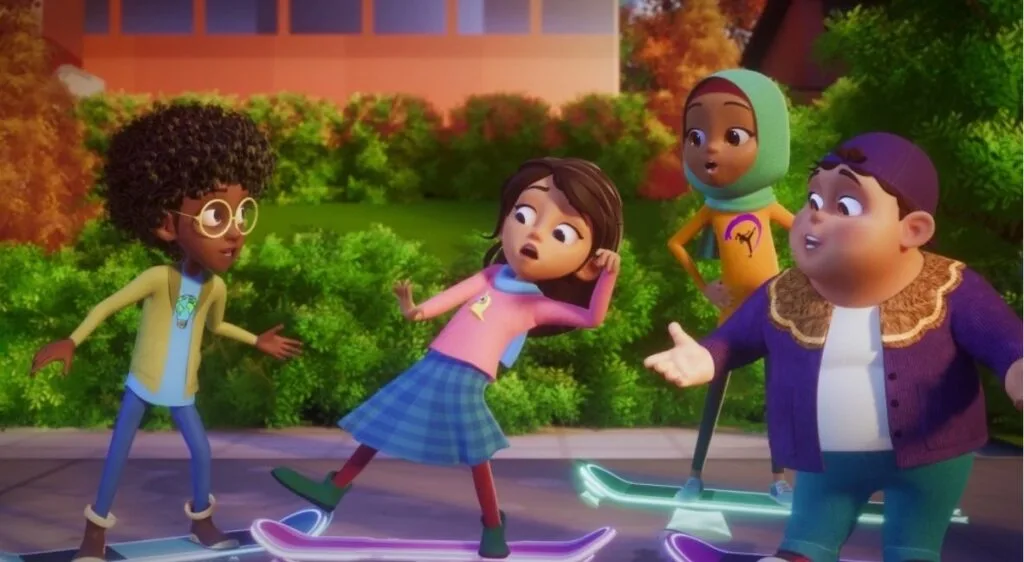

The year 2050 arrives with cold, clinical precision. Layla and her father, Habib, live in a Seattle ruled by pressure and corporate menace. A brutal home invasion by the Zoola Corporation tears through their fragile domestic routine. That rupture sends them fleeing to Vancouver, where they seek refuge inside Aqli Academy, a citadel for gifted minds. A failed temporal experiment snaps the story into a new register.
Layla and three fellow students disappear into the ninth century and surface in the House of Wisdom at the peak of the Islamic Golden Age. Fasid appears as the resident threat, a resentful alchemist who steals the time technology and turns his fury toward the structure of modern knowledge itself.
What follows is a pursuit stretched across the Silk Road, with the children moving through Baghdad, Timbuktu, and Aleppo in an effort to protect the figures who shaped science. A mishap becomes a race to preserve humanity’s intellectual inheritance. The stakes are huge. The film knows it.
Alchemical Erasure and the Classroom of the Past
After its futuristic opening, the film settles into a thickly layered study of scholarship and historical memory. It serves as a correction to the standard Western classroom model, placing Islamic intellectual history in full view and under narrative pressure. In 825 AD Baghdad, the students meet Al-Khwarizmi, and his appearance marks the birth of algorithmic thinking with admirable clarity.
The script folds these lessons into a breathless chase structure, chasing educational heft through thriller mechanics. The group reaches Timbuktu and encounters Mansa Musa. In Cairo, Ibn Al-Haytham appears during his work in optics. In Aleppo, Maryam Al-Astrolabi enters carrying the film’s link between precise craftsmanship and cosmic inquiry through her astrolabes.
The pacing moves at a near constant sprint, sending facts across the screen with the speed of a data feed. That momentum gives the film energy, though younger viewers may struggle to pin down exact dates as the scenes rush forward. The script leaves the Silk Road undefined in formal terms and trusts the imagery to sketch its routes and importance. That choice works well enough, though a little extra clarity would have helped. Ancient philosophy meets contemporary survival in nearly every major beat.
The filmmakers redraw the historical map and give Islamic achievement the weight it deserves. Their edutainment strategy depends on suspense, using the threat of historical erasure to make mathematics and scientific thought feel immediate. Beneath the rush sits a thoughtful question about inheritance and understanding: how fully can a child value a legacy still half-discovered? The answer arrives through motion, urgency, and a brisk intellectual charge.
Identity and the Architecture of the Hero
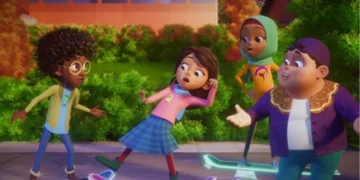
The four young leads form a persuasive portrait of resilience taking shape under pressure. Layla carries the emotional bruise left by her mother’s absence, and her character arc moves from private sorrow toward active protection. She becomes the point where historical fragility meets future obligation.
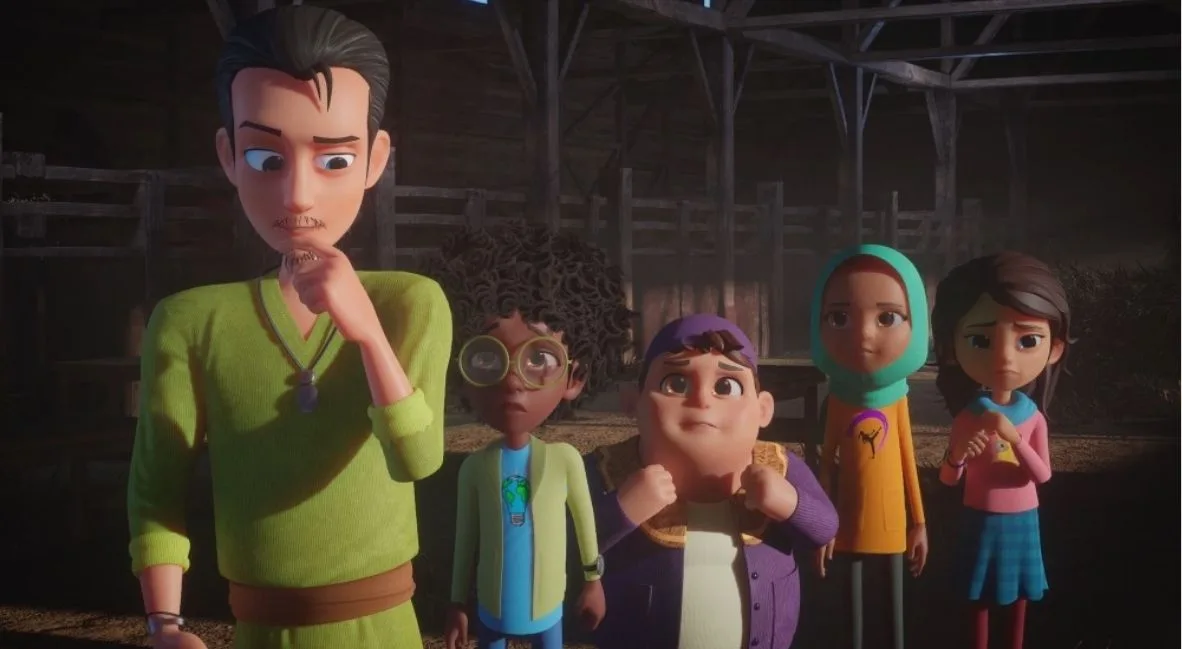
Aysha functions as the group’s tactical center, and her presence as a hijabi martial artist gives the frame a fresh visual grammar for science fiction. She moves with conviction and supplies the kind of certainty that keeps the others from scattering. Khalid serves as the team’s analytic mind, leaning on data and reason as the world around him slips out of temporal alignment. Abdullah brings buoyancy, walking through crisis with a cheerful ease that feels almost absurd. Thankfully, the film seems aware of that comic note.
Their cultural identity is treated as an ordinary fact of life. Casual prayer appears without ceremony, and modest dress belongs to the texture of the world. The film handles these details with a light touch. Around them, the adults hover at the margins like dim figures at the far end of a noir corridor, oddly calm while children manage ninth century political peril.
Fasid, by comparison, receives little inner shading. He functions as a source of obstruction, a bitter man with a time machine and enough malice to keep the story in motion. That simplicity still serves a purpose. His hostility gives the young protagonists room to discover agency, discipline, and shared strength. The film places its faith in collective action, and that faith holds.
Digital Artifacts and Aesthetic Ambition
The visual design lives in a space between cinematic reach and the hard-edged geometry of a game engine. Character models carry a rigid digital texture, and their motion rarely achieves the flowing ease associated with expensive animation.
During action scenes, the frame rate dips, giving moments such as Aysha’s training strikes a jerky, mechanical pulse. Those limitations expose the realities of an independent production. Yet the surrounding environments show genuine care. Aleppo’s architecture and Baghdad’s markets are rendered with close attention, giving the world historical texture and spatial density.
Lighting does much of the thematic lifting. In the ancient libraries, the filmmakers reach for chiaroscuro, stretching shadows across stone floors and letting darkness press against pools of illumination. The effect suits a story haunted by threatened knowledge, secrecy, and pursuit. Shot composition often leans toward expressionistic framing, with corridors, arches, and library interiors shaping the children as small figures moving through large repositories of memory. The visual language carries ambition in every direction.
The soundscape proves less steady. Dialogue from certain historical figures carries an audible echo that points to recording conditions far from a polished soundstage. Name pronunciations shift in distracting ways, producing a note of dissonance that the film never quite smooths out.
Even with those rough edges, the project moves with visible purpose. The filmmakers are reaching for scale, atmosphere, and historical sweep beyond the size of their means. That gap between aspiration and execution gives the film a peculiar energy. At moments, it frustrates. At others, it charms. The closing cliffhanger signals plans for growth and suggests a much larger world waiting for sharper technical refinement.
This animated feature reached North American theaters through a limited engagement on February 7, 2026. It focuses on four students from Aqli Academy who use temporal technology to travel back to the ninth century. Viewers can currently find the film on major transactional video platforms like Prime Video and Apple TV as of its March 31, 2026, digital launch. The project serves as a bridge for a broader television series scheduled for the Muslim Kids TV streaming service. It highlights the intellectual contributions of historical scholars within a fast paced adventure.
Where to Watch Time Hoppers: The Silk Road (2025) Online








Full Credits
Title: Time Hoppers: The Silk Road
Distributor: Vision Films, Fathom Entertainment, Miracle Communications Ltd, Muslim Kids TV
Release date: February 7, 2026
Rating: PG
Running time: 85 minutes
Director: Flordeliza Dayrit
Writers: Flordeliza Dayrit, Sakina Fakhri, Nuha Elalem, Sarah Mokh, Asil Moussa
Producers and Executive Producers: Michael Milo, Flordeliza Dayrit, Mohannad Malas, Dr. Abdullah Patel, Dr. Fatima Coovadia, Dr. Hussein Amery
Cast: Jayce McKenzie, Omar Regan, Tareek Talati, Angel Haven Rey, Emily Gin, Aliyah Harris, Morris Seng, Alhusain Hadidi, Ahmad Harris, Ali Ardekani, Jenna Abu Tineh
Director of Photography (Cinematographer): Shaun Finch
Editors: Michael Milo
Composer: Ilyas Mao, Olajide Odewale, Ari Rhodes
The Review
Time Hoppers: The Silk Road
The film struggles under the weight of its own intellectual reach. Technical flaws feel like shadows in an unlit alley. Still, the project offers a rare glimpse into a neglected history. It prioritizes cultural literacy over visual polish. The result remains a bumpy, earnest trek through the mechanics of the past. It is a sketch of a grander vision.
PROS
- Detailed focus on Islamic Golden Age scholars.
- Strong representation for hijabi girls.
- High educational value for young audiences.
CONS
- Stiff animation and low frame rates.
- Poor sound mixing and inconsistent audio.
- One dimensional villain and supporting adults.