
























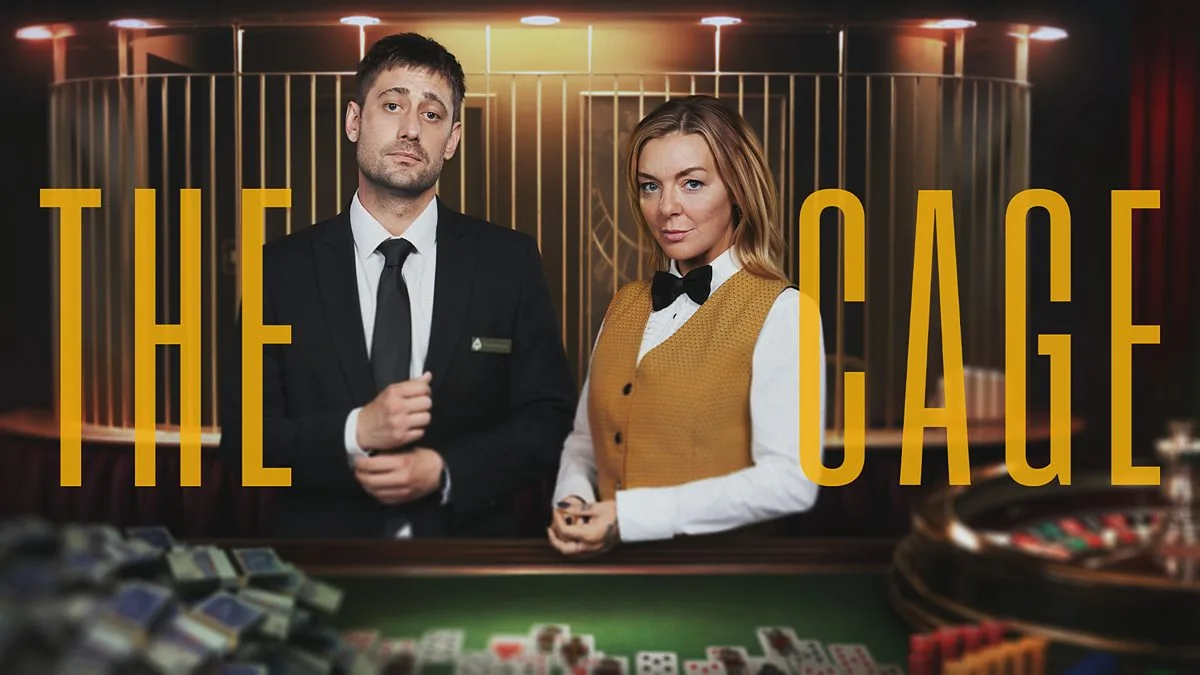

The Cage is a five-part BBC One drama set in the casinos and council estates of Liverpool, written and created by Tony Schumacher, whose debut drama The Responder established him as one of British television’s most distinctive voices. Schumacher drew the seed of this new series from time spent working on cruise ships, watching casino employees and their complicated, often self-destructive relationships with money.
The premise is deceptively simple. Leanne (Sheridan Smith), a casino cashier, and Matty (Michael Socha), the casino’s manager, have each been quietly stealing from their employer for months, driven by separate but equally desperate financial circumstances. When they discover each other’s secret, they are forced into an uneasy alliance, only to find that the casino they have been pilfering from is a front for serious organised crime.
What follows operates on two levels simultaneously. On the surface, it is a tightly plotted thriller with real momentum and wit. Underneath, it is a raw, angry portrait of contemporary Britain, a study of lives compressed by debt, addiction, caring responsibilities, and a system that offers very little give to those who need it most.
The System Is the Villain
The casino in The Cage is, by design, the wrong place to look for meaning. Garish, artificial, and engineered to extract money from people who can least afford to lose it, it is a setting chosen with considerable irony. Schumacher uses it as a frame rather than a subject, a controlled environment in which to examine what financial desperation does to people who have exhausted every other option.
His background as a former police officer and taxi driver saturates the writing with credibility. He knows how debt collectors think, how estranged fathers bargain with their own shame, how the small humiliations of poverty accumulate into something crushing. The result is a world where no character is left without texture, where a peripheral figure can carry an entire history in a single exchange. Debt collectors have conflicted feelings. Estranged partners carry years of affection alongside their frustration. This density of detail lifts the series well above the standard crime drama template.
The plot mechanics are well-engineered. Leanne and Matty are unwittingly stealing from a casino being used to launder drug money by its owner Gary (Barry Sloane), which means the two most ethically compromised people in the building are, by some distance, its most principled employees. It is a mordantly funny structural irony, and Schumacher lets it breathe.
The first episode is deliberately loaded with converging plot threads and can feel busy. The scaffolding pays off. Consequences accumulate without easy resolution. The series resists the pull toward tidy outcomes, and its finale arrives as a surprise that the preceding episodes have quietly and carefully earned.
Running through the script is a strand of Northern, working-class gallows humour that functions as both a pressure valve and a form of character revelation. When a detective tells Matty, “F—ing hell, Matty, it’s not Line of Duty,” the line carries a self-awareness about genre that signals Schumacher knows exactly which kind of drama he is making. The opening track, The The’s “This Is The Day,” sets the tone with equivalent wryness: a promise of transformation that Leanne and Matty’s lives will spend five episodes systematically dismantling.
Two Performances, One Remarkable Partnership
Sheridan Smith plays Leanne as a woman whose composure is a survival mechanism. At work she is warm, alert, and authoritative; the person who keeps things running. The private Leanne, driving home in tears, standing at the edge of a rooftop car park unable to step into the void because there are too many people counting on her, is a figure Smith renders with quiet devastation.
What makes the performance exceptional is its physical intelligence. Smith communicates the weight of Leanne’s circumstances through posture, through the heaviness with which she moves, through a haunted smile that does the work of a monologue. Sympathy arrives before the audience has fully assembled the facts of her situation. She is the more clear-headed of the two leads, quicker to read a room and sharper in a crisis, and Smith ensures this practical competence never reads as coldness.
Michael Socha, as Matty, is the revelation. Matty is a recovering drug addict still losing the battle with gambling, sleeping in his office, breakfasting on beer dregs, and too ashamed of himself to maintain regular contact with his teenage daughter. He is a man in free fall who has somehow preserved, somewhere inside the chaos, a genuine capacity for love and warmth. Socha excavates every layer of that contradiction with matchless precision.
His comic timing is immaculate. He moves between lightness and despair with a physical nimbleness that reads as entirely natural, and his expressive, hangdog face is doing considerable work before a word is spoken. As the series develops and the reasons behind Matty’s addictions are gradually revealed, the performance deepens from affectionate comedy into something considerably affecting. Understanding Matty, rather than simply feeling for him, is a harder achievement, and Socha earns it.
His scenes with Emily, his teenage daughter, and with Trace, Emily’s mother played by Mona Goodwin, are the emotional backbone of his arc. Goodwin does a remarkable amount with limited screen time, and one hopes awards consideration reflects that. These relationships carry years of accumulated history, and every moment of reunion or disappointment feels fully inhabited.
The supporting cast is assembled with equal care. Louis Emerick plays Paul, the debt collector who is also, in some complicated sense, a friend. His reluctant beatings of Matty, complete with a cold compress and a glass of water for the bruise afterwards, are simultaneously the series’ best running joke and one of its most perceptive observations about human nature. Barry Sloane’s casino owner Gary is a monster with layers. Eileen O’Brien, as Leanne’s grandmother, lands her moments of clarity with quiet force.
The presence of Brookside alumni Emerick and Sue Jenkins in the cast gives the Liverpool setting a warmth and familiarity that rewards long-term viewers of British television without alienating those who don’t carry the reference.
Poverty Trap, Written in Neon
The Cage is rooted in a specific and recognisable contemporary British experience: the condition of people who work, who try, and who still cannot keep their heads above water. Schumacher is not interested in judging this, and the writing makes that clear from the first episode.
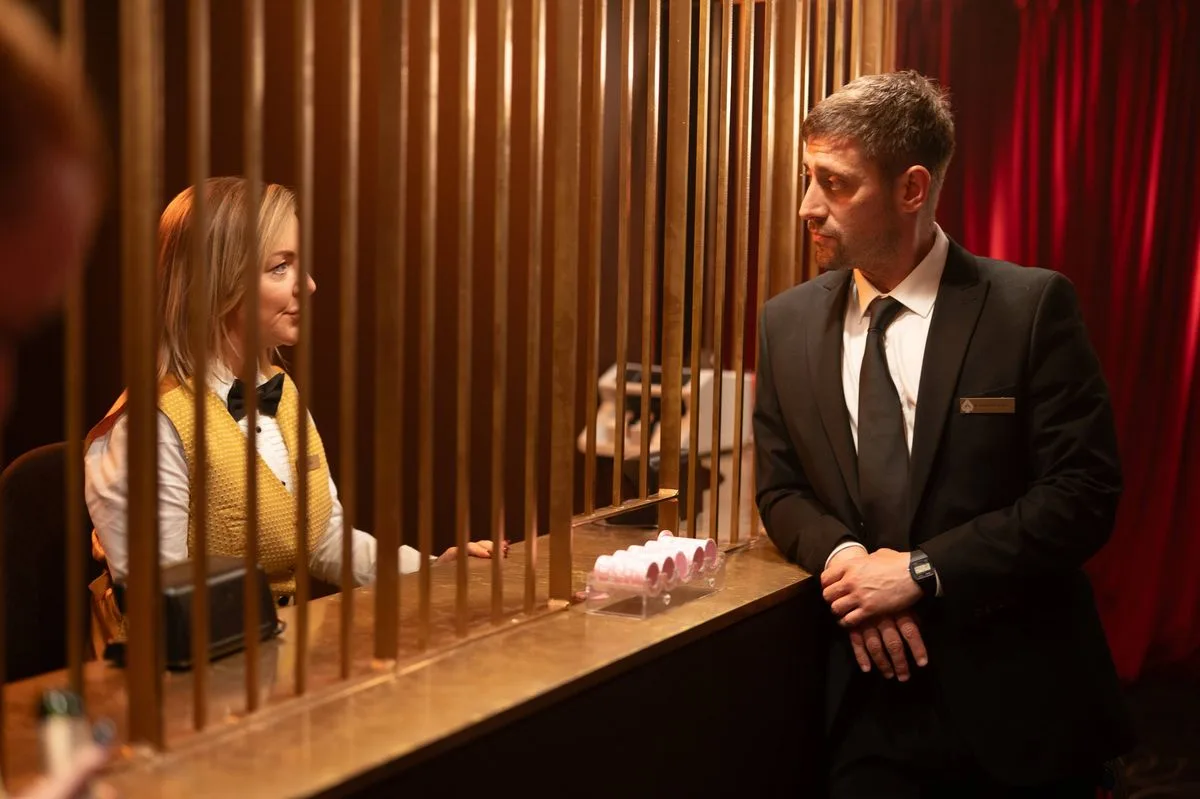
Leanne’s predicament is constructed with procedural accuracy. She is widowed, the sole carer for her children and her grandmother, and facing eviction because the council tenancy is held in her grandmother’s name and will lapse when her grandmother moves into care. She needs a deposit she cannot save legitimately because there is nothing left after the bills, the childcare, and the caring responsibilities are met. The money she steals is, within the logic of the series, the money the system already owes her.
Matty’s situation is shaped by addiction, but Schumacher refuses the simple narrative of personal failure. Something happened to Matty, something the series reveals carefully and without melodrama, that explains the shape of his choices without excusing them. He is in debt, under physical threat, living at work, and too ashamed of himself to show up consistently as a father to the daughter he loves. The show treats his gambling and drinking as symptoms rather than character flaws.
This moral framing extends across the whole series. The loan shark who administers beatings is also a reluctant friend. The gangster laundering money is capable of something resembling kindness. The two people stealing from a criminal enterprise are among the most sympathetic individuals in the building. Schumacher blurs the line between wrongdoing and survival so consistently that it ceases to be a line at all.
What gives The Cage a cultural weight that outlasts the thriller plot is the argument embedded in its structure: that the system designed to support people like Leanne and Matty has already failed them before the first frame. Their theft is the response to a prior theft. The series builds toward the possibility of redemption with great care, refusing to offer it cheaply, and refusing to deny it entirely.
Liverpool, Unvarnished and Loved
Schumacher sets The Cage in his home city with the confidence of someone who knows it well enough to see both its difficulties and its dignity. Liverpool here is not a backdrop of unrelieved grimness, and it is not a tourist poster. It is a city where people do their best inside circumstances that make their best very difficult, and the series treats that effort with consistent respect.
Small victories carry real weight. A grandmother momentarily remembering your name. A father and daughter sharing a conversation about Depeche Mode that costs nothing and means everything. These moments are written and played without sentimentality, which is precisely what makes them land.
The Cage sits lighter on the tonal register than Schumacher’s previous work. The comedy runs more consistently through the narrative, and the thriller pacing gives the series a propulsive quality. The balance between darkness and humour is difficult to maintain, and it is maintained here with considerable skill. The jokes work because the surrounding pain is real; strip either element and the other collapses.
The soundtrack is doing serious creative work. The The’s “This Is The Day” opens the series with an irony so pointed it amounts to a thesis statement: a song about transformation deployed at the precise moment when everything is about to get considerably worse. New Order’s “5-8-6” anchors the series in a particular cultural mood, the post-industrial North, the world that produced the music alongside the conditions that inspired it.
The casino itself, artificial and garish by design, serves as a quietly devastating ironic frame for the entirely unartificial lives playing out inside it.
The Cage is a gritty, high-stakes British crime thriller that premiered on BBC One and BBC iPlayer on April 26, 2026. Created by Tony Schumacher—the mind behind the acclaimed series The Responder—the show is set in Liverpool and follows the lives of two casino employees, Leanne (Sheridan Smith) and Matty (Michael Socha). The plot thickens when they realize they are both independently skimming money from the casino’s safe, leading them into a dangerous collision with local organized crime and the police. You can currently stream all episodes of the first season on BBC iPlayer.
Where to Watch The Cage Online
Full Credits
Title: The Cage
Distributor: BBC One, BBC iPlayer
Release date: April 26, 2026
Rating: TV-MA (due to strong language and violence)
Running time: 60 minutes
Director: Al Mackay
Writers: Tony Schumacher
Producers and Executive Producers: Hilary Martin, Christopher Aird, Ed Guiney, Andrew Lowe, Tony Schumacher, Sheridan Smith, Lucy Richer, Clare Shepherd
Cast: Sheridan Smith, Michael Socha, Barry Sloane, Geraldine James, Anton Bibby, Freya Jones, Sophie Mensah, Abby Mavers, Shaun Mason, Louis Emerick, Ian Puleston-Davies
Director of Photography (Cinematographer): Pierre-Yves Bastard
Editors: Jean-Baptiste Beaudoin, Benjamin Favrol, Flora Volpelière
Composer: Bastien Burger, Myd
The Review
The Cage
The Cage is Tony Schumacher at full stretch, angry, compassionate, and wickedly funny in equal measure. Sheridan Smith delivers with her customary precision, but Michael Socha is the one who will stay with you, a performance of rare emotional intelligence wrapped inside a character designed to break your heart. Schumacher's Liverpool is vivid and specific, his script dense with humanity, and the thriller machinery genuinely taut. British television rarely produces social drama this sharp wearing its genre clothes this lightly.
PROS
- Michael Socha gives a career-best performance
- Schumacher's script is layered, humane, and consistently surprising
- The gallows humour is perfectly calibrated
- Every supporting character feels fully realised
- The social portrait is specific, credible, and quietly devastating
- Sheridan Smith brings enormous physical and emotional intelligence to Leanne
- The finale earns its emotional payoff without cheating
CONS
- The opening episode is heavily loaded and can feel congested
- The police corruption subplot and its central detective feel thinner than the rest of the cast
- Viewers unfamiliar with strong Scouse accents may find some dialogue hard to follow