

















![Kingdom Hearts Collection [I-III] Review](https://gazettely.com/wp-content/uploads/2026/10/Kingdom-Hearts-Collection-I-III-1-360x180.webp "Kingdom Hearts Collection [I-III] Review: KHII Holds Steady as Newer Entries Fluctuate 37")



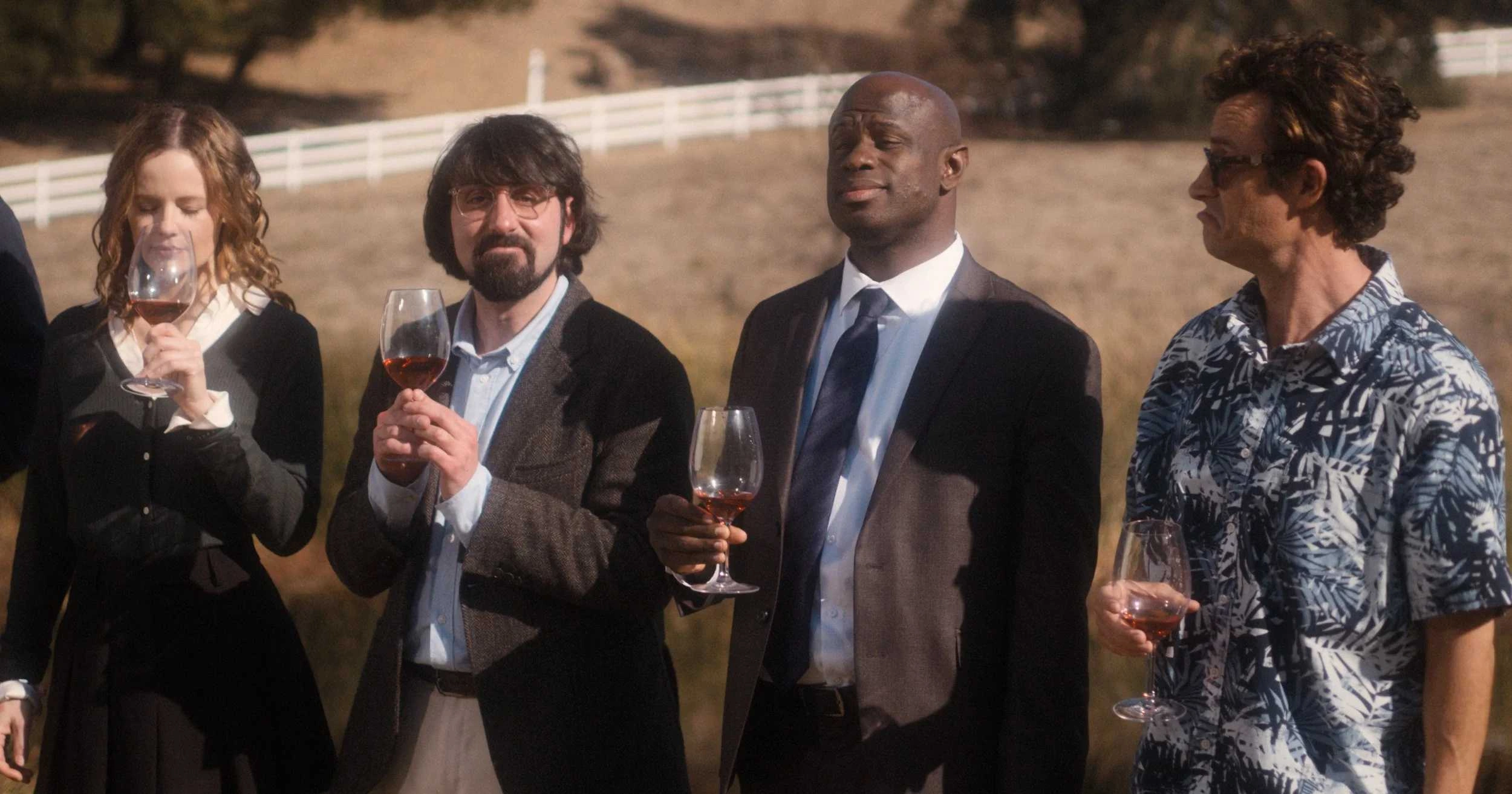

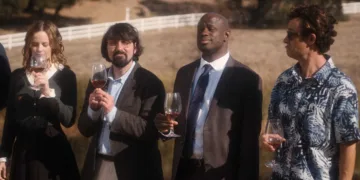
The Napa Boys plays like a phantom text dug up from a timeline that never existed. It lives under the long silhouette of Alexander Payne’s 2004 drama and announces itself as a fourth chapter with complete confidence. Nick Corirossi and Armen Weitzman fabricate a franchise history out of thin air, then proceed as if the absent chapters are common knowledge.
Miles Jr. and Jack Jr. move across California in search of a mythical sommelier, trailed by a disorderly pack of friends and a superfan who tracks their every move. The film breathes absurdity. Conventional comic architecture gets discarded early, and the movie settles into a sidelong study of franchise culture in its current, exhausted form. It adopts the depleted spirit of mid-2000s direct-to-video comedy and treats that cheapness like an aesthetic program.
Anti-comedy drives the machine. Bizarre repetition keeps it running. Meta-commentary supplies the rhythm. Corirossi stages the material with a keen sense of the ridiculous, turning a road trip into something like a surreal odyssey with spilled wine, bodily fluids, and comic-book mythology crashing into each other. The effect is narrow, peculiar, and stubborn. It can wear down the viewer. It can also pay off for anyone with patience for cinema at its strangest.
The Archaeology of an Invented Past
The opening title card names the film The Napa Boys 4: The Sommelier’s Amulet. That detail matters. The “Indiana Jones” style font immediately borrows the visual grammar of blockbuster adventure, giving the image a counterfeit grandeur. The joke begins there, in typography, with a graphic flourish that promises scale and legacy. The script then builds on that false promise by citing earlier entries that never existed. Female-led spin-offs float through the dialogue. Reboots focused on a younger generation receive mention.
Studio recycling becomes the target, and the satire lands through accumulation instead of finesse. Every character repeats, “The Napa Boys are back!” until the line becomes a synthetic memory forced onto the audience. The comic method is blunt, almost brutish. A joke irritates, keeps going, and circles back into humor through sheer stubborn repetition. Persistence does the heavy lifting. Subtlety takes the day off.
That design feels entropic by intent. The humor collapses the second the audience tries to apply logic, and the film knows it. Corirossi and company borrow the visual and structural feel of mid-2000s bargain sequels, with the later American Pie installments serving as a clear reference point. Cheap production value becomes an organizing principle. It creates an empty chamber where the “Napa Boys” brand can somehow pass for a real inheritance.
Franchise satire drives the premise, though the film pushes that idea into something bleaker, a world in which sequel logic has become the only logic available. The camera often hangs back and watches these characters wrestle with lore that never existed in the first place. That framing gives their confusion a deadpan charge. It also points a finger at sequel culture and its hollow rituals.
Flat camera angles mimic the visual language of a discount DVD pulled from the bottom shelf at a big-box store. The style is intentionally debased. Lighting runs harsh through many of these scenes, exposing the falseness of the spaces and giving the mood an unexpectedly existential chill. These people look stranded inside an endless rerun of a franchise pitch meeting. Not ideal.
The “Indiana Jones” font continues to function as a visual lie throughout this opening stretch. It advertises narrative density, myth, and momentum. The film then withholds all three. The direct-to-video look serves as a weaponized nostalgia object, recalling an era when sequels could feel sloppier, cheaper, and weirdly free.
That very roughness becomes the movie’s main asset, since it gives the performers room to lean hard into the absurd. Meaning buckles under repetition. Anti-comedy depends on that collapse, and The Napa Boys treats collapse as a participatory sport. The viewer is invited to sit inside the wreckage and keep watching. It is a risky tactic. Confusion is part of the ticket price.
Avatars of the Absurd: Psychological Archetypes in the Valley
Miles Jr., played by Armen Weitzman, arrives as a clownish refraction of Paul Giamatti’s Miles. His bowl cut creates an expressionistic frame around his face, pushing his awkwardness into something close to caricature. He works as a comic-book artist and insists that his art has no relation to his actual life, a denial that opens a neat psychological split inside the character.

He feels like a man fleeing a parody of himself and somehow running deeper into it with every scene. Jack Jr., played by Nick Corirossi, supplies the other half of the pair as a crass id figure, an amplified version of Thomas Haden Church’s Jack. He drives a “Wine Wagon” SUV with the license plate “IH8MERLOT.” He pursues parties. He fixates on infidelity. The characterization is broad, vulgar, and very deliberate.
Together, the two men create a kind of comic chiaroscuro. Miles Jr. carries a frantic, exposed energy. Jack Jr. moves with a darker, more sealed-off impulse. Stifler’s Brother, played by Jamar Neighbors, introduces another register entirely. He is identity as a void. His name points to a known figure, yet he bears no resemblance to the original actor and drags a suitcase through the film without explanation.
He becomes a signifier detached from its source, a franchise remnant with no origin point left behind it. Puck, played by Sarah Ramos, serves as the watcher. She is a podcaster, a superfan, and the one figure willing to announce that weirdness is acceptable. Her presence gives the audience a guide, though “guide” may be too orderly a word for someone studying chaos with clinical devotion. She observes the leads with fascination that feels half scholarly, half unhinged.
Squirm, played by Paul Rust, enters as the antagonist, a rich winery owner rendered in openly offensive and extravagant terms. Rust plays him at a heightened pitch that suits the film’s fussy-villain template. His presence introduces a strain of recognizable conflict into a movie that spends much of its time dismantling recognizability. Mike Mitchell and Nelson Franklin join the ensemble, and their presence helps create an improvisational drift in scene construction.
Episodes tumble forward without a clear map. That shapelessness carries purpose. It mirrors the characters’ mental disarray and gives the film a loose psychological rhythm. During their most ridiculous arguments, the lighting often drops into deep shadow, which gives the exchanges a mock-serious weight and turns petty behavior into something dimly existential. Noir lighting applied to nonsense can be a very funny image. It can also feel weirdly apt.
Weitzman plays Miles Jr. like the lead of a psychological thriller who has wandered into a farce and realized escape is unavailable. His movements register as precise. His line delivery carries a faint tremor of doom. Corirossi’s Jack Jr. becomes a study in moral rot, a figure of appetites stripped of reflection.
Stifler’s Brother presses against the film like a metaphysical problem. His very existence asks for explanation, and the script refuses to provide one. These archetypes begin in familiar territory, then get twisted into shapes that no longer fit any stable category. Character study remains part of the film’s project, even inside a world with no consequences and no interest in supplying them.
Aesthetics of the Accelerated: Technical Rhythms and Sonic Dissonance
The production was shot in under ten days, with Malibu standing in for Napa. That compressed method gives the film a thin, urgent texture that suits its restless sensibility. Corirossi uses beatific montages scored with music from a “Golden Age Western,” and the contrast between lofty musical feeling and crude comic material creates one of the film’s stranger tonal effects.

The “Wine Wagon” becomes a mechanized emblem of absurdity, an object whose very presence lowers the stakes in a way that feels carefully calibrated. Sound design leans into diegetic dissonance. Needle drops arrive as small acts of sabotage. The Supremes appear during moments that play as distinctly odd. The Chipmunks’ “The Girls of Rock ‘n’ Roll” scores a seduction. Those choices produce a surreal acoustic atmosphere, one that keeps the viewer slightly off balance even in scenes that look visually plain.
The wine competition sequence functions as the film’s major gross-out centerpiece, built around explosive bodily fluids. It stretches the anatomy of a joke until the joke starts to come apart. Discomfort becomes part of the comic mechanism. The scene lasts longer than comfort would advise, and that extension feels strategic, a way of testing how perception shifts under repetition and excess.
The diarrhea scene operates through the same principle. It is less a simple gag than an endurance exercise in comic timing and audience response. David Wain appears as Wilbur Winejudge, a cameo that ties the film to Wet Hot American Summer. Jay and Silent Bob also appear and talk about franchises, entering the movie as meta-textual intrusions and carrying with them the spectral residue of 90s comedy.
DJ Qualls arrives late as the Sommelier and brings a mystical green amulet with him, pushing the road-trip plot toward fantasy. The characters almost never change clothes, and that continuity gag intensifies the slapdash atmosphere while suggesting a suspended world where time has stopped moving in any ordinary sense.
Lighting remains flat through these passages, imitating the look of low-budget television and reinforcing the theme of derivative art. Pacing turns frantic and repetitive at once, a difficult balance that the film pursues with a kind of perverse discipline. That rhythm pushes the viewer to confront the outer edge of personal amusement and sit there for a while.
The Malibu hills glow with an artificial sheen, like scenery borrowed from a stage production about humor’s final collapse. The engine of the Wine Wagon hums beneath the soundtrack as a low-frequency note of anxiety. Cameos appear like glitches in a simulation, briefly tearing the surface of the narrative and reminding the audience that narrative stability has never been the point.
The movie refuses comfort. It keeps asking why anyone is still watching, which is a risky question for any comedy to pose. Still, that aggression gives The Napa Boys its identity. It emerges as cinematic anarchy in concentrated form, hostile to polish, indifferent to corporate smoothness, and fully committed to noise, mess, and the strange aura of a relic from a future that never arrived.
Following its premiere at the Toronto International Film Festival on September 12, 2025, The Napa Boys was released in theaters across the United States on February 27, 2026. Distributed by Magnolia Pictures, the film offers a surreal, high-concept parody of early-2000s indie dramas and franchise culture, specifically framing itself as the “fourth entry” in a nonexistent series. Viewers can currently watch the film in select theaters, with a wide digital and VOD release through Magnet Releasing scheduled for May 19, 2026.
Where to Watch The Napa Boys (2026) Online










Full Credits
Title: The Napa Boys
Distributor: Magnolia Pictures, Magnet Releasing
Release date: February 27, 2026
Running time: 92 minutes
Director: Nick Corirossi
Writers: Nick Corirossi, Armen Weitzman
Producers and Executive Producers: Mike Rosenstein, Erin Owens, Armen Weitzman, Jerrod Carmichael (Executive Producer)
Cast: Armen Weitzman, Nick Corirossi, Sarah Ramos, Jamar Malachi Neighbors, Mike Mitchell, Nelson Franklin, Chloe Cherry, Vanessa Chester, Paul Rust, David Wain, Harley Quinn Smith, DJ Qualls, Steve Agee, Riki Lindhome, Natasha Leggero, Ray Wise, Ivy Wolk, Beth Dover
Director of Photography (Cinematographer): Markus Mentzer
Editors: Caleb Swyers
Composer: Dan Curcio, Moonshiner Collective
The Review
The Napa Boys
"The Napa Boys" serves as a defiant exercise in anti-comedy. It succeeds through a total commitment to the absurd. The film weaponizes the aesthetics of the bargain bin to interrogate the fatigue of modern franchise culture. While the commitment to the grotesque and the repetitive may alienate those seeking traditional wit, it offers a singular, entropic experience. It stands as a messy, deliberate deconstruction of the cinematic sequel.
PROS
- Audacious subversion of the "Sideways" legacy.
- Commitment to the "anti-comedy" bit through extreme repetition.
- High-energy performances from the ensemble cast.
- Subversive and ironic musical choices.
CONS
- Intentional pacing issues might prove exhausting for some.
- High-gross-out sequences border on the repulsive.
- Niche references limit the potential audience.