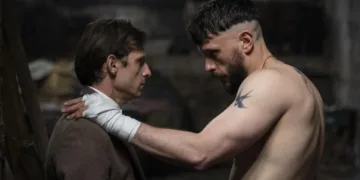












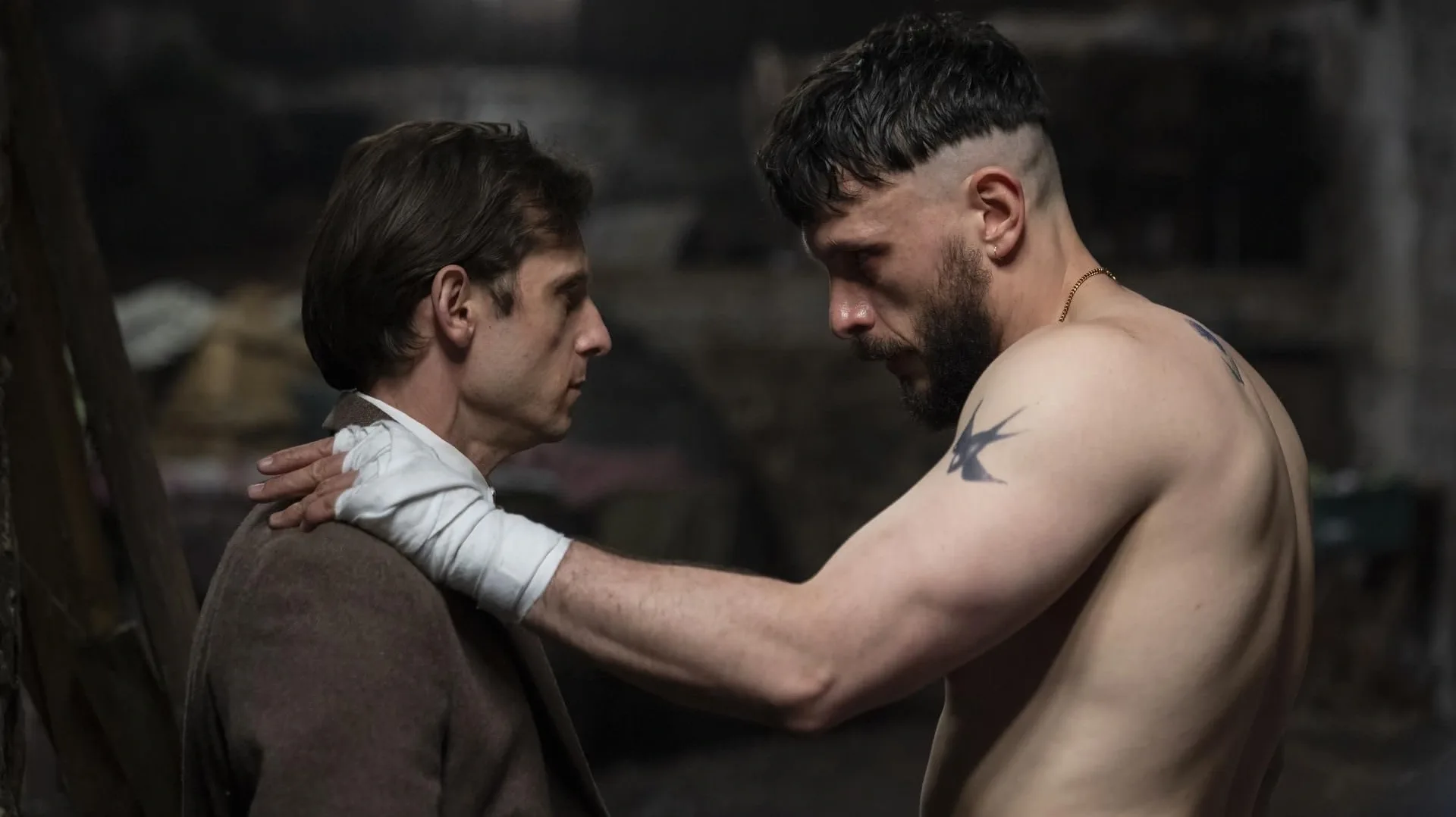

Half Man begins with an image of ceremony colliding with animal force. Niall Kennedy stands in wedding clothes, shaped by a stiff version of Scottish respectability. Across from him is Ruben Pallister, naked, stripped of decorum, his hands taped like a street fighter. The stand-off in the barn fixes the series to a single point in time while the story stretches back across three decades of shared damage. The plot moves to the late 1980s and traces the infection to its source.
Niall is fifteen, inward, quiet, and already trained to retreat from a world that treats softness as exposure. His life shifts when his mother brings a new roommate into the home. Ruben is the seventeen-year-old son of her partner, fresh out of a young offenders institution. He arrives with stories of bitten noses and a presence that turns every room unstable.
The boys are pushed into one bedroom, and the bond that forms between them carries the logic of coercion. Protection and punishment occupy the same space. Their lives lock into a cycle of duty, fear, and anger that follows them into adulthood. The series studies trauma as a force that matures alongside the body. It asks if either man can step outside the shape that youth carved into him.
The Visceral Record of Pathological Aging
The dual casting gives the series a harsh sense of continuity, showing how fear in adolescence settles into adult behavior. Mitchell Robertson plays young Niall with painful precision. He carries himself like a boy trying to disappear inside his own frame, folding inward each time the outside world presses against him. The mockery from his peers lands on a body already preparing for defeat.
Jamie Bell takes over the role as an adult whose career success as a writer covers a hollow interior. Bell works through tiny involuntary movements, each one suggesting a man whose nervous system still expects impact. The shift from Robertson’s open, uncertain face to Bell’s drained alertness feels exact. Thirty years of concealment sit inside that transition.
Ruben demands the same continuity, and Stuart Campbell and Richard Gadd deliver it. Campbell presents the younger Ruben as magnetic and predatory, a boy who has learned to treat violence as the only tender accepted in his world. That quality gives him a warped authority in Niall’s life. He can rescue Niall from one danger and create the next one in the same motion. Gadd enters the adult role carrying a physical menace that feels worn into the skin. His Ruben seems untouched by peace.
He disturbs Niall’s fragile stability through presence alone. Across both performances, Ruben remains feral, governed by impulse, appetite, and injury. That thread makes the shared history feel earned. It keeps the series grounded in a social reality where damaged boys grow into damaged men with alarming consistency. The casting keeps the focus on erosion, on what happens when a person spends years being shaped by fear, silence, and humiliation.
Deforming the Male Psyche through Toxic Norms
The series presents a cold view of masculinity and the cultural rules that sustain it. The repeated phrase “brother from another lover” lands like a bitter joke, a line that tries to package coercion as kinship. Ruben becomes Niall’s protector by beating up his bullies. That arrangement gives Niall a form of safety tied to submission. He survives by accepting Ruben’s cruelty as a condition of being spared someone else’s. Love, terror, gratitude, and dependency collapse into one another.
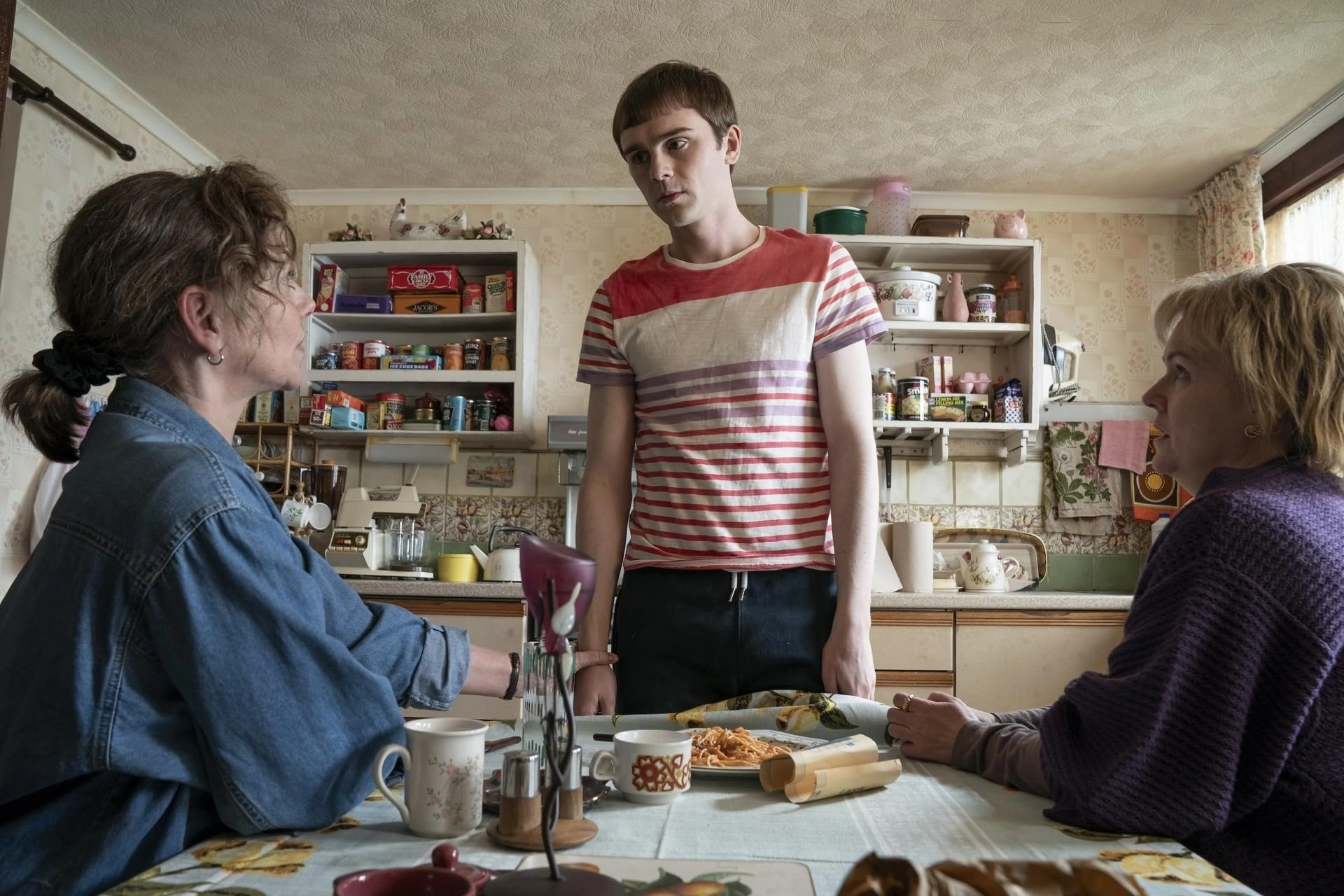
Working-class Scotland gives this dynamic a sharp social frame. Sensitivity carries the status of a defect. Ruben treats Niall’s gentleness as something to break out of him through force. The series connects that pressure to Niall’s concealed sexuality. He grows up in a house where his mother, Lori, keeps her relationship with Maura hidden.
That silence inside the home teaches him the same lesson that the outside world teaches through mockery and threat. Truth must stay buried if survival is the goal. This detail gives the show its strongest cultural charge. Repression is not framed as a private weakness. It is shown as a learned response, handed down through family secrecy, class expectation, and the policing of gender.
Ruben becomes the accidental engineer of Niall’s repression. He tries to guide Niall through early sexual experience with control, possessiveness, and a distorted kind of care. These scenes are brutal to sit with because they expose trauma moving from one body into another. Niall then spends decades trying to perform the bruised masculinity Ruben embodies.
The result is a life built on passivity and manipulation. He grows into a man who cannot speak plainly because plain speech has been coded as danger. The series treats him as both casualty and participant, a victim of Ruben’s whims and a product of the same environment that produced Ruben. That tension gives the writing its moral sting. The show understands how social norms can scar the private self long before adulthood gives those scars a professional wardrobe.
Visual Stagnation and the Rhythm of Abuse
Directors Alexandra Brodski and Eshref Reybrouck shape the series through images of emotional standstill. The palette stays locked in gray and brown, draining scenes of warmth and giving the whole production a stale, airless feeling.
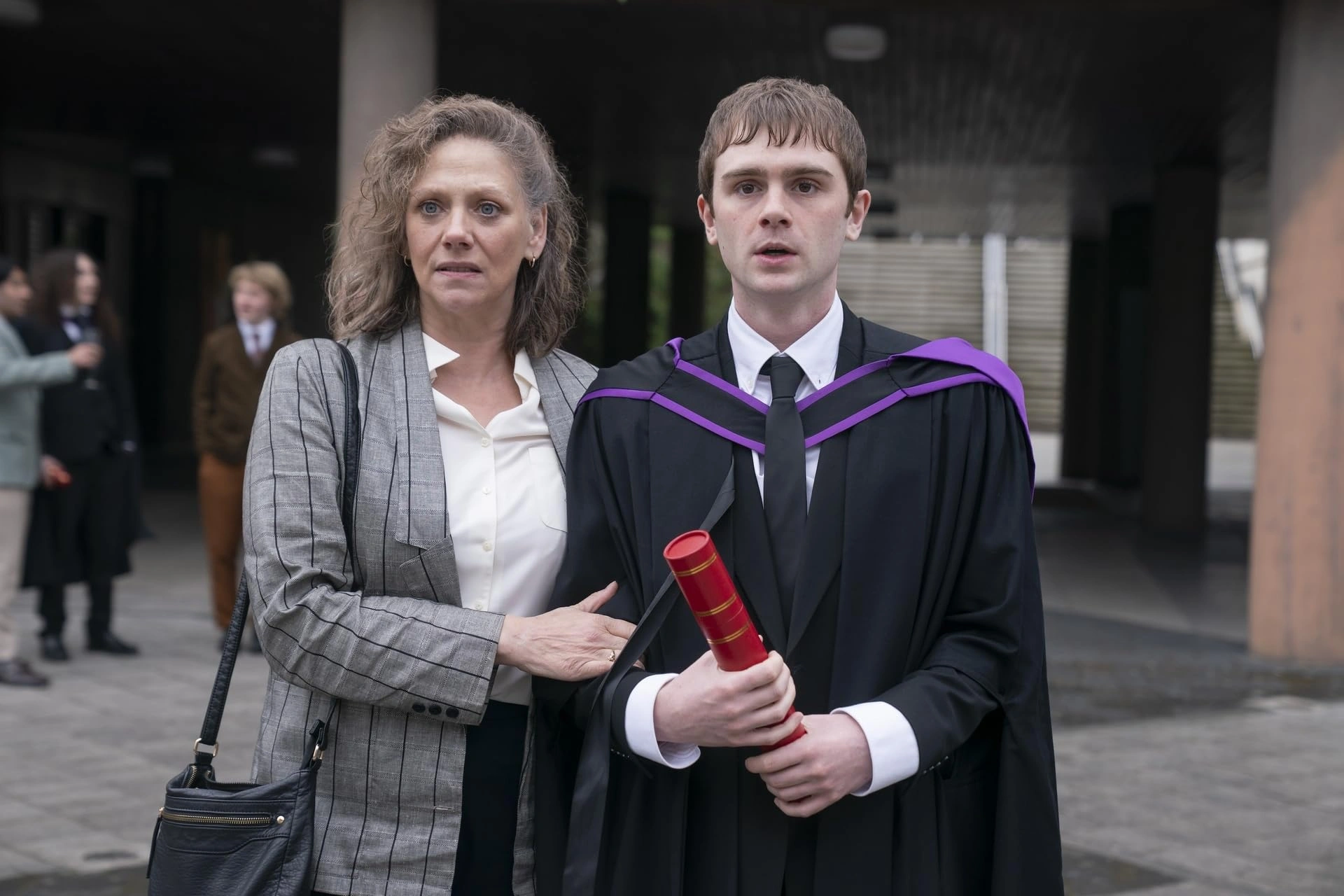
Moments that should carry celebration feel almost sarcastic inside that design. The rural wedding and the filthy streets of Niall’s youth belong to different moments in his life, yet the visual language binds them together. The past keeps leaking into the present. The wedding should signal renewal. Here it feels staged for ruin.
Production design sharpens that idea through objects that chart the loss of self. Niall’s Doctor Who posters mark a private zone of imagination, one of the few signs that he once had a world apart from fear. Ruben erases that space and replaces it with his own harder taste. The change registers as an invasion of identity. Niall does not simply lose a bedroom wall. He loses evidence that an inner life once existed outside Ruben’s influence.
The soundtrack, built from songs of the eighties and nineties, adds a beat to the misery. Those tracks often sit against scenes of violence, giving the suffering a grim pulse. The pacing works through absence as much as event. Ruben hangs over Niall’s university years and adult life like a permanent threat that never needs to announce itself.
The script moves through repeated patterns of reunion and fallout, and that repetition captures the lived tempo of long abuse with unsettling accuracy. Brodski and Reybrouck refuse comic relief and keep the mood physically oppressive. That decision denies the audience any easy release. Each decade lands with weight.
Symbiotic Fracture and the Non-Linear Exorcism
The structure turns time into a trap. By opening with the barn confrontation and placing that collision in the first minutes, the series locks every later scene into a countdown. The episodes move backward and forward, giving the sense that the past never stays in the past for people shaped by trauma. The present lives under occupation. Niall’s attempts to change, to build a career, to move through adult life with some degree of control, all carry the shadow of what has already been shown.
The image of a snake shedding its skin gives the series one of its clearest ideas. Clothes change. Jobs change. Surfaces change. The primal damage stays attached. Half Man finds its title in the split between Niall and Ruben. They read like two fragments of a single wound. Niall carries emotional depth that Ruben has cut away from himself. Ruben carries the aggression Niall has never been able to claim. Each man seems built around what the other lacks, and that design keeps them locked in mutual ruin.
Their bond becomes a study of symbiosis warped into destruction. The final confrontation in the barn plays as an exorcism forced into physical form. Niall has to face the source of his shame if he is going to reach any version of self-acceptance. The ending offers no comfort. It offers honesty, severe and costly.
The series argues that personhood may require a violent severing from the stories youth imposes on us. The final emotional force comes from that recognition and from the exhausting truth underneath it. Survival asks an immense amount from people trying to outlive the hold of those they once loved.
The six part limited series Half Man is scheduled to premiere on HBO and HBO Max in the United States on April 23, 2026. For audiences in the United Kingdom, the drama will be available to stream on BBC iPlayer starting April 24, 2026, followed by a linear broadcast on BBC One on April 28. International viewers in Australia can watch the series on the streaming platform Stan. Filmed on location in Glasgow, the project explores a decades spanning bond between two men, moving from their formative years in the 1980s to a violent confrontation in the present day.
Where to Watch Half Man Online


Full Credits
Title: Half Man
Distributor: HBO, BBC One, BBC iPlayer, Stan
Release date: April 23, 2026
Rating: TV-MA
Running time: 52 minutes
Director: Alexandra Brodski, Eshref Reybrouck
Writers: Richard Gadd
Producers and Executive Producers: Wendy Griffin, Richard Gadd, Gaynor Holmes, Gavin Smith, Tally Garner, Morven Reid, Sophie Gardiner, Anna O’Malley, Lindsay Salt
Cast: Richard Gadd, Jamie Bell, Mitchell Robertson, Stuart Campbell, Marianne McIvor, Neve McIntosh, Charlie De Melo, Bilal Hasna, Julie Cullen, Amy Manson, Philippine Velge, Stuart McQuarrie, Piers Ewart, Scot Greenan, Charlotte Blackwood, Calum Manchip
Director of Photography (Cinematographer): Carlos Catalán, Frederic Van Zandycke
Editors: Rachel Erskine, Berny McGurk, Ben McKinstrie
Composer: Evgueni Galperine, Sacha Galperine
The Review
Half Man
Half Man is a rigorous examination of how proximity to violence stunts the male spirit. It avoids easy redemptive arcs to focus on the static nature of trauma. The performances by Jamie Bell and Richard Gadd provide a harrowing look at the cost of shared secrets. While the pacing occasionally drags under its own weight, the series offers a necessary critique of the ways men fail each other. It demands that the audience sit with the discomfort of unresolved grief and the heavy price of survival.
PROS
- The dual casting creates a seamless timeline of psychological erosion.
- Directorial restraint prevents the subject matter from becoming sensationalist.
- The script offers an unflinching look at the connection between domestic silence and toxic norms.
- Exceptional performances ground the abstract concept of brotherhood in physical reality.
CONS
- The relentless gloom can feel draining over six hours of television.
- Supporting female characters remain underwritten and peripheral to the central duo.
- Structural repetition sometimes makes the narrative beats feel predictable.