



























![Kingdom Hearts Collection [I-III] Review](https://gazettely.com/wp-content/uploads/2026/10/Kingdom-Hearts-Collection-I-III-1-360x180.webp "Kingdom Hearts Collection [I-III] Review: KHII Holds Steady as Newer Entries Fluctuate 40")
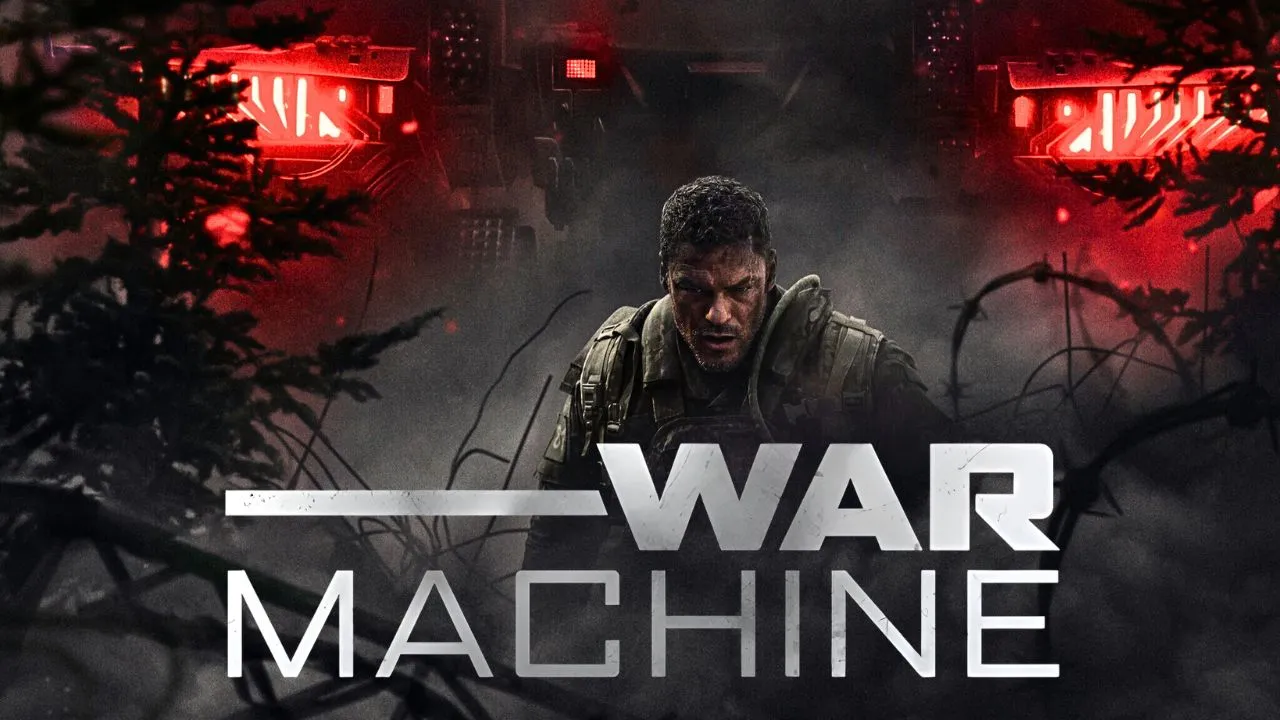

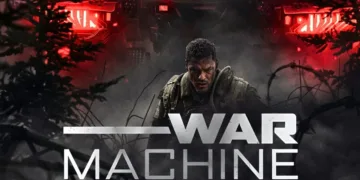
War Machine, Netflix’s sci-fi action hybrid directed by Patrick Hughes and co-written with James Beaufort, arrives knowing exactly what it wants to be. Alan Ritchson, best known as television’s block-shaped embodiment of Jack Reacher, plays an unnamed Army Ranger candidate whose guilt over a brother lost in Afghanistan propels him through the Ranger Assessment and Selection Program. Roughly a third of the way through, a very large alien robot crashes the exercise. Running, gore, and grim determination follow.
The film’s influences — Predator, Aliens, The Terminator — are worn openly, almost defiantly. Hughes has no interest in subversion or irony. War Machine is old-fashioned by design: sun-dappled, earnest, and clear-eyed about its heroes and its threat. The aesthetic leans closer to John Ford’s wartime Americana or Tony Scott’s muscular 1980s action than to the self-aware, socially coded genre films that now crowd the streaming landscape. The question is one of sincerity: does it read as refreshing discipline or creative timidity? The answer, as these things tend to go, is stubbornly both.
Brothers, Numbers, and the Art of the Training Montage
The film opens in Afghanistan under a golden sunrise, cinematographer Aaron Morton framing the desert with an almost nostalgic warmth that immediately signals Hughes’s tonal register. Ritchson’s character and his brother (Jai Courtney) share an easy camaraderie across crossing convoy routes, the kind of shorthand brotherly rapport that action cinema has always deployed to make us care before it takes something away. A Taliban ambush arrives efficiently. The brother does not survive. Ritchson’s character does, barely, and the wound is as psychological as it is physical.
Two years later, he enters RASP with a scarred knee, a painkiller dependency, four prior medical rejections, and the kind of hollow-eyed focus that signals a man who has replaced feeling with function. He becomes 81. All candidates become numbers, which is either a clever comment on military dehumanization or a convenient way to avoid writing personalities for the supporting cast. Probably both.
Dennis Quaid and Esai Morales preside over the training as commanding officers operating at peak clench-jawed seriousness. They are credible and broad in equal measure. The training montage itself — fire hoses, obstacle courses, hands-tied pool plunges — is brawny and mercifully free of irony. Hughes shoots it straight and trusts the physicality to carry the drama.
What is striking about this section is how effectively it functions as a standalone military film. The pacing is disciplined, the stakes are clear, and 81’s deliberate refusal to bond with his squad gives the arc its shape. A man who cannot afford to lose anyone has stopped letting anyone get close. Philosophically thin, perhaps. Cinematically efficient, certainly.
The Machine Arrives, and So Does the Movie
The final RASP test dispatches 81 and the surviving candidates into remote mountain terrain on a simulated mission called Death March — locate a downed aircraft, destroy it, extract the captured pilot. The exercise’s name turns out to be prophetic in ways the Army did not anticipate.
The candidates find the aircraft. They strap C4 to it and detonate. This is a mistake.
What rises from the wreckage is a bipedal alien mecha of considerable size and hostile disposition — part Transformers Cybertron, part Tron Recognizer, entirely uninterested in their training schedule. The reveal is not quite a surprise. Hughes places a news broadcast about a suspicious asteroid in the RASP mess hall earlier in the film, tipping his hand to the audience and to the characters. The better version of this story withholds that information. The mystery of an unknown, technologically advanced killing machine in the wilderness would have been far more disorienting — and disorientation, in this genre, is currency.
The machine operates with a chilling logic: it scans before it strikes, its targeting laser cycling from blue to red in a visual shorthand borrowed liberally from Jurassic Park’s water-ripple grammar. It scrambles communications. It sends compasses spinning. It repositions ahead of its prey with a stealth its bulk has no business possessing. The candidates carry blank rounds. This is, to put it charitably, a disadvantage.
The violence that follows earns the film’s R rating without performing it. Impalements, dismemberments, holes blown through bodies — Hughes shoots the carnage with a steadiness that gives it weight. This is consequence, managed carefully.
Practical Grit and Digital Gravity
War Machine’s most persuasive argument for its own existence is the physical commitment behind its action sequences. Hughes and his stunt team stage Class V rapids traversals, cliff-edge pursuits, and rope crossings with a preference for real bodies in real environments. Morton’s camera captures the Australian exteriors — standing in for the Rocky Mountains with considerable success — as a landscape of genuine natural beauty: dense green forest, roaring rivers, and rocky terrain rendered in digital-crisp widescreen that turns the wilderness into something almost elegiac. There is something wryly appropriate about staging a story of human survival against such serene backdrops.
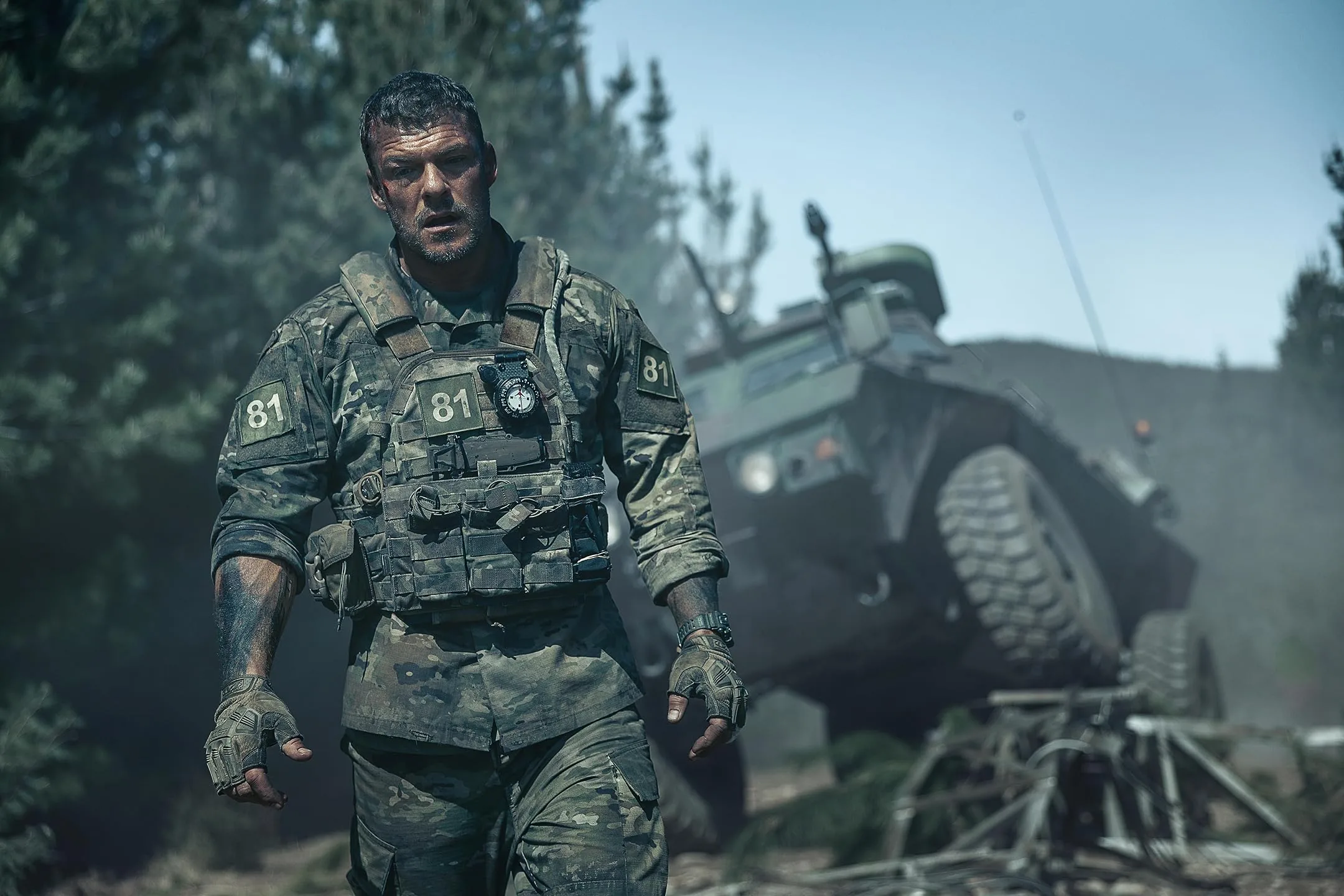
The first major encounter between the squad and the machine is the film’s action apex. Hughes paces it for maximum compression — the editing tightens, the sound design sharpens, and the combination of Ritchson’s exertion and Morton’s close-quarters framing transmits physical effort with unusual directness. You feel the running. That is rarer than it sounds.
From there, a slide begins. The film is substantially stronger at generating tension from soldiers fighting terrain, cold, and injury than from the machine itself in motion. As the runtime extends, VFX seams surface. The CGI compositing that looked invisible in earlier sequences becomes apparent, and late-stage set pieces carry the flat, weightless quality of video game cinematics. Given the tactile credibility Hughes establishes early, this regression is a genuine loss.
His direction is muscular and spatially coherent — geography rarely collapses into chaos, a discipline many action directors abandon entirely. He carries no particular visual signature, but he has functional craft. The final act is where that craft stretches thinnest.
The Boulder and His Supporting Rubble
Ritchson is asked to do something genuinely difficult here: to be a screen presence worth watching while suppressing nearly every tool an actor reaches for. No charm, no humor, no warmth — just a physical mass animated by guilt and obligation. He manages it, mostly. In the RASP sections, his closed-off stillness reads as controlled rather than vacant, and there is something quietly expressive in the way he moves through the training sequences with mechanical precision. He is a man who has converted grief into a program.
Where the performance strains is in the finale, when the script asks for emotional release that the preceding two acts have deliberately suppressed. The arc is not quite calibrated. What should feel earned lands slightly forced. This is as much a structural problem as a performance one — Ritchson has demonstrated genuine range elsewhere, and War Machine does not give him the scaffolding to show it.
The supporting cast performs designated functions without distinction. Jai Courtney’s brother provides the necessary emotional seed in a handful of brief scenes. Stephan James, as the wounded squadmate 7, gives 81 a human weight to carry — and the two men’s dynamic, built on straightforward encouragement rather than wisecracking camaraderie, is the film’s most quietly affecting relationship. Blake Richardson’s 15 — panicky, mouthy, first to break — is a functional character who exists primarily to remind you of Bill Paxton in Aliens. He serves his purpose. Quaid and Morales are credible authority figures used sparingly to the point of negligence.
The Heart on the Sleeve and the Recruitment Poster on the Wall
There is a reading of War Machine in which the alien machine is grief made manifest — an unstoppable, scanning, repositioning force that 81 cannot outrun or outsmart, only face. The script gestures at this architecture without fully building it. The monster-as-trauma reading is available, even satisfying in outline, but Hughes never commits to it with the structural deliberateness that would give it genuine weight. It remains a suggestion rather than a statement.
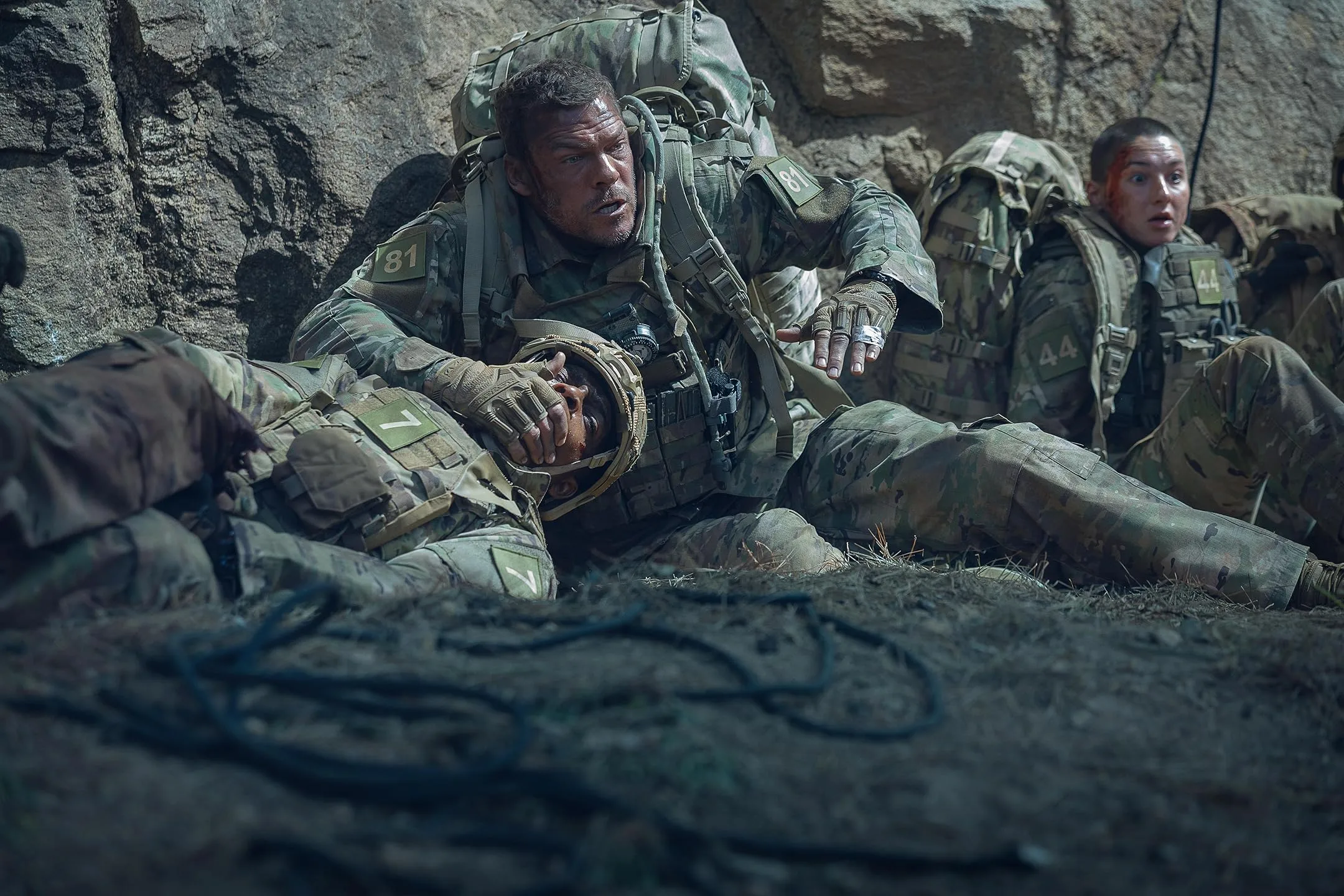
What does distinguish War Machine from its nostalgia-adjacent peers is its sincerity. The bond between 81 and the wounded 7 is played with an earnestness that recalls wartime films of an earlier era — no winking, no deflection, just two men in genuine distress being honest with each other. In the current action landscape, that unguarded quality registers as its own small act of defiance.
The film’s trouble arrives in its final minutes. A low current of military valorization runs throughout — toughness, loyalty, and sacrifice as its moral vocabulary. That current is manageable. The closing scene, with its overt recruitment-poster register, tips into something less comfortable, transforming earned sentiment into something closer to advertising copy.
The franchise tease compounds the problem. A story building toward resolution pivots instead toward continuation. It is a deflating choice, and the film would have been better served by knowing when to stop.
War Machine is a high-octane science fiction action thriller that premiered worldwide on Netflix on March 6, 2026. Directed by Patrick Hughes, known for The Hitman’s Bodyguard, the film follows a group of elite US Army Rangers during the final 24 hours of a grueling selection program. What begins as a routine training exercise in the wilderness quickly descends into a desperate fight for survival when the squad encounters a mysterious and lethal robotic threat. Starring Alan Ritchson as the squad leader “81,” the movie has been a massive streaming hit, topping global charts shortly after its release. It is currently available to stream exclusively on Netflix.
Where to Watch War Machine (2026) Online


Full Credits
Title: War Machine
Distributor: Netflix (Global), Lionsgate, Roadshow Films (Australia)
Release date: March 6, 2026
Rating: R
Running time: 107 minutes
Director: Patrick Hughes
Writers: Patrick Hughes, James Beaufort
Producers and Executive Producers: Patrick Hughes, Todd Lieberman, Alex Young, Rich Cook, Greg McLean, Valerie Bleth Sharp
Cast: Alan Ritchson, Dennis Quaid, Stephan James, Jai Courtney, Esai Morales, Keiynan Lonsdale, Daniel Webber, Blake Richardson, Alex King, Jack Patten
Director of Photography (Cinematographer): Aaron Morton
Editors: Andy Canny
Composer: Dmitri Golovko
The Review
War Machine
War Machine is a film that respects its own limitations and, for long stretches, that restraint works in its favor. Hughes delivers a physically credible, sincerely felt action film that earns genuine tension in its first two acts before losing grip in the third. Ritchson anchors it with stoic presence, the practical stunt work impresses, and the old-fashioned earnestness disarms. The franchise-baiting finale and overt recruitment register leave a sour aftertaste. Solid, unambitious, occasionally gripping.
PROS
- Strong practical stunt work and location photography
- Disciplined, spatially coherent direction
- Genuine earnestness that sets it apart from ironic contemporaries
- Ritchson is a credible, commanding physical presence
- First two acts are lean and propulsive
CONS
- Third act collapses into visible CGI and weakening set pieces
- Supporting characters are thinly drawn
- The alien reveal is telegraphed too early
- Ending doubles as recruitment advertising
- Thematic potential around grief is left underdeveloped
- The machine's weakness strains credibility