























![Kingdom Hearts Collection [I-III] Review](https://gazettely.com/wp-content/uploads/2026/10/Kingdom-Hearts-Collection-I-III-1-360x180.webp "Kingdom Hearts Collection [I-III] Review: KHII Holds Steady as Newer Entries Fluctuate 37")




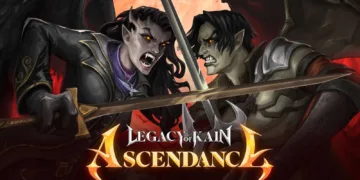
Legacy of Kain: Ascendance marks a sharp mechanical shift for a series long tied to third-person 3D exploration. Developed by Bit Bot Media and published by Crystal Dynamics, this 2D side-scrolling action-platformer sets out to connect Blood Omen and Soul Reaver in story terms. It brings players back to Nosgoth during a decisive period in its history, with the setting presented as dark and visibly decayed.
The plot moves away from relying entirely on the franchise’s familiar leads and introduces Elaleth, Raziel’s sister, as a central figure. Her role shapes the main conflict, since her story is driven by a need for revenge against her brother.
As a prequel, the game works to expand the lead-up to the undead apocalypse and uses Elaleth to open a different angle on the series mythology. It frames itself as canon meant to clarify Raziel’s transformation and Kain’s rise to power. Presenting that material through a side-scrolling format invites a clear comparison to gothic action games such as Super Castlevania IV.
A Triptych of Vengeance and Power
The story is built around a rotating perspective, giving players three viewpoints on Nosgoth’s past. Elaleth stands at the center of the game for much of its runtime, and her character arc begins with the death of her lover, Mathias. She holds Raziel responsible and follows him across time in pursuit of revenge.
Her abilities are built around speed and aerial control. She can air dash, use wing flaps to gain height, and slam downward with force. That mobility gives her sections a strong identity and ties directly into the game’s focus on vertical movement. The script also places her near several major events in the series timeline, including the resurrection of the Sarafan lieutenants.
Raziel appears in two separate forms, and each version changes the tone of play. In his human role as a Sarafan Inquisitor, he fights with a grounded style and uses a “souls-roll” to evade attacks. Later, he shows up as a winged vampire lieutenant with the power of flight. Taken together, those sections trace the arc of his downfall before his execution and give that tragedy a mechanical shape.
Kain enters the game for a shorter segment, though his part still has a clear purpose. He raids the Sarafan crypts and raises his undead army, and his gameplay reflects his place in the hierarchy of Nosgoth. He hits hard in melee combat and can turn into mist or a swarm of bats for movement. The inclusion of his blood-telekinesis feeding animation, recreated in pixel art, serves as a direct callback for long-time fans.
The Mechanics of Predation and Ascent
The main gameplay loop revolves around the “thirst” mechanic, and that system controls the rhythm of exploration for the vampire characters. Health drains constantly, so survival depends on steady aggression. Players need to feed on defeated enemies or gather red blood orbs placed through the environment to stay alive.

That pressure gives the game a steady sense of urgency and recalls the health management seen in earlier Legacy of Kain titles. Combat itself is built on a simple three-button structure covering jumping, attacking, and dashing. From there, the game adds extra texture through a block and parry mechanic. Timed well, parries reward the player with strong damage bonuses, which gives fights a sharper tempo.
Ascendance puts heavy emphasis on upward and aerial movement, fitting for a game built around winged characters. Flight uses a magic resource bar, and that meter refills slowly or through green orbs. In practice, these sequences often work like traversal puzzles. The player has to move through layered hazards while keeping an eye on the remaining magic supply. The result is a steady link between movement skill and resource management.
The three playable perspectives do not feel equally demanding. Elaleth comes across as very strong, and that makes her levels feel fluid and accommodating. Human Raziel faces a far harsher structure. His stages use distant checkpoints and enemy placement that often catches the player from off-screen. That change alters the pace of the game in a noticeable way. Elaleth’s sections encourage momentum, while human Raziel’s stages reward caution and careful repetition.
A Fractured Glimpse Through the Chronoplast
The visual design draws heavily from 16-bit pixel art, echoing the look of the Super Nintendo and Game Boy Advance eras. The gothic environments benefit from strong lighting effects, which help build atmosphere across the ruined landscapes of Nosgoth.

At the same time, the presentation struggles to hold a single visual identity. The cutscenes shift between anime-style portraits, PS1-era 3D models, and still flashback images with a cartoon-like look. Those choices pull in different directions and leave the game feeling visually split. Dialogue scenes add another distraction through character sprites that bob constantly on screen.
The audio side is steadier. The return of the original voice cast gives the game a strong sense of continuity. Michael Bell and Simon Templeman deliver Raziel and Kain with skill and presence. Their voices carry some age, though the performances still bring weight to the dialogue’s theatrical tone.
Richard Doyle and Anna Gunn also return, which helps maintain the link to earlier entries. The soundtrack by Celldweller leans on energetic remixes of familiar themes from the series, giving the action a driving pulse. Sound design also lands well during combat, especially in the parry system, where each successful deflection carries a heavy and satisfying impact.
The Review
Legacy of Kain: Ascendance
Legacy of Kain: Ascendance offers a nostalgic return to Nosgoth that struggles with its own identity. The primary pixel art and returning voice cast provide strong links to the past. However, the inconsistent visual styles and frustrating difficulty spikes hinder the experience. The narrative choice to rewrite established lore through a powerful new lead will likely alienate longtime fans. This flawed prequel succeeds in its atmosphere while falling short in mechanical polish and narrative cohesion.
PROS
- Original voice cast returns
- Atmospheric 16-bit pixel art
- Satisfying parry mechanic
- Classic Kain gameplay segments
CONS
- Inconsistent art direction
- Frustrating difficulty spikes
- Controversial story retcons
- Short and repetitive combat