
























![Kingdom Hearts Collection [I-III] Review](https://gazettely.com/wp-content/uploads/2026/10/Kingdom-Hearts-Collection-I-III-1-360x180.webp "Kingdom Hearts Collection [I-III] Review: KHII Holds Steady as Newer Entries Fluctuate 37")




Gniewoszów appears here less as a town than as a crime scene that has learned to breathe normally. The roads are quiet, the buildings modest, the rural calm almost offensively serene. Yet the film understands that landscapes can lie with perfect manners. Beneath the stillness sits a layered biography of coexistence, rupture, murder, erasure, and political self-protection.
Director Yoav Potash approaches the town with the discipline of an investigator and the patience of a historian. For centuries, Jewish and Catholic residents occupied the same civic space, held together by a fragile arrangement that history later shattered. World War II enters the film as the obvious catastrophe, yet the more disturbing material arrives after the familiar historical frame has settled. The horror is local. The damage does not end with invasion. It seeps into neighbors, property lines, inherited houses, stolen gravestones, and silence hardened into custom.
The film’s central tension comes from that silence. A modern Polish law threatening punishment for public acknowledgment of local complicity gives the documentary the structure of a political thriller, though its antagonist wears no trench coat and fires no gun. It is bureaucracy as shadow. State power becomes an editor of memory, slicing away guilt and calling the cut patriotism. The film, with admirable severity, argues the reverse. National pride without self-scrutiny is stage lighting on a corpse. It may flatter the room. It does not restore life.
The Witness as Moral Instrument
The film’s moral architecture rests on Yaacov Goldstein and Pelagia Radecka, two witnesses positioned on opposite sides of historical injury. Goldstein, the last living Jewish survivor from Gniewoszów, carries himself with the controlled endurance of a man who has spent decades living beside absence. His search for his brother, Ezra, gives the film its most intimate wound. Potash’s camera studies his face during the return to Poland with unusual restraint. The frame does not plead. It waits. That patience allows every small tremor of recognition, confusion, or grief to register as evidence.
Goldstein is a history professor, which gives his presence a painful irony. He knows how history is built, sourced, footnoted, disputed. Yet his own family history comes back to him in fragments, as if recovered from rubble. The film’s philosophical question sharpens here: what is identity when the record of one’s life has been hidden by fear, shame, and the convenience of others? Free will, in this frame, is limited by what the dead were allowed to leave behind.
Radecka’s testimony has a different charge. After seventy years of silence, her account lands like a confession in a noir chamber, lit less by mercy than by exposure. She witnessed the murder of the Weinbergs, Jewish neighbors killed by local Poles rather than Nazi invaders. That distinction shifts the film into darker ethical weather. Evil is no longer safely outsourced to the occupying force. It has a familiar address.
The surrounding residents form a fractured chorus. Janina Jaworska, speaking from a doorway with timid alarm, admits her home once belonged to Jewish owners. Zofia Lecka speaks of local anti-semitism with a weary dismay that suggests knowledge long carried and poorly digested. These moments create a mosaic of moral evasion, fear, guilt, and delayed candor. Nobody here gets the comfort of simple innocence. The film is polite about this. Too polite, perhaps, which makes it worse.
Investigator Aleksander Schwarz gives the documentary one of its clearest methodological statements. Tools matter, he explains, yet the witness remains the strongest instrument. The line could serve as the film’s working thesis. Excavation is physical, psychological, and civic. When Jewish gravestones are found repurposed as building material, metaphor becomes masonry. The town has quite literally built itself from the markers of those it erased. Noir rarely offers a more brutal production design.
Animation, Chiaroscuro, and the Outsider Eye
Potash’s visual strategy depends on a sharp division between recorded reality and interpreted memory. The live-action material holds to surfaces: roads, doorways, interiors, fields, faces caught in the hesitation before speech. The hand-drawn animation enters where archival footage cannot. It does not prettify trauma. Its austerity is the point.
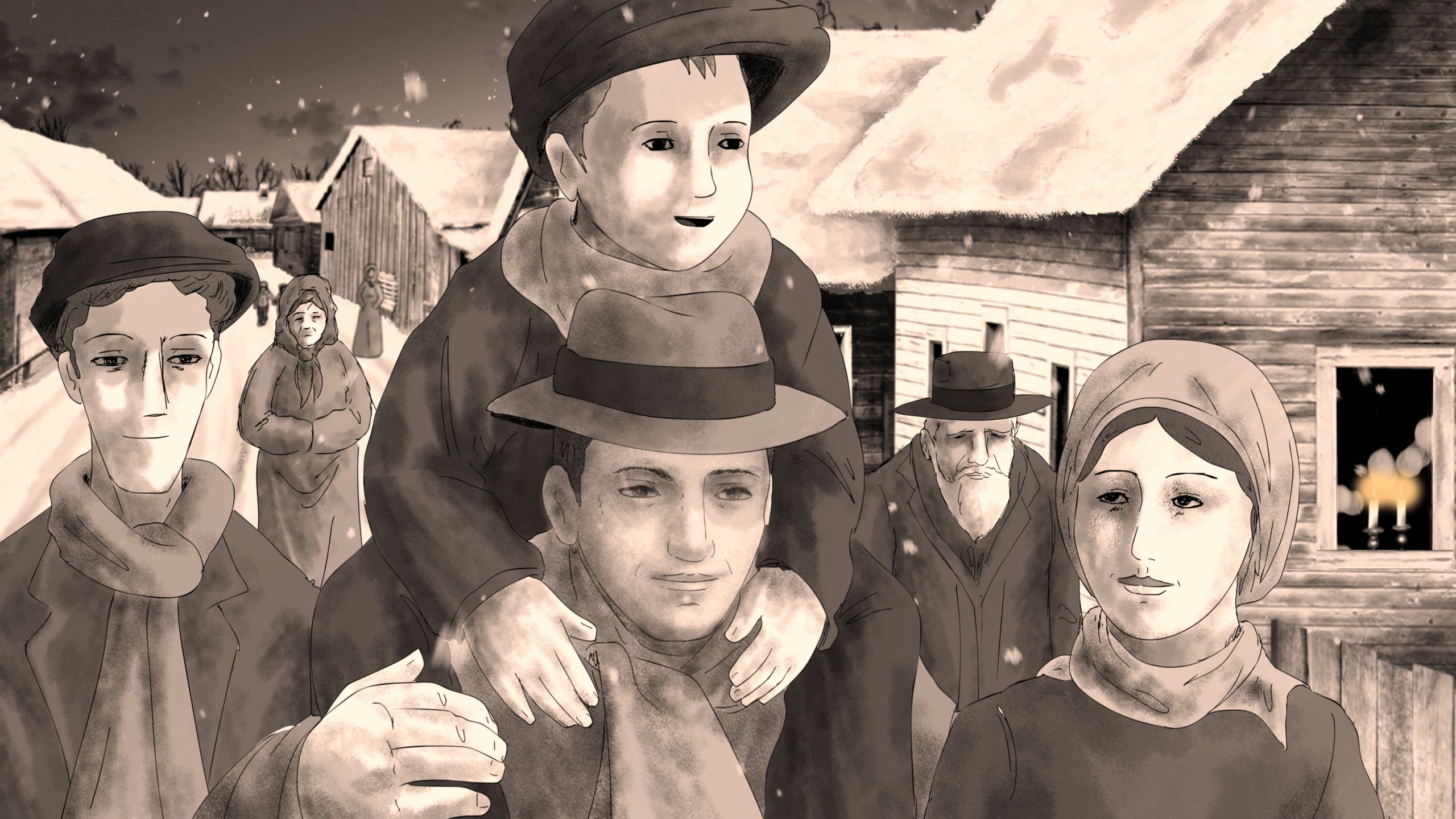
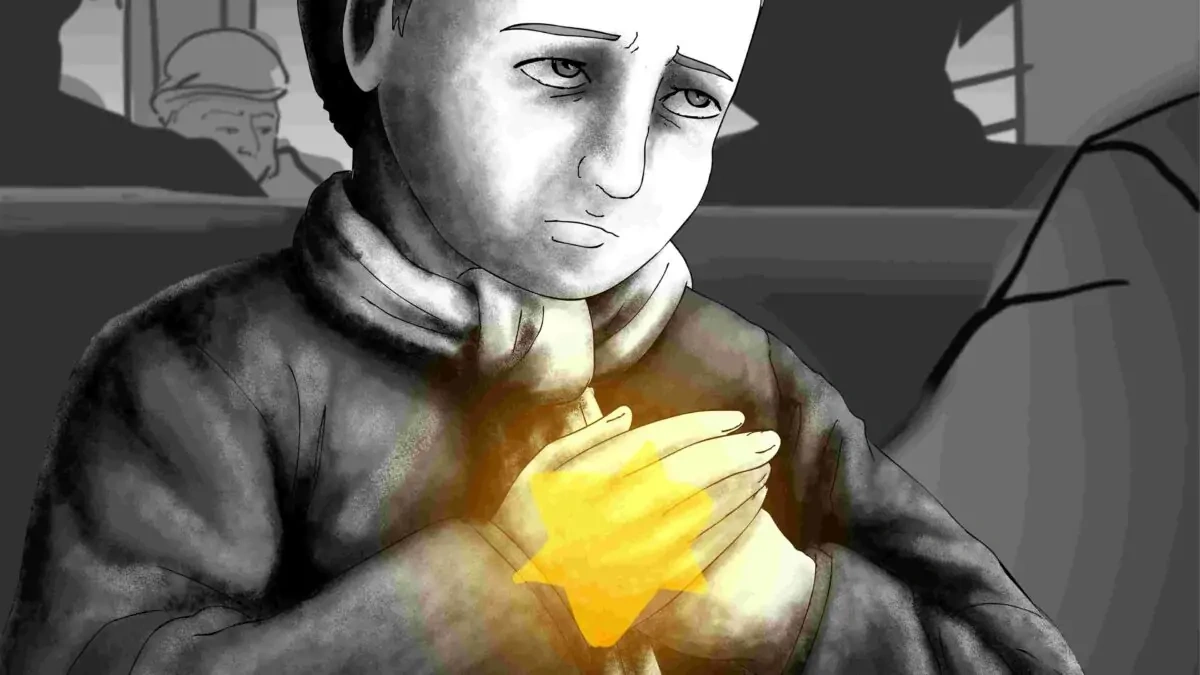
The black-and-white palette immediately recalls classic noir, particularly its faith in chiaroscuro as moral grammar. Light does not simply illuminate in this film. It interrogates. Darkness does not simply conceal. It stores. Targeted red and blue details break the monochrome field like psychic evidence: a child’s blue dress, a red ribbon, glowing red eyes assigned to figures hunting victims. These accents work as moral signals, perhaps blunt ones, though bluntness has its uses when history has spent decades perfecting the art of understatement.
The animation’s expressionistic framing aligns the film with psychological thriller traditions. Bodies become signs. Faces turn spectral. Memory bends into nightmare. Yet the device also carries a philosophical burden. The film uses animation to suggest the “beating heart” of Jewish identity hidden under forced secrecy, a visual idea that turns absence into pulse. The past has not vanished. It has changed form.
Potash’s own presence complicates the film’s texture. He appears as an American detective moving through a foreign landscape, often dependent on interpreters, often watching for the moment when denial cracks. There is a touch of the noir investigator in him, though he is less hardboiled than quietly relentless. One half expects a rain-soaked office and a bad cup of coffee. Instead, he gets rural Poland, archival clippings, and people who have had seven decades to rehearse silence.
The archival material gives the film its factual ballast: black-and-white clips, old headlines, family photographs. These fragments keep the animated sequences from floating into abstraction. The Friedman family adds another outsider perspective, as American descendants searching for roots meet danger, resistance, and the strange hostility that often greets unwanted memory. Their presence widens the emotional field. Modernity arrives with questions. The town answers with walls.
Cinematographically, the film’s strongest instinct is its attention to texture. Establishing shots do not behave like scenic pauses. They feel investigative, as if every field, fence, and facade might conceal a missing sentence. Camera movement is measured, often sober, refusing the cheap electricity of sensationalism. The pacing draws tension from accumulation. A doorway. A pause. A face tightening. A witness correcting herself. History advances by inches, which is to say, by terror.
Silence, Law, and the Hate Tree
The film’s final movement places Gniewoszów within a larger intellectual and political field. Historians Dariusz Stola and Magda Teter provide a scholarly frame that keeps the local story from becoming an isolated moral curiosity. Stola’s professional loss after opposing the revisionist law gives the subject immediate stakes. Teter’s historical timeline, reaching back to 1264, positions the present suppression of history as part of a longer struggle over Jewish life, civic truth, and national self-image.
Journalist Konstanty Gebert provides the film’s sharpest philosophical blade: victims can do evil things. The sentence is small, almost plain, and devastating. It refuses the sentimental mathematics by which suffering automatically purifies the sufferer. Poland’s history of victimhood under occupation remains real. The film does not ask viewers to discard that fact. It asks them to hold another fact beside it: pain can reproduce violence. A wounded community can imitate the logic of its former oppressors. Human beings, ever inventive, can turn trauma into license.
The interview with former Ambassador Piotr Wilczek brings the political tension into a more combative register. His defense of the government, along with his dismissal of international criticism as one-sided media treatment, gives the film a living example of state narrative pushing against historical evidence. The exchange has the brittle rhythm of a courtroom scene without a judge. Everyone knows what is being tried. Nobody agrees on the law.
Sound design and pacing play a quiet role in this moral pressure. The film does not appear to chase shock through volume or velocity. Its tension comes through delay, repetition, and the discomfort of listening. Testimony becomes suspense. Silence becomes a cutaway. The audience is placed in the uneasy position of waiting for people to say what they have avoided saying for most of their lives. This is psychological manipulation of a refined sort. No jump scare required. History has already jumped.
Potash’s “hate tree” metaphor gives the film its broadest ethical claim. Hatred grows from common roots, with branches taking different national shapes. The image risks neatness, yet it carries force because the film has already shown hatred in physical form: stolen homes, repurposed gravestones, erased names, frightened witnesses. Some residents seem relieved after confession, as if truth-telling has loosened a wire around the chest. The film treats that relief with caution. Confession is no resurrection. It is a beginning, and sometimes a very late one.
The shame of Gniewoszów cannot be dissolved by silence. It cannot be legislated into innocence. Potash’s film insists that light remains the only serious instrument against historical poison, even when the light is harsh, unflattering, and bad for the national complexion. Especially then.
Among Neighbors premiered at the Warsaw Jewish Film Festival in November 2024 and began its theatrical run in the United States on October 10, 2025. As of May 2026, the documentary has completed its primary theatrical screenings and continues to be featured at international festivals and special virtual streaming events hosted by organizations such as the Jewish Telegraphic Agency (JTA). The film has recently garnered global attention following its broadcast on TVP, Poland’s public television network, which prompted a national investigation by Polish authorities earlier this year.
Where to Watch Among Neighbors (2024) Online

Full Credits
Title: Among Neighbors
Distributor: 8 Above, TVP (Telewizja Polska)
Release date: November 2024 (World Premiere), October 10, 2025 (United States)
Running time: 101 minutes
Director: Yoav Potash
Writers: Yoav Potash
Producers and Executive Producers: Yoav Potash, Anita Friedman, Aaron Tartakovsky, Aaron I. Butler
Cast: Yaacov Goldstein, Pelagia Radecka, Aaron Friedman Tartakovsky, Anita Friedman, Michael Schudrich, Magda Teter, Dariusz Stola, Piotr Wilczek
Director of Photography (Cinematographer): Błażej Pyrka, Yoav Potash
Editors: Aaron I. Butler, Lauren Schwartzman
Composer: José Garnelo
The Review
Among Neighbors
Potash delivers a forensic study of cultural amnesia. The film functions like a documentary noir. It swaps dark alleys for the sun-drenched silence of rural Poland. The chiaroscuro is psychological. Truth emerges through the jagged lines of animation and the heavy pauses of the elderly. This is a vital interrogation of national identity. It demands that a country look into its own shadow to find its soul. The pacing is deliberate. The impact is visceral. It provides a chilling reminder that buried secrets never stay dead.
PROS
- Innovative use of expressionistic animation to depict trauma.
- Fearless pursuit of difficult historical facts.
- Strong synthesis of personal testimony and academic analysis.
- Haunting cinematography that treats the town as a crime scene.
CONS
- Occasional American-centric "gotcha" directorial interjections.
- Fragmented pacing in specific archival sequences.
- The language barrier sometimes softens the immediate punch of the interviews.







