























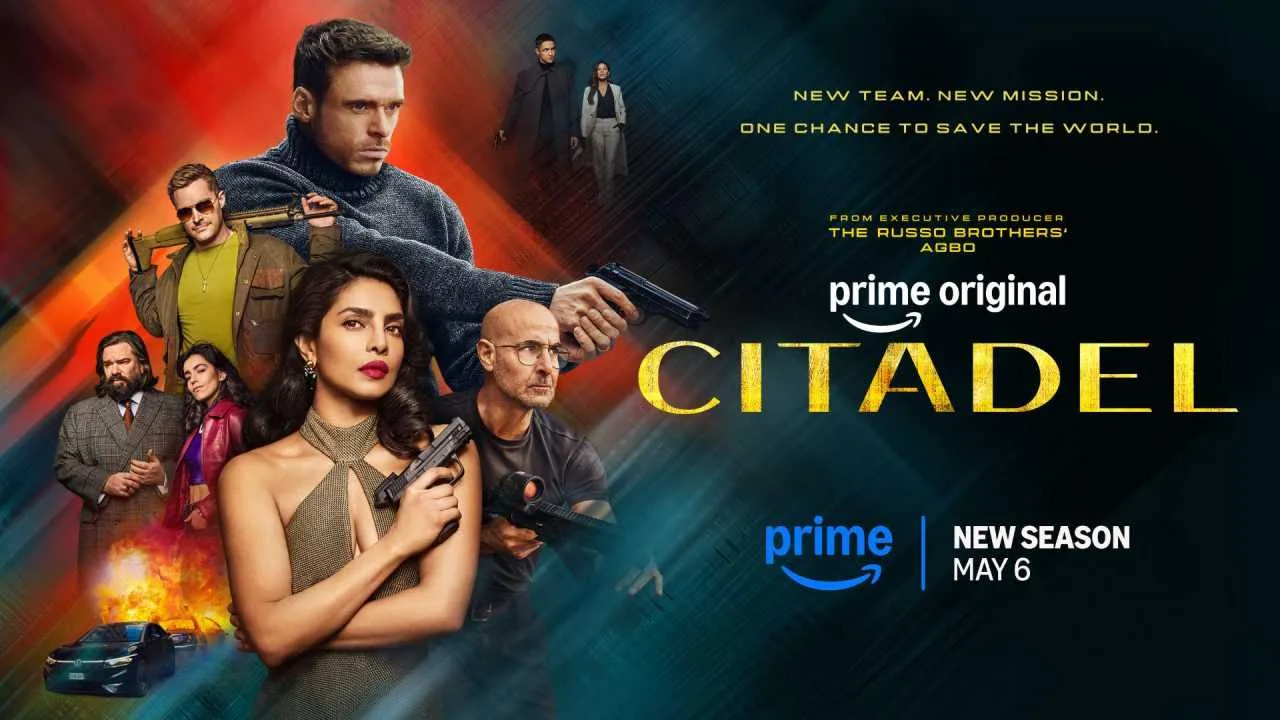

Citadel Season 2 arrives on Prime Video three years after a first season that cost a reported $300 million and delivered a beautiful, expensive muddle. Directed in its entirety by Joe Russo, this seven-episode continuation follows former Citadel spymaster Bernard Orlick (Stanley Tucci), held captive by billionaire villain Paolo Braga (Gabriel Leone), who wants him to engineer a brain chip capable of creating a fully controllable assassin. Freed with the help of rogue CIA operative Hutch (Jack Reynor), Orlick must reunite the fractured partnership of Nadia Sinh (Priyanka Chopra Jonas) and Mason Kane (Richard Madden), each carrying deep personal wounds from the events of Season 1.
The season spreads across England, France, Germany and Sweden, each location framing a different piece of the puzzle. The tone is lighter, the humor more deliberate, and the pacing sharper than before. Season 2 is a cleaner, more self-aware piece of entertainment, one that has made peace with being a high-gloss spy romp. What it gains in fun and confidence it occasionally sacrifices in emotional depth, but as spy television goes, it offers enough to hold attention across its run.
One Director, One Vision
The most significant structural change in Season 2 is Joe Russo directing all seven episodes. The first season suffered from visible tonal inconsistency, creative friction and a lack of narrative identity. With a single directorial voice, the series moves with far greater confidence. Russo brings the same instincts that made his large-scale blockbuster work successful: set pieces anchored by character-driven stakes, propulsive editing rhythms, and a willingness to let humor breathe inside tense situations.
The shift is palpable from the opening sequence. Set aboard a party boat off England, the scene has Hutch bribing his way past security to track Braga, and it signals immediately that the show is leaning into a more playful register. The vibe evokes the slick, winking energy of a heist film rather than the grim procedural weight of a surveillance thriller. Russo leans into this without apology, and the decision pays off.
Where the first season felt like it was trying to be multiple shows simultaneously, Season 2 commits to one. The action sequences are staged with clarity, each fight scene using geography and character physicality to build tension rather than relying on disorienting cuts. The close-combat work feels earned, particularly a sequence involving Orlick that transforms Tucci’s character from a desk-bound strategist into someone who can hold his own in a firefight. It is a transformation the show earns rather than simply announces.
Two Shows Running Side by Side
Stanley Tucci is, without question, the season’s most valuable presence. He plays Orlick with a dry, wry intelligence that makes almost every line land with quiet comic precision. In one scene, he dismisses a villain’s grandiose self-image with the observation that the nobility in the room is so thick you could cut it with a plastic spoon. It is a throwaway barb, but in Tucci’s hands it carries real wit. He has the rare ability to be funny and grounded simultaneously, and Russo uses him wisely, placing him at the centre of scenes that need both levity and credibility.
Jack Reynor’s Hutch is an effective comic foil. His character is deliberately excessive, a man who carries his own cache of grenades apparently as a lifestyle choice, and Reynor plays this with full commitment and genuine timing. Matt Berry, whose voice is itself a comic instrument, adds further texture to the lighter side of the cast. Two CIA agents played by Michael Trucco and Rahul Kohli round out the fun, trading banter with the easy rhythm of a well-matched double act.
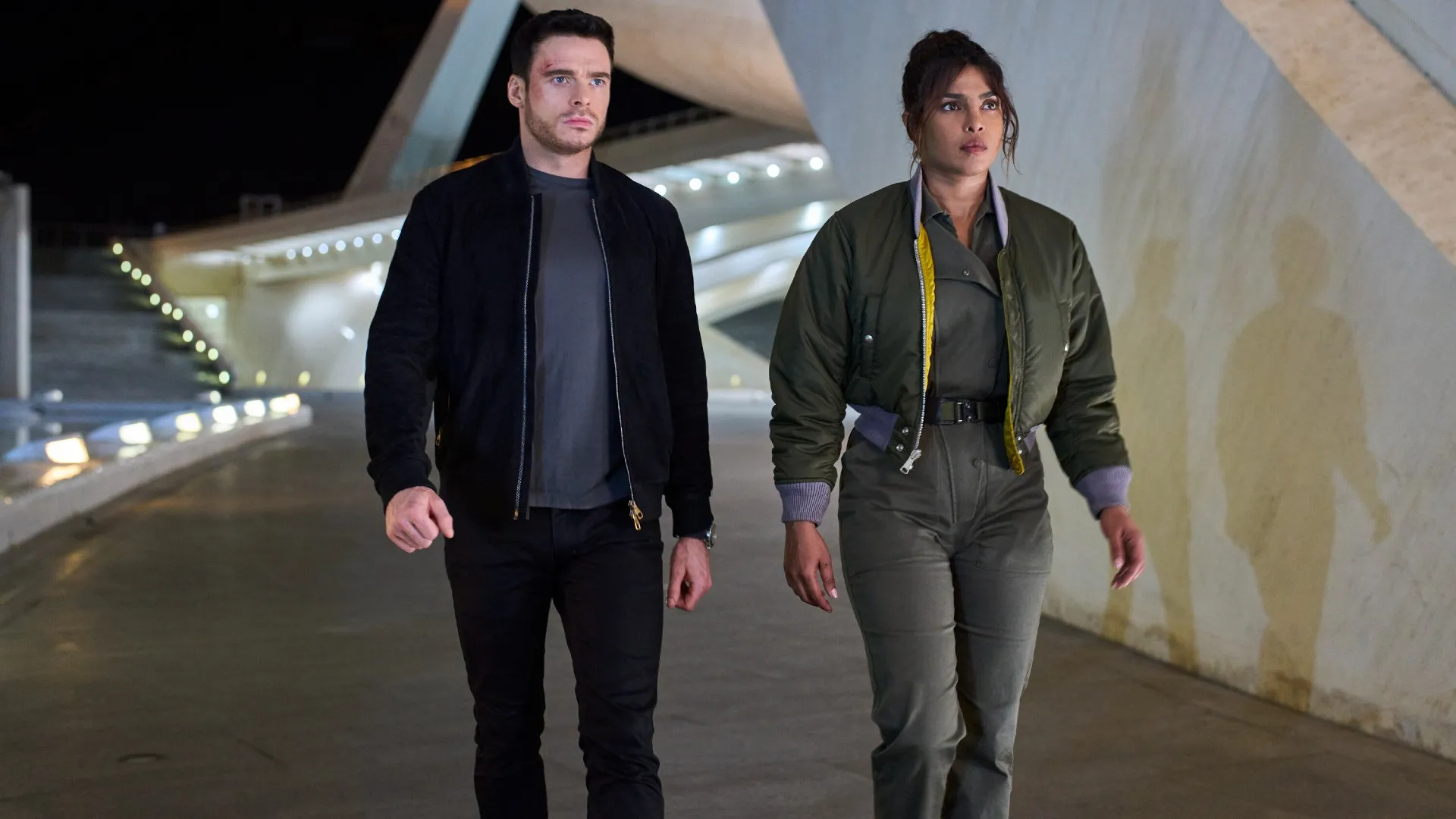
The tonal challenge comes with the two leads. Priyanka Chopra Jonas and Richard Madden are both anchored to emotional baggage from Season 1, and the writing keeps them there. Madden’s Mason is still processing the revelation that he was the mole who caused most of Citadel’s agents to be killed, a betrayal orchestrated at his mother Dahlia Archer’s command. Lesley Manville, icily controlled as ever, brings cold-blooded sharpness to Dahlia, but the mother-son dynamic rarely moves beyond pointed stares and frozen silences.
Chopra Jonas has her finest moment in a quiet exchange with her daughter Asha. Nadia tells her she used to sing Kishore Kumar’s classic “Aa Chalke Tujhe” to bring more love into her life. “But nobody was listening to me,” she says. “I was listening,” Asha replies, and hums the song back to her as Nadia weeps. It is the season’s most genuinely moving scene, offering a glimpse of Chopra Jonas’s emotional range that action roles consistently underuse. The song choice is culturally deliberate. It is a mid-century Hindi film standard about longing and belonging, and it threads Nadia’s backstory with a specifically South Asian emotional register that international franchise television rarely makes room for.
Beyond that scene, the writing keeps Nadia and Mason locked in an intensity that sits awkwardly alongside the show’s lighter ambitions. At times it feels like two different series are sharing screen time: one frothy and fun, the other determined to carry dramatic weight. The gap between those two registers is where the season’s most persistent creative tension lives, and it is a tension the show never fully resolves.
When the Script Loosens and When It Holds
Season 2’s most thoughtful writing decision is its integration of elements from the franchise’s Indian spin-off, Citadel: Honey Bunny. A character who appeared in that series shows up here, older and still sharp, in a brief but sassy exchange with Nadia. The moment acknowledges that the larger franchise has been building something across cultures, and it rewards viewers who followed the Indian chapter.
The Honey Bunny connection also sharpens Nadia’s character in ways the main series has struggled to achieve on its own. The Indian spin-off grounded her origins in a particular kind of Bollywood action cinema, the late-1990s masala film world where glamour and violence coexisted with family melodrama and emotional excess. Season 2 picks up that thread carefully, using the Kishore Kumar scene to connect Nadia emotionally to that heritage. It is a small but precisely placed detail, one that suggests the writers understand cross-franchise character consistency requires genuine emotional logic, built on something deeper than shared plot mechanics.
The villain’s technology, a brain chip designed to create a programmable assassin, is familiar territory for spy fiction. It does not bring freshness to the genre, and the script occasionally leans too heavily on its MacGuffin nature, using the chip as an excuse for chase sequences rather than exploring the more unsettling philosophical implications of mind control. The idea that a person can be turned into a weapon against their own will carries genuine dramatic potential. Season 2 only grazes it.
The betrayals and double-crossings accumulate across the season and begin to feel mechanical by the midpoint. Each revelation is staged with urgency, but the emotional payoff diminishes with repetition. Spy fiction has always relied on the double-cross, but the best examples of the genre make each betrayal feel like a wound. Here, they begin to feel like genre furniture.
Beautiful and Built for Speed
Production design continues to be one of Citadel’s clearest strengths. The series moves across continental European locations with a polish that feels cinematic rather than televisual. The color palette shifts with the geography: the cool greys of Sweden, the sun-warmed stone of southern France, the industrial chill of German interiors. Each setting is used as more than backdrop; it frames the emotional temperature of the characters within it, giving the globe-trotting a visual coherence that the first season lacked.
The fight choreography has improved. Sequences are staged with physical logic, and the camera holds long enough for the geography of each encounter to register. A scene in Nadia’s safe house, where a Manticore operative attacks and nearly demolishes the building around her, is slightly undone by some implausible staging, but the speed and aggression of Chopra Jonas’s performance carries it through. The sequence around Orlick’s escape from Braga’s compound is the season’s most satisfying set piece, balancing dark comedy with genuine menace.
The series is glossy by design, and it knows it. The white designer clothes that somehow survive gunfights, the immaculate villain’s mansion before it meets a grenade, the spy tradecraft that runs on charm as much as competence. These are not flaws being overlooked; they are part of the show’s self-aware register. Citadel Season 2 has accepted its identity as high-end entertainment, and it delivers that with real skill. The gaps between action sequences can feel slow, and the character drama does not always fill them convincingly. As a stylish, self-aware spy series that has finally figured out what it wants to be, Season 2 represents a genuine step forward.
The second season of the global spy thriller Citadel premiered on May 6, 2026, continuing the high-stakes narrative of elite agents Mason Kane and Nadia Sinh. Following the destruction of their independent agency by the shadowy syndicate Manticore, the surviving operatives are forced to recruit a new team of skilled agents to stop a conspiracy threatening global stability. This season expands the “Citadel Spyverse” with new characters and intense action sequences filmed across international locations. Viewers can watch all seven episodes of the second season exclusively on Amazon Prime Video.
Where to Watch Citadel Season 2 Online




Full Credits
Title: Citadel (Season 2)
Distributor: Amazon Prime Video
Release date: May 6, 2026
Rating: TV-14
Running time: Approximately 50 minutes per episode
Director: David Weil, Greg Yaitanes, Joe Russo
Writers: David Weil, Josh Appelbaum, Bryan Oh, Lauren Wilkinson, Melissa Glenn, Angela Russo-Otstot
Producers and Executive Producers: David Weil, Joe Russo, Anthony Russo, Angela Russo-Otstot, Scott Nemes, Greg Yaitanes, Josh Appelbaum, André Nemec, Jeff Pinkner, Scott Rosenberg, Chris Castaldi, Debra James, Newton Thomas Sigel, Bryan Oh, Natalie Laine Williams, David J. Rosen, Patrick Moran
Cast: Richard Madden, Priyanka Chopra Jonas, Stanley Tucci, Lesley Manville, Ashleigh Cummings, Jack Reynor, Matt Berry, Lina El Arabi, Merle Dandridge, Gabriel Leone, Rayna Vallandingham
Director of Photography (Cinematographer): Newton Thomas Sigel
Editors: Peter B. Ellis, Robert Lanford, Kiran Pallegadda, Ruthie Aslan
Composer: Alex Belcher, Henry Jackman
The Review
Citadel Season 2
Season 2 is a sleek, self-aware evolution that trades the first season's muddle for high-gloss confidence. Joe Russo’s consistent direction and Stanley Tucci’s dry wit elevate the series into a fun, propulsive spy romp that finally understands its own identity.
PROS
- Stanley Tucci’s standout performance
- Consistent and confident tonal direction
- High-end cinematic production design
- Improved and physically logical choreography
CONS
- Persistent tonal friction between leads
- Formulaic and familiar technology plot
- Repetitive and mechanical betrayal tropes
- Underutilized emotional range for stars