


























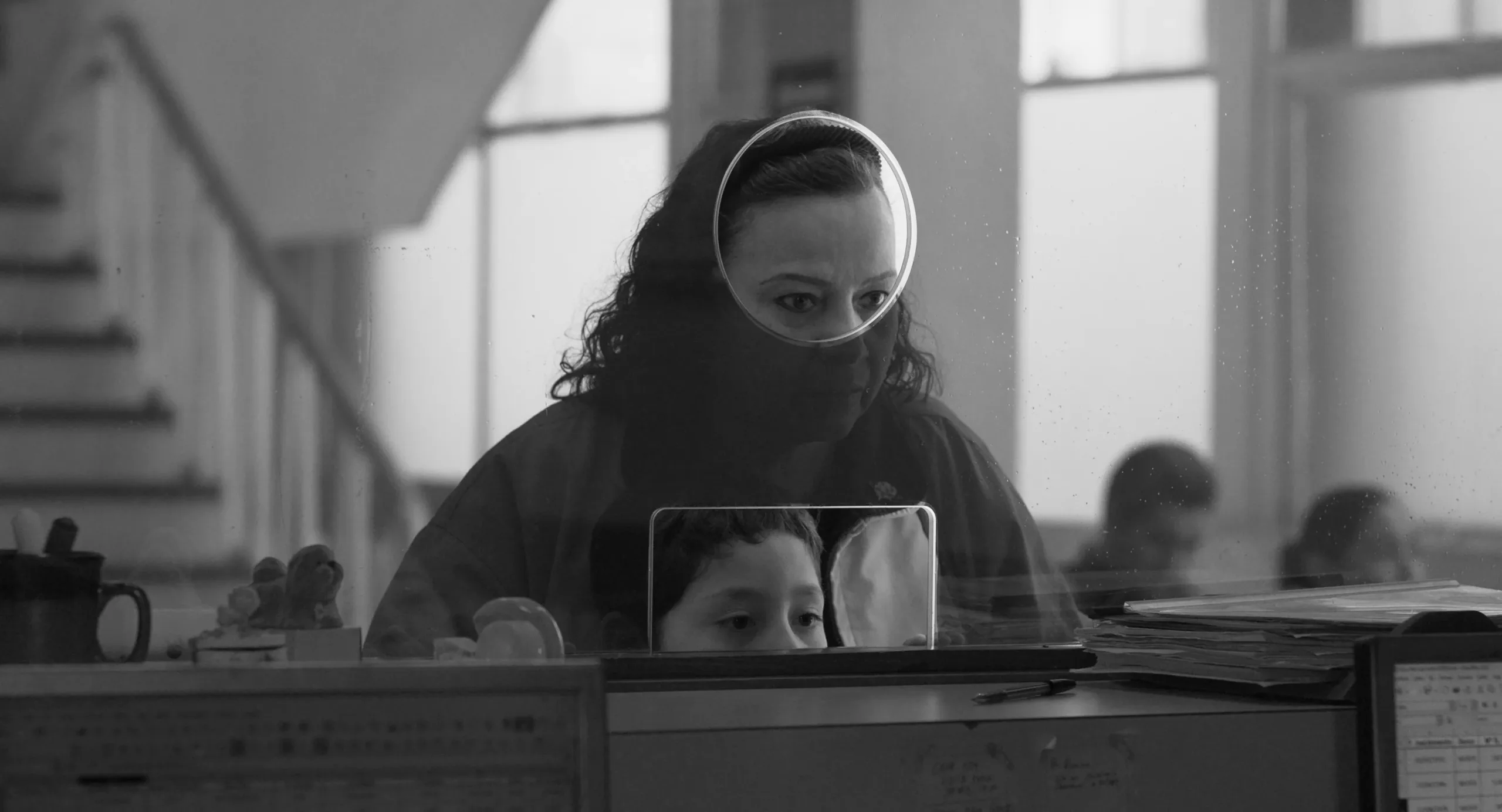

The street facing a major medical complex becomes an existential holding area, a strip of pavement where time dilates, stalls, then seems to forget its own function. In Mexico City, this geography of waiting fixes the outer limit of Olga’s life. Her apartment sits like a Brutalist mooring, a concrete chamber that grants shelter from the clinical despair across the asphalt.
The hospital rises as a mute colossus. It shapes the neighborhood’s economy, converting residential blocks into temporary lodging for people tethered to a loved one’s decline. Olga is retired, defended, and immovably alone. Her days have hardened into routine, her world reduced to the stubborn physical facts of four walls.
Need opens the first fissure. Olga posts a handwritten room-for-rent notice, a modest surrender to financial pressure. Tulio and his nine-year-old son, Cristian, arrive from elsewhere, displaced by the mother’s cancer treatment and the city’s indifferent systems. Tulio carries silence like an old injury. He smuggles Cristian into the apartment, bypassing Olga’s rule about single occupants. Death remains near, unnamed, and fluorescent. The hospital’s glow seeps across the narrative, bleaching the ordinary exchanges that follow with a faintly mortuary light.
The Stalled Engine of the Interior
Teresita Sánchez plays Olga with stone-cut restraint, pitched toward classic noir without theatrical varnish. Her performance depends on small movements, withheld reactions, and a face trained by long defense. She moves through the apartment with the prickly force described as “cactus-like,” treating space as territory under siege. Her daily company consists of buzzing flies and Sudoku puzzles on a boxy old computer. Those gestures form a private security system, the rituals of a woman who has filed the outside world under nuisance.
Cristian’s discovery triggers a glacial response. Olga gives Tulio a two-day eviction notice, as if human attachment were a chemical leak requiring containment. The film rejects the easy mechanics of instant softening. It studies a slower alteration, almost geological. Tulio leaves for long stretches while searching for work, and Olga becomes a reluctant guardian to the boy she never agreed to host. Sánchez marks that evolution through the eyes, through the angle of a look, through the charged pause before a meal is prepared. The change arrives quietly. It has the tact of a hand hovering near a wound.
A locked closet in the guest room contains child-sized clothing, a silent record of past loss. The filmmaker lets those objects carry the burden. Dialogue would flatten them. The closet becomes a chamber of identity, proof that Olga’s isolation has history and moral shape. She is defined by concealment, by the private archive she guards against language. Her connection with Cristian grows into a fragile truce with life, brief and wary, tinged with the absurd difficulty of caring again. People do heal, apparently. The process remains rude about timing.
Silvery Textures and the Percussive Void
The film’s craft is built from minimalist precision. DP María Secco uses crisp, silvery monochrome to turn the apartment’s plain surfaces into charged visual matter. Walls, curtains, furniture, and corridors acquire the severity of evidence. The camera often holds still, and that stillness matters. Static shots and exact composition mirror Olga’s fixed habits, while the frame presses bodies into architectural order. Every image has the studied poise of a still life, though one with a faint pulse beneath the varnish.
This visual restraint gives the sound design room to attack. The frantic buzzing of the titular flies becomes a percussive violation of Olga’s peace. The muffled sex of upstairs neighbors supplies a cruel comic rhythm, life intruding from above with poor manners and decent acoustics. These sounds serve as the film’s score, replacing conventional music with the noise of existence disturbing a domestic tomb. The audience hears Olga’s solitude before it fully understands it. Perception is guided through irritation, repetition, and the small violence of unwanted sound.
The electronic pings of the “Cosmic Defenders Pro” arcade game outside a convenience store provide the other melodic thread. That digital chirping offers Cristian a sonic refuge from the hospital’s clinical heaviness. The film sets curtained softness inside the apartment against the bleached glare of city sidewalks, creating a moral weather system from light alone. Salvador Reyes Zuñiga’s editing gives each comic beat sharp timing. A phone thief’s lightning reflexes briefly puncture the solemn mood, a small noir gag slipped into the machinery of grief.
Camera and sound work together with rare focus. The images hold back. The soundtrack presses forward. Shadows accumulate meaning because the film trusts absence, silence, and offscreen pressure. Its noir inheritance appears in the monochrome palette, the boxed-in rooms, the moral twilight around caretaking and survival. The modern deviation lies in scale. The danger here is intimate, bureaucratic, domestic, and medical. The femme fatale has been replaced by a rental agreement. Cinema adapts.
The Digital Shroud and the Logic of Bereavement
Cristian finds refuge in the blinking lights of a vintage arcade game. His fixation on “Cosmic Defenders” gives the film one of its sharpest narrative devices, because the game translates tragedy into rules a child can grasp. Combat has structure there. Enemies appear, patterns emerge, skill can matter. Across the street, his mother’s body is a battleground governed by a disease with no such fairness. Tulio explains the illness through the game, equating screen monsters with invasive cells. The moment is devastating in its clarity. The toy becomes a grammar for loss.
The film then slides toward a surrealist register as the game and the world begin to blur in Cristian’s mind. The magic realism is handled lightly, as a recognition of how children convert sorrow into playable forms. Isaac, the hospital orderly, connects the clinical sphere with the boy’s imaginative refuge. His decision to risk his position for an act of empathy interrupts the institution’s cold machinery. That gesture matters because the film has spent so much time showing systems that absorb pain without answering it.
The bond between Olga and Cristian rests on shared grief and shared powerlessness. They stand at opposite ends of life, one confronting innocence as it fractures, the other facing an awakening that arrives late and without ceremony.
Free will in this world feels narrow, restricted by money, illness, age, and housing rules, yet small ethical acts still register. A meal. A look. A risk taken in a hospital corridor. The film grants them solace without sugar. It understands that comfort can be temporary and still necessary. The reels stop spinning, and for a moment, someone has stayed nearby.
Flies (Spanish: Moscas) premiered on February 18, 2026, at the 76th Berlin International Film Festival, where it competed in the main competition and received the Prize of the Ecumenical Jury. This Mexican comedy drama follows a solitary woman in Mexico City who forms an unexpected connection with a young boy after his father secretly moves him into her rental apartment. Following its festival debut, Mubi acquired the distribution rights for Mexico and the rest of Latin America, with a theatrical release scheduled for the second half of 2026. Currently, the film is primarily available through prestigious international film festival screenings as it continues its global circuit.
Full Credits
Title: Flies (Spanish: Moscas)
Distributor: Mubi, A Contracorriente Films, Alpha Violet
Release date: February 18, 2026
Running time: 99 minutes
Director: Fernando Eimbcke
Writers: Vanesa Garnica, Fernando Eimbcke
Producers and Executive Producers: Eréndira Núñez Larios, Michel Franco, Fernando Eimbcke, Daniela Leyva Becerra Acosta, Luis Collar, Jorge Moreno
Cast: Teresita Sánchez, Bastian Escobar, Hugo Ramírez, Enrique Arreola
Director of Photography (Cinematographer): María Secco
Editors: Salvador Reyes Zúñiga, Fernando Eimbcke
Composer: Camilo Lara
The Review
Flies
Flies operates as a clinical observation of grief. Eimbcke uses monochromatic stillness to capture the friction between solitary ritual and the invasive nature of empathy. The film avoids pitfalls of sentimentality through its percussive sound design and the granite performance of Teresita Sánchez. It serves as a study of how humans seek order in the face of terminal chaos. The pacing demands patience. The connection feels earned. This is a quiet marvel of technical restraint and psychological depth.
PROS
- Crisp, silvery black and white cinematography by María Secco.
- Impeccable, percussive sound design that functions as a narrative engine.
- A subtle, internal performance by Teresita Sánchez.
- An emotionally honest portrayal of a child's perspective on tragedy.
CONS
- Deliberate pacing requires significant viewer patience.
- The surrealist shift near the end feels slightly jarring.