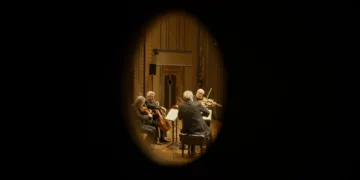




















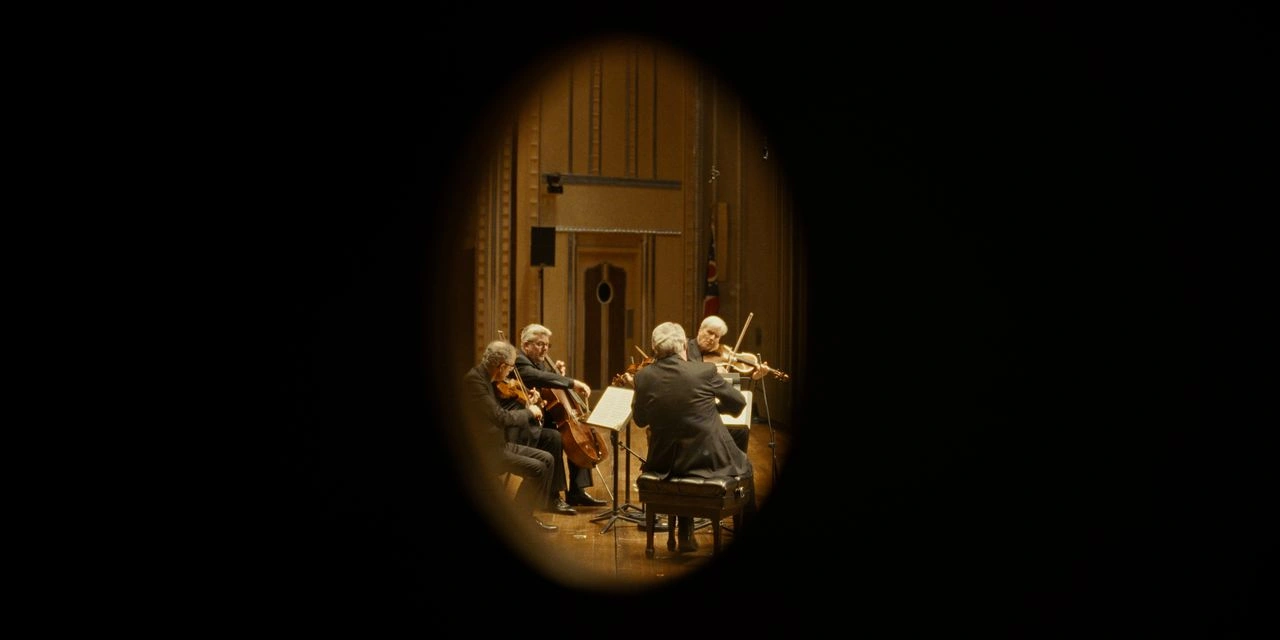

Goethe imagined the string quartet as a conversation among four rational people. The phrase carries a chill of order, a belief that passion can pass through the discipline of reason without losing its pulse. Tristan Cook’s film, named after that idea, watches the Emerson String Quartet standing before its final silence.
The group began in 1976 at Juilliard. For forty-seven years, its members sustained a dialogue that resisted the familiar decay of human partnership. Cook’s documentary follows their 2023 farewell tour with quiet attention. He watches the dusk gather around an institution without forcing thunder into the room. The mood carries a bittersweet gravity. These musicians leave with calm purpose.
They move toward retirement as if entering a dimmer chamber of memory. The film avoids the crashing drama common to musical biographies. It listens for the steady rhythm of a life closing by choice. This is a study of departure, a meditation on the strange labor of saying goodbye to forms that have given shape to nearly half a century of existence.
The Mechanics of a Fifty-Year Conversation
The Emerson String Quartet was built on a foundation laid in 1976. Philip Setzer and Eugene Drucker met by chance near a library, a plain encounter that became the first note in a decades-long commitment to chamber music’s severe demands. Their partnership survived through reserved intelligence. They seem like stoic architects of the group’s identity, men who understand that music can require discipline close to monastic silence.
Lawrence Dutton brings a more talkative energy. His non-classical background gave him a distinct view of the formal world the quartet occupied. A major shift arrived in 2013, when David Finckel retired and Paul Watkins took the cellist’s seat. Watkins brought continuity through memory: he had grown up listening to the quartet’s landmark Béla Bartók recordings. Those recordings earned nine Grammy Awards and remain monuments to a particular kind of American musical excellence.
The film presents musicians with little appetite for ego. They are affable, self-deprecating, and unusually sane about the fragile machinery of collaboration. Their rational temperament explains their endurance while many quartets collapse under competing identities.
The Emersons chose collective resonance above vanity. Their history becomes the slow construction of one shared soul from four separate bodies. Logic and friendship prevail here over the creative mind’s wilder impulses. The partnership feels ancient, carrying the sediment of thousands of hours spent together in small rooms, where time is measured by breath, bow pressure, and the faint terror of being fully heard.
The Artifacts of Professional Grace
The quartet’s middle years aligned with the rise of digital recording, an era marked by frantic, near-mechanical force. Lawrence Dutton remembers the intensity of their Deutsche Grammophon schedule. They once flew on a supersonic jet to attend European award ceremonies, then returned at once for American commitments. That memory of high-speed prestige belongs to a vanished recording industry, one where acclaim could move at the speed of steel through the sky.
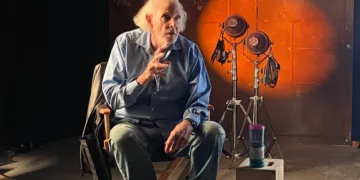
Cook sets that former velocity against the present’s stillness. He turns toward the quiet, domestic reality of the musicians. We see them drinking white wine and mingling at cocktail hours after performances. There is a strange sadness in watching masters of chamber music wrestle with an office coffee machine. These ordinary details replace the expected myths of artistic warfare. The film finds warmth between the men. They avoided the internal wars that consume many long collaborations.
Their retirement grows from a clear-eyed awareness of mortality. They speak of travel’s physical strain and of wanting to pursue other interests while they still can. Their departure is measured, lucid, and deliberate. They will leave public life before their abilities betray them. The gesture has the shape of personal peace. They are leaving the stage before the stage abandons them.
The Silence of the Last Performance
Tristan Cook approaches his subjects through social atmosphere. He gives little attention to the rehearsal room’s technical pressure. The film stays close to the public-facing rituals of the classical world, which leaves an ache where the music might have lived. This is no concert film.
Cook offers performance footage sparingly. He prefers to observe the musicians passing through professional ceremonies, receptions, and quiet exchanges. The limited music creates a ghostly effect. It reminds us that sound is temporary, that even the most disciplined human conversation vanishes into air.
The final five minutes reveal the quartet’s force. They play Schubert’s String Quintet, and the mood deepens into an almost unbearable emotional concentration. The musicians speak of sitting inside the sound, of feeling total unification. Here, Goethe’s rational conversation reaches its final height. The film treats the Emerson legacy as something preserved in recordings, while the documentary itself serves as an intimate introduction to aging men preparing to exit with dignity.
They move toward the wings with somber grace. The ending feels sealed, like a door closing on a half-century of shared breath. The rational people have finished speaking. What remains is an earned silence, cold at the surface and warmed by the long human history behind it.
Four Rational People premiered in select theaters on February 20, 2026. This documentary follows the legendary Emerson String Quartet during their final year of professional performances. It explores their collective history and their choice to retire after forty-seven years of partnership. Juno Films serves as the distributor for the project. You can find the film at independent cinemas such as the Quad Cinema or look for its digital availability on streaming platforms later this year.
Full Credits
Title: Four Rational People
Distributor: Juno Films
Release date: February 20, 2026
Running time: 104 minutes
Director: Tristan Cook
Writers: Tristan Cook
Producers and Executive Producers: Birgit Gernböck, Carolyn Moriarty, Donald Moriarty
Cast: Eugene Drucker, Philip Setzer, Lawrence Dutton, Paul Watkins, David Finckel
Director of Photography (Cinematographer): Zac James Nicholso
Editors: Tamara Mattos
Composer: Emerson String Quartet
The Review
Four Rational People
This documentary is a quiet study of the architecture of time. It frames the Emerson String Quartet as a monument to intellectual partnership, yet it remains haunted by the inevitable silence of retirement. While the film prioritizes social intimacy over the raw mechanics of rehearsal, it succeeds in capturing the dignity of an ending. The focus on camaraderie provides a warm counterpoint to the cold logic of aging. It is a poetic, if slightly detached, farewell to a shared life.
PROS
- Captures a rare, fifty-year history of artistic stability and mutual respect.
- Avoids the tired tropes of professional infighting in favor of genuine warmth.
- Provides an intimate, domestic look at musicians as aging human beings.
- The final performance of Schubert’s String Quintet offers a profound emotional payoff.
CONS
- Lacks deep technical insight into the actual process of music-making.
- The scarcity of full performance footage may frustrate fans of the music.
- Occasional over-reliance on social gatherings and cocktail hours.
- The tone can feel overly sedate, missing the friction that often drives great art.