













The story begins in modern Tel Aviv, where an elderly Ilya receives a message that breaks the hush of his later years. The discovery pulls him back toward a history he has kept from his grandsons, and the film lets that movement begin in a small domestic beat: Ilya in his living room, a news report about the current conflict in Ukraine flickering across the television. That screen becomes a quiet mechanic of memory, linking historical suffering to a present struggle and making the past feel active in the room.
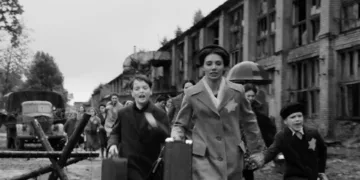
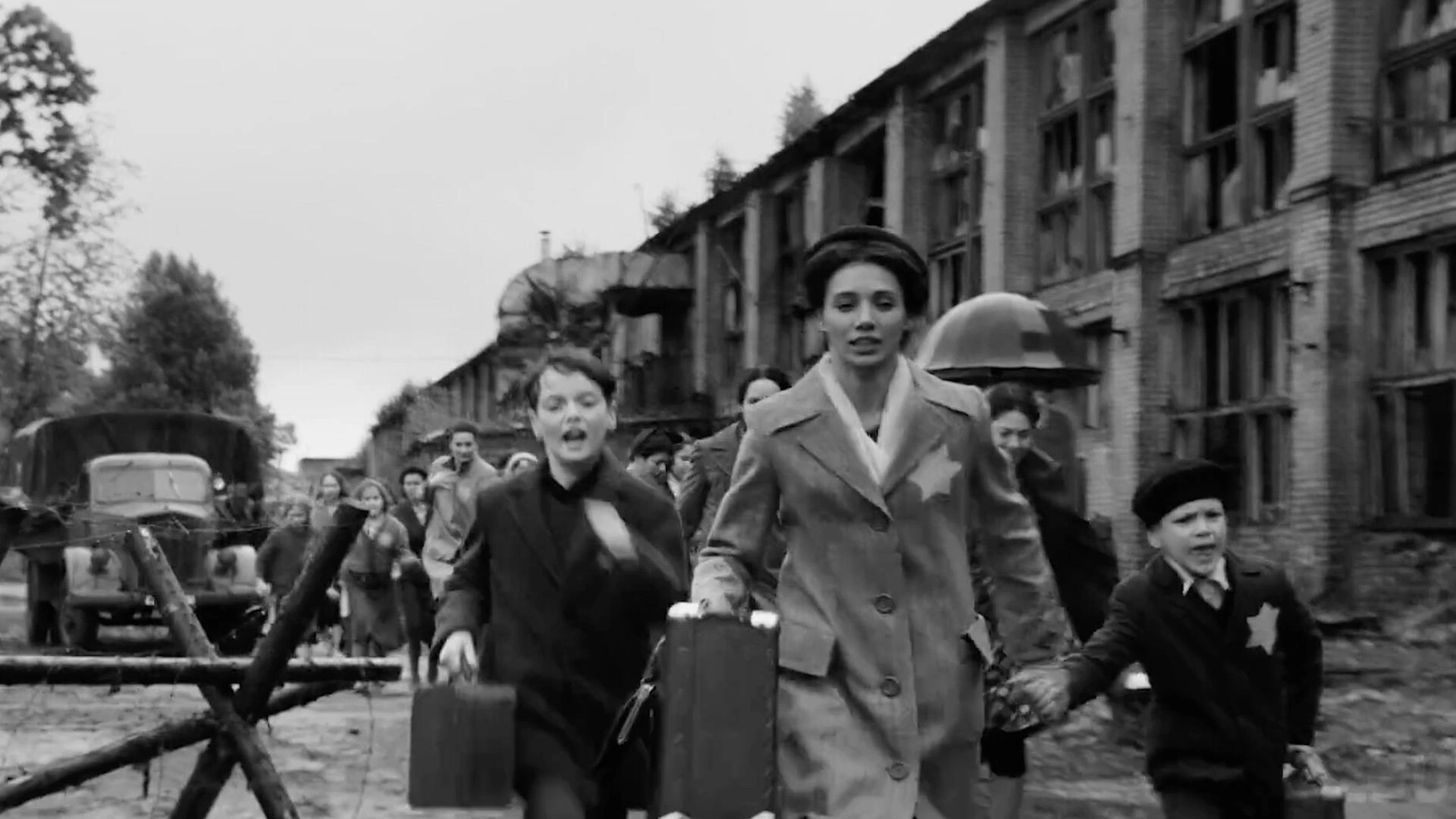
From there, Ilya’s mind returns to his childhood in Minsk during the Nazi invasion. He and his younger brother Sasha are torn from their parents, a separation that shapes the rest of their lives. The film gives that rupture two tactile anchors: a family photograph ripped in half at the moment of parting and a hand-carved wooden stork held as a promise of reunion.
These objects work like inventory items in a story-driven game, small enough to hold in a hand yet heavy with identity, loss, and hope. The script handles this setup with plain force. The elderly Ilya’s apartment, filled with artifacts from a long life, frames the experience as preservation through memory. The news report gives his current peace a direct line back to violence.
The Psychological Toll of Hidden Identity
Ilya survives by taking shelter with Ganna and Vasily, a local couple who protect him at grave risk. He becomes Stasik, and that borrowed name turns daily life into a performance with lethal stakes. Every word, glance, and gesture must be controlled. The film understands survival here as a psychological system, closer to resource management than heroism. The resource being spent is the child’s sense of self.
Vasily’s most painful sacrifice gives that idea its sharpest form. To secure the lie, he destroys the tombstone of his own deceased son and throws it into the river to prevent questions about the boy’s origin. A father buries his grief a second time to protect a living child. Young actor Andrey Davidyuk plays this pressure with remarkable stillness. His Stasik carries the terror of a child asked to hide his heritage so completely that safety begins to feel like erasure.
The villagers deepen that tension. Many know the truth and choose silence, aware that their quiet defiance could bring execution. Each exchange in the village carries the pressure of shared danger. The survival logic recalls This War of Mine, with attention fixed on civilians making small, desperate decisions under occupation.
Stasik exists in a suspended state, repeating a new history while the old one demands recognition. The narrative progression works because the stakes remain intimate. Identity becomes the fragile mechanic holding the boy together.
The Technical Language of Survival
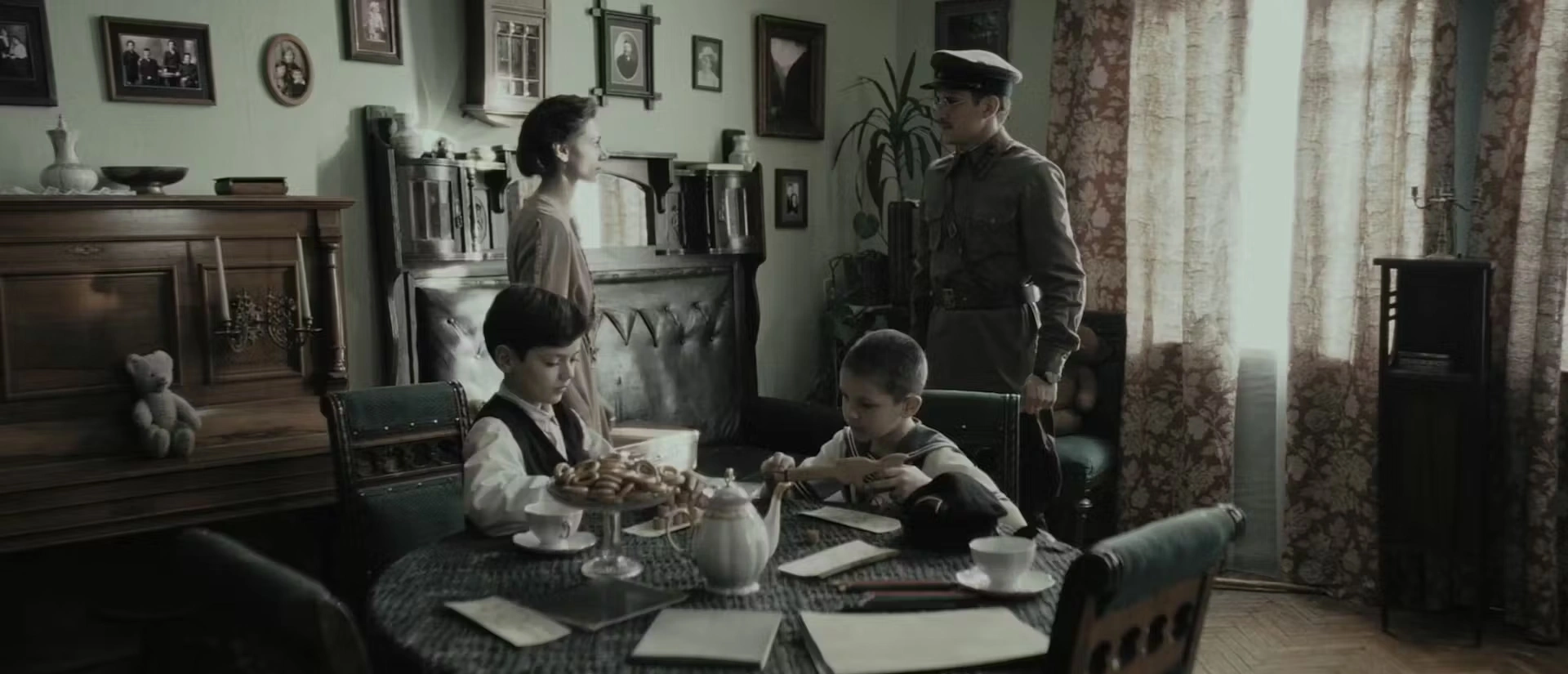
The film’s visual design treats color as story language. The flashbacks use a desaturated, washed-out palette that makes Ilya’s childhood world feel drained of life. Present-day scenes look brighter and fuller, giving memory and old age distinct emotional registers. A specific shade of red appears in the most harrowing passages, signaling the moment safety breaks.
Director Alexander Franskevich-Leie builds tension through restraint, then cuts through it with sudden brutality. He often lets the viewer imagine the horror, which makes the moments of public execution hit with a sharper force. The production design has a surprising polish for this material.
Clothing and settings appear cleaner than the grime of war imagery might lead viewers to expect, creating an aesthetic shaped by memory and distance. This choice gives the film a recollected quality, as if Ilya’s mind has preserved certain surfaces with unusual clarity.
Lukasz Pieprzyk’s score breaks into the silence with heavy, sudden arrangements. Those musical surges mirror the instability of life under occupation and give Ilya’s memories jagged edges. The pacing has the slow dread of a stealth sequence in Through the Darkest of Times, where the feeling of being hunted matters as much as any single event. The camera lingers on doors, rooms, forests, and other small environmental details, grounding large historical terror in physical space. A heavy door or a silent tree line becomes part of the storytelling system.
The Endurance of the Human Spirit
The film represents the enemy through a pointed visual pattern. A single German officer appears across different locations, making the occupation feel like one repeated face, singular, ordinary, and interchangeable. The choice gives Ilya’s terror a recognizable shape and suggests the banality of the evil moving through his life.
The narrative keeps returning to endurance. Its tragedy is framed through survival, and its ending allows room for healing. That tonal path makes the history accessible to a wider audience, with gentler emotional pressure than the devastating severity of Schindler’s List.
The final reunion between the elderly brothers delivers the closure promised by the opening structure. They bring together the two halves of the photograph, and the wooden stork reaches the destination it has carried across decades of silence.
That moment resolves the film’s central tension with a clear emotional design. The scars of war remain permanent, and the human spirit still holds its shape. The film honors survivors by giving their trauma a peaceful resolution, placing memory above the destruction that tried to erase it. Survival becomes resistance through remembrance.
The brothers’ legacy rests in their ability to recall who they were before the world tried to rename them. By staying close to one family’s experience, the film gives history a ground-level texture and leaves space to feel what was lost, what was carried, and what remained.
This production arrived on digital storefronts in the United Kingdom on January 5, 2026, following a successful circulation through international festivals during 2025. It is currently accessible on streaming platforms such as Prime Video and Apple TV. The narrative provides a focused look at the survival of two siblings during a period of intense global conflict.
Full Credits
Title: Stork of Hope
Distributor: Miracle Media, House of Film
Release date: January 5, 2026
Rating: TV-14
Running time: 108 minutes
Director: Alexander Franskevich-Leie
Writers: Alexander Franskevich-Leie, Marina Cheblakova, Denis Nupreichik
Producers and Executive Producers: Alexander Franskevich-Leie, Elance Diamant
Cast: Andrey Davidyuk, Tatyana Garkusha, Jean-Marc Birkholz, Aleksandr Abramovich, Sergey Belyakovich, Lev Bokhan, Yair Helman, Josef Ash
Director of Photography (Cinematographer): Konstantin Pozheletsky
Editors: Alexander Franskevich-Leie
Composer: Lukasz Pieprzyk
The Review
Stork of Hope
Stork of Hope is a sincere exploration of survival. It favors accessibility over historical grit. The performances anchor the narrative while the visual symbolism of the stork and photograph provide a grounded emotional focus. It feels too polished for its setting at times. Still, the film succeeds as a respectful tribute to those who lived through these events.
PROS
- Natural performances from the young cast members.
- Effective use of physical symbols to drive the narrative.
- Score provides a sharp sense of tension.
CONS
- Production design lacks the grit of the period.
- Villains feel like symbols instead of characters.
- Script occasionally relies on heavy sentimentality.