
























![Kingdom Hearts Collection [I-III] Review](https://gazettely.com/wp-content/uploads/2026/10/Kingdom-Hearts-Collection-I-III-1-360x180.webp "Kingdom Hearts Collection [I-III] Review: KHII Holds Steady as Newer Entries Fluctuate 37")



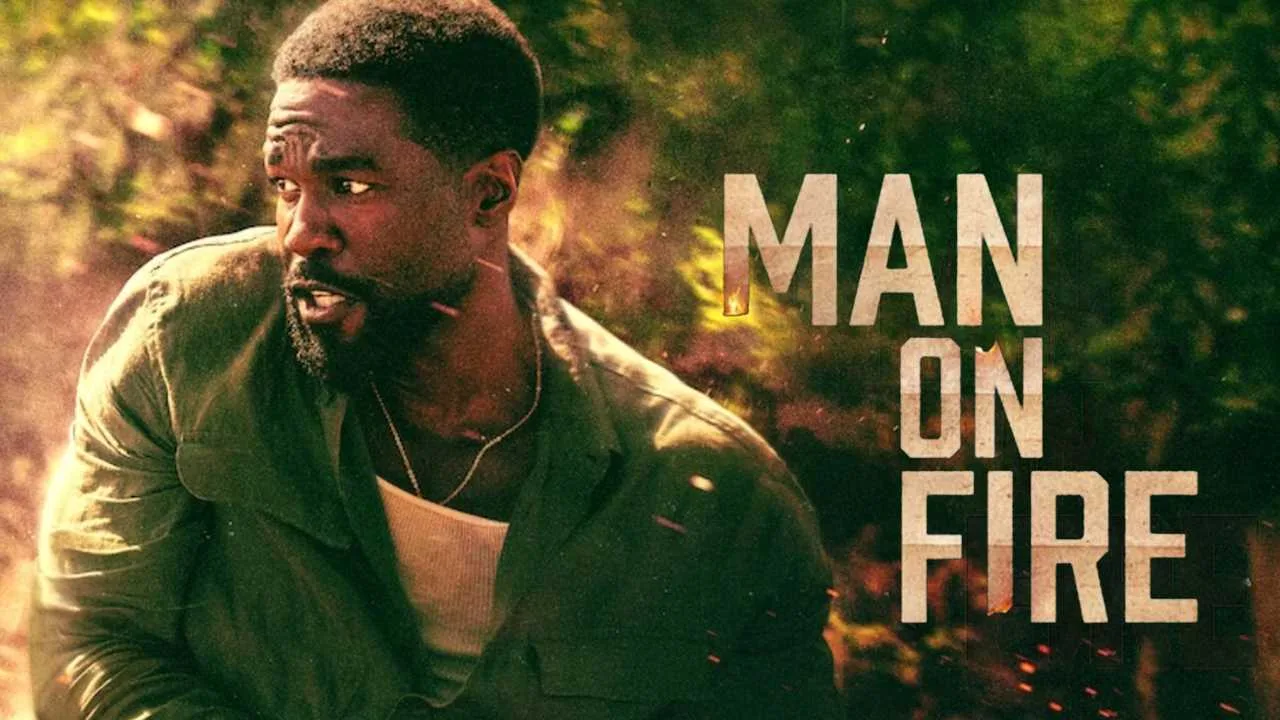

Netflix’s Man on Fire arrives carrying the particular burden of a story told before, twice on film and long before that on the page. A.J. Quinnell’s damaged mercenary, John Creasy, has survived enough reinventions to suggest the character endures because he resists easy definition. This seven-episode series, created by Kyle Killen, understands that instinct, at least partially.
Yahya Abdul-Mateen II steps into the role as a former Special Forces operative brought to Rio de Janeiro on the eve of a politically volatile election. He is tasked with maintaining order in a city where order has long been a polite fiction. Then a terrorist attack strips away everything around him, and Creasy finds himself protecting Poe (Billie Boullet), the teenage daughter of his mentor, through a conspiracy reaching from Rio’s favelas to the corridors of American intelligence. Key supporting players include the sharp, grounded driver Valeria Melo (Alice Braga) and Livro, a young Brazilian boy who enters the story through the favela community.
The show surrounding him is uneven. The plotting telegraphs itself, the setting is used more as backdrop than as breathing world, and the seven-episode structure occasionally strains against both the material and the pacing. Yet Abdul-Mateen’s performance, and the genuine sincerity of the show’s emotional argument, make this something worth sitting with.
The Man Who Carries the Fire
There is a kind of performer who understands that stillness can be the loudest thing in a room. Yahya Abdul-Mateen II is that kind of performer, and his John Creasy is built from a controlled, contained physicality that makes every movement feel like a decision. He stands differently. He listens differently. The body speaks a language that the scripts sometimes fail to honor, yet the performance finds its own eloquence regardless.
From the first scene, Abdul-Mateen establishes Creasy as a man whose training has been burned into his nervous system. Weapon handling feels like second nature. A tactical awareness expresses itself through the angle of his shoulders and the careful placement of his feet. This is not an actor approximating military competence. It reads as something lived, the bearing of someone shaped by years inside institutions designed to produce a very particular kind of human being.
What the performance refuses to do is simplify. Creasy is brusque and yet protective. He is calculating and yet capable of reckless, self-destructive choices made in the name of grief. He commits acts that should place him beyond sympathy, torture delivered with cold precision, bodies disposed of with practiced efficiency, and yet Abdul-Mateen holds onto something in Creasy that keeps the audience from releasing their investment in him. It is not warmth exactly. It is more like the memory of warmth, visible in the way he softens almost imperceptibly around Poe.
Creasy is a man in conflict with his own nature. He carries enough self-awareness to know what he is and enough damage to be unable to stop being it. The show reads this as a tragic condition rather than a character flaw, and Abdul-Mateen plays the distinction with precision. Even his most violent acts carry within them a kind of grief. The mourning is inward, directed at a version of himself that no longer exists.
His PTSD is rendered with the specificity that separates careful writing from lazy shorthand. The inability to sleep without a bag over his head, a detail connected directly to a formative trauma, is the sort of thing that locks a psychological portrait into something real rather than decorative. The freeze responses, the self-medication, the social withdrawal: each symptom is shown, not announced. The performance takes these details and makes them architecture rather than ornament.
There is a scene late in the season whose specifics are best left undisclosed. It asks Abdul-Mateen to do something nakedly emotional without the protection of action or tactical purpose. He meets it fully. It may represent the finest single sequence of his career to date.
The show’s writing, however, does not always deserve the performance. Creasy’s expertise is periodically asserted rather than earned. He apparently accomplishes extraordinary things off-screen, achievements the audience is simply told about. This undercuts the show’s own credibility in Creasy as a tactician, and Abdul-Mateen, for all his skill, cannot manufacture what the material withholds.
Violence With a Logic of Its Own
The action sequences in Man on Fire operate under a philosophy worth naming: realism as a moral stance. In a genre that has long made violence gorgeous, the show treats it as metabolically expensive. Bodies carry the cost of what happens to them. Time passes awkwardly inside a fight. The choreography, shaped by supervising stunt supervisor Henry Kingi Jr. and fight coordinators David Will No and Malay Kim, refuses the balletic inflation that makes genre violence comfortable to watch. The result is something scrappier and more honest, fights that feel like events with consequences rather than set pieces designed for applause.
Abdul-Mateen trained with elite tactical gun instructors for the role, and the preparation registers in every gesture. He holds a weapon the way someone holds a tool they have used for years, with a familiarity that has passed beyond consciousness into reflex.
What distinguishes the action design most is a decision that sounds simple but proves surprisingly rare: each character fights at the level their background would actually produce. Poe has the limited, panicked movements of someone with no training. Favela gang members have experience with violence but lack the structure of organized military force. Military operatives carry themselves above that, and Creasy sits above them all. This stratification carries an implicit argument: competence is earned through specific histories, and the capacity for violence any individual carries says something true about where they came from.
The standout sequences include an early airplane confrontation directed with genuine kinetic momentum, a three-way standoff that manages tension through geography rather than spectacle, and a prison break that expands engagingly into ensemble territory. There is one inconsistency: a character whose background implies elite combat training proves surprisingly ineffective in hand-to-hand exchanges. It is a small crack in an otherwise carefully constructed system.
The Wound That Teaches
There is a philosophical question buried in the architecture of Man on Fire, one the show approaches with more seriousness than its genre tends to allow: can the same capacity for violence that destroys a person’s inner life also, redirected, restore it? The show’s answer is complicated and does not fully convince, but the question itself is asked in good faith.
The treatment of trauma is the series’ most carefully considered element. Creasy’s PTSD is never deployed as backstory decoration or a shortcut to audience sympathy. It is structural, determining what he can and cannot do, where he can and cannot go, who he is capable of being around on any given day. The image of him sleeping with a bag over his head, tied to a specific incident of captivity, functions as a recurring emblem of what it means to carry the past as a physical weight. He does not overcome this. He learns, perhaps, to carry it with a slightly different posture.
What the show argues, sincerely if not always with grace, is that people do not save themselves. Poe’s presence in Creasy’s life reopens a capacity for attachment he had treated as permanently foreclosed. There is something almost Camusian in this structure: the man who has made peace with nothingness, who has stripped existence down to function and damage, and who finds himself, against his own wishes, pulled back into meaning by the persistence of other people. She does not heal him. She offers evidence that closeness can be survived, and for a man who has organized his entire existence around the opposite assumption, that constitutes a kind of revelation.
Melo’s relationship with Poe works through a different register, built from presence and conversation rather than action, and the show treats this quieter form of care with equivalent seriousness. Livro’s arc, shaped by Poe choosing to see him as an equal rather than a charity case, extends the argument further into the margins of the story.
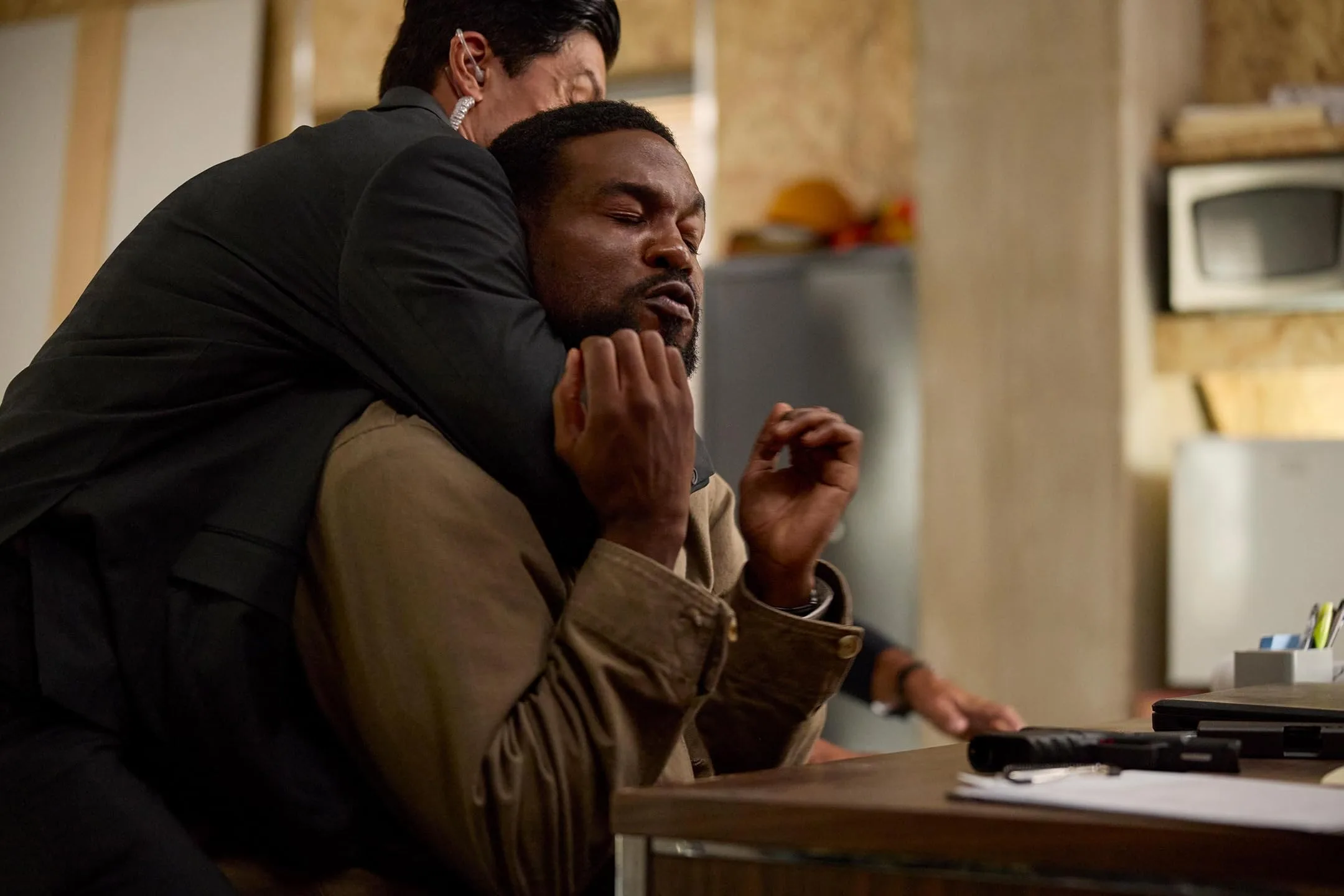
The tonal challenge this creates is genuine. A series willing to show a car battery applied to a restrained informant is also asking the viewer to care deeply about the same man’s capacity for love. These registers do not always reconcile cleanly. The brutality and the warmth exist in the same frame, occasionally pulling against each other with more force than the writing can contain.
A City the Show Doesn’t Fully Earn
The conspiracy at the spine of Man on Fire, political corruption threading from Brazil’s election machinery through to American intelligence, is serviceable architecture for an action series and little else. It functions. It keeps bodies moving through space and gives Creasy targets to pursue. What it rarely does is surprise. The alignment of trustworthy and untrustworthy characters tends to announce itself early, and the audience finds itself waiting for Creasy to reach conclusions it reached several episodes prior. For a show that asks you to believe in its protagonist’s intelligence, this is a particular problem.
Rio de Janeiro, shot partially on location, is present as geography without being present as place. The show reaches for the city’s contradictions, wealth pressed against poverty, political aspiration rotting from within, but too often retreats to drone shots and atmospheric shorthand. The favela sequences are the exception. Here, the show finds a warmth and specificity it cannot locate elsewhere. The residents of this community, connected to Creasy and Poe through Melo, carry a moral complexity that the official forces of order conspicuously lack. They survive through crime and prove more honorable than the people charged with maintaining justice. This world deserved more space within the series.
The supporting cast reflects the writing’s inconsistencies. Alice Braga anchors Melo with grit and grounded specificity, ensuring the character registers as human even when the plot uses her primarily as a connective device. Bobby Cannavale and Scoot McNairy bring their considerable presence to roles the writing never fully earns; they are vivid within scenes that do not quite deserve them. Billie Boullet’s Poe is handled more carefully than the prestige-TV teenager archetype usually allows, and the bond with Creasy accumulates weight across the season, even if its foundations are slow to solidify. The most unexpectedly vivid performances come from Jefferson Baptista and Iago Xavier, two young actors whose characters’ arcs hold the season’s most genuine surprises.
The 2026 series Man on Fire is a gritty action-thriller reimagining of A.J. Quinnell’s iconic novels, premiering globally on Netflix on April 30, 2026. This eight-episode adaptation follows John Creasy, a former Special Forces mercenary played by Yahya Abdul-Mateen II, who is hired to protect young Poe Rayburn in Brazil. When a violent kidnapping attempt shatters their peace, Creasy’s dormant skills resurface in a relentless quest for justice and redemption. Unlike previous film versions, this series utilizes the long-form format to dive deeper into Creasy’s fractured psyche and the political corruption surrounding the central conflict.
Where to Watch Man on Fire Online


Full Credits
Title: Man on Fire
Distributor: Netflix
Release date: April 30, 2026
Rating: TV-MA
Running time: 42–59 minutes
Director: Steven Caple Jr., Vicente Amorim, Clare Kilner, Michael Cuesta
Writers: Kyle Killen
Producers and Executive Producers: Kyle Killen, Scott Pennington, Arnon Milchan, Yariv Milchan, Natalie Lehmann, Peter Chernin, Jenno Topping, Tracey Cook, Steven Caple Jr., Michael Polaire, Edward L. McDonnell, Yahya Abdul-Mateen II, Stacy Perskie
Cast: Yahya Abdul-Mateen II, Billie Boullet, Scoot McNairy, Alice Braga, Bobby Cannavale, Paul Ben-Victor
Director of Photography (Cinematographer): Felipe Lacerda
Editors: Jamie Kirkpatrick, Plinio Pires
Composer: Max Aruj
The Review
Man on Fire
Man on Fire is a uneven but compelling thriller that lives or dies on Yahya Abdul-Mateen II’s excellent performance. The series has strong emotional sincerity, credible action, and a few sharp supporting turns, but its plotting is predictable and its Rio setting feels underused. Even so, the central bond and the show’s serious treatment of trauma give it real weight.
PROS
- Yahya Abdul-Mateen II’s commanding performance
- Emotionally sincere storytelling
- Gritty, grounded action
- Strong trauma portrayal
- Some vivid supporting performances
CONS
- Predictable plotting
- Rio feels more like backdrop than character
- Uneven pacing
- Some character expertise feels unearned
- Conspiracy thread lacks surprise







