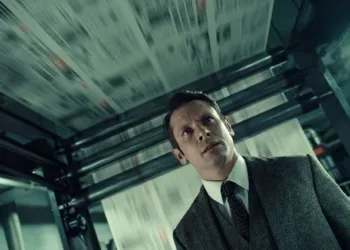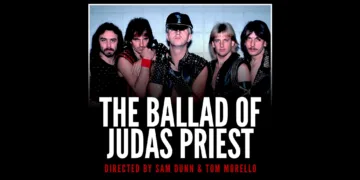



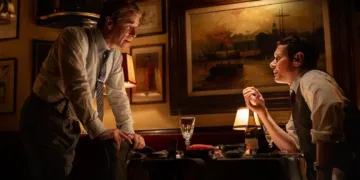




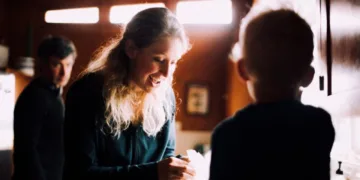













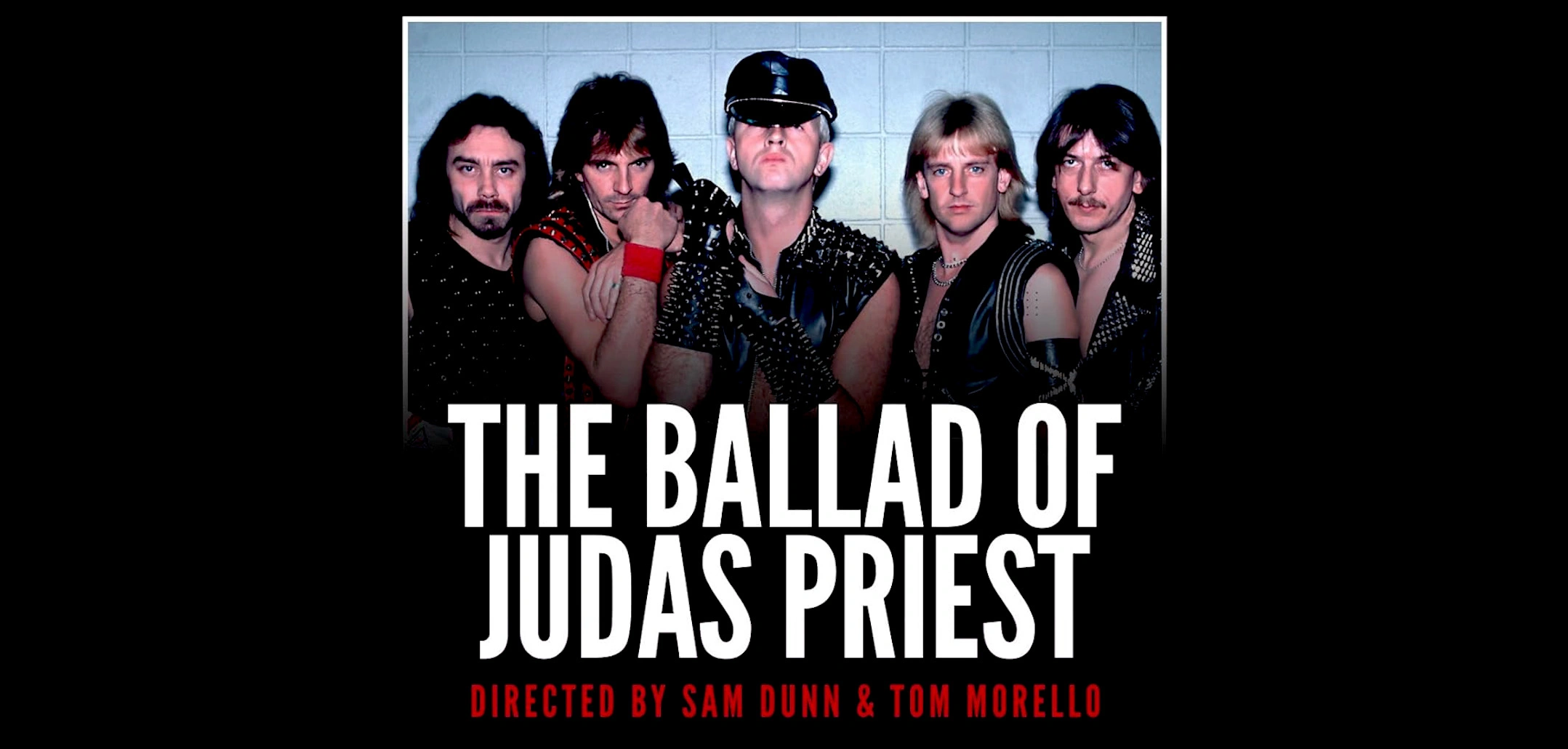

Directors Tom Morello and Sam Dunn approach their subject with the devotion of acolytes and the discipline of craftsmen. They place the band’s origin in the heavy air of the English Midlands, where the Black Country supplied a landscape of rhythmic clang, grinding gears, and spiritual residue. Birmingham’s factories seem to give the music a weight older than the first note, a pressure already waiting in the smoke.
This is a world where industrial soot settles on the soul. Rob Halford, Ian Hill, Glenn Tipton, and K.K. Downing rise from that smoke as figures shaped by labor, noise, and shadow. The film builds a historical record around a precise aesthetic. Morello examines the lineage with stern clarity.
Earlier sparks receive acknowledgment; this group gives the fire its structure, its ritual, its law. The record draws on decades of archive footage and intimate present-day reflection. Scandal remains peripheral, treated as a lesser force beside the permanence of their cultural contribution. The visual span covers five decades of shadow and light.
The Alchemy of Leather and Chrome
The band’s technical architecture rests on the synchronized lightning of Tipton and Downing. Their guitarmony acts as a load-bearing beam, generating a melodic density that reshapes the genre’s frame. This sonic design finds its visual double in a radical remaking of the self. The group sheds the sequins of the early years and grows a harder skin. Leather and studs, soon their defining armor, come from the gay sex shops of London’s Soho.

The irony glows with almost theological mischief. A hyper-masculine biker image takes form through the aesthetic language of a marginalized subculture. Strength, the film suggests, is often borrowed from the rooms where vulnerability has learned to survive. Halford describes himself as a simple figure in the gay world, a remark that brings quiet humor to the ferocity of the stage persona.
The band accepts real creative risk. Joan Baez’s introspective folk becomes a heavy anthem in their hands. The delicate and the brutal fuse into a spirit of controlled combustion. The footage moves from gritty working men’s clubs to the polished stage of the American Idol finale, tracing a rise from local grit to global saturation. The sound stays dense with intent.
The Trial of the Subconscious
External friction shapes much of the middle period. The 1990 Nevada trial stands as a peak of societal hysteria, a moment when lawyers argued that hidden messages had prompted tragic ends for two young men. The film captures the absurdity of a courtroom listening for ghosts in static. Halford identifies the logical wound inside the accusation: a creator gains nothing from destroying an audience.
Beneath that public theater waits a private weight. Halford lives for years as a gay man inside an industry devoted to a specific alpha-macho performance. He hides his identity to protect the group from possible fallout. Such concealment asks for payment. It takes its toll through periods of chemical dependency and a necessary stay in rehab. His 1998 revelation on MTV brings an unexpected wave of support.
The metal community offers an embrace that breaks the myth of its intolerance. The music becomes sanctuary for those on the fringes, a home for people living outside conventional lines. This community offers a form of secular grace.
The Fragility of the Eternal
Time eventually humbles even the gods of thunder. Testimonials from Jack Black and Dave Grohl mark the lasting ripples of the band’s influence. Kirk Hammett and Billy Corgan speak with a sincerity that affirms the group’s place in the canon. The film reaches its deepest register in the face of physical decline. Glenn Tipton’s battle with Parkinson’s disease gives the story a stark vision of human fragility.
The condition feels especially cruel for a man whose life was defined by the speed of his fingers. It raises a question the film can barely answer: what remains of the artistic spirit as the body begins to fail? Ozzy Osbourne offers a moment of shared grief, reflecting on his own struggles with the same ailment. The band’s history holds fractures and healing. Halford’s departure in 1992 and return in 2003 are settled with very British simplicity.
They meet for tea. The quiet reconciliation resists the usual vanity of rock legendry. Richie Faulkner joins the ranks with humility and places the collective above individual ego. The 2022 Hall of Fame induction becomes the final visual peak. The core four members stand together one last time. They fix their status as enduring masters of their craft.
The Ballad of Judas Priest celebrated its world premiere at the 76th Berlin International Film Festival in February 2026, where it screened in the Berlinale Special Midnight section. Co-directed by the acclaimed documentarian Sam Dunn and legendary guitarist Tom Morello, the film offers an unfiltered look into the fifty-year journey of the heavy metal pioneers. Since its debut, the documentary has been a highlight at major international events, including the Hot Docs Festival in April 2026 and the Sheffield Doc/Fest. Currently, the film is making its way through the festival circuit and special screenings, with global distribution handled by Sony Music Vision.
Full Credits
Title: The Ballad of Judas Priest
Distributor: Sony Music Vision, Banger Films
Release date: February 12, 2026 (Berlin International Film Festival Premiere)
Running time: 98 minutes
Director: Sam Dunn, Tom Morello
Writers: Sam Dunn, Tom Morello
Producers and Executive Producers: Sam Dunn, Scot McFadyen, Tom Morello, Rick Krim, Sheila Stepanek, Jayne Andrews, Tom Mackay, Krista Wegener, Abby Davis, Sylvia Rhone
Cast: Rob Halford, K.K. Downing, Glenn Tipton, Ian Hill, Scott Travis, Richie Faulkner, Tom Morello, Jack Black, Darryl McDaniels, Dave Grohl, Lzzy Hale, Billy Corgan, Scott Ian, Kirk Hammett, Ozzy Osbourne
Director of Photography (Cinematographer): Martin Hawkes
Editors: Nick Taylor, Dave McMahon
Composer: Ramachandra Borcar
The Review
The Ballad of Judas Priest
The Ballad of Judas Priest succeeds as a meditation on the permanence of identity amidst the decay of the physical form. It avoids the shallow trap of a typical biography. It finds beauty in the industrial soot and the leather skin. The film captures the quiet dignity of artists facing their own ending. It is a profound record of a community built on the fringes of the world. It honors the spirit of the music. This film is a heavy, necessary reflection.
PROS
- Poetic treatment of Rob Halford’s personal path and the shift in metal culture.
- Rich archive footage documenting the physical and sonic evolution of the band.
- Honest look at the fragility of the body and the weight of aging.
CONS
- Skims over internal band tension and interpersonal struggles.
- Adopts a festive stance that avoids harsher critical interrogation.
- The structure follows a familiar chronological template.