
























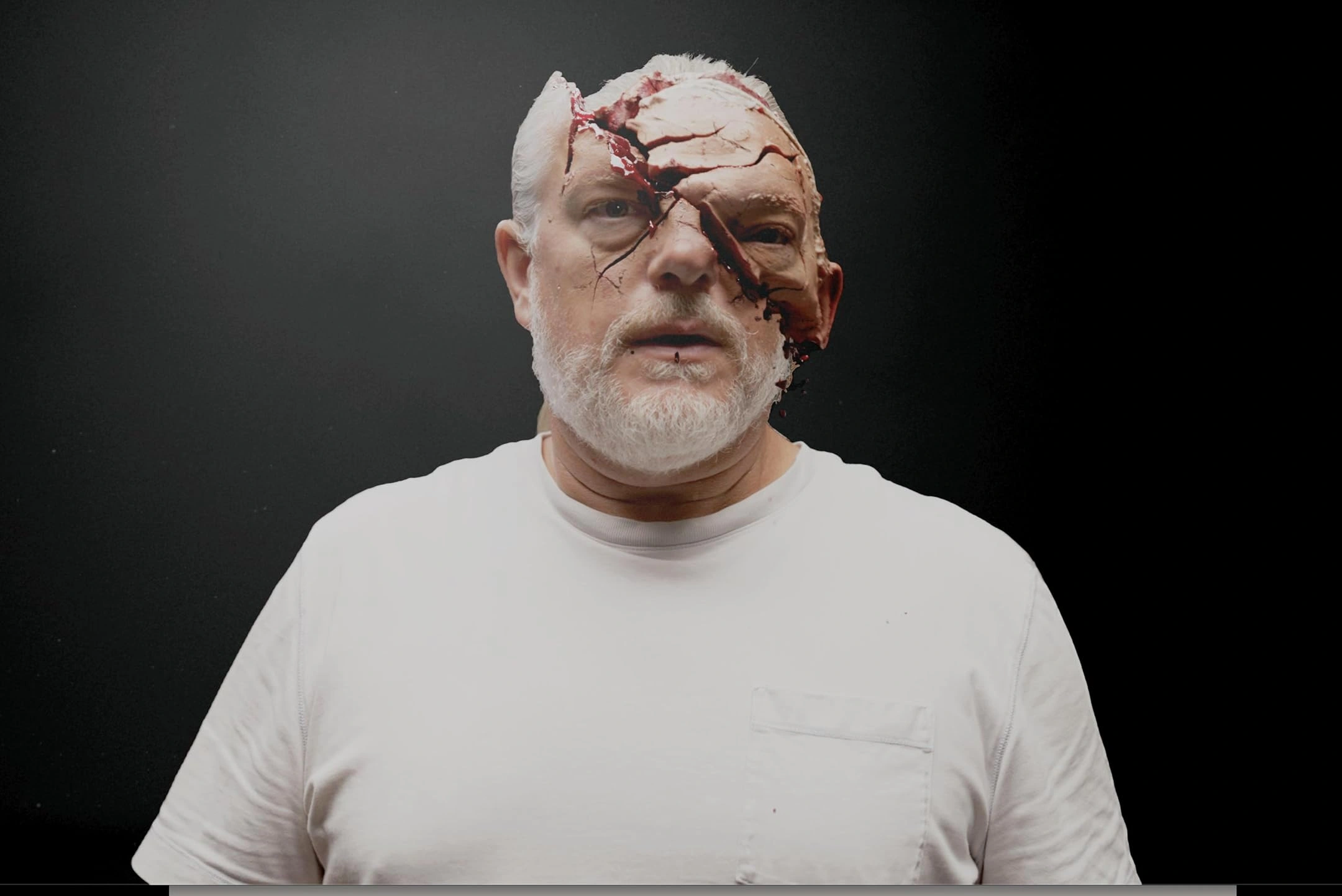
A quote appears on screen, then the camera sweeps across the rugged West Coast mountains before placing the viewer inside an immediate state of clinical unease. Devin Adams, a retired professor of Visual Studies, sits in front of a camera in November 2024, documenting a physical and mental collapse that has already reached a terrifying stage.
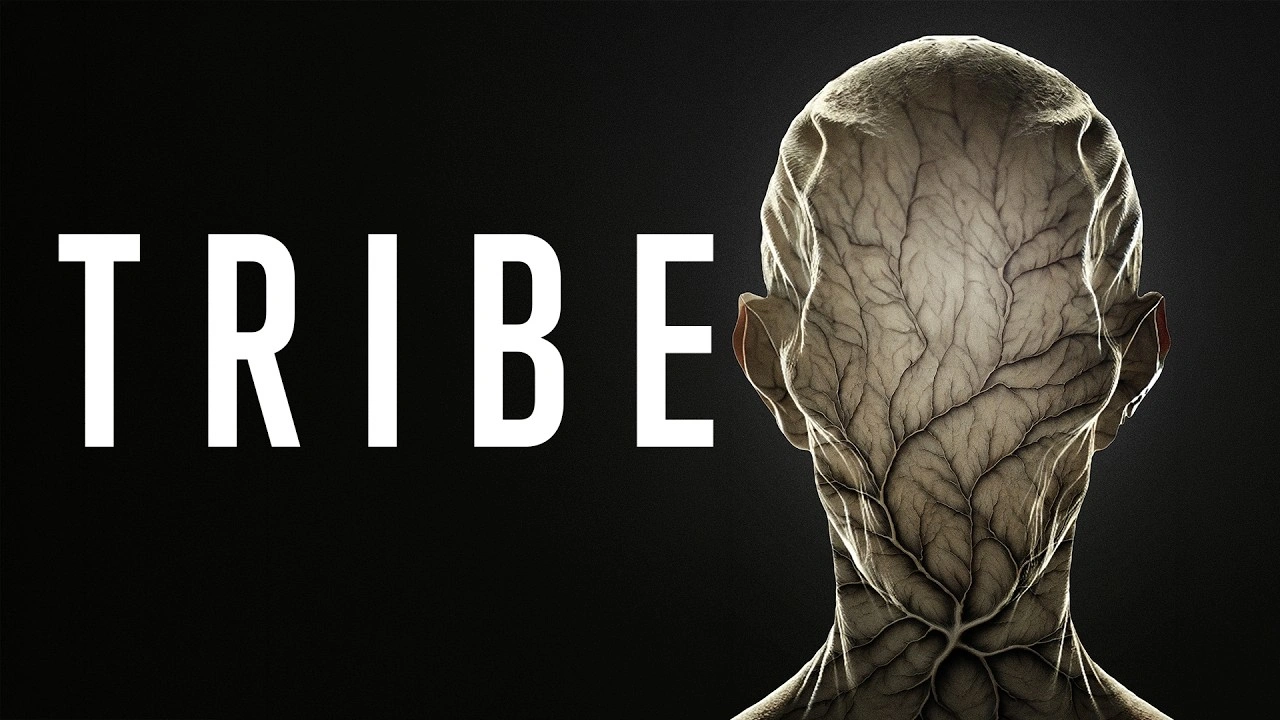
His face has been warped by a spreading, vein-choked deformity, his motor control is failing, and his memory has splintered so severely that the simple act of driving out of the wilderness has become impossible. Stranded in an Airstream trailer in the Cuyamaca mountains, Devin clings to seven hard drives as his remaining tether to reality.
Director Dan Asma, drawing on a long career editing high-profile theatrical trailers, shapes the mystery as a literal archival investigation. Devin must examine his own digital record to make sense of the disaster already unfolding in his body.
The narrative spark comes from older videotapes delivered by his ex-wife, Kate, which document the erratic behavior of their late college friend, Charlie, before his suicide. Charlie’s childhood tie to the mysterious Church of Heaven’s Light brings cosmic dread into the frame, turning a medical mystery into an existential countdown.
Unraveling the Chronological Design
The film’s story architecture depends on a dual-timeline structure that upends familiar pacing habits. By showing Devin’s advanced deterioration in the opening minutes, the script trades standard survival suspense for a controlled retrospective inquiry.
The story then moves back to August 2024, tracing the chain of choices that led to his isolation. That inquiry begins when Kate brings Devin old camcorder excerpts from their university days. The tapes feature long conversations with Charlie, a troubled man who was found wandering the wilderness alone as a child after escaping a dark religious commune.
Devin’s academic curiosity pushes him out of his ordered life and into Charlie’s final path through the desert. His research narrows around a single geographical anomaly. In a canyon scattered with boulders, he finds a pristine modern Conex shipping container that appears untouched by age, despite Charlie having documented its presence three decades earlier.
The plot widens beyond a solitary expedition through the introduction of academic peers who study Devin’s material from a distance. Devin sends video logs, trail camera images, and translated documents to Archer, a former student whose remote technical analysis gives the growing madness a scholarly texture. This research partnership lets the film deliver exposition through Zoom calls and FaceTime consultations, recreating the layered, multi-window work habits of contemporary professionals.
As Archer uncovers historical material tied to the Church of Heaven’s Light, the story moves from grounded inquiry into contact with an ancient intelligence. This entity travels between dimensions through shadows, a concept that places human logic under immediate strain.
The structure keeps the film consistently absorbing, yet the decision to reveal Devin’s end-state early creates a clear pacing issue. The viewer knows Devin lives long enough to record his final logs inside the trailer, which reduces the immediate danger during his tense encounters with distorted figures in the desert. The second act runs on intellectual curiosity rather than physical peril. Its momentum comes from the slow accumulation of cryptic evidence, and that method works best when the data feels like a trap tightening one file at a time.
The Syntax of Screen-Life Aesthetics
The film’s form rests entirely on a screen-life framework, building its visual identity from the digital wreckage of modern communication. The 75-minute runtime is assembled from desktop recordings, vlogs, drone feeds, trail cameras, and damaged analog VHS tapes. In a field crowded with found-footage projects, the production maintains strict visual discipline by giving every shot a clear source inside the characters’ world. Timestamps and hard drive directories become the viewer’s map, guiding the movement through layers of time and perspective.
Asma’s background in trailer editing is visible in the handling of fragmented media. Multi-window formats can turn stiff or muddy fast, a problem this film mostly avoids through controlled rhythm. The editing moves between file transfers, FaceTime buffers, and recovered footage with sharp timing. The visual language favors raw believability over polished composition. Cameras shake with ordinary human impatience, exposures blow out under direct desert sun, and consumer-grade lenses reinforce the rough quality of Devin’s private archive.
That commitment to authenticity carries into the performances, which gain force from naturalistic delivery. Asma captures the exhausted despair of an academic whose faith in logic is failing him. Nicole Jones gives Kate a grounded presence as a distant ex-wife whose concern still feels genuine. Keaton Asma plays Charlie with frantic, feral energy in the retro VHS sections, making him an effective trigger for the story’s descent into madness.
The sensory design is key to the film’s tension. Low-frequency hums, digital audio glitches, and warped radio static turn ordinary computer screens into instruments of unease. The dread often comes from the interface itself, from the sense that each recovered file may contain a piece of knowledge Devin cannot survive.
The visual effects are less consistent, and that unevenness hurts the final stretch. During the atmospheric buildup, the micro-budget practical effects, shadow compositions, and glimpses of deformed figures among the boulders carry real force. They work because they leave the mind space to complete the image. The digital effects and CGI assets used during the explicit third-act reveals lose texture under clear visibility, briefly cracking the illusion of a genuine document.
Subversive Faith and Cosmic Hubris
The narrative operates as a hybrid of investigative mockumentary, psychological collapse, and visceral body horror. Its refusal to settle into one subgenre keeps the audience unstable, mirroring Devin’s cognitive decline. The script’s literary foundation draws from cosmic horror and speculative science fiction, placing ancient mythology beside theoretical evolutionary biology.
The film’s treatment of the fictional cult avoids easy caricature. The script studies the internal logic of extreme belief, showing how a localized offshoot of a mainstream religious movement can twist doctrine into isolation and devotion to an otherworldly force.
This idea comes through the translation of a recovered historical codex and Charlie’s frantic monologues about alternate evolutionary branches. The plot brings in a variation of the Silurian hypothesis, proposing that an advanced non-human species inhabited Earth millions of years ago, retreated underground, and developed ways to cross dimensional limits through physical shadows.
The film’s main thematic pressure comes from technological obsession. Devin’s academic training in visual media becomes his fatal weakness. His learned need to read images, find patterns, and impose order pushes him deeper into files that should have stayed closed. The hard drives fail to rescue him. They archive his transformation and collapse in real time, turning documentation into a digital snare.
The final sequence weakens the film’s momentum as the storytelling moves from suggestion to explanation. The third act leans on a large dose of exposition meant to clarify the interdimensional intelligence and Charlie’s role in the plot.
That clarity drains some of the cosmic dread built earlier, since the unknown works best here when it keeps its full shape out of reach. The pursuit is stronger than the arrival, leaving the viewer with a carefully assembled digital puzzle whose most effective pieces remain jagged, partial, and faintly alive.
Originally screening across the independent festival circuit, Tribe held its digital debut on streaming platforms in late 2025 before arriving on UK digital formats via GrimmVision on May 25, 2026. This independent sci-fi horror feature is currently available to watch through selected transactional video-on-demand services and global digital media networks.
Full Credits
Title: Tribe
Distributor: GrimmVision, Plex TV
Release date: October 10, 2025 (Plex TV), May 25, 2026 (UK Digital Release)
Running time: 75 minutes
Director: Dan Asma
Writers: Dan Asma
Producers and Executive Producers: Dan Asma
Cast: Dan Asma, Keaton Asma, Nicole Jones, Tyona Bowman, Justina Biosah, Ray Buffer
Director of Photography (Cinematographer): Blake Horn
Editors: Dan Asma
Composer: Spunkshine
The Review
Tribe
Tribe delivers a structurally ambitious puzzle box that relies heavily on atmospheric tension and technical precision. While its final narrative revelations drop some of the cosmic mystery established early on, the immersive screen-life design and raw execution remain thoroughly engaging for genre enthusiasts.
PROS
- Creative deployment of multi-format digital media.
- Strong, naturalistic lead performance.
- Tense, localized sound design.
CONS
- Predictable stakes due to the dual-timeline structure.
- Underwhelming micro-budget digital effects in the final act.
- Overly literal exposition during the climax.