












![Kingdom Hearts Collection [I-III] Review](https://gazettely.com/wp-content/uploads/2026/10/Kingdom-Hearts-Collection-I-III-1-360x180.webp "Kingdom Hearts Collection [I-III] Review: KHII Holds Steady as Newer Entries Fluctuate 33")








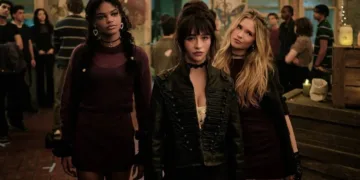
Izabel Pakzad’s Find Your Friends plants a psychological thriller inside a bender and lets the fumes do much of the talking. Amber, Lavinia, Zosia, Lola, and Maddy begin on a yacht, where the music is loud, the liquor flows, and every interaction seems lit by the cheap glare of social performance. Then Amber is sexually assaulted, and the film’s party atmosphere curdles into something harsher.
The group pushes forward to Joshua Tree, carrying its own private storm of drugs, flirtation, resentment, and denial. Amber’s trauma becomes the story’s unstable axis. Her friends see her change in mood as a nuisance, then as an accusation. That misreading gives the film its central ache.
Pakzad aims for a thriller about misogyny, predatory men, and friendship built on mutual self-destruction. Some of the visual instincts are strong: bright surfaces, blown-out desert light, bodies caught in motion, faces half-swallowed by shadow. The ideas are sharp enough to draw blood. The film, sadly, keeps nicking itself with the same knife.
Friendship as a Crime Scene
Amber begins the film inside the group, yet never fully at peace with it. Helena Howard plays her as someone already drifting away from the ritual of nonstop excess. After the assault, her decision to continue with the trip reads as denial, social pressure, and survival reflex tangled together. She wants the old rhythm to return. Her body knows it cannot.
That tension gives Find Your Friends its strongest dramatic question: are these women friends, or are they fellow fugitives from sobriety and consequence? Lavinia drives the group’s momentum with an almost noirish fatalism, pushing toward the next party, the next substance, the next man, the next bad idea wearing lip gloss. She treats motion as freedom, which is convenient, since stillness might require thought. A terrifying prospect.
Zosia comes closest to noticing Amber’s distress, though her care rarely moves beyond a soft check-in. Lola and Maddy bring energy and volatility, yet the screenplay too often defines them by volume, appetite, and impulse. They function less as fully drawn women than as moving pieces in Amber’s isolation chamber.
The film’s treatment of misogyny is blunt, sometimes effective. Men repeatedly treat flirtation, vulnerability, and rejection as openings for control. From the yacht assault to the desert pursuit, Amber is right to be afraid. The horror lies in the fact that her friends treat fear as poor etiquette. Here, the film brushes against a bleak philosophical idea: danger becomes easier to deny when denial keeps the party alive.
Still, the thematic design strains under shallow characterization. The friends are so careless, so frequently indifferent, that their betrayal can feel programmed rather than tragic. The moral gray zone narrows, and with it goes some of the film’s bite.
Amber Holds the Frame
Howard gives Find Your Friends its most credible human temperature. Her Amber is jittery, wounded, defensive, furious, and frighteningly alone. In the film’s best moments, Howard lets trauma register through physical hesitation: a glance held too long, a step backward, a sudden hardening of the eyes. She understands that terror does not always arrive screaming. Sometimes it sits in the throat and waits.

The performance also lends the film a psychological texture that the writing cannot always supply. Amber keeps trying to rejoin the group’s delirium, yet every party beat becomes hostile. Music turns invasive. Laughter becomes accusation. Light itself feels overexposed, like the world has lost the mercy of shadow.
Bella Thorne’s Lavinia has a corrosive charisma. She is abrasive, magnetic, and exhausting, the kind of person who could turn a wellness retreat into a minor felony by noon. Thorne gives her presence, though the script often reduces her to selfish provocation.
Zión Moreno’s Zosia suggests a gentler counterweight, but the role needs sharper definition. Chloe Cherry brings loose comic charge to Lola, with flickers of vulnerability that deserve richer development. Sophia Ali’s Maddy has flashes of aggression and denial, yet she too gets pulled into the film’s pattern of interchangeable friend-group writing. The cast hints at a deeper ensemble drama. The material keeps dragging them back to the shallows.
Sun-Bleached Noir and Stalled Panic
Pakzad’s strongest filmmaking choices come from atmosphere. The yacht and desert sequences have a disorienting polish: quick cuts, dense sound, bright skin, dark interiors, bass that seems to thump from inside Amber’s skull.

The visual language has traces of neo-noir, though this is noir bleached by California sun rather than soaked in rain. Chiaroscuro appears in flashes: faces split by cabin light, bodies framed against night windows, desert darkness turning empty space into threat.
The camera often treats the party as a trap. Movement is restless, close, invasive. Shot compositions crowd Amber inside frames packed with bodies, bottles, and noise. This is social life as surveillance. Everyone is watching, performing, judging, ignoring. A clean little nightmare, with better makeup.
The sound design manipulates perception with similar force. Music swells until it feels less celebratory than coercive. Silence, when it arrives, has greater menace than the shouting. The audience is placed near Amber’s nervous system, where every man’s gaze can become a warning signal and every dismissed concern begins to feel like proof of abandonment.
Pacing is the major wound. The film spends too long repeating the same cycle: drugs, argument, Amber’s distress, group dismissal, another haze. The structure may reflect addiction to chaos, but repetition drains suspense from the middle stretch. The story keeps teasing escalation, then wanders back toward the dance floor.
The desert pursuit works because it trusts ordinary menace. Male entitlement becomes immediate physical danger, without needing ornate genre machinery. The late violent shift delivers shock and revenge-fantasy release, pushing Amber into a final-girl shape formed by rage rather than innocence. The climax has force, yet its emotional charge is uneven. The film wants catharsis. It earns fragments of it.
Find Your Friends is an American psychological survival thriller film that premiered its official commercial release on Shudder on June 12, 2026, following its initial festival run at the 2025 Fantasia International Film Festival. Written and directed by Izabel Pakzad in her feature length directorial debut, the narrative tracks a close group of five young women who flee Los Angeles for what is supposed to be a wild weekend trip in Joshua Tree. The situation spirals out of control when hostile confrontations with local neighbors and hidden personal trauma ignite a violent, chaotic struggle for revenge and survival. Audiences can stream the gritty independent genre piece directly by logging into the Shudder digital premium network application.
Where to Watch (2025) Online









Full Credits
Title: Find Your Friends
Distributor: Shudder
Release date: June 12, 2026
Running time: 89 minutes
Director: Izabel Pakzad
Writers: Izabel Pakzad
Producers and Executive Producers: Monika Bacardi, Allison Friedman, Andrea Iervolino, Luca Matrundola, Izabel Pakzad, Gary Michael Walters, Bella Thorne, Robert Dean, Abbie Friedman, Chris Hanley, Eric Kohn, Todd Lundbohm, Danielle Maloni, Ana Menendez, Ellie Papadiamanti, David Tickle, Iris Torres
Cast: Helena Howard, Bella Thorne, Zión Moreno, Chloe Cherry, Sophia Ali, Chris Bauer, Jake Manley, Israel Broussard, Harrison Sloan Gilbertson, Blaine Kern III
Director of Photography (Cinematographer): Tim Curtin
Editors: Maxime Pozzi-Garcia
Composer: Ben Frost
The Review
Find Your Friends
Find Your Friends has a strong premise, a vivid sun-scorched visual mood, and a committed Helena Howard performance, yet its thriller mechanics stumble through repetition and thin characterization. Its rage is clear, its atmosphere often striking, but its emotional payoff feels uneven.
PROS
- Strong Helena Howard performance
- Stylish desert atmosphere
- Effective moments of grounded menace
- Sharp premise about trauma and failed friendship
CONS
- Repetitive middle stretch
- Underwritten supporting characters
- Blunt thematic execution
- Uneven final-act payoff