























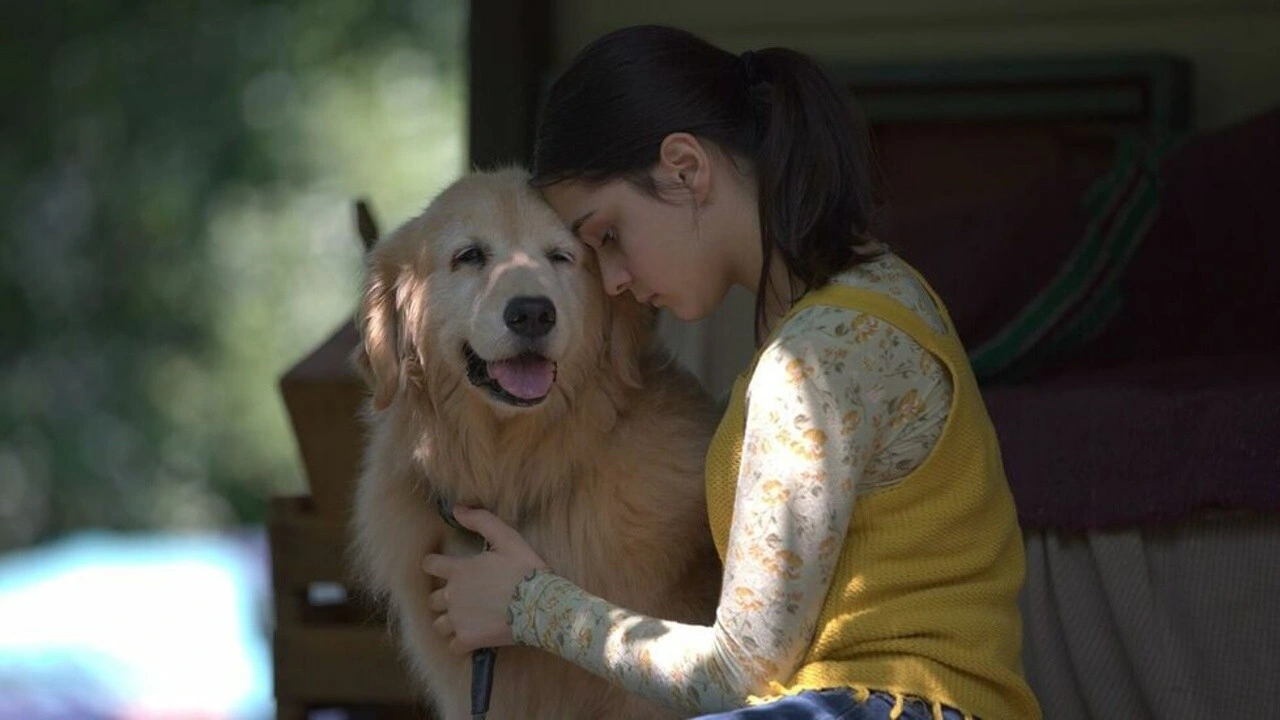

Rain Reign is a sincere family drama about the fragile systems people build to survive a world that rarely follows their rules. Adapted from Ann M. Martin’s novel, the film centers on Rose, a 12-year-old neurodivergent girl in rural upstate New York whose life is shaped by homonyms, prime numbers, schedules, grammar, and moral clarity. The title comes from the name she gives her golden retriever, Rain, a word that fits her love of language and her instinct for assigning order to the mess of daily life.
The film’s storytelling is gentle and direct, closer to classic children’s literature than high-concept family cinema. Its emotional force comes from relationships rather than surprise. Rose lives with Wesley, her father, a mechanic worn down by grief, money trouble, alcohol, and the constant strain of single parenthood. His brother, Weldon, brings a calmer presence into Rose’s life, offering steadiness where Wesley can only manage bursts of affection and frustration.
After a severe storm, Rain goes missing. That search gives the film its central movement, pushing Rose into fear, uncertainty, and a painful lesson about care that reaches beyond possession.
Rose’s Language of Rules and Feeling
Rose is the film’s anchor, and Rain Reign works best when it lets the viewer see the world through her structure. She depends on rules because rules promise safety. Schedules, road laws, classroom routines, and grammar are her way of making sense of an environment that often feels careless, noisy, and unfair.
This gives the film a quiet cross-cultural accessibility. Rose’s experience is specific, rooted in American rural life and a school system unsure how to support her, yet her need for order speaks to a wider human desire for stability.
Felice Kakaletris gives the film its most persuasive performance. She avoids theatrical signals and plays Rose with control, stillness, and sharp emotional precision. Rose may appear rigid to others, especially when she corrects people or interrupts conversations, but Kakaletris lets small shifts in breath, posture, and expression reveal the anxiety underneath. The performance understands that clarity can be a shield.
The classroom scenes are especially effective. Rose being overwhelmed and stepping outside to breathe gives the film a practical, physical sense of anxiety. Later, when a classmate is shaken after the storm, Rose asks if they need to step outside too. The gesture is simple, yet it reframes her rule-based thinking as a form of care. She learns compassion through the language she already knows.
The narration sometimes explains too much. It gives access to Rose’s logic, yet the film often needs less guidance. Kakaletris is fully capable of carrying those meanings without verbal instruction.
Care, Fracture, and the Men Around Rose
The relationship between Rose and Wesley gives Rain Reign its roughest emotional texture. Wesley loves his daughter, but love alone does not make him patient, stable, or prepared. The film refuses to polish him into the noble struggling father. He is exhausted, defensive, sometimes frightening in his anger, and painfully aware that Rose’s needs expose every weakness he has tried to hide.
Jeremy Sisto plays Wesley with a raw, blue-collar tension that keeps the character from becoming a stock figure. His body seems braced for failure before it arrives. He can look at Rose with tenderness, then retreat into irritation because tenderness requires a steadiness he cannot sustain. The detail that he told Rose her mother left, rather than explaining her death, says much about him. He cannot give Rose the truth because he cannot face it himself.
Paul Rudd’s Weldon is softer, warmer, and easier to trust. He understands how to give Rose space and reassurance, and his presence brings relief to the film. Still, Weldon is written with less internal conflict than Wesley. He functions partly as the adult Rose deserves, a necessary counterweight rather than a fully equal dramatic force.
The brothers’ history deepens the family drama. Their foster-care past, hinted at through old wounds and unfinished conversations, gives their tension a lived-in quality. Wesley pushes Weldon away because betrayal still feels possible. Weldon keeps returning because family, in this film, is a responsibility people keep accepting after failing at it.
A Familiar Shape, Held by Compassion
The storm and Rain’s disappearance shift the film from intimate portrait to moral test. Rain is Rose’s comfort, routine, companion, and emotional translator. Losing her places Rose in a state no rule can repair. The search forces her to face a painful idea: loving something may require letting go of what she wants most.
Erika Burke Rossa directs with restraint. The rural setting feels grounded, with its modest homes, damaged roads, school corridors, and animal shelter spaces giving the story a plainspoken realism. There are small visual flourishes tied to Rose’s homonyms and inner life, yet the film rarely decorates her neurodivergence for effect. That choice matters. In a global film culture that has often treated neurodivergent characters as symbols, puzzles, or inspirational devices, Rain Reign keeps Rose human, specific, and sometimes difficult.
The film has limits. Several threads could use greater development, including social services, Wesley and Weldon’s childhood, the foster-parent connection, and the deeper roots of Wesley’s grief. The story rarely surprises, and some family-drama beats arrive exactly where expected.
Still, its compassion holds. Rain Reign understands that care can be tiring, imperfect, awkward, and full of mistakes. Its best scenes sit in that discomfort, where a girl who loves rules learns that love often asks for judgment, mercy, and courage when no rule feels strong enough.
Rain Reign is an American independent coming-of-age drama film that celebrated its official world premiere at the Tribeca Festival on June 6, 2026. Directed and written by Erika Burke Rossa, the narrative follows a neurodivergent young girl named Rose whose structured daily life is upended when her beloved dog goes missing during a massive superstorm. Audiences can currently catch the poignant independent adaptation at select film festival venues across New York City, while wider commercial theatrical rollout tracking and regional streaming network rights are being organized by its sales representation.
Full Credits
Title: Rain Reign
Distributor: City Hill Arts, Ley Line Entertainment, Lost Winds Entertainment, Poster Child Pictures, Twist/Long Odds/Rainbow Goat Production (Sales agents handling distribution market rights include CAA and Gersh)
Release date: June 6, 2026 (Tribeca Festival world premiere)
Running time: 100 minutes
Director: Erika Burke Rossa
Writers: Erika Burke Rossa, Ann M. Martin
Producers and Executive Producers: Julie Rudd, Nikki Silver, Erika Burke Rossa, Robin Jonas, Jonathan Lim, Theresa Steele Page
Cast: Paul Rudd, Jeremy Sisto, Felice Kakaletris, Gretchen Mol, Mary Stuart Masterson, Jeremy Davidson, C. J. Wilson
Director of Photography (Cinematographer): Tami Reiker
Editors: Joe Klotz
Composer: Eric D. Johnson
The Review
Rain Reign
Rain Reign is a quietly moving portrait of resilience, structure, and imperfect love. Its strength lies in Felice Kakaletris’ nuanced performance as Rose and the layered depiction of family dynamics. The film avoids sentimentality while giving space to neurodivergent experience, showing that care and growth often come through tension, patience, and empathy. Its straightforward storytelling allows emotional depth to flourish, even when narrative threads remain lightly sketched. For audiences willing to sit with subtle character-driven drama, it delivers insight, warmth, and an authentic, grounded perspective on family and individuality.
PROS
- Authentic portrayal of a neurodivergent child
- Strong performances, especially Kakaletris, Sisto, and Rudd
- Subtle, empathetic direction
- Grounded rural setting and visual storytelling
- Thoughtful depiction of imperfect family relationships
CONS
- Some narrative threads underdeveloped (social services, backstory)
- Limited plot surprises
- Uncle Weldon character thinner than others
- Voiceover narration occasionally over-explains