
























![Kingdom Hearts Collection [I-III] Review](https://gazettely.com/wp-content/uploads/2026/10/Kingdom-Hearts-Collection-I-III-1-360x180.webp "Kingdom Hearts Collection [I-III] Review: KHII Holds Steady as Newer Entries Fluctuate 37")




A bruised woman praying beside her ninety-five-year-old mother is already a horror image before anyone mentions demons. That is the sharpest instinct in The Voices of Our Mother, Mark O’Brien’s Gothic family horror film about care, inheritance, resentment, and the awful administrative question of what to do with a parent who hurt you by doing nothing.
Harriet Scaflen, played by Sheila McCarthy, has lived under the close watch of her mother Johanna, whose death leaves her suddenly unmoored. Harriet’s four adult children return home: William, Annika, Therese, and Martin. They do not come back as a family healed by distance. They come back as people summoned by logistics. A body must be buried. A mother must be assessed. A house must be entered again, which is the worst chore of all.
The film’s cleverest move is to make caregiving feel like possession before possession takes formal shape. Harriet’s body confuses doctors after her collapse. She appears medically healthy in ways that make no sense, almost childlike. Her children have to tend to her bed, her moods, her silence, her strange whispers. The parent has become the child, except this child once let monsters live in the house. Call this moral caretaking, the duty imposed after affection has expired.
The Siblings Carry the Curse
O’Brien, who writes, directs, and plays William, understands that the siblings are scarier than the supernatural material because they know exactly where to cut each other. William presents himself as the responsible one, the practical son who can organize the family crisis, yet his outbursts reveal a man exhausted by the role. His anger is not theatrical. It has the shape of a habit. When he softens afterward, apologizing or trying to regain control of the room, the film finds a person inside the function.
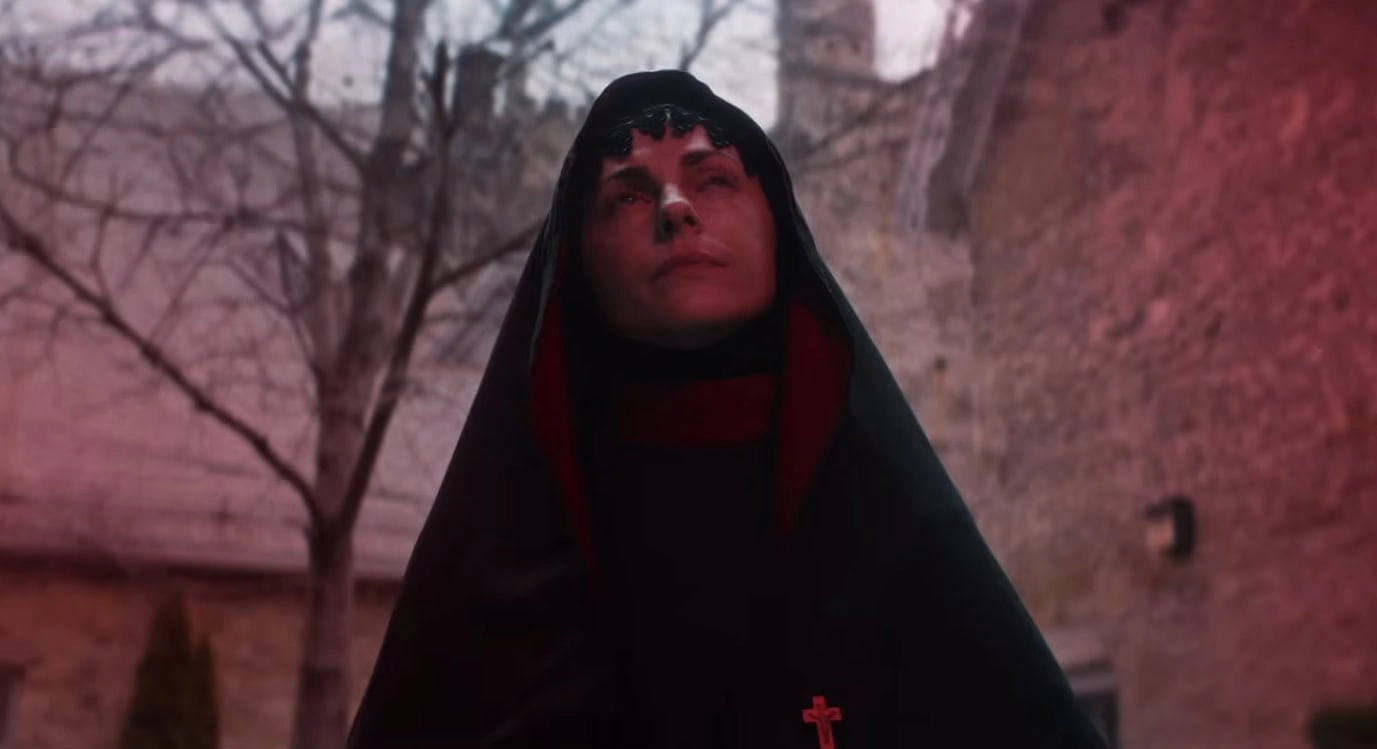
Annika, played by Georgina Reilly, arrives with the visual authority of faith: the habit, the prayers, the vocabulary of sin. Her opening vision of a burning house and an unseen demonic force looks like a warning from God, or cinema’s idea of one. The more interesting crisis is smaller and crueler. She knows her father was evil, which makes hating him easy. Harriet’s sin was passivity, and passive sins are harder to punish cleanly. How does a nun care for a mother who did not care enough?
Therese and Martin expand the wound. Therese’s marriage to a woman William once loved could have been cheap soap opera, and at times it nearly becomes that, yet it also gives the siblings’ bitterness a practical target. Martin’s drug use signals a life that kept running from the house long after his body left it. Then the film reveals a shared secret involving William, Therese, and Martin, and the priest’s repeated line, “Evil begets evil,” stops sounding like theology and starts sounding like a family calendar.
The best scenes keep the siblings in rooms they want to escape. They argue over Harriet’s care, then over their childhood, then over who became what because of whom. O’Brien’s direction works here because it lets speech curdle. The horror is not in a door opening by itself. It is in one sibling saying the exact sentence the other has spent years avoiding.
The Demon Has a Scheduling Problem
The possession material is both the film’s hook and its limitation. Harriet begins whispering secrets into her children’s ears, switching tones, mocking them with a childish cruelty that makes her frailty feel like disguise. McCarthy is excellent in these turns. Early on, her bruised quietness makes Harriet seem like a victim of age, history, and Johanna’s suffocating care. Later, her face hardens, her voice sharpens, and she seems to enjoy turning the siblings against one another. It is a nasty performance in the best sense.
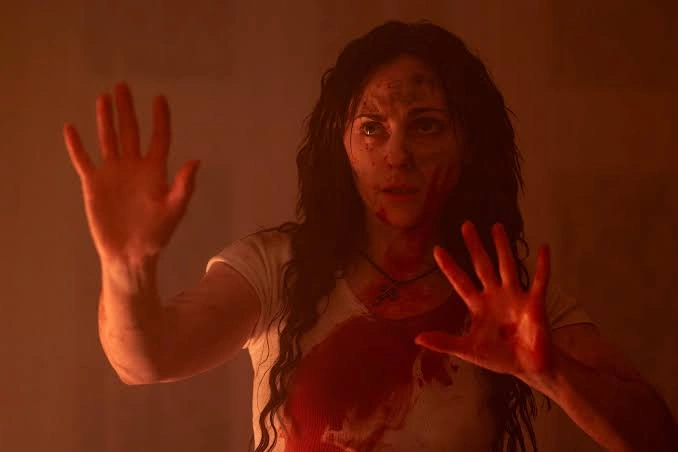
O’Brien also finds a smart variation on a tired possession setup. Horror has given us plenty of endangered children and young women treated as battlegrounds for priests, doctors, and devils. Here, the afflicted body belongs to an elderly mother, and the people around her are not innocent rescuers.
They are survivors, caretakers, accusers, and dependents. That shift matters. Watching Annika confront Harriet near the end, with images cutting toward a younger Harriet and Johanna, gives the film its most painful metaphor: age can make parenthood reversible, and reversal does not erase the bill.
Yet the supernatural thread often behaves like a rude guest at its own dinner. Whenever the sibling drama gets too sharp, Harriet’s condition erupts and redirects the scene. A whisper here, a demonic clue there, a burst of possession logic to stop human conflict from doing its full damage.
The film wants evil to be spiritual, familial, inherited, medical, and psychological. Fine. Evil contains multitudes (apparently it has a busy LinkedIn profile). The problem is rhythm. Some scenes feel cut short just when they should become unbearable.
Firelight and Family Accounting
The film looks best when it leans into old Gothic texture. The credits nod toward early monster cinema. Red skies hang over the house like stained glass after a bad sermon. Firelight flickers across faces in ways that make prayer feel closer to threat than comfort. Annika’s dream of the burning house is blunt symbolism, yes, but blunt symbols are not always the enemy. Sometimes the house really is on fire.
The sound design understands the house better than some of the plotting does. Prayers, breath, silence, and whispered voices make the rooms feel occupied before any overt supernatural event confirms it. A late stretch of practical effects gives the film some welcome physical madness, with McCarthy’s Harriet becoming less a patient than a rupture in the family’s agreed reality. The weaker digital effects near the end carry less weight because the film has already taught us to fear a voice beside a bed.
O’Brien’s blocking can be uncertain. Some scenes place characters in emotional conflict without giving the room enough visual clarity, so ambiguity becomes fog rather than dread. That matters in a film about family geometry. Who stands near Harriet? Who stays by the door? Who moves first when she speaks? These choices should cut like evidence.
The final act hurries through revelations, violence, and theological payoff before the sibling relationships have fully metabolized what has happened. The last bookend to Annika’s opening vision has force as an image, but it lands before the drama beneath it has finished breathing. The Voices of Our Mother has a strong idea of horror: the mother as burden, wound, patient, and possible vessel. It keeps finding rooms where that idea feels alive. Then it leaves some of them too soon.
The Voices of Our Mother premiered on the streaming platform Shudder on June 19, 2026, where it is currently available to watch. The supernatural horror film follows a collection of siblings who return home to care for their troubled matriarch after she falls seriously ill. While dealing with her chilling mental and physical decline, the family uncovers dark secrets and realizes their deep ancestral ties are bound by a sinister, otherworldly force.
Where to Watch The Voices of Our Mother (2026) Online










Full Credits
Title: The Voices of Our Mother
Distributor: Shudder
Release date: June 19, 2026
Rating: R
Running time: 93 minutes
Director: Mark O’Brien
Writers: Mark O’Brien
Producers and Executive Producers: Christopher Giroux, Justin Rebelo, Jesse Ikeman, Nataline Rodrigues, Bill Marks
Cast: Sheila McCarthy, Mark O’Brien, Georgina Reilly, Carolina Bartczak, Alex Ozerov-Meyer, Anna Ferguson, Shawn Doyle
Director of Photography (Cinematographer): Scott McClellan
Editors: Angela Jekums
Composer: Andrew Staniland
The Review
The Voices of Our Mother
The Voices of Our Mother has a sharp, ugly idea: caregiving as punishment for children abandoned by protection. Its sibling drama often cuts deeper than its possession mechanics, and Sheila McCarthy gives Harriet a frightening, brittle charge. The film’s Gothic atmosphere, whispered prayers, and firelit dread carry real force, but the supernatural plot keeps interrupting the human damage before it can fully detonate. A flawed, serious horror film with a demon problem and a family problem. The family problem is better.
PROS
- Strong sibling conflict
- Sheila McCarthy’s unsettling performance
- Rich Gothic atmosphere
- Smart caregiving horror angle
- Potent religious imagery
CONS
- Rushed final act
- Uneven possession mechanics
- Some unclear blocking
- Digital effects lack weight
- Human drama cut short too often







