



















Shu-yi has learned the most efficient way to disappear: keep the house beautiful, keep the children moving, keep her husband’s public life frictionless. Julian Chou’s Blind Love works best when it understands that repression is a routine before it becomes a crisis. Ariel Lin’s Shu-yi is not introduced as a woman trapped by one decision. She is trapped by thousands of small accommodations that have hardened into a life.
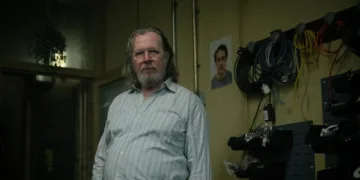
The family looks prosperous from the outside. Feng, played by Frederick Lee, is a respected surgeon positioning himself for greater status at the hospital. Their older son Han is being pushed toward medical school, partly because Feng sees his child less as a person than as a succession plan with a backpack.
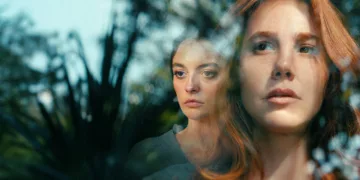
The younger Rui watches from the margins, still young enough to register tension without having the language for it. Then Xue-jin, an ophthalmologist and photographer played by Ke-Xi Wu, reenters Shu-yi’s life. She is Han’s new fixation, and she is also Shu-yi’s former lover. That overlap gives the film its melodramatic engine. Its real subject is quieter: the damage caused by a family that treats image maintenance as love.
Shu-yi’s Buried Self
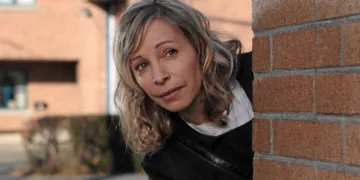
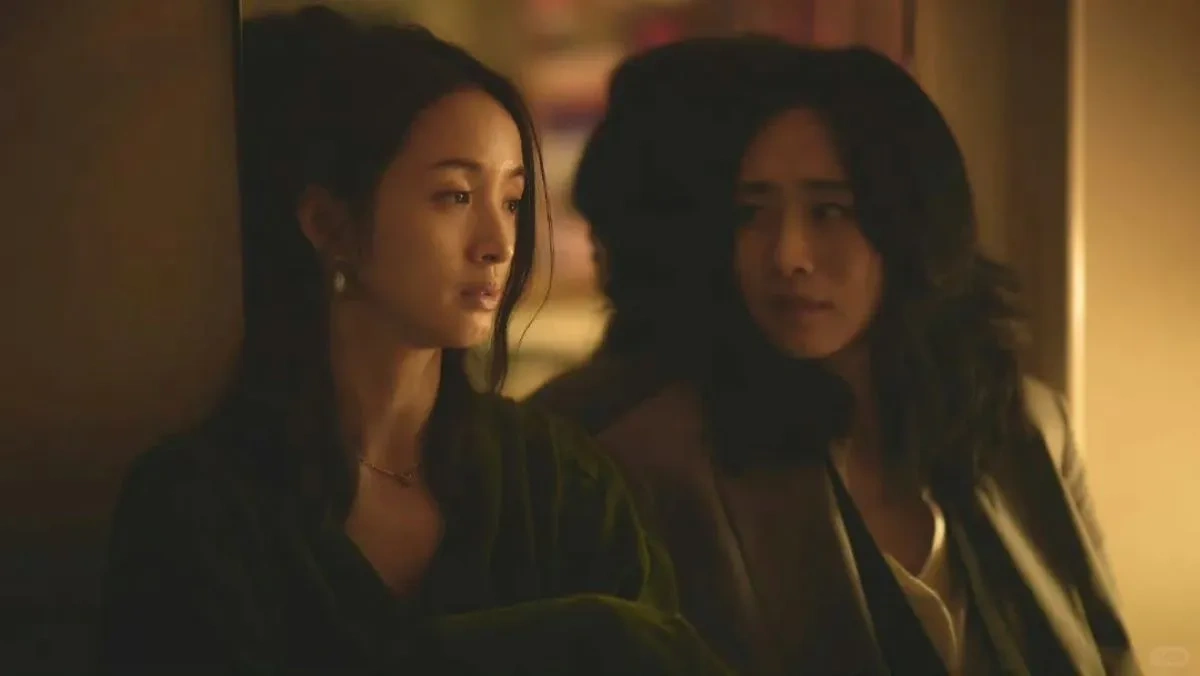
Lin gives Blind Love its center by making Shu-yi’s stillness active. Watch how she holds herself around Feng, how she seems to edit her own presence before anyone else can object to it. The performance is built from pauses, glances, and half-finished impulses. Shu-yi does not need to announce that she is unhappy. The film lets the house do some of that work, placing her in polished rooms that look less lived-in than managed.
The flashbacks to Shu-yi and Xue-jin’s teenage romance bring the source of that containment into focus. Their past is tied to photographs, touch, and the kind of intimacy that survived only because it was hidden. When Shu-yi’s mother discovers her queerness, the judgment lands like a family sentence. Chou is sharpest in showing how that sentence keeps running long after the judge is gone.
One of the film’s strongest scenes comes after Shu-yi’s mother dies, when Shu-yi admits feeling relief and is immediately wounded by her own guilt. That moment says more about inherited shame than several heavier passages around it. The old authority figure has vanished, yet the rule remains.
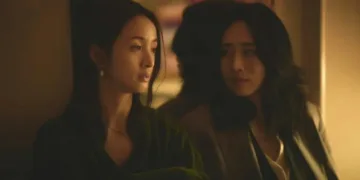
The reunion with Xue-jin carries that same pressure. Their confrontation in the women’s restroom, framed through mirrors, is the film’s cleanest visual idea: Shu-yi is forced to look at the self she performs and the self Xue-jin remembers. It is a tight scene, almost too neat in its symbolism, yet Lin and Wu give it enough emotional abrasion to keep it human.
A Triangle With a Structural Problem
Han’s attraction to Xue-jin is the story’s boldest choice and its least stable one. On paper, it is a smart piece of narrative engineering. Han and Shu-yi are drawn toward the same woman because both are trying to escape lives Feng has already drafted for them. He pressures Han toward medicine with the same dead certainty that keeps Shu-yi inside marriage, motherhood, and respectability. Nobody in this house is asked what they want. They are assigned a role, then graded on compliance.
There is good material in Han’s pull toward photography. Xue-jin does not merely tempt him sexually; she gives him permission to see himself outside the narrow future Feng has built. Their scenes work best when they stay in that uncertain zone between mentorship, desire, and projection. The trouble starts when the script needs their intimacy to carry too much plot weight.
The sexual encounter between Han and Xue-jin is carefully staged, with mostly static framing that echoes her photographic eye. The scene has a strange, deliberate quiet, and Jimmy Liu plays Han’s confusion with sensitivity. Still, the relationship feels thinner than Shu-yi and Xue-jin’s. Chou uses it to trigger revelations, near-collisions, and family irony, but the emotional groundwork is not always there. The film wants the triangle to expose buried longing across generations. Sometimes it does. Sometimes it feels like a diagram with skin.
Ke-Xi Wu helps steady the problem. Her Xue-jin is warm, elusive, and faintly dangerous because she means different things to different people. To Han, she is escape. To Shu-yi, she is evidence. To the film, she is often a symbol, which is a hard job even for a strong actor.
Seeing, Underlined
Chou fills Blind Love with eyes, mirrors, photographs, medical spaces, bathrooms, and frames within frames. Xue-jin being an ophthalmologist is subtle in the way a siren is subtle, but the visual scheme has force when Chou trusts it. Tamas Dobos’ subdued interiors give the family home a glossy airlessness. The static compositions make certain rooms feel posed, as if the family is always preparing for a portrait nobody asked to take.
The Pride parade glimpsed through Rui’s car window is one of Chou’s better social gestures. Public Taiwan appears changed, visible, even celebratory. Inside the family car, the old order remains intact. That contrast says plenty without turning legal progress into an easy cure for private fear.
The film is less persuasive when it turns Feng into a blunt instrument. Lee plays the coldness clearly, but the script keeps stacking cruelties until Feng becomes less a man than a patriarchal filing cabinet with a hospital badge. His ambition, his control over Han, his fixation on Shu-yi’s appearance, and the marital rape scene all point in the same direction. The last of those scenes is upsetting and direct, but it also reveals the film’s habit of pressing harder after the point has landed.
At 145 minutes, Blind Love has room for silence, and some of its best acting lives there. It also repeats emotional beats it has already made plain: Shu-yi is suffocating, Han is resisting, Feng is controlling, Xue-jin is disruption made flesh. The long runtime gives Lin and Wu space to build tension through small changes in posture and eye contact. It gives the screenplay space to circle the same wound with a very clean pen.
The 2024 coda is warmer than expected, and thankfully less tidy than it might have been. Feng begins to open emotionally. Shu-yi and Xue-jin can share a frame without the same fear pressing against them. Chou does not erase the harm that brought them there. The film’s better instinct is to let release look fragile, because in this family, even honesty has to learn how to stand.
The atmospheric Taiwanese melodrama Blind Love made its global festival debut at the International Film Festival Rotterdam in early 2025 before launching its digital footprint in the West. Audiences in the United States can stream the feature film on-demand via the subscription platform Film Movement Plus, where it was made available on June 19, 2026. The storyline centers on a quiet, deeply unhappy mother and her rebellious teenage son who unknowingly become infatuated with the exact same woman, a local eye doctor and hobbyist photographer, which exposes the hidden fractures running beneath their family’s outwardly perfect domestic facade.
Where to Watch Blind Love (2025) Online
Full Credits
Title: Blind Love (失明)
Distributor: Film Movement, Flash Forward Entertainment
Release date: February 6, 2025 (Rotterdam International Film Festival), June 19, 2026 (United States Streaming Release)
Running time: 145 minutes
Director: Julian Chou (Mei-Yu Chou)
Writers: River Wu
Producers and Executive Producers: Chen Pao-ying, Ariel Lin, Patrick Mao Huang
Cast: Ariel Lin, Wu Ke-xi, Jimmy Liu, Frederick Lee, Moon Lee, Wang Yu-xuan, Li Xing, Bella Chen
Director of Photography (Cinematographer): Tamás Dobos
Editors: Chen Po-wen
Composer: Chris Hou
The Review
Blind Love
Blind Love is strongest when it treats repression as a family system rather than a personal mood. Ariel Lin gives Shu-yi a quiet, precise ache, and her scenes with Ke-Xi Wu carry the film through its baggier passages. The Han and Xue-jin thread has the right dramatic idea, but not enough emotional scaffolding. Feng, meanwhile, becomes the sort of villain a sharper script would have resisted. Still, Julian Chou finds real feeling in Shu-yi’s delayed self-recognition and in the fragile peace of the 2024 coda.
PROS
- Ariel Lin’s restrained performance
- Strong Shu-yi and Xue-jin tension
- Mirror and photography motifs
- Sharp mother-son parallels
- Gentle, earned 2024 coda
CONS
- Han romance feels underbuilt
- Feng is written too bluntly
- Blindness metaphor gets overworked
- 145-minute runtime drifts
- Some revelations feel engineered