














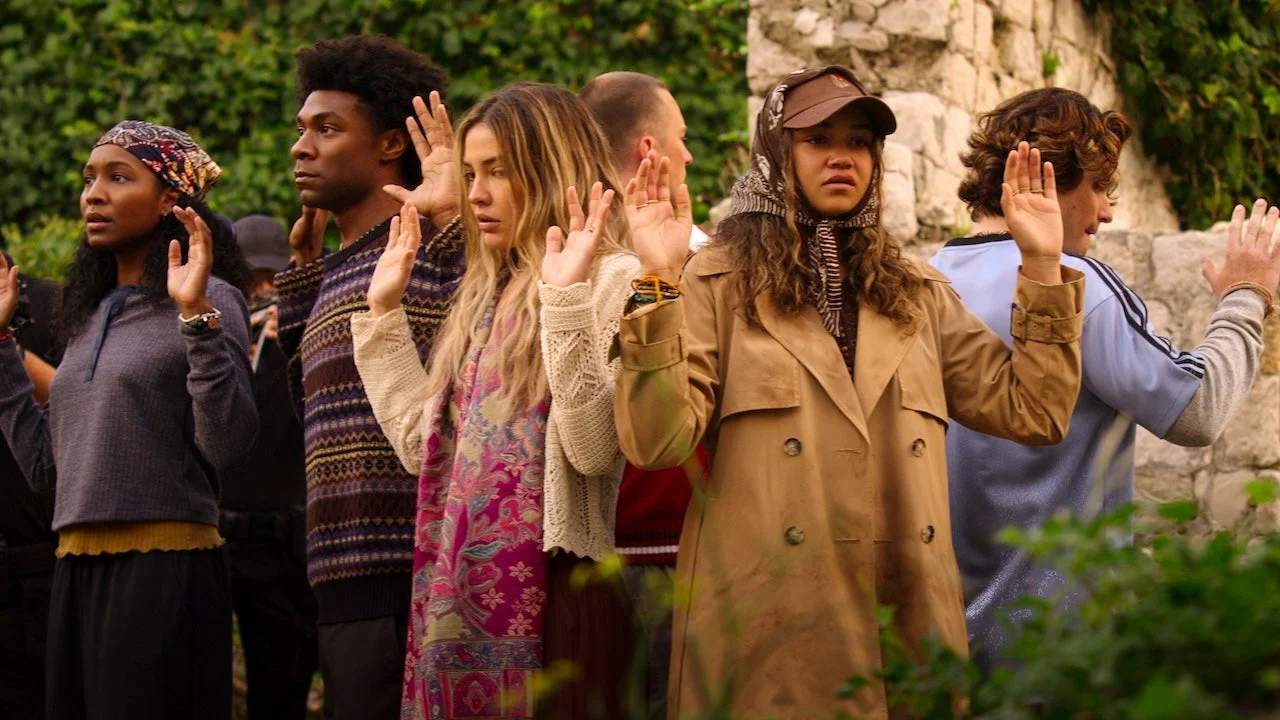

Five seasons of Outer Banks have turned a North Carolina class divide into an international logistics problem. What began with John B (Chase Stokes) and his friends chasing buried gold through a community split between Pogues and Kooks now sends the same group through Morocco, Spain, Croatia, Nassau, the Balkans, Azerbaijan, and New Orleans. Netflix has spent years making the map larger. Season 5 finally has to ask what all that expansion cost.
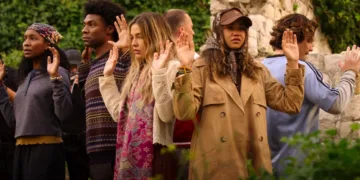
That question arrives through absence. JJ Maybank (Rudy Pankow), the reckless spark who could turn terrible judgment into irresistible television, was murdered by his biological father Chandler Groff (J. Anthony Crane) at the end of Season 4. The final 10 episodes begin with the Pogues stranded in Morocco, mourning him while Groff escapes with the Blue Crown.
JJ’s death changes the show’s rhythm immediately. The Pogues have always survived through chemistry, their catastrophes made pleasurable by the sense that these kids would happily ruin their lives together. Remove the loudest source of that energy and the series becomes heavier. Sometimes productively so.
Season 5 remains addicted to escalation, yet its best material keeps pointing backward, toward the beaches, class resentments, bad decisions, and friendships that once made the Outer Banks itself feel like a character rather than a departure gate.
Kiara Gets the Weight
The final season belongs emotionally to Kiara Carrera. Madison Bailey is asked to carry grief, rage, physical action, and a large portion of the treasure mythology, often while separated from the ensemble that previously defined her character. She responds with the strongest work of the season.
Kiara watched JJ die. Her pursuit of Groff therefore has none of the playful opportunism that once powered the Pogues’ treasure hunts. She wants revenge, and Bailey lets that desire hollow Kiara out rather than turning it into simple action-hero resolve. Her scenes pursuing Groff carry a physical aggression that feels less like newfound competence than someone who no longer sees self-preservation as especially persuasive.
Also Read





That distinction matters once the Blue Crown’s mythology starts suggesting that death itself might be reversible. The Crown is said to possess supernatural power connected to the dead, giving Kiara a reason to invest emotionally in a treasure beyond money. The show has flirted with increasingly fantastical mythology for years. Here, the idea gains unusual legitimacy because grief makes irrational hope entirely credible.
The penultimate episode gives Bailey her finest material when Kiara’s relationship with JJ is reframed through memory. Instead of allowing his murder to become the final definition of him, the sequence recalls the friendship and romance that came before it. The visual polish helps, yet Bailey’s face does most of the work. Grief stops functioning as a plot engine for a moment and becomes something recognizably human.
Streaming dramas regularly kill a beloved character for velocity, then discover mourning is inconvenient once the next episode needs to move. Outer Banks gives JJ’s absence real duration. The irony is that Kiara’s isolation means the season sometimes sacrifices the group dynamic it is trying to honor.
Poguelandia Meets Plot Inflation
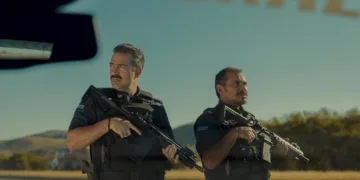
Returning to Kildare should simplify things. Instead, Season 5 briefly resembles a writers’ room determined to use every index card before the series ends. Cleo (Carlacia Grant) faces deportation to the Bahamas. Pope (Jonathan Daviss) spends time in county jail. John B and Sarah Cameron (Madelyn Cline), now expecting a child, struggle with housing and money. The Blue Crown is gone. Groff remains loose. Each problem is substantial enough to support its own storyline. Then John B finds drugs floating in the water.
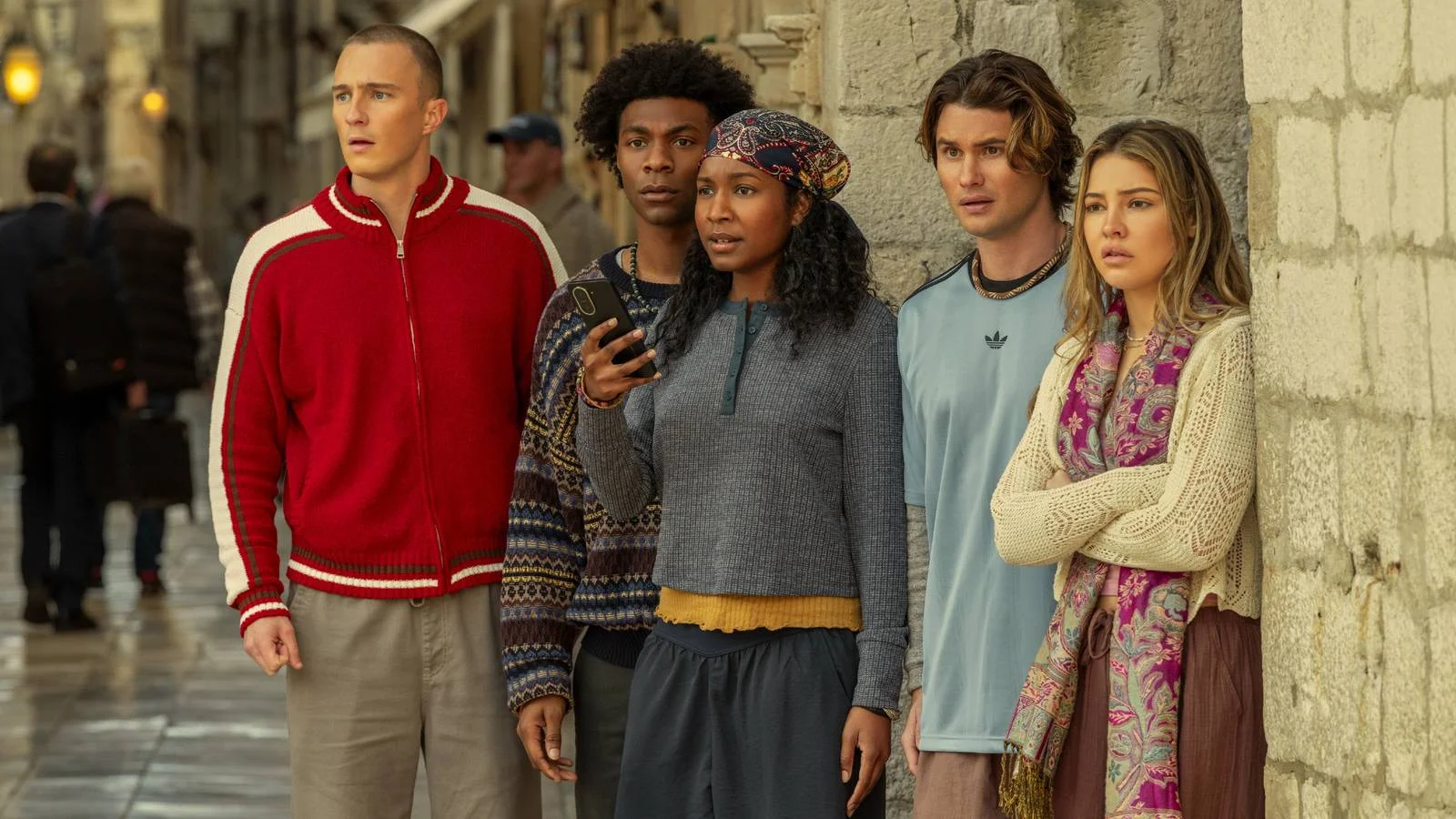
His decision to get involved with them kicks off a trafficking plot that sends him and Sarah toward New Orleans and brings another set of criminals into an already crowded season. The choice has the chaotic stupidity of early John B, which would be charming under different circumstances. Season 5 has already positioned him as someone beginning to understand the human cost of chasing one dangerous opportunity after another. Reverting him here feels less like characterization than the machinery demanding fuel.
A revived land-development fight produces Dale Zeasy (Jason Davis), another wealthy Kook antagonist whose hostility is tied to profit and contempt for Pogues. The storyline reconnects the series to its original class politics, where money shaped housing, policing, social access, and the possibility of escaping Kildare’s hierarchy. Yet Zeasy is written with so little complexity that the social conflict becomes a button the series can press rather than a system it can examine.
Sarah turning 20 provides an unintentionally useful reality check. These people have spent years fleeing murderers, surviving shipwrecks, uncovering lost civilizations, handling firearms, crossing borders illegally, and confronting murderous fathers. They are barely adults. That tension has always been part of the show’s charm. Season 5 occasionally mistakes perpetual recklessness for permanent youth, and those are different things.
Growing Sideways
John B and Sarah are now the closest thing this franchise has to stability, which says plenty about everyone else. Their early romance supplied much of the show’s emotional momentum. By Season 5, their relationship is calmer, with Sarah’s pregnancy forcing the pair to imagine a future shaped by something other than the next treasure.
The show still refuses to let domestic responsibility interfere with spectacle. Sarah ends up hanging upside down from a fence during the finale with electrocution looming nearby, because apparently prenatal care in Kildare includes advanced stunt work. Cline sells the terror and determination of the scene without reducing Sarah to someone suddenly too fragile for the series around her.
Pope receives promising material after jail temporarily roughens a character once defined by caution and academic ambition. Jonathan Daviss suggests a changed relationship to risk, particularly when Pope’s family becomes entangled in the renewed land conflict. The season does not always give that development enough room.
Cleo fares worse. The threat of deportation gives her an immediate crisis, yet her later material increasingly positions her through Pope. A character who entered the series with her own history and survival instincts deserves stronger ownership of her farewell.
Rafe Cameron gets one of the stranger, richer transformations. Drew Starkey has spent years making Rafe’s entitlement and instability feel dangerous, so watching the Pogues rely on him carries necessary discomfort. He does not suddenly become pleasant. Good. Starkey’s sharp delivery works far better when Rafe is an abrasive ally carrying the memory of everything he has done.
This rehabilitation also exposes a recurring streaming habit: keep a charismatic antagonist around long enough and the story eventually starts negotiating with him. Rafe survives that process because Starkey never lets decency erase the unpleasant man underneath.
Groff goes in the opposite direction. Ward Cameron’s monstrosity was complicated by recognizable attachment to his children. Groff is greed stripped of sentiment, played by Crane with the greasy confidence of a villain who seems one wardrobe adjustment away from tying someone to railway tracks. His simplicity fits the heightened adventure serial that Outer Banks has gradually become.
Bigger Weather, Smaller Truths
The final season still knows how to stage chaos. A motorcycle chase races along castle walls. A rockslide erupts. Kiara gets punishing solo action. Sarah’s fence sequence piles peril onto pregnancy. The extended hurricane climax drenches the cast in enough water to make the production’s insurance department deserve its own documentary.
Location shooting remains one of the series’ strongest production choices. Croatia, the Bahamas, and other international settings have physical texture that keeps even absurd narrative turns grounded in real space. The persistent night-for-day photography can look awkward, yet the larger action sequences retain a tactile quality that streaming adventure often loses beneath polished digital environments.
The hurricane finale pushes that physicality hardest. Heavy rain, practical staging, digital effects, debris, and sustained environmental danger make the closing episode feel appropriately enormous. Television finales are currently encouraged to resemble feature films, as though scale itself were proof of affection for an audience. Outer Banks happily accepts the assignment. Yet the series’ most meaningful image remains much smaller: the Pogues together, near home, with no mythical city required.
Across five seasons, treasure has mutated from gold into crosses, El Dorado, crowns, resurrection myths, and international conspiracies. The economic fantasy underneath stayed remarkably consistent. These young people keep trying to acquire enough wealth to escape a system that has already decided which side of the island belongs to them.
JJ’s death finally makes that cycle impossible to treat as harmless adventure. Every new fortune has carried another cost, and Season 5 understands this whenever Kiara remembers the person rather than the prize. The Pogues keep looking outward because movement is the grammar of the show. Home is where its meaning has been hiding.
That makes the final season frustrating in a particularly appropriate way. It sends these characters across half the planet before allowing them to recognize the value of staying put. Netflix built a global hit from kids who wanted freedom from one tiny island, then spent years proving how difficult it is to leave an identity behind once a franchise has learned to sell it. The beaches were enough. The Pogues were enough. Season 5 takes the scenic route to remember it.
Outer Banks Season 5 premiered on August 20, 2026, and is available for streaming globally on Netflix. Serving as the final chapter of the hit teen adventure series, the fifth season follows John B and the Pogues as they embark on one last high-stakes treasure hunt, confronting dangerous rivals and uncovering long-buried secrets to complete their journey.
Where to Watch Outer Banks Season 5 Online


Full Credits
Title: Outer Banks
Distributor: Netflix
Release date: August 20, 2026
Rating: TV-MA
Running time: 50 minutes per episode
Director: Jonas Pate, Josh Pate, Shannon Burke, Darnell Martin, Valerie Weiss, Gonzalo Amat
Writers: Josh Pate, Jonas Pate, Shannon Burke, Keith Josef Adkins, Kathleen Hale, Rachel Sydney Alter, Dan Dworkin, Jay Beattie
Producers and Executive Producers: Jonas Pate, Josh Pate, Shannon Burke, Aaron Miller, Sunny Hodge, Carole Sanders Peterman
Cast: Chase Stokes, Madelyn Cline, Madison Bailey, Jonathan Daviss, Rudy Pankow, Austin North, Drew Starkey, Carlacia Grant, Fiona Palomo
Director of Photography (Cinematographer): J.B. Smith, Brad Smith, Gonzalo Amat
Editors: Sunny Hodge, Jeffrey M. Werner, Aaron Boodman
Composer: Fil Eisler
The Review
Outer Banks Season 5
Outer Banks ends caught between two versions of streaming television: the intimate teen drama that made the Pogues matter and the global franchise machine that keeps sending them somewhere bigger. Madison Bailey gives the final season its emotional center, turning Kiara’s grief into something the endless chases cannot manufacture. The hurricane finale delivers the scale Netflix clearly wants, yet the strongest moments remain remarkably small, rooted in friendship, memory, and the Outer Banks itself. The Pogues deserved a little more time at home.
PROS
- Madison Bailey’s powerful performance
- Kiara’s sustained grief arc
- Drew Starkey’s evolved Rafe
- Impressive location photography
- Spectacular hurricane finale
CONS
- Overstuffed final-season plotting
- Unnecessary drug-trafficking detour
- Uneven character attention
- Groff lacks Ward’s complexity
- Too much time away from the OBX