




























The strangest burden in Let Us Through, Dear Ancestors is not the marble itself. It is the knowledge of what that marble will become. Men drag it through jungle paths, guard it from thieves, collapse under the work, and continue because a church must rise where Padre Enciso has decided a church belongs. Lav Diaz makes that future structure feel present long before we see its walls. Every slab carries the weight of a building that will survive the people forced to serve it.
Set in the Philippines in 1617, the film places colonialism inside ordinary acts of obedience. Enciso, played by Bart Guingona, commands labor in the name of Catholic salvation while moving through the settlement with the appetites of a man who believes power has erased consequence.
Men are sent on dangerous expeditions. Women are treated as available bodies. Local belief is recast as threat. His authority enters work, sex, property, family, and faith until there is almost no part of life left untouched by it. The cruelty is institutional, but Diaz keeps returning it to bodies that have to carry, wait, kneel, walk, endure.
Dungwen gives that violence a familial shape. Christian Bables plays him as a man who rejects the father who claims him and still cannot escape the world that father controls. Enciso sends him to lead the transport of marble for the church, a mission Dungwen accepts without any meaningful freedom to refuse.
He has a wife and daughters. He wants to provide for them. He wants distance from the priest whose blood ties him to the colonial hierarchy. None of those desires matter much once an order has been given. The father can be hated. The system remains.
This is where the film becomes especially bleak, because resentment offers no protection. Dungwen’s hostility toward Enciso does not grant him a clean moral position outside colonial power. He still has to move through roads shaped by that power, manage men trapped inside it, and haul material toward a monument to the religion that has helped justify their subjugation. Diaz understands domination as something that outlives conviction. You do not have to believe in the church to spend your life building it.
The title gives that idea another register. Dungwen’s daughters call toward the forest and ask the ancestors to let them pass. The phrase carries humility, a recognition that the land is inhabited by memory even when no living person stands in the path. It is difficult not to hear the ethical contrast. The indigenous characters ask permission from the unseen. The colonizers ask permission from no one.
Babayeng Indimatandog, played by Isabel Sandoval, belongs to that older spiritual order. A healer traveling with her brother Himamat, she practices a form of faith that Enciso cannot absorb into Catholic rule, so he treats her existence as defiance. She is arrested and confined in a small cell.
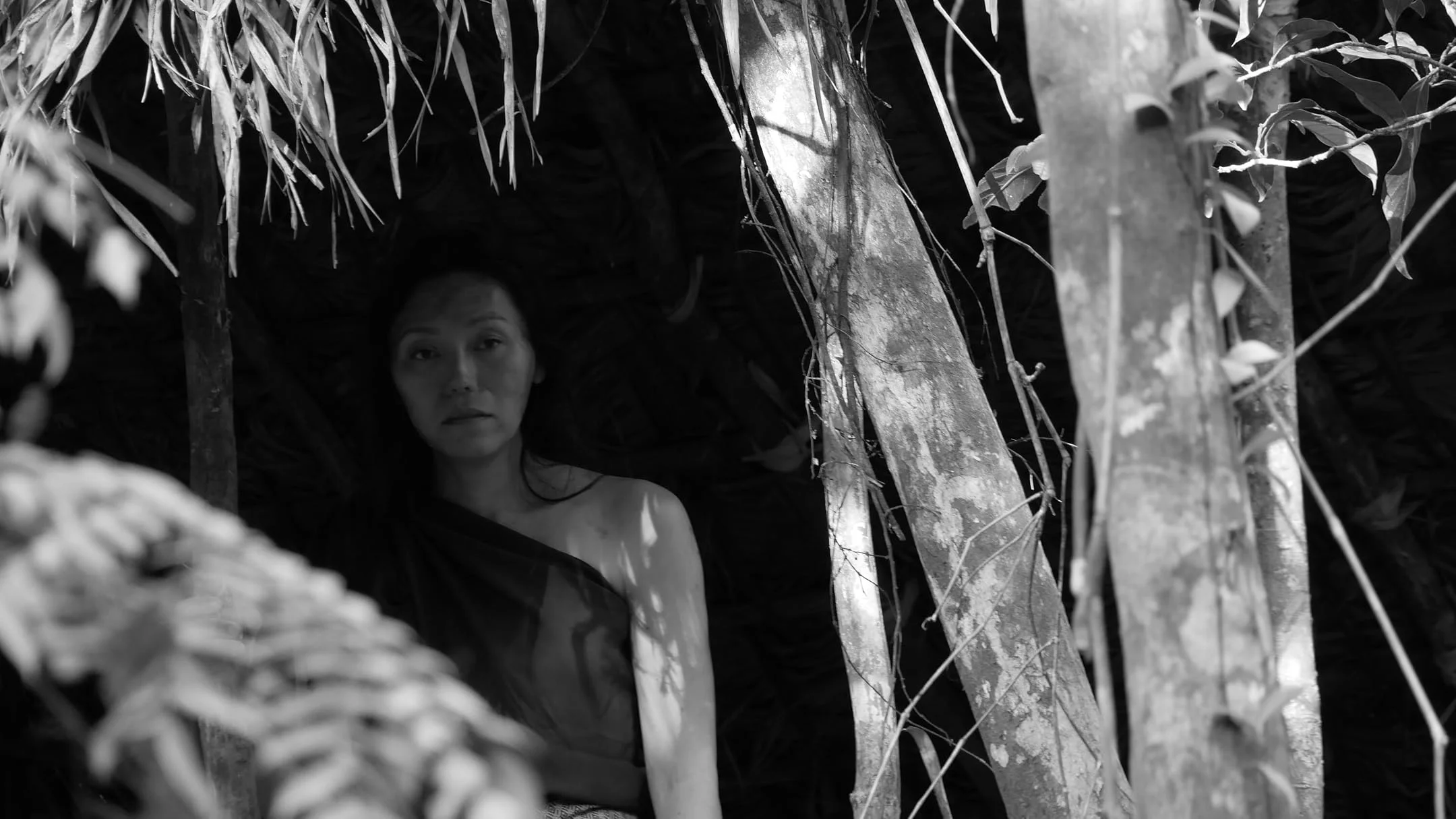
Sandoval’s stillness matters here. Diaz rarely gives her the kind of close-up that would turn suffering into a demand for immediate sympathy. She is often held within the larger frame, a human figure surrounded by walls, jungle, distance, and watching bodies. Her presence becomes quieter as the forces around her grow louder.
There is a moment when she looks from the darkness toward the camera and smiles. The film does not explain the expression, and explanation would probably shrink it. It can feel like recognition, surrender, communion, or a glance across centuries toward those who inherit the world that follows her imprisonment. Diaz lets the ambiguity remain physical. A face looks out. Someone, somewhere, is looking back.
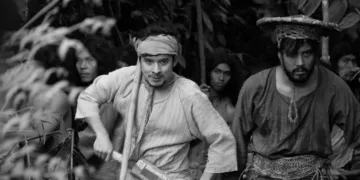
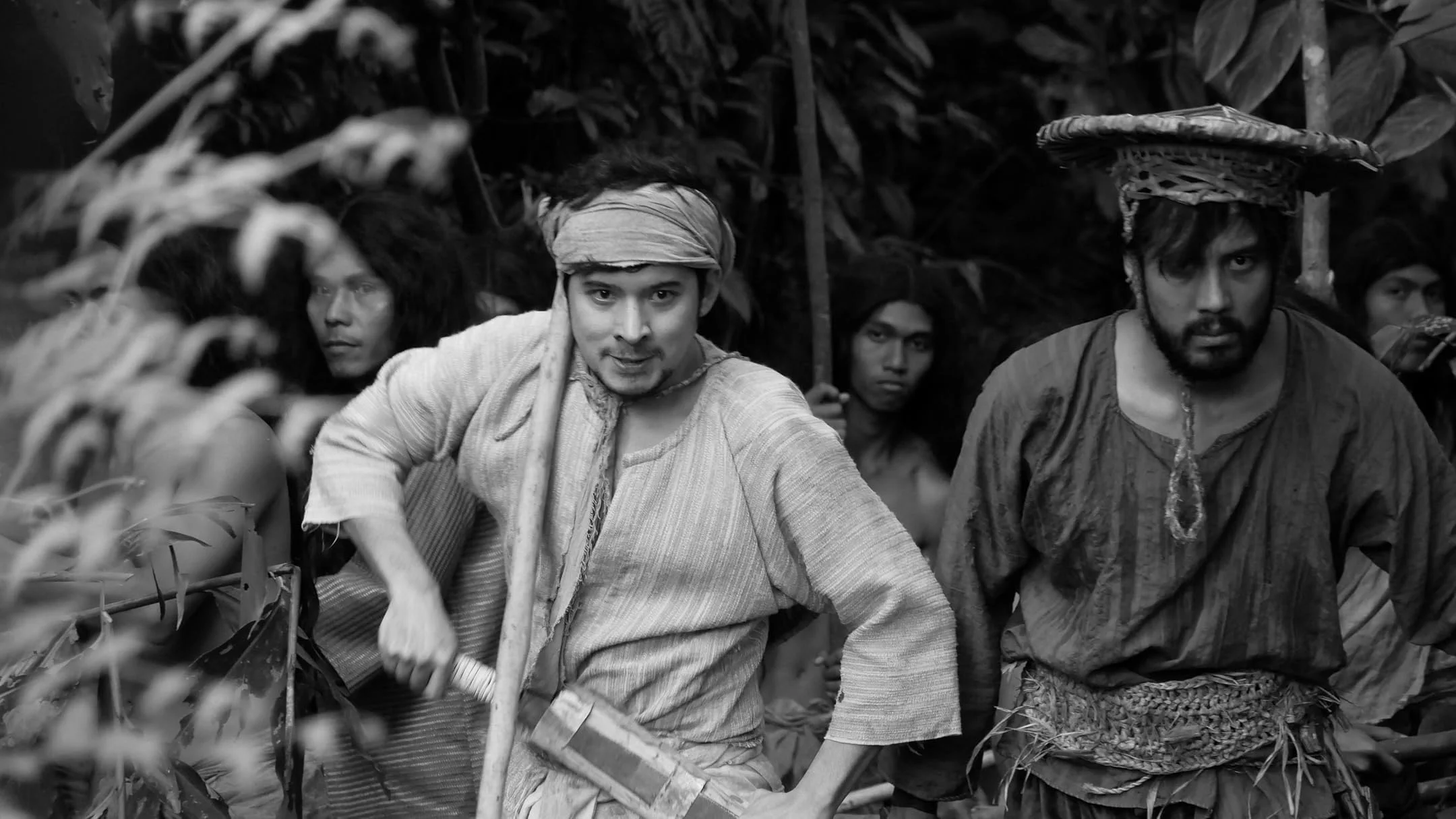
His black-and-white photography gives the landscape the density of weathered memory. The jungle is rarely background. Vegetation crowds paths, insects press into the soundscape, mud drags at bodies, and figures can become small inside the frame. Long shots and middle distances keep us from consuming every emotion through faces. The people remain visible, but the land keeps refusing to become scenery. It has its own duration, its own indifference, its own record of what has crossed it.
That distance also changes the violence. Bari-bari and his men trail Dungwen’s group, and danger thickens as the expedition moves through the forest, yet Diaz often withholds the attack itself. He gives us approach, fear, aftermath, bodies, absence. The expected burst of action is removed. What remains is labor interrupted by death and then resumed by whoever is left. There is something terrible in that rhythm because it denies violence the dramatic privilege cinema usually gives it. Death does not become a climax. It becomes another condition of work.
At 151 minutes, this is unusually compact for Diaz, though compact is a strange word for a film that still asks the viewer to sit inside walking, waiting, hauling, and silence. The slowness is not uniformly productive. During some of the expedition’s repeated stretches of walking, hauling, and waiting, the narrative pressure thins rather than deepens.
Yet the duration also gives exhaustion a moral dimension. We are made to spend time with effort that historical storytelling often compresses into a montage or a line of exposition. Here, the road stays long because it was long for the people ordered to cross it.
Enciso’s hypocrisy would be easier to bear if the film allowed him to become a singular monster. Diaz refuses that convenience. His racism, sexual violence, drunkenness, and religious arrogance are personal, but the church project does not depend on his personality.
Remove him and the marble is still there. The hierarchy is still there. The promises of money and land are still there. The belief that one people may rename another people’s gods and call the theft salvation is still there. Evil becomes harder to dismiss when it looks administrative.
That may be the film’s deepest sadness. Some men die. Some disappear. Some are left with grief and no meaningful recompense. The building toward which all this suffering flows can still stand. Diaz does not need to show the completed church for its future to become oppressive. We already know what endurance will belong to stone and what fragility belongs to flesh.
The closing vision of liberation remains deferred, spoken as something still to be achieved rather than something history has generously delivered. Diaz offers no easy revenge to correct the record. He leaves the wound open and the path crowded with the dead. Dungwen’s daughters ask their ancestors for passage because memory deserves respect. The tragedy is that empire entered by another rule entirely.
Let Us Through, Dear Ancestors had its world premiere out of competition at the 83rd Venice International Film Festival on September 11, 2026. Set in 1617 during the Spanish colonial period in the Philippines, the historical drama follows a Spanish friar enforcing forced labor to build a church while native populations resist colonial and religious subjugation.
Full Credits
Title: Let Us Through, Dear Ancestors
Distributor: C’est Lovi Productions, Epicmedia Productions, Sine Olivia Pilipinas
Release date: September 11, 2026 (Venice International Film Festival)
Running time: 2 hours 31 minutes (151 minutes)
Director: Lav Diaz
Writers: Lav Diaz
Producers and Executive Producers: Bianca Balbuena, Montgomery Blencowe, Lovi Poe
Cast: Bart Guingona, Ronnie Lazaro, Isabel Sandoval, Yul Servo, Christian Bables, Bong Cabrera, Rafa Siguion-Reyna, Amado Arjay Babon
Director of Photography (Cinematographer): Lav Diaz
Editors: Lav Diaz
The Review
Let Us Through, Dear Ancestors
Let Us Through, Dear Ancestors turns colonial history into something bodily: marble dragged through mud, faith enforced through confinement, power inherited like a wound. Lav Diaz’s distant framing and refusal to stage violence as spectacle give the film a grave, lingering force. Its 151 minutes occasionally repeat an emotional pressure already understood, yet that patience also makes exhaustion part of the argument. The church may outlive everyone forced to build it. Diaz finds his tragedy there, in the terrible durability of structures and the fragile lives buried beneath them.
PROS
- Haunting black-and-white photography
- Violence withheld with purpose
- Powerful use of landscape and duration
- Strong colonial and spiritual themes
- Isabel Sandoval’s restrained presence
CONS
- Some expedition passages repeat their dramatic pressure
- Deliberate pacing can test patience
- Several characters remain secondary to the larger historical design