


























Gavin has already performed the culturally approved version of queer escape before grief sends him back to Missouri. He left for Chicago, built a life around friends and a drag-show community, and learned to treat home as somewhere that could safely remain behind him. Then his father dies. The return should activate a familiar American movie grammar: the liberated city self confronting the small town that made liberation necessary. Trash Mountain keeps setting up that story and then quietly refusing to deliver it.
That refusal gives Kris Rey’s film its most interesting quality, even when the surrounding structure feels inherited from an older Sundance playbook. Gavin, played by co-writer Caleb Hearon, does encounter the expected markers of homecoming: an awkward run-in with an old schoolmate while shopping, a blunt local dispensing wisdom, a brief Grindr romance, a grandmother whose reactions could power a network sitcom.
Yet the film denies Gavin the clean moral hierarchy those devices usually create. His father accepted his sexuality. His sister Abbi, played by Zooey Deschanel, is not an estranged sibling waiting for a third-act reconciliation. Gavin has good reasons for leaving, but the town is not reduced to a punishment he escaped.
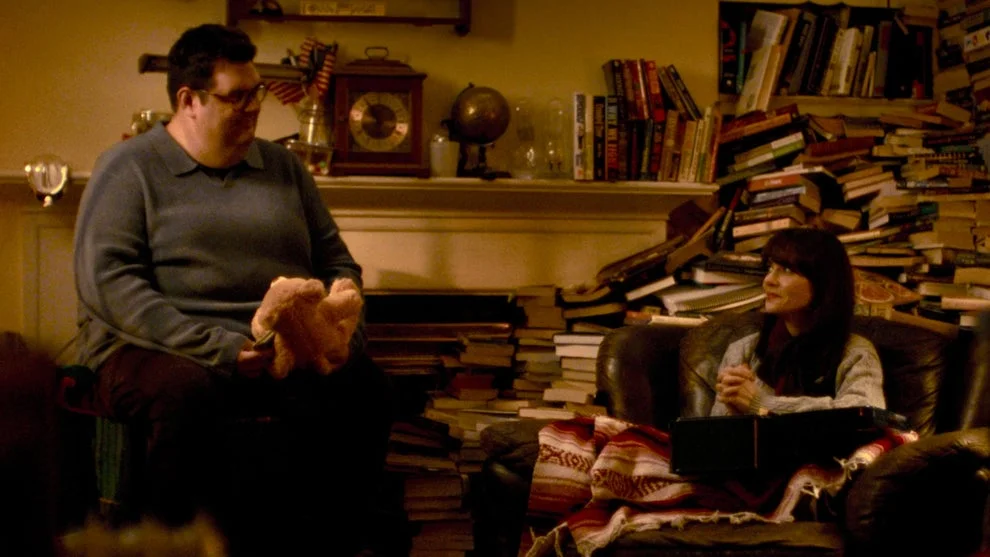
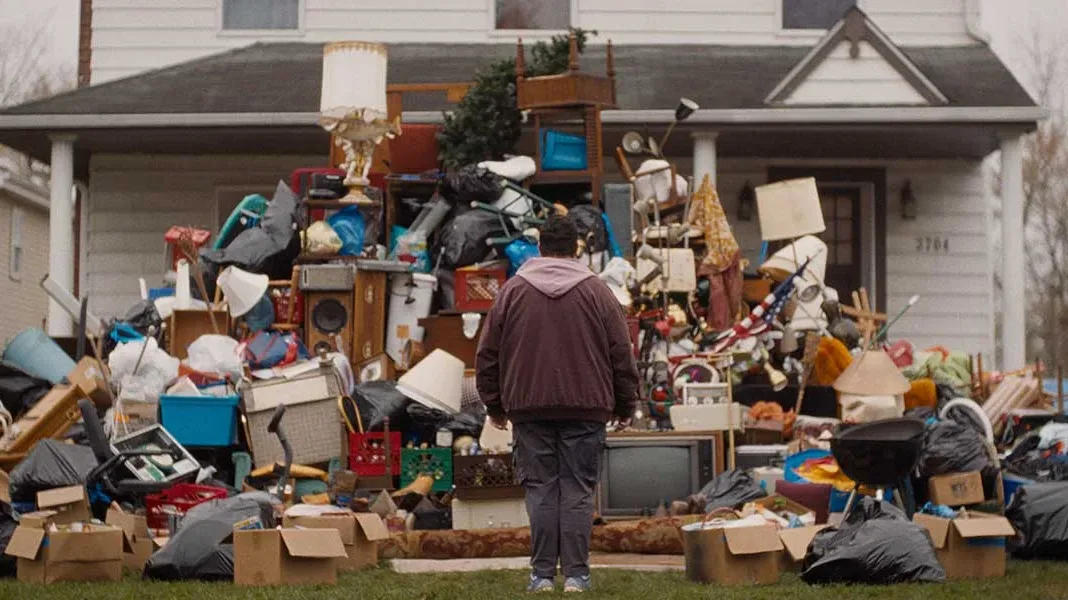
The house their father leaves behind makes that refusal physical. He was a hoarder, and Gavin and Abbi must clear rooms packed with the residue of his life while hunting for the Social Security card needed to move the estate process forward. One slow pan across the accumulated junk captures the task better than exposition could: grief has become labor, bureaucracy and triage. Every object has to be judged. Garbage can go. Memory is harder.
That is where the film’s familiar premise acquires some genuine texture. Their father was an alcoholic and a loner, yet the siblings cannot sort him with the same confidence they bring to his belongings. The missing Social Security card is almost comically mundane beside the emotional work surrounding it, which is precisely why it functions so well. Death does not arrive as a grand revelation here. It arrives as paperwork, cleaning and the strange indignity of deciding what another person’s possessions were worth.
Hearon is well suited to this tension because Gavin’s humor rarely feels separate from his evasions. The opening stretch gives him the social command of a performer accustomed to moving quickly through a room, and Missouri gradually strips away the usefulness of that command.
He remains funny, sometimes very funny, but anger and hurt begin appearing in the gaps between jokes. A late fireside conversation with Abbi lets that armor loosen, though the film arguably waits too long to give shape to Gavin’s relationship with his father. Restraint can preserve ambiguity. Here it occasionally leaves an emotional blank where a more precise history would have deepened the final act.
Deschanel works best against Hearon when the siblings are needling each other with the ease of people who do not need conflict to prove intimacy. The absence of a manufactured feud is refreshing. It creates another problem, though: Gavin, Abbi and her husband often share a similar comic cadence, and the wit can flatten distinctions between them. The writing understands how this family jokes before it always understands how each member sounds when nobody is performing for the others.
Jacki Weaver’s grandmother pushes that tonal strain further. Her praying, swearing and wailing can be funny, and her emotional directness gives the siblings something their deflection cannot. The performance is also broad enough to feel imported from a louder film. In a story whose best material depends on uncertainty about how people should remember the dead, such emphatic comic signaling occasionally breaks the spell.
Leaving is easier than belonging
The film becomes sharper once Gavin’s discomfort with Missouri is allowed to extend beyond family history. Rey and the screenplay acknowledge the town’s conservative politics through details such as a truck carrying Confederate and “Don’t Tread on Me” flags alongside a Trump 2020 bumper sticker. The point is clear, but the film does not let that image become the entire social diagnosis. Jerome, Gavin’s local Grindr connection, is openly gay and content there. Trish is abrasive, funny and kind. The landscape itself receives an affection Gavin has difficulty granting it.
This matters because queer American storytelling has often treated geography as destiny. The small town signifies repression; the city signifies selfhood. Gavin has built his adult identity around that map. Trash Mountain complicates it through behavior instead of speeches. The old classmate who corners him while shopping is irritating without becoming a monster. Jerome’s existence challenges the assumption that a gay life in this place must be incomplete. Even Gavin’s father refuses the role of homophobic patriarch that the genre has trained audiences to anticipate.
The romance with Jerome initially looks like another predictable stop on the homecoming itinerary, but their easy chemistry gives it weight, and a later conversation about how swiftly gay intimacy can be entered and abandoned introduces a sharper emotional idea. Gavin is fluent in departure. Chicago, casual sex, jokes and the promise of being back by Thanksgiving have all given him ways to keep experience temporary. Jerome makes that habit visible without turning himself into a lesson delivered for Gavin’s benefit.
That same tension runs through the house. Gavin wants to clear it, complete the estate business and leave. The material surrounding him keeps insisting that departure does not settle meaning. This is also why the film’s conventional last-act machinery lands unevenly. Mild confrontations, quick repairs and emotional disclosures arrive with the recognizable efficiency of the genre, and some of the hardest feelings have not been developed enough to carry the force the climax seeks.
Still, Trash Mountain is strongest when it refuses the easy sorting its title seems to promise. The father can be loving and damaging. Missouri can be politically hostile and personally sustaining. Gavin can have escaped something real while still misreading what remained.
Rey and Hearon do not consistently escape the formulas of the homecoming dramedy, but their best scenes expose the cultural fantasy beneath those formulas: that adulthood means learning which place, family and version of the self belongs in the trash pile. Gavin’s problem is that the categories keep collapsing as he cleans.
Trash Mountain had its world premiere in the Centrepiece section at the Toronto International Film Festival in September 2026. The comedy-drama follows a young gay man living in Chicago who returns to his rural Missouri hometown to sort through his late hoarder father’s estate alongside his sister.
Where to Watch Trash Mountain (2026) Online
Full Credits
Title: Trash Mountain
Distributor: Metronome Film Co.
Release date: September 2026 (Toronto International Film Festival)
Rating: R
Running time: 1 hour 30 minutes
Director: Kris Rey
Writers: Ruby Caster, Caleb Hearon
Producers and Executive Producers: Colin Trevorrow, Carrie Holt De Lama, Zachary Spicer, Kelley Sims, Rebecca Linfoot, Ben Gojer, Lilly Wachowski
Cast: Caleb Hearon, Zooey Deschanel, Kyle Marvin, Jaboukie Young-White, Jacki Weaver, Holmes
Director of Photography (Cinematographer): Andy Rydzewski
Editors: Troy Lewis, Tania Goding
The Review
Trash Mountain
Trash Mountain works best when its familiar homecoming structure begins resisting the cultural assumptions built into it. Gavin’s father, family, and Missouri hometown refuse to become convenient villains, while Caleb Hearon gives that ambiguity warmth, anger, and comic bite. Some supporting characters feel written in the same cadence, and the final act reaches emotional resolutions faster than its strongest ideas deserve. Still, the film finds considerable truth in the messy distance between escaping a place and understanding what remains there.
PROS
- Caleb Hearon balances comedy and grief convincingly
- Queer homecoming conventions receive thoughtful scrutiny
- The hoarded house gives grief a strong physical dimension
- Gavin and Abbi share believable sibling chemistry
CONS
- Several characters share overly similar comic rhythms
- Jacki Weaver’s broad register can disrupt the quieter tone
- Gavin’s history with his father remains underdeveloped
- The final emotional resolutions arrive too quickly