


















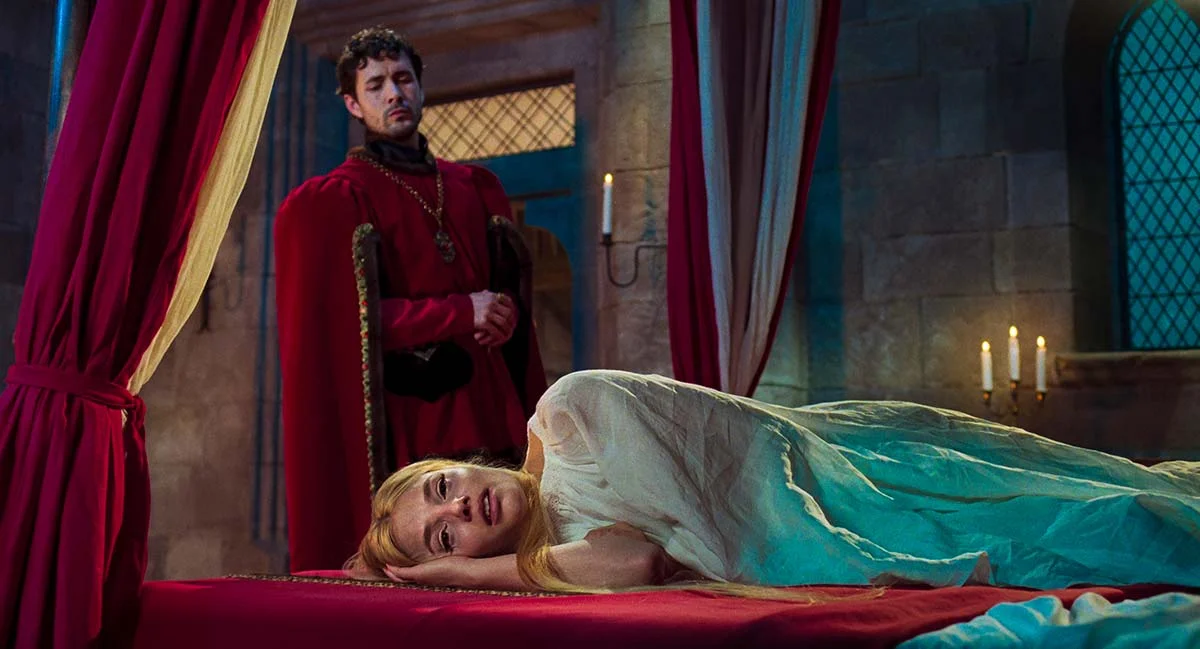

Anna Biller has made a film in which nearly everything looks artificial except the cruelty. The castles resemble studio castles, the armor gleams with improbable cleanliness, faces are lit as though every medieval bedroom came equipped with a Hollywood lighting crew, and the colors announce themselves before the characters do. Then Edward murders the father of the woman he wants to marry. The joke is obvious. The implications are less tidy.
The Face of Horror returns Biller to feature filmmaking a decade after The Love Witch, this time transplanting the Japanese ghost story Yotsuya Kaidan into a medieval England imagined through the visual grammar of old Hollywood. Historical accuracy is barely invited to the feast.
Biller and cinematographer M. David Mullen construct something closer to a forgotten studio production, saturated reds and greens, polished interiors, theatrical costumes, static compositions, and faces illuminated with the reverence once reserved for movie stars and saints. It would be easy to call this pastiche and move on. The harder question is what the pastiche is doing to the people trapped inside it.
Edward, played by Jonah Hauer-King, provides a useful answer. He wants Eleanor, played by Kristine Froseth, and responds to her father’s refusal by killing him. He then approaches the grieving daughter as her protector, promising justice for the murder he committed and securing the marriage he wanted. Chivalry becomes a costume before the film has finished displaying its literal costumes. Call it decorative morality: the belief that virtue can be worn convincingly enough to replace having any.
Edward is surrounded by the symbols of masculine honor while behaving like appetite with a sword. His affection for Eleanor proves equally ornamental. After marriage and childbirth alter their domestic life, his interest drifts toward Countess Isabel, whose wealth and position offer another path upward. Eleanor’s body, once the object that justified murder, becomes an inconvenience once it no longer satisfies the terms Edward privately imposed upon it.
I initially thought Biller’s point might be too simple. Man desires beautiful woman, woman changes, man reveals himself as monster. There are subtler machines for examining misogyny. Yet the film’s bluntness gradually starts to look deliberate in a richer sense. Edward inhabits a world obsessed with ceremony, rank, beauty, vows, and prescribed behavior. Nothing here is private. Even desire arrives wearing heraldry. His shallow treatment of Eleanor therefore belongs to a social order that keeps converting human beings into visible categories. Beauty is simply the category Eleanor has been assigned.
That makes Biller’s visual obsession especially productive. Mullen’s cinematography draws from three-strip Technicolor, with piercing whites, dense reds, lush greens, carefully sculpted faces, and compositions that resemble illustrated storybooks.
Biller compounds the effect with painted-looking environments, conspicuously glamorous armor, elaborate gowns, old-fashioned lighting, theatrical dialogue, and occasional sound choices resembling slightly imperfect studio ADR. Even a traditional panto sequence appears, because apparently the movie has decided two hours is insufficient unless a medieval ghost tragedy occasionally behaves like regional Christmas theater. This is either glorious commitment or an alibi.
The Face of Horror repeatedly asks the audience to accept choices that might look like flaws elsewhere because they belong to the cinematic language being recreated. Performances can become broad. Dialogue can become stiff. The camera often resists contemporary dynamism. Scenes linger. Characters sometimes discuss beauty and gender with the delicacy of someone engraving the thesis into a shield. There is a danger in this strategy. Intentional awkwardness remains awkwardness. A filmmaker cannot automatically convert sluggishness into sophistication by proving that films once moved slowly.
Biller mostly survives that problem because the delay serves a meaningful transformation. The supernatural material arrives late, with Eleanor’s disfigurement and Edward’s subsequent haunting positioned as consequences rather than opening attractions.
Until then, the film spends considerable time inside the marriage, Edward’s dissatisfaction, Eleanor’s insecurity, social rituals, Beatrice’s continued presence, Isabel’s entrance, and several deliberate detours. The horror has to wait while the conditions that produce it become intolerable. That wait will test patience. It tested mine. Then Eleanor changes, and the film’s excessive concern with appearances snaps into place.
Froseth appears essential to making that transition work. Early Eleanor carries the wide-eyed composure of an old studio ingénue, a woman expected to occupy the image prepared for her. After her disfigurement, Froseth’s performance expands into something physically ferocious, with grief, rage, screaming, and monster-movie theatricality pressing against the earlier restraint. The transformation risks becoming another spectacle of female suffering, except Biller turns the spectacle back toward the culture that produced it. Edward cannot endure the face created by his own cruelty.
The supernatural revenge is satisfying partly because it literalizes something already present. Edward has treated Eleanor as an image from the beginning. When that image becomes horrifying to him, he experiences her as a monster. She has not suddenly entered his nightmare. She has become impossible for him to aestheticize.
Hauer-King’s casting strengthens the irony. He has the physical outline of the gallant screen knight, which lets Biller use his appearance against the character’s behavior. Edward looks like the hero of the movie he imagines himself inhabiting.
His murders, betrayals, cowardice, and pursuit of Isabel keep exposing the distance between that fantasy and the man underneath. Bella Heathcote’s Isabel extends the film’s mixture of theatricality and social calculation, while Ellie Bamber’s Beatrice gains weight as her loyalty to Eleanor becomes increasingly important to the revenge structure.
Some of these figures remain archetypal. I am not convinced that is entirely a defense. Biller wants the clarity of fable and the artificiality of studio melodrama, yet archetype can still become emotional thinness when a two-hour film asks us to live beside it for this long.
That is the bargain The Face of Horror keeps offering. Its artificial surfaces create distance, then use that distance to expose a remarkably familiar ugliness. Edward belongs to a medieval fantasy, a Japanese ghost-story lineage, and an old Hollywood visual world, yet his governing principle requires no translation: he loves women according to the conditions under which they remain useful to him.
By the time Eleanor’s ruined face becomes the image Edward cannot escape, the film’s fixation on beauty has stopped looking decorative. Biller turns that principle into production design. Every glowing complexion, jeweled gown, polished breastplate, painted wall, and carefully illuminated eye has prepared a world where appearance is treated as moral evidence. The horror comes when the surface breaks and the people who worshipped it discover there was a person underneath all along.
The Face of Horror had its world premiere in the Midnight Madness program at the Toronto International Film Festival on September 11, 2026. Set in 14th-century England, the medieval horror film follows an unfaithful knight who finds himself haunted by his former wife after her tragic death.
Where to Watch The Face of Horror (2026) Online
Full Credits
Title: The Face of Horror
Distributor: Good Chaos, Sirena Films
Release date: September 11, 2026 (Toronto International Film Festival)
Running time: 2 hours (120 minutes)
Director: Anna Biller
Writers: Anna Biller
Producers and Executive Producers: Anna Biller, Mike Goodridge, James Bowsher
Cast: Jonah Hauer-King, Kristine Froseth, Ellie Bamber, Leo Suter, Bella Heathcote, Ben Radcliffe
Director of Photography (Cinematographer): M. David Mullen
Composer: Gabriel Andrés Gallegos
The Review
The Face of Horror
Anna Biller builds a medieval nightmare from artificial beauty, theatrical cruelty, and a visual language obsessed with surfaces. The deliberate pacing and archetypal characterization occasionally make its two hours feel heavier than intended, yet the excess has purpose. Kristine Froseth’s transformation gives the film its emotional violence, while Biller and M. David Mullen turn Technicolor glamour into part of the moral argument. The prettiness is bait. The ugliness was there first.
PROS
- Striking Technicolor-inspired cinematography
- Froseth’s escalating physical performance
- Beauty and cruelty work as one argument
- Hauer-King’s casting sharpens Edward’s hypocrisy
- Camp and horror feed each other effectively
CONS
- Deliberate pacing can become sluggish
- Some characters remain archetypal
- The thematic dialogue can be overly explicit