




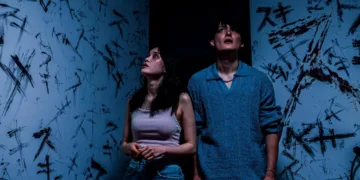
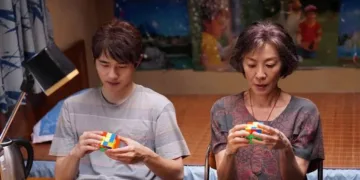








Miriam has barely settled into her brother’s Italian home before everyone around the dinner table starts managing her. Ray hesitates over pouring her wine. Michelle watches her with the concentration of someone waiting for a fire alarm.
Miriam, recently released from psychiatric care after an episode she calls a spiritual awakening, sits between them as the family’s unresolved problem. Frieda Luk builds Sacred Creatures from that discomfort, then slowly turns a brittle reunion into something much stranger.
Ray lives in rural northern Italy with his partner Renzo, an artist whose country house has become a gathering place for friends and creative hangers-on. Michelle arrives with the neat habits of an advertising executive and little patience for uncertainty. Luk’s smartest early decision is to keep Miriam’s motives unreadable. The film works best when her siblings cannot diagnose, manage, or fully dismiss her.
Three Versions of Miriam
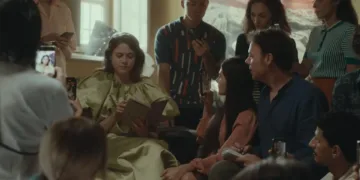
Olivia Luccardi gives Miriam a performance that forces every scene around her to reorganize itself. She can look fragile at breakfast, vaguely amused at a party, then oddly serene while reciting a self-help passage as if she has been handed scripture. None of those versions settle into a stable answer.
That uncertainty gives Ray and Michelle something concrete to fight about. Ray treats Miriam’s visit as a chance to recover in a safer environment. Michelle sees warning signs and assumes the next collapse is already forming. Their disagreement feels rooted in history, especially in the small acts of supervision around Miriam’s drinking, clothing, and behavior.
James Cusati-Moyer makes Ray’s patience credible without turning him into a saint. Romina D’Ugo gives Michelle a rigid, practical rhythm, the sort of person who prefers a problem she can name because naming it implies a solution.
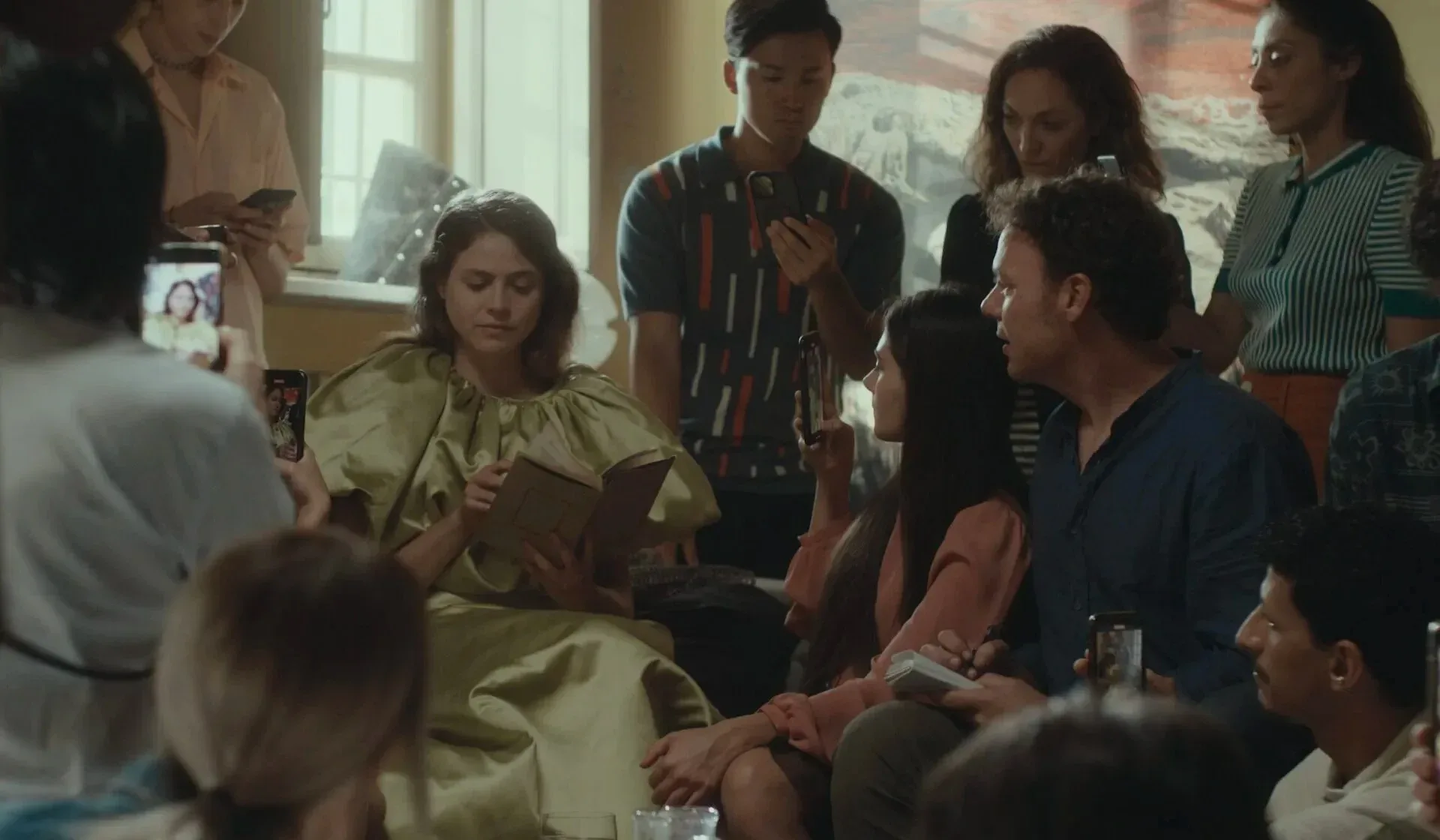
The gold-chartreuse dress Michelle buys after seeing Miriam admire it becomes the film’s most effective prop. It is ugly, regal, funny, and strangely ceremonial. Once Miriam begins wearing it constantly, her siblings see another fixation. The locals see an image.
The Accidental Prophet
The story changes shape after Miriam takes Fiorella Valletti’s Will Speaks Wisdom from a local library. Its inspirational phrases sound like bargain-bin philosophy, yet the people around her start treating them as revelation. At Renzo’s parties, Miriam reads those lines in clumsy Italian while dressed like a misplaced religious icon. Renzo’s wealthy, New Age-minded aunt is captivated and starts bringing admirers into the house.
This is where the satire is sharpest. Miriam does very little to build a following. Other people do the work for her. They assign significance to the dress, solemnity to the quotations, and authority to her calmness. The mechanism is recognizable from influencer culture and spiritual grifting alike: repetition plus confidence can make empty language sound expensive.
Luk has prepared the setting for this turn. Renzo’s villa is full of artists, parties, sculptural oddities, and people accustomed to treating eccentric behavior as evidence of depth. Miriam enters a social space already eager to believe that strangeness means something.
The structural problem arrives when curiosity becomes devotion. The local followers move from fascination to near-religious surrender with too few intermediate beats. A satire built on credulity still needs to show how credulity grows. Here, the staircase loses a few steps. As the crowd grows, the family drama that gave the film its strongest tension gets pushed aside.
A Family Story Losing Ground
That shift costs the film because Ray and Michelle are richer opponents for Miriam than the acolytes are. Michelle’s instinct to contain her sister may be harsh, yet the story gives her concrete reasons for concern. Ray’s instinct to protect Miriam’s autonomy feels humane, yet his tolerance starts to look dangerously passive once the gatherings become larger and stranger.
The film could have tightened those positions against each other. Instead, several confrontations arrive after the cult material has absorbed much of the dramatic oxygen. Miriam’s previous breakdown remains deliberately vague, which preserves ambiguity, but it also leaves Ray and Michelle arguing around missing information.
Luccardi keeps the imbalance interesting. When Miriam talks about reaching a higher plane, she never plays the line as a wink or as straightforward madness. She seems convinced, then oddly detached from her own conviction. That slipperiness prevents the screenplay from turning her into a diagnosis or a punchline.
Italy, Slightly Misaligned
Nicolas Villegas photographs the Piedmont setting without postcard romance. Flat farmland, pylons, retail roads, and industrial spaces surround Renzo’s old house. Inside, aristocratic architecture and pastoral frescoes sit beside modern sculpture and pop art. The location feels caught between uses, matching a story about people assigning new meanings to things they barely understand.
Villegas frequently uses extreme shallow focus, leaving faces sharp while rooms dissolve around them. At its best, the technique makes social scenes feel unstable, as if everyone is standing inside a world that has stopped agreeing on what matters. Used repeatedly, it starts calling attention to itself. Luk’s softer fades and occasional muffled sound cues are subtler, letting scenes drift into each other without declaring exactly when the film has crossed from family drama into fable.
The restrained final stretch benefits from that approach. Luk stops escalating and allows uncertainty back into the room. Miriam remains unreadable, and the siblings return to the problem established at dinner: they can watch her closely, argue about her endlessly, and still fail to know what they are looking at.
Sacred Creatures world premiered at the Edinburgh International Film Festival on August 16, 2026. The dark comedy follows three estranged siblings who reunite in rural Italy after their sister experiences a controversial spiritual awakening following psychiatric treatment.
Full Credits
Title: Sacred Creatures
Release date: August 16, 2026 (Edinburgh International Film Festival)
Director: Frieda Luk
Writers: Frieda Luk, Chris Sanchez, Raha Shirazi
Producers and Executive Producers: Ines Eisses, Jefferson Moneo, Chris Sanchez, Raha Shirazi
Cast: Olivia Luccardi, James Cusati-Moyer, Romina D’Ugo, Antonio De Matteo, Pia Engleberth
Director of Photography (Cinematographer): Nicolas Villegas
The Review
Sacred Creatures
Sacred Creatures is strongest when Frieda Luk keeps Miriam suspended between revelation and instability, letting Olivia Luccardi’s performance disturb the tidy assumptions of everyone around her. The sibling conflict gives that ambiguity real dramatic weight, especially through Michelle’s suspicion and Ray’s guarded compassion. The film loses structural control once Miriam’s admirers become a full-fledged cult, with the escalation moving faster than its credibility can support. Nicolas Villegas’ uneasy shallow focus and the peculiar Italian setting keep the film visually alive through those weaker stretches. A messy, ambitious debut with a genuinely strange pulse.
PROS
- Olivia Luccardi’s elusive performance
- Strong sibling dynamics
- Distinctive rural Italian setting
- Effective visual unease
- Bold tonal ambition
CONS
- Cult escalation feels rushed
- Sibling drama loses prominence
- Magical realism lacks enough grounding
- Second half grows structurally loose