























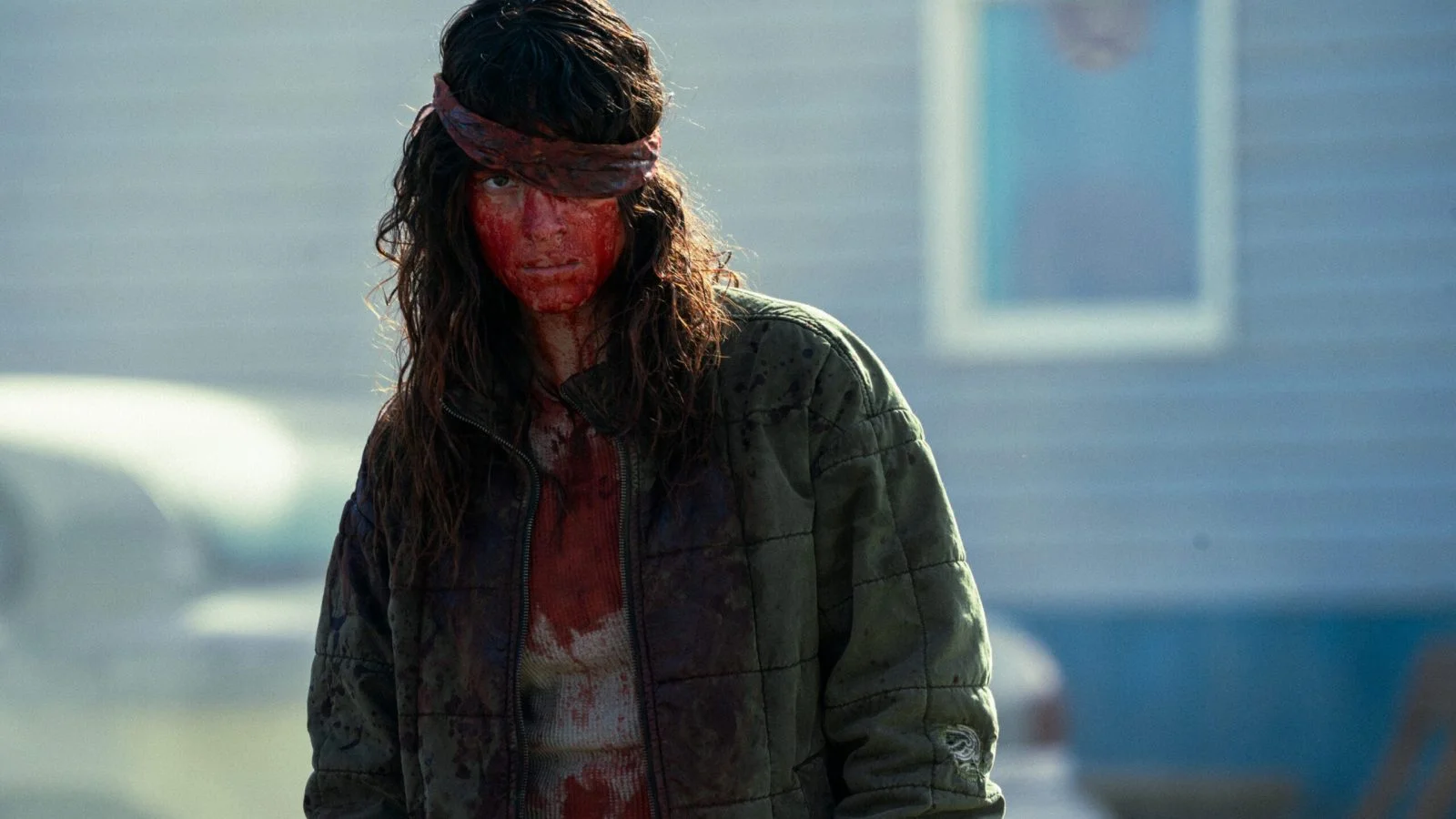

Adam Wingard has spent the last decade directing monsters large enough to flatten cities, so his return to a dusty New Mexico trailer park should feel like a contraction. It does not. Onslaught simply replaces skyscraper-sized creatures with three genetically engineered soldiers who can punch through walls, ignore bullets, and treat civilians like disposable scenery. Smaller geography, same appetite for destruction.
The difference is that Wingard once again looks personally invested in the destruction. After Blair Witch, Death Note, and two Monsterverse films, this reunion with longtime collaborator Simon Barrett resembles the filmmaker rediscovering a toolbox left behind after You’re Next and The Guest: synthesizer-era paranoia, practical gore, siege-movie architecture, people with alarming wardrobes, and violence staged with the enthusiasm of someone who has finally escaped a very expensive meeting.
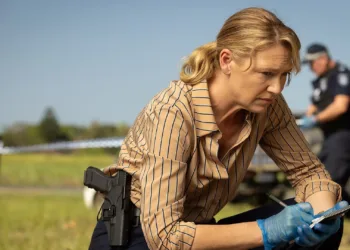
Celeste, played by Adria Arjona, manages the Windy Oasis trailer park and spends her spare time firing automatic weapons at jack-o’-lanterns. The pumpkins make the John Carpenter reference difficult to miss, especially beside the film’s retro title design. Nearby, German scientist Hans Kammler has created three super-soldiers called the Butcher, the Cockroach, and the Crybaby.
His experiments escape. Celeste’s daughter Daisy arrives unexpectedly for the weekend. The distance between those two plotlines quickly disappears. This is Assault on Precinct 13 filtered through The Terminator, with slasher villains drafted into the military. Wingard understands the lineage. The harder question is what he wants to inherit from it.
The Veteran as Weapon
Celeste is the film’s strongest argument because Arjona plays her resistance to ordinary life before she ever has to resist a monster. Her hands shake. Dirty dishes accumulate. Guns are maintained with greater confidence than domestic relationships. When Daisy’s father unexpectedly leaves their daughter with her, Celeste seems less frightened of responsibility than uncertain about the choreography of motherhood.
That hesitation matters. Daisy is not introduced as an instant emotional key that unlocks Celeste’s softer side. Their scenes initially contain small gaps in rhythm, the pauses of two people who love each other without quite knowing their current roles. Arjona lets those gaps remain visible.
Black-and-white military flashbacks explain part of the damage. They show Celeste in combat and connect her past to one of the soldiers who will later threaten Windy Oasis. There is also an amateur boxing memory that should carry considerable emotional force. Yet the screenplay treats these memories like evidence submitted too late in a trial. We understand that history exists. We rarely feel its full shape.
The film is more comfortable building Celeste through behavior. Her friendship with Josiah, an older Vietnam veteran played by Reginald VelJohnson, has the easy shorthand of people who recognize something in each other and know better than to interrogate it.
They tease, assist, and eventually fight side by side. VelJohnson even gets to fire a shotgun while declaring that the attackers chose the wrong trailer park, a casting joke that works because Josiah has earned some existence outside it. Eric Wareheim’s Kovacks enters from another direction. He is a drunk, abrasive cop whose first contribution to community defense is making everyone wonder how soon he will become part of the problem.
There is an interesting political mechanism hiding inside Celeste’s gun collection. The movie presents her arsenal with the visual language of action cinema, inviting us to assume it will become the answer once danger arrives. Then the soldiers absorb gunfire with near-indifference. The fantasy of the perfectly armed citizen runs into opponents produced by the same national obsession with superior firepower. Call it the armory paradox: everyone has guns, and the government has built something guns cannot fix.
Slashers With Military Training
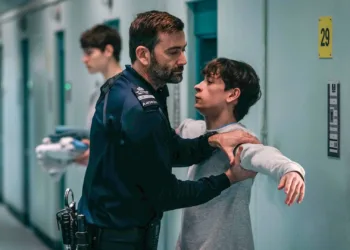
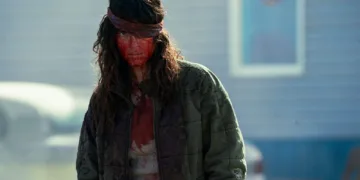
The Butcher, the Cockroach, and the Crybaby are less like characters than military policy given muscle mass. Kammler describes his creations as the human equivalent of heat-seeking missiles. Once loose, they communicate through hand signals, shrug off pain, survive punishment that would end an ordinary action movie, and hunt targets with the blank persistence associated with Jason Voorhees or Michael Myers. Their glowing eyes push them further from soldier toward creature. Then Wingard gives them machetes, hatchets, and a chainsaw, in case anyone somehow missed the slasher grammar.
Their escape from the laboratory immediately exposes the joke embedded in Kammler’s confidence. Here is a scientist boasting that he has engineered perfect killers while apparently never considering the philosophical inconvenience contained in the phrase “perfect killers.”
The truck-stop massacre is where Wingard’s genre collision becomes most disturbing. Oren Soffer photographs the location under severe fluorescent light, stripping away the shadows that usually protect horror filmmaking from its own consequences. Ordinary customers are trapped in plain sight while the soldiers move through them with impersonal efficiency. Then the camera occasionally adopts a first-person-shooter perspective.
I initially read the choice as an indictment of mechanized violence, a visual language turning human beings into targets because that is precisely how these soldiers perceive them. I am less convinced after watching the scene continue. The perspective also makes slaughter entertaining in exactly the flattened way the movie might be criticizing. That ambiguity would be productive if Onslaught stayed with it. Wingard is already rushing toward the next explosion.
The Windy Oasis assault converts the trailer park into a rural siege fortress. Bodies crash through windows. Walls become temporary. Celeste organizes resistance while conventional firearms prove increasingly inadequate. Nick Interlandi’s sound design gives each exchange mechanical weight, then isolates smaller sensations such as bone striking glass. Practical blood and squibs keep the violence tactile.
Yet the central siege never quite reaches the delirium promised by everything surrounding it. For all the film’s blood, its confrontations can feel oddly restrained in construction. The soldiers are nearly unstoppable, which should produce escalating tactical desperation. Instead, their durability sometimes reduces the encounters to repeated demonstrations of durability. Invincible villains are exciting until the screenplay starts using invincibility as choreography.
Government Freaks
The super-soldiers may provide the muscle, though Onslaught’s strangest life belongs to the people who created them. Dan Stevens plays Kammler beneath aging makeup that looks deliberately theatrical, wearing pale capes and speaking with the confidence of a man who believes mad science deserves a dress code. His relationship with Frau Kammler pushes the film somewhere even stranger. Rebecca Hall appears as his imperious wife, and one scene has him crawl across the floor to lick her stilettoed foot.
This could have been empty provocation. Hall and Stevens make it feel like a glimpse into an entire psychosexual bureaucracy the film has misplaced. Then Kammler exits before any of it can develop.
Drew Starkey’s Cyrus receives an equally extravagant entrance. He is introduced high on MDMA at a sex club, surrounded by fetishistic imagery, before being summoned to clean up the government’s escaped-human-weapon problem. Pale, detached, and almost comically composed around massacres, Cyrus seems poised to become the film’s second major human threat after Kammler.
Instead, he mostly arrives after events, surveys bodies, follows orders, and occasionally receives instructions to do nothing. It is difficult to invent a stranger character introduction for such an administrative job description.
Michael Biehn appears as a representative of the military-industrial machinery pressuring Kammler for results, another casting decision that connects Onslaught to the action cinema it raids for spare parts. Biehn, VelJohnson, Stevens, Hall, Starkey, and Wareheim make the supporting cast feel like occupants of six slightly different exploitation movies who have accidentally rented neighboring trailers. Sometimes the collision is the pleasure. Sometimes it reveals how many better subplots are standing around waiting for permission to begin.
Paranoia Without Architecture
The film’s opening collage invokes MKUltra, Operation Paperclip, Abu Ghraib, technological warfare, and the historical intimacy between American power and morally convenient science. Kammler is described as “third-generation Paperclip,” turning the legacy of recruited Nazi scientists into a family business. His soldiers are intended for urban pacification. The phrase is bureaucratic enough to sound harmless until one remembers that the product being discussed is an indestructible human being trained to kill civilians. This material gives Onslaught a political vocabulary far richer than its plotting.
The escaped soldiers can be read as military experiments, slasher villains, and mass shooters at once. Their black hoods and restraints recall images from detention sites. Their truck-stop attack translates the abstract language of weapons programs into bodies on tile floors. Celeste, meanwhile, is a veteran already discarded into civilian isolation, living among other people at society’s economic and geographic margins.
There is a brutal idea available here: the state damages veterans, abandons them, manufactures improved replacements, loses control of those replacements, then sends another government operative to erase the civilians caught between them. Onslaught keeps touching this idea and withdrawing its hand.
The conspiracy material expands faster than the film can metabolize it. Kammler’s family history, the purpose of the program, corporate pressure, Cyrus’s cleanup operation, Celeste’s connection to one attacker, Frau Kammler’s strange authority, and the military’s interest in observing the escaped soldiers all suggest an institutional horror larger than Windy Oasis. The 92-minute runtime gives these ideas entrances rather than lives.
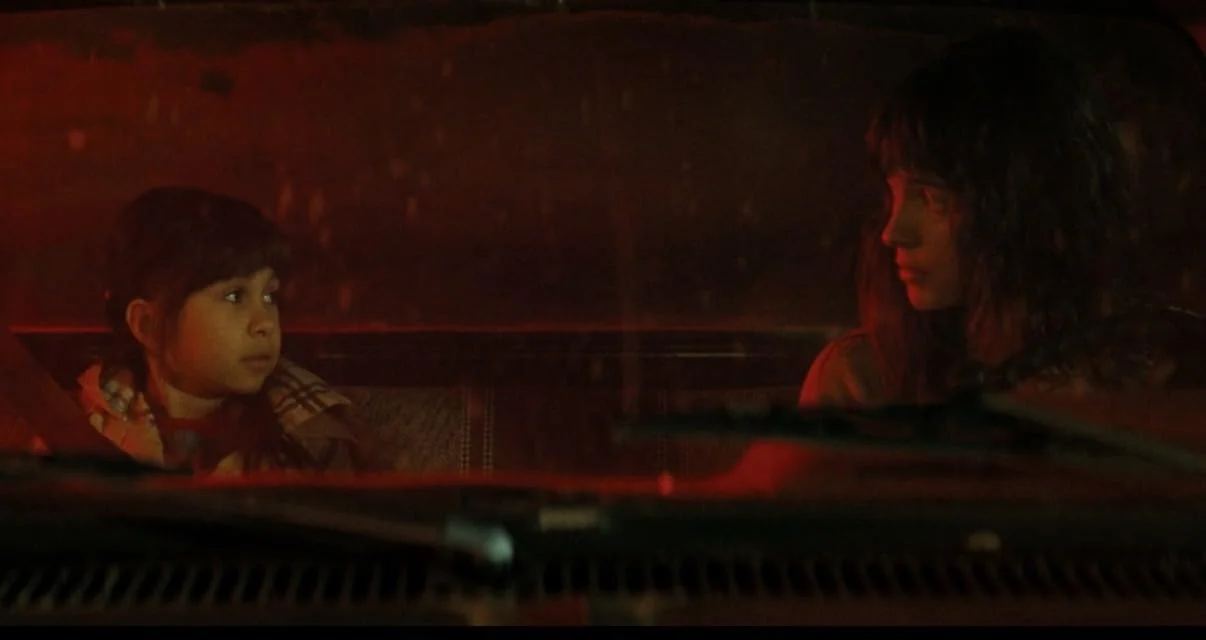
Soffer’s cinematography keeps supplying the world the screenplay cannot. The overlit truck stop looks sickly rather than clean. Fog turns the soldiers’ approach into supernatural intrusion. Vehicle interiors glow red around characters who already seem to inhabit a national fever dream. The bunker has the sterile brightness of a place where moral decisions have been replaced by procedural ones.
Maybe that is why Onslaught frustrates as much as it entertains. Wingard has returned from gigantic franchise filmmaking with his appetite intact, his camera alert, and several ugly ideas about American power rattling around in the trunk. He just keeps driving past the exits where those ideas might become something dangerous.
Onslaught releases in theaters via A24 on September 4, 2026. The action thriller follows a military sniper fighting to shield her family after an army of genetically modified super soldiers escapes from a classified facility.
Where to Watch Onslaught (2026) Online






Full Credits
Title: Onslaught
Distributor: A24
Release date: September 4, 2026
Rating: R
Running time: 1 hour 32 minutes
Director: Adam Wingard
Writers: Simon Barrett, Adam Wingard
Producers and Executive Producers: Aaron Ryder, Andrew Swett, Adam Wingard, Jeremy Platt, Alexander Black, Simon Barrett, Richard Mirisch
Cast: Adria Arjona, Alex Pereira, Dan Stevens, Eric Wareheim, Reginald VelJohnson, Michael Biehn, Drew Starkey, Rebecca Hall
Director of Photography (Cinematographer): Oren Soffer
Editors: Josh Schaeffer, Adam Avery
Composer: Matthew Pusti
The Review
Onslaught
Onslaught has rediscovered Adam Wingard’s appetite for grime, practical blood, fluorescent ugliness, and characters who seem dressed for films stranger than the one surrounding them. Adria Arjona gives Celeste enough guarded humanity to keep the trailer-park siege grounded, while Oren Soffer photographs the violence with real texture. The trouble is ideological overpopulation: Operation Paperclip, military experimentation, mass-shooter imagery, government cover-ups, and conspiracy paranoia all compete for space inside 92 minutes. The film keeps opening doors into darker rooms, then sprints past them.
PROS
- Adria Arjona’s grounded lead performance
- Tactile practical gore
- Oren Soffer’s textured cinematography
- Strong slasher-siege imagery
- Eccentric supporting performances
CONS
- Underdeveloped conspiracy threads
- Thin super-soldier mythology
- Uneven trailer-park siege
- Provocation without enough purpose
- Promising characters abandoned early