




























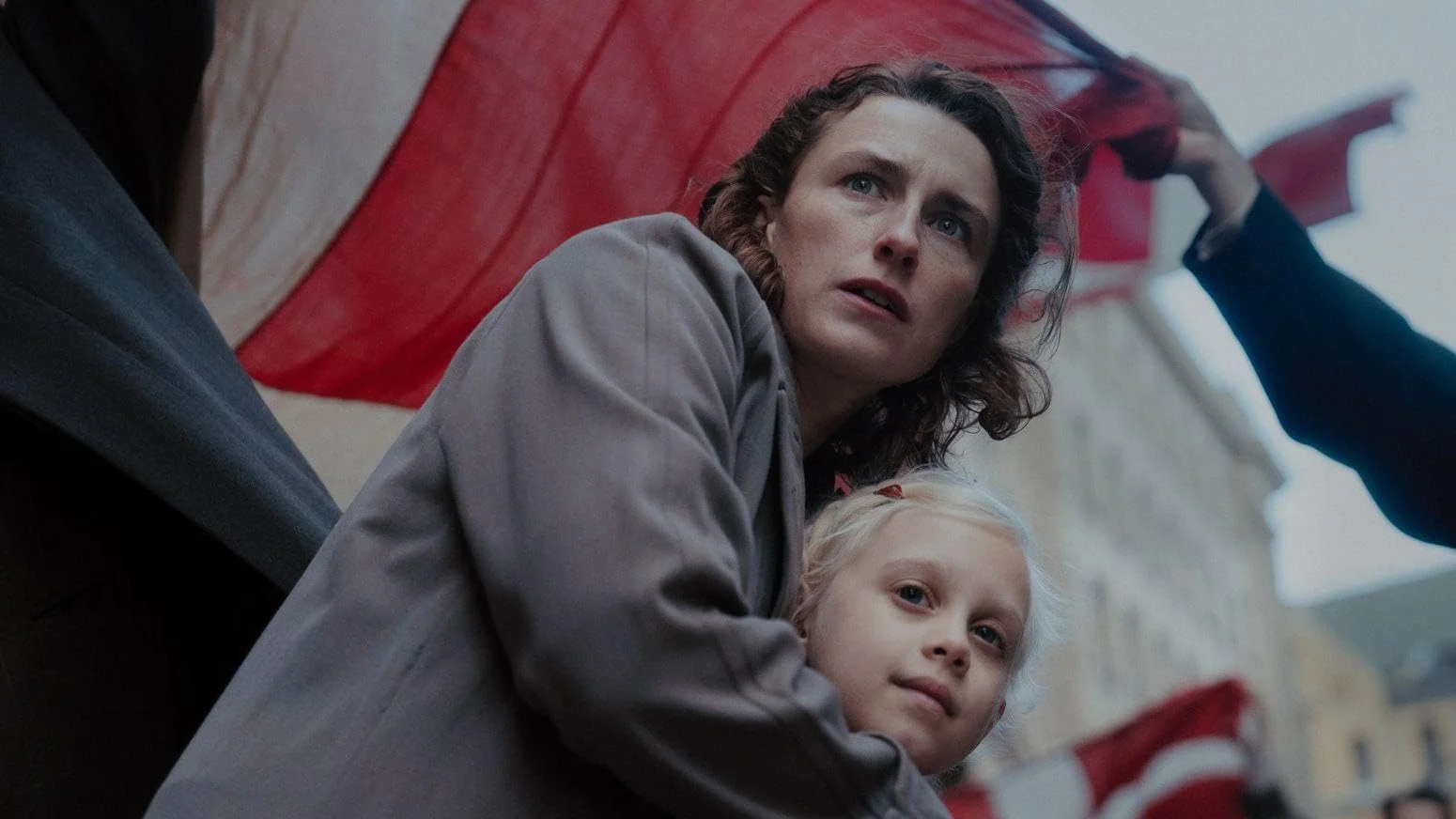

Respectability is the most dangerous costume Marie wears. May el-Toukhy’s Woman Unknown places her in Copenhagen just after Denmark’s liberation from Nazi occupation, when resistance groups are hunting suspected collaborators and women accused of sleeping with German soldiers are being dragged into the streets for punishment. Marie has escaped that fate so far. Her safety depends on remaining almost invisible.
Mathilde Arcel plays her as a maid and nanny working for Christian, a wealthy widower who owns a glove factory. They are engaged, yet marriage has done little to disturb the hierarchy of his home. Marie still serves, still follows household protocol, still calculates every word before speaking. Christian plans for her to wear his dead wife’s wedding dress, a gesture that reveals how easily his idea of marriage absorbs Marie into an existing role.
She has another identity buried underneath. During the occupation, Marie had a relationship with a German soldier, became pregnant, lost the child after a difficult birth, and fled the life attached to that history. In 1945 Denmark, discovery would carry consequences far beyond embarrassment.
Fear Behind Closed Doors
Arcel establishes Marie’s anxiety before the screenplay explains it. One early scene finds her lying awake beside the sleeping Christian, staring into the room while he rests without concern. Her body rarely enjoys that luxury again.

Watch the difference between Marie outside the house and inside it. On Copenhagen’s streets she moves quickly, scanning people around her. At home her movements become slower and almost rehearsed. Every plate, conversation, and glance appears subject to inspection. Marina Bouras’s housekeeper Esther reinforces that atmosphere through rigid domestic standards, yet Christian creates the deeper pressure because Marie’s future depends on satisfying him.
Their relationship contains several quietly disturbing details. Christian uses Marie’s hand to demonstrate gloves from his factory, turning part of her body into a display object. Sex causes her visible pain, which she hides from him before returning to a doctor for morphine drops. Christian hardly seems interested in asking why.
The sharpest measure of his morality arrives during dinner. He tells Marie that a factory employee suspected of collaborating with the Germans must be dismissed, regardless of guilt, because suspicion could damage the company’s reputation. Marie carefully asks what happens if the man did nothing wrong. Christian’s answer barely changes. Reputation wins.
The irony is severe. Christian’s own business benefited from German customers during the occupation. His economic compromises can be folded back into polite society. Marie’s sexual history could get her stripped, beaten, and publicly marked.
Liberation as Punishment
El-Toukhy makes that threat brutally visible through sequences in which accused women are surrounded by crowds, have their hair cut away, their clothing torn, and swastikas painted across their bodies. These scenes are difficult to watch partly because the rest of the film is so controlled.
Cinematographer Jasper Spanning works with muted interiors, gray streets, deep shadows, and static compositions. When red suddenly appears on skin or clothing, it practically tears through the frame. That kind of restricted palette is simple filmmaking language: keep one color scarce, then give it emotional force whenever it returns.
The camera also makes Marie seem constantly observed. She is framed through doors, windows, grates, and reflections, sometimes from positions that belong to no obvious character. The effect creates an important ambiguity. Someone may actually be watching her, or Marie may have internalized surveillance so completely that every room feels occupied. Mikkel Hess’s heavy percussion works along similar lines. The music rarely announces an approaching threat. It suggests the threat has already entered.
The film occasionally loses this elegant control during flashbacks and superimposed images connected to Marie’s past. Those flourishes explain psychological fragmentation through visible technique, yet the quieter scenes accomplish the same task with greater precision. Arcel staring across a dinner table can communicate panic without the image needing to fracture around her.
What Survival Costs
Karl brings Marie’s hidden life into the present when he recognizes her on a bus and repeatedly calls after her. Thorbjørn Hedegaard gives him a predatory confidence that immediately changes the film’s stakes. He knows enough about Marie to destroy her new identity, and he understands the value of that knowledge.
Their encounters become increasingly degrading. One sexual sequence makes the power arrangement brutally physical as Karl controls Marie’s body while she endures what he demands. El-Toukhy links that violation to quieter moments involving Christian, from the glove demonstration to the fitting of the inherited wedding dress. Different men claim different forms of authority over the same woman.
Karl is also where the screenplay becomes less precise. His behavior grows so reckless and openly threatening that he sometimes feels designed to force Marie toward disaster. Christian is more unsettling because his domination hides inside manners, employment, marriage, and social expectation.
Marie responds to both forms of pressure by becoming increasingly dangerous herself. She lies, redirects suspicion, and eventually pushes attention toward Mrs. Berg, the friendly single mother next door whose independence already leaves her exposed to judgment. The choice prevents Marie from remaining a comfortable victim.
Arcel makes that moral deterioration painful because Marie’s tenderness has already appeared in her scenes with children, especially Christian’s daughter Leonora. The same woman who can quietly care for a child can sacrifice another person when survival demands it.
When Marie’s tightly controlled behavior finally breaks, Arcel changes the performance rather than merely increasing its volume. The stillness disappears. Movements that once seemed measured become frantic. After spending so much of the film watching Marie compress fear into tiny gestures, seeing that discipline fail becomes its own form of violence.
Woman Unknown had its world premiere at the 83rd Venice International Film Festival on September 6, 2026. Set in post-World War II Denmark, the drama follows a young nanny preparing to marry her wealthy employer while concealing a dangerous secret from the wartime occupation.
Full Credits
Title: Woman Unknown
Distributor: Nordisk Film
Release date: September 6, 2026 (Venice International Film Festival)
Running time: 2 hours 4 minutes
Director: May el-Toukhy
Writers: May el-Toukhy, Maren Louise Käehne
Producers and Executive Producers: Mikael Christian Rieks
Cast: Mathilde Arcel, Carsten Bjørnlund, Thorbjørn Hedegaard, Marina Bouras, Mia Plantin, Sofia Nolsøe, Flora Sanders
The Review
Woman Unknown
Woman Unknown turns postwar Denmark into a pressure chamber where public justice, private shame, and class privilege collide. May el-Toukhy gets her strongest results from restraint: Jasper Spanning’s distant framing makes Marie appear watched even when nobody is there, while Mathilde Arcel lets fear register through posture, glances, and carefully rationed speech. Karl’s blackmail occasionally forces the drama toward a harsher register than it needs, yet Marie’s increasingly destructive survival choices keep the film morally unsettled. Its ugliest scenes expose a society eager to punish women for sins men could hide behind respectability.
PROS
- Mathilde Arcel’s controlled performance
- Oppressive visual framing
- Brutal postwar gender critique
- Strong Christian-Marie power dynamic
- Effective use of sound and silence
CONS
- Karl can feel overly constructed
- Expressionistic flashbacks disrupt the restraint
- Late escalation strains the film’s control