



























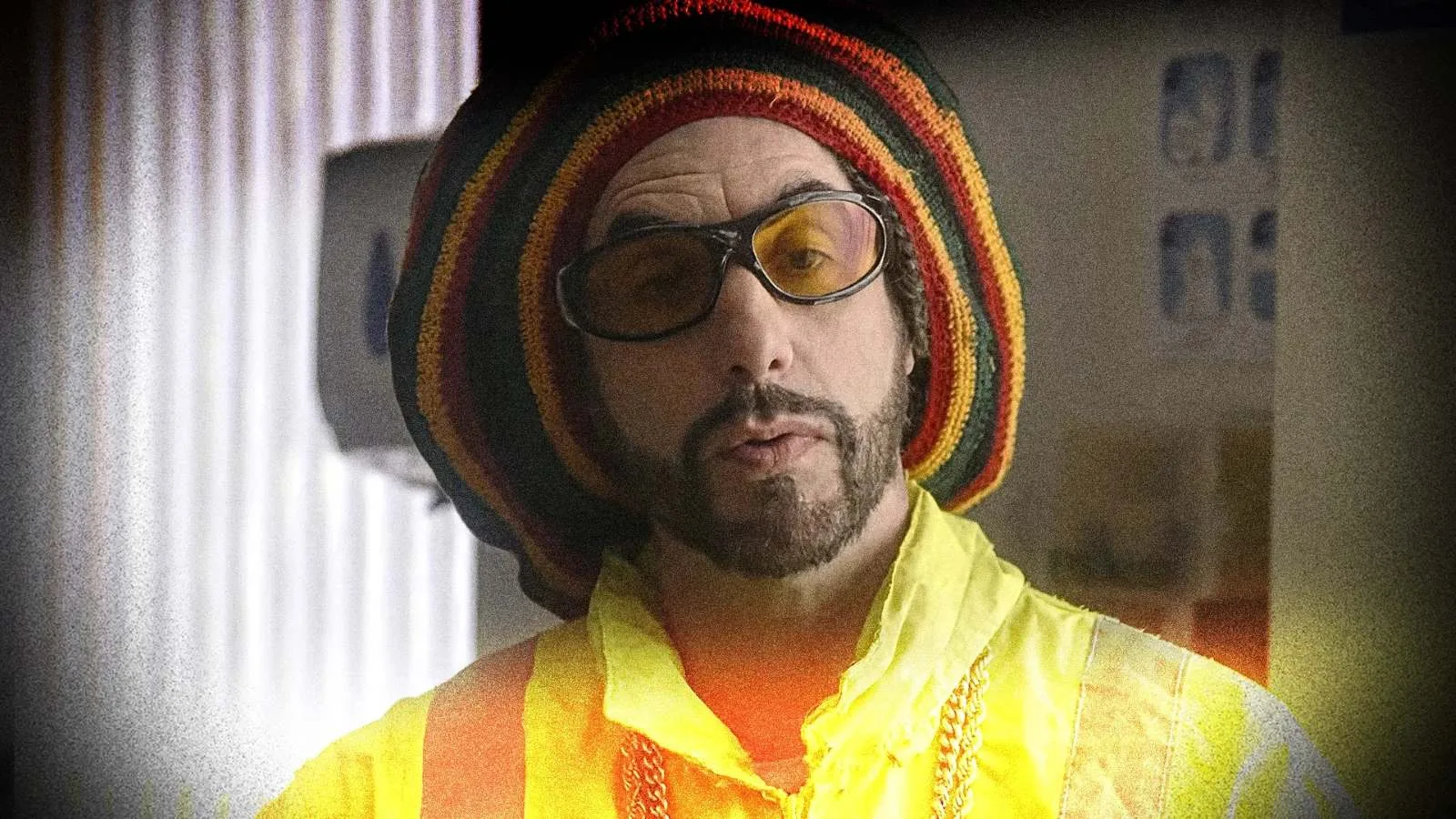

The estate agent in Ali G: Who Iz I? keeps relaying increasingly indecent messages between Ali and his pregnant partner, Julie. He remains patient as the requests grow harder to say aloud. Sacha Baron Cohen gives the exchange room to develop, and the agent’s willingness to help makes Ali’s childishness funnier. The man has done nothing foolish; he has simply taken an unreasonable customer seriously.
That distinction matters in a film built around encounters with people who are unaware of the joke. Ali’s presentation to a group of religious leaders works differently. He plays a video containing plainly artificial testimonials from famous dead figures, then insists it is not AI. The leaders’ bafflement gives the audience a sensible point of reference. Cohen can still find a laugh in the gap between what Ali believes he can get away with and what another person will accept.
The film needs those encounters to serve a larger story. Long after the end of his television career, Ali is broke and living in Staines with Julie (Morgana Robinson), whose pregnancy has given him a reason to seek work. An old fax machine produces an equally old offer from HBO, which he mistakes for a fresh chance to revive Da Ali G Show. They head to America, where that misunderstanding soon catches up with them. Unlike the scripted Ali G Indahouse, this feature joins fictional plotlines to meetings with real people. The film takes care to identify who belongs to its invented story, a necessary distinction that occasionally draws attention to the machinery holding it together.
At their best, the real encounters resist that machinery. Cohen knows how to let Ali misunderstand an ordinary task and then follow the other person’s response. Elsewhere, the setup does too much work and the response too little. Ali’s expensive restaurant meeting with a supposed production team runs on the impending discovery that HBO will not pay the bill. Once that is clear, the scene has little new to ask of anyone at the table. Several brief shop and job encounters likewise end close to the point where their premise has been established. A prank needs time for an unexpected reaction to alter its course; a feature cannot gain momentum simply by lining up more premises.
Cohen tries to give the film another source of momentum through Dr. Nira Cain-N’Degeocello, his self-appointed authority on cultural appropriation. Nira condemns Ali’s borrowed hip-hop persona while claiming expertise over the culture he purports to defend. At an education meeting, his proposal for a compulsory year of gender reversal tests how far that confidence can carry an absurd idea. There is a recognizable comic target in someone who mistakes his own certainty for understanding. Yet Nira is Cohen’s creation, so the film controls his excesses before an unsuspecting participant has said a word. The joke tells us what Cohen thinks of this type of scold; the meeting has the harder job of making a real response interesting.
“The Free Speech Show” presents the opposite difficulty. Ali finds a platform willing to indulge him, with public figures including George Santos entering a spectacle that slides toward fascist display. The scene’s escalation is plain enough, but it has limited power to uncover an attitude hidden behind polite language. The audience is often ahead of Ali, waiting to see how far the show will go rather than learning much from the people it draws in. Cohen’s confidence as a performer remains enjoyable, even when the exposure his format promises feels thin.
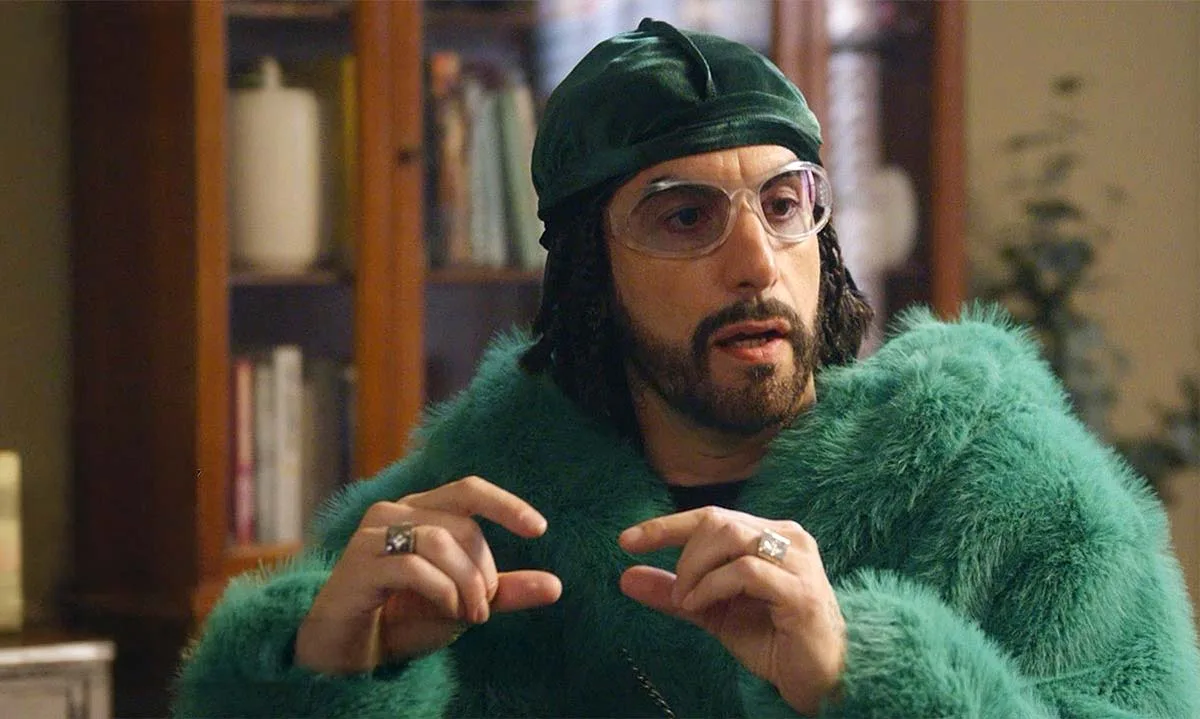
The most elaborate test comes through Erran Morad, another of Cohen’s characters, who recruits anti-immigration participants into a scheme aimed at Julie’s baby. The absurdity of the mission and its equipment cannot soften the willingness the setup elicits. Here the real participants give the political comedy a force that Nira’s invented extremism lacks. Still, the sequence has to complete an increasingly complicated fictional plot, and its disturbing implications compete with a loud, prolonged climax. Cohen has engineered a startling encounter, then placed considerable story between its setup and its meaning.
Ali himself sits uneasily at the join between these approaches. His costume, speech, and borrowed cultural identity once helped make him a ridiculous interviewer. The film now names the objection to that act through Nira, while allowing Ali to remain largely oblivious to it. His fantasies about heritage and his growing responsibilities to Julie suggest a personal story, but his comic strength lies in the instant when another person must decide how to answer him. Robinson commits to Julie’s part in the estate-agent exchange, sending intimate messages back through a stranger. Later, the rescue plot gives Ali a reason to act, but leaves less room for somebody else’s answer to change the scene.
Ali G: Who Iz I? is a satirical mockumentary comedy film directed by and starring Sacha Baron Cohen, which premiered in theaters on October 23, 2026. The film marks the secret return of the iconic British comedy persona as Ali G navigates modern-day political and social culture through unscripted encounters and absurd interviews. You can currently catch the movie in select theaters following its theatrical debut by Amazon MGM Studios.
Where to Watch Ali G: Who Iz I? Online
Full Credits
Title: Ali G: Who Iz I?
Distributor: Amazon MGM Studios
Release date: October 23, 2026
Rating: R
Running time: 88 minutes
Director: Sacha Baron Cohen
Writers: Sacha Baron Cohen, Anthony Hines, Peter Baynham, Dan Swimer, Dan Mazer
Producers and Executive Producers: Sacha Baron Cohen, Anthony Hines, Colton Dunn, Vernon Chatman
Cast: Sacha Baron Cohen, Morgana Robinson
Director of Photography (Cinematographer): Luke Geissbuhler
Editors: James Thomas
Composer: Erran Baron Cohen
The Review
Ali G: Who Iz I?
Ali G: Who Iz I? is funniest when Cohen lets an unsuspecting person’s response reshape a scene. The patient estate agent and baffled religious leaders give him room to improvise, while Morad’s recruits lend the political comedy a disturbing force. Shorter encounters stall, and the rescue plot pulls Ali away from the exchanges that suit him best. Cohen can still make this character funny; the feature struggles to give those laughs a sustained shape.
PROS
- Cohen’s quick improvisation
- The estate agent and religious leaders’ reactions
- - Morad’s unsettling recruitment sequence
CONS
- Several encounters end before they develop
- Nira’s invented satire has limited reach
- - The rescue plot crowds out stronger interactions