























The ten-minute delivery guarantee in Minimum Wage runs into a practical obstacle: the employee making the delivery is dressed as a pizza. The costume interferes with his steering, and the trip ends in a lake. There is a pleasing chain of stupidity here.
A restaurant’s promotional gimmick makes its service promise harder to fulfill, and the person caught between those decisions keeps going until geography intervenes. The gag has a setup, a physical complication, and a destination nobody ordered. Before we know much about these employees, we know the business has placed considerable trust in people who should probably be carrying smaller responsibilities.
The documentary crew is already setting up around this disaster, giving the series another audience for its employees’ behavior. Interviews and looks toward the lens offer convenient ways to punctuate their incompetence, though the actions often supply enough commentary themselves. Tommy takes a blow-dryer to pizzas; the staff neglects to replace the display slices. We can establish the restaurant’s professional standards without an employee explaining them.
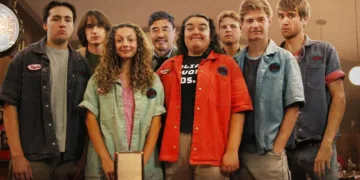
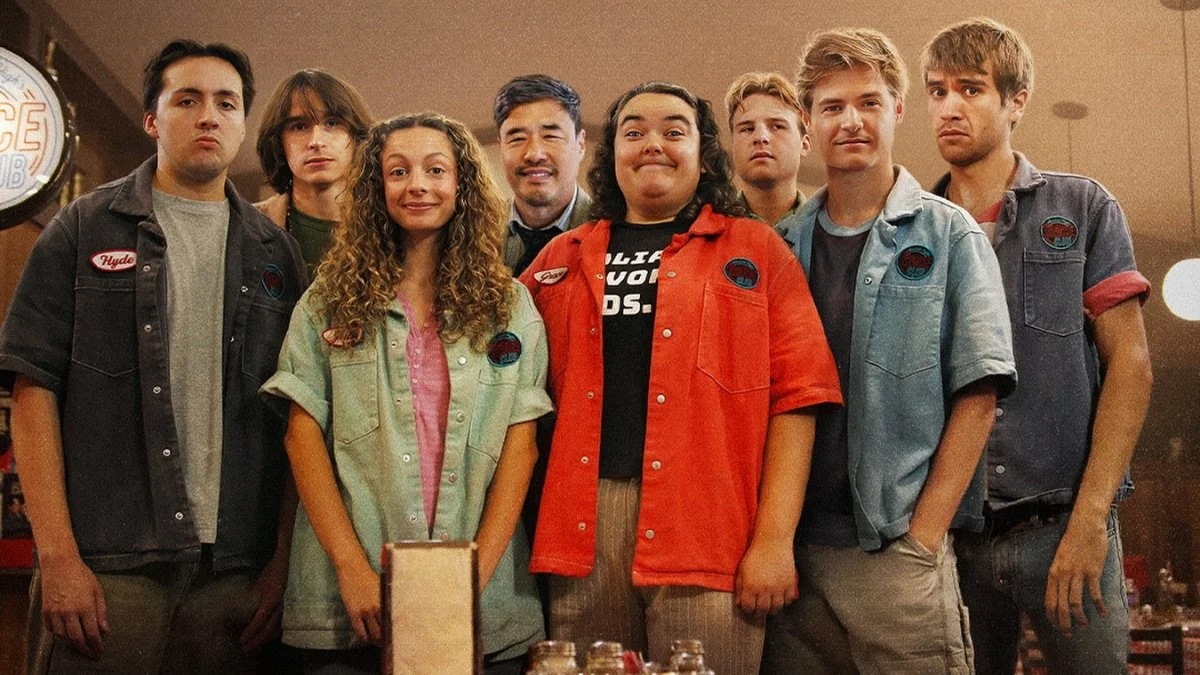
Expanded from American High’s web series, this Netflix incarnation places seven young employees inside Slice Club, a failing pizzeria in upstate New York. The opening fourteen episodes run roughly twelve to twenty minutes apiece, a sensible scale for stories about people finding inventive ways to avoid fairly straightforward tasks.
Finding abandoned lottery tickets gives the group something small to inflate through conversation about spending the winnings. Making a restaurant commercial similarly provides an objective everyone can get involved in, with ample room for vanity and distraction. These are serviceable sitcom premises, modest enough to fit the space and the running time.
Yet a short episode can still feel stretched when the situation keeps producing chatter without giving the characters sufficiently different reasons to participate. Minimum Wage is comfortable generating exchanges; it is less reliable at making those exchanges change the direction of a story.
The commercial, lottery tickets, and customer disturbances keep supplying fresh occasions for the group to assemble, but the employees’ company often matters more than the activity bringing them together. The slumber-party episode makes that arrangement particularly clear by taking them away from Slice Club. Their social circle survives the change of venue with little difficulty. The restaurant supplies somewhere to put the counter.
That looseness becomes an advantage when a relationship has a clear comic imbalance. Ryan’s persistent attempts to hug Luke give Ryan Micho and Luke Burke something specific to play: one employee’s need for connection meets the older worker’s less accommodating presence. Repetition helps because the behavior belongs to Ryan, rather than arriving as another random workplace disruption.
Luke, around twenty, occupies the absurd position of being the group’s elder, and Burke finds some weariness inside the age jokes. In this company, reaching twenty appears to qualify you for a commemorative clock. The joke also gives him a recognizable relationship to everyone else, which several of his colleagues could use.
Aidan’s pursuit of a nickname taps a similarly useful source of teenage seriousness. The practical value is negligible; the social value, to him, is enormous. A small desire like that can support comedy without a traumatic history or an emotional speech. The problem is consistency. Aidan’s credulity gives him an initial shape, but that shape can soften whenever another joke needs accommodating.
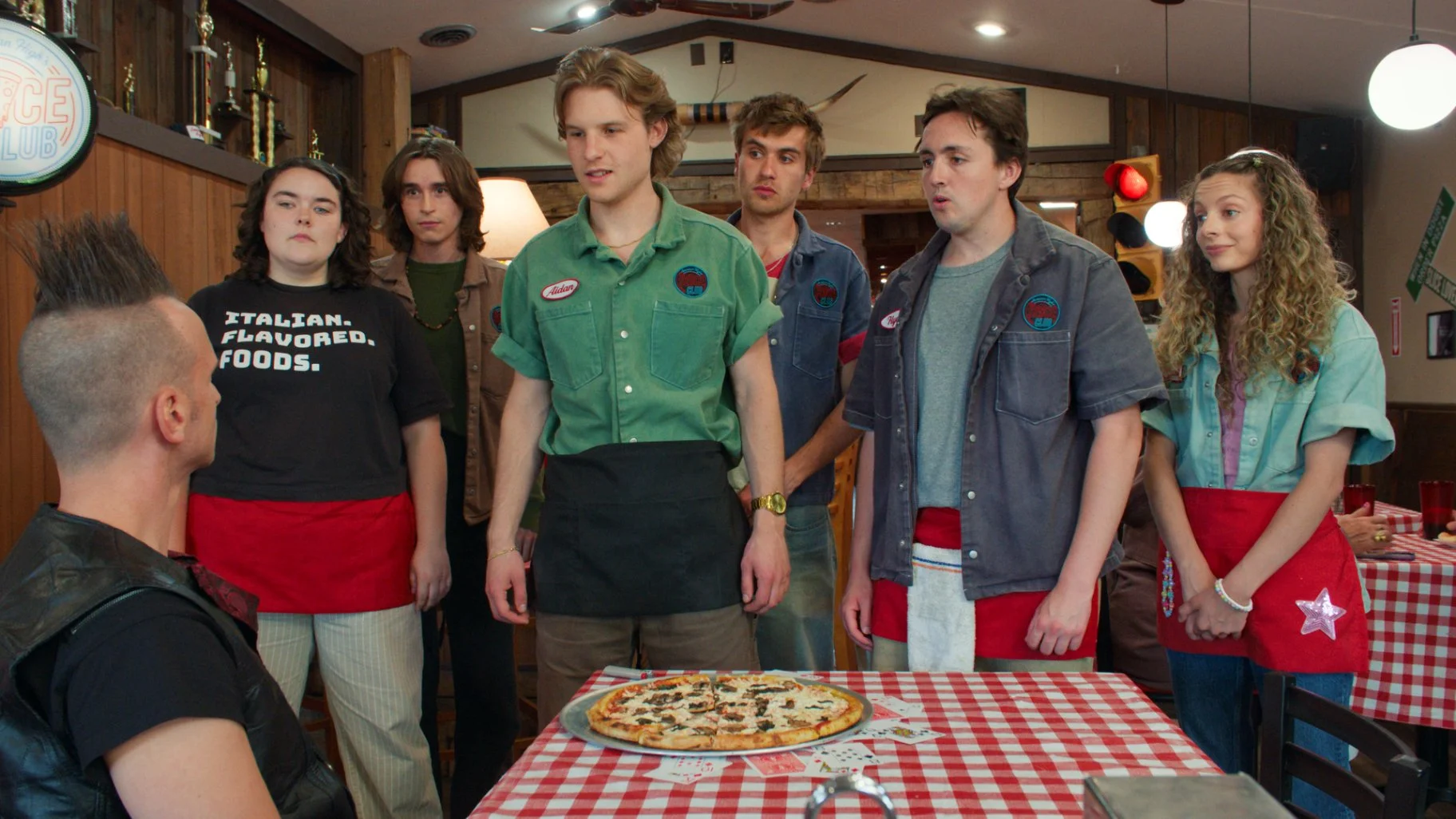
Julia is easier to retain because her sheltered upbringing establishes a particular gap between her understanding and the group’s assumptions. Julia DiCesare makes that innocence playable, though the various crushes surrounding her offer a fairly narrow set of relationships. Too often, romantic interest supplies the distinction that friendship has yet to establish.
Grace Reiter brings welcome force to the manager, also named Grace, whose slight investment in keeping the business functional puts her several steps ahead of her employees. Her nominal authority creates a useful imbalance with a staff capable of treating ordinary restaurant duties as optional activities. Still, the writing does not always turn that position into a durable perspective.
Ryan’s anxiety about arranging tables communicates his need for approval through an actual task; Grace’s managerial title should be equally productive. The performers’ ease together, strengthened by their involvement in writing and directing, keeps scenes sociable and frequently funny. What remains hazier is how each person changes the group’s behavior simply by entering it.
Randall Park arrives with a much firmer comic proposition. His Terry Sylvester founded the franchise, but a divorce has left him with its money-losing branch. He threatens closure unless the employees improve, then moves into the basement. Park can play the boss’s self-importance without protecting him from embarrassment, and the arrangement gives his authority an immediate weakness: the man evaluating the restaurant’s usefulness needs it for housing. His intermittent appearances bring a different kind of disorder into the room. For a few minutes, the staff has someone to answer to whose private circumstances are considerably less orderly than his entrance suggests.
Terry’s predicament also exposes the limits of the workplace stakes. Closure hangs over Slice Club, yet the employees spend much of their time pursuing personal distractions, with little sustained anxiety about hours or pay. The title promises a connection to low-paid employment that the show mostly leaves unexplored.
That lightness makes the restaurant an inviting place to spend a few episodes, but it also reduces the pressure that might turn its amusing situations into stronger stories. Terry offers the sharpest unfinished possibility. Every threat he makes against the business now contains a threat against his own accommodation.
Minimum Wage premiered on Netflix on October 26, 2026. Created by Jeremy Garelick and Will Phelps, the mockumentary workplace comedy follows a chaotic group of teenage employees as they try to survive the daily grind of running a local pizza shop.
Where to Watch Minimum Wage Online


Full Credits
Title: Minimum Wage
Distributor: Netflix, American High
Release date: October 26, 2026
Rating: TV-MA
Running time: 12–15 minutes per episode
Director: Will Phelps, Jeremy Garelick
Writers: Will Phelps, Jeremy Garelick
Producers and Executive Producers: Jeremy Garelick, Will Phelps, Axelle Azoulay
Cast: Aidan Micho, Grace Reiter, Hyde Healy, Julia DiCesare, Luke Burke, Ryan Micho, Tommy Armstrong, Randall Park
The Review
Minimum Wage
Minimum Wage has the social confidence of a cast that knows each other’s rhythms and the storytelling uncertainty of a show still learning what to do with them. Ryan and Luke’s mismatched affection supplies repeatable comedy, while Randall Park gives authority a useful basement address. Across the opening fourteen episodes, indistinct characters and loosely developed situations keep the laughs from accumulating into much attachment. Pleasant company, though several employees still need a job description.
PROS
- Comfortable ensemble chemistry and lively exchanges.
- Ryan and Luke’s clearly defined comic imbalance.
- Randall Park’s entertainingly compromised authority.
- Physical gags built on clear comic logic.
CONS
- Several characters lack consistent defining traits.
- Episode premises sometimes stretch into directionless chatter.
- The closure threat generates little sustained pressure.