












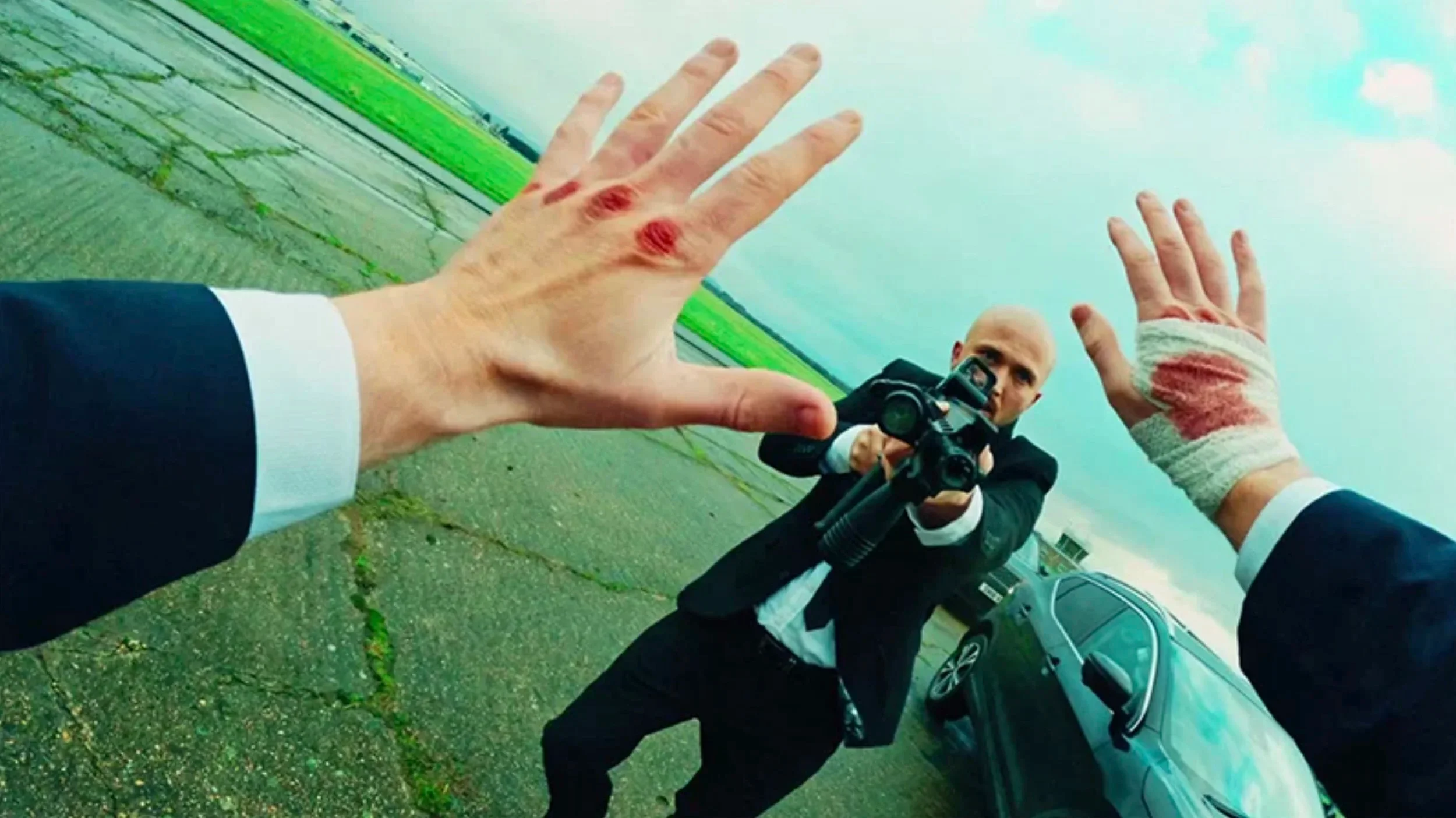

Karl Davis cannot explain the corpse in his hotel bathtub, but he knows what to do when two impostor policemen come through the door. His memory has failed; his capacity for violence remains in excellent working order. Chee Keong Cheung films the encounter from inside the emergency, making the immediate question of survival crowd out the awkward matter of the dead man. Before we can establish what Karl deserves, Bad Day at the Office has given us a practical interest in his staying alive.
The body retains knowledge the conscious self cannot access, and each efficient response supplies another reason to suspect its owner. John Hannah’s Karl fights with a proficiency that should trouble our allegiance to him. Yet first-person photography makes those same skills reassuring: someone is trying to kill the person whose viewpoint we occupy, and that person can defend himself. The camera establishes an intimacy that the character’s missing history cannot justify. For a while, the gap between those two things gives the mayhem an interesting undertow.
The film’s predominantly GoPro perspective also travels beyond Karl. Hotel maid Molly, played by Radha Mitchell, becomes his companion after entering during the hotel confrontation, while Ivan, the Serbian gangster played by Tim Fellingham, has a personal claim on the unfolding violence. The corpse was his father. Moving into Ivan’s viewpoint gives the pursuit another grievance, disturbing the convenient assumption that everyone chasing Karl exists merely to impede his escape. Cheung supplies competing visual positions, though their rapid circulation leaves little room to inhabit competing motives. We change eyes faster than we revise our loyalties.
The physical action offers firmer pleasures. Karl’s flight through a multi-storey car park and across rooftops benefits from the camera’s refusal to stand at a comfortable distance. Movement arrives as bodily pressure, with the frame pulled through the same urgent changes of direction as its apparent owner. Hannah makes an enjoyably improbable centre for this athletic activity.
The format helps sell his character’s capabilities by locating us within their execution, while reducing opportunities to study the actor from outside. His casting supplies surprise; the choreography supplies conviction. There is considerable ingenuity in making that combination work, even when the speed makes the geography difficult to retain.
One of the best passages loosens this arrangement. Molly browses pastries while Karl scrambles over rooftops, and the change of viewpoint acquires a purpose beyond delivering the next assault. Her ordinary interest in food gives his desperation a comic scale.
The city briefly contains activities that have nothing to do with killing him, which makes his predicament seem both more absurd and more specific. Mitchell’s character gains a separate rhythm, too. Cheung allows the distance between two experiences to generate the joke, trusting the juxtaposition to do work that elsewhere gets assigned to on-screen commentary.

The pink graffiti-style graphics are considerably less trusting. They annotate the violence, including a tally of the people Karl incapacitates with a dildo. The device is amusingly shameless, but it also changes the terms on which we watch. An opponent becomes an increment; an injury becomes evidence of progress.
First-person camerawork has already encouraged us to want Karl’s body preserved, and the tally adds a small system of rewards for the damage he inflicts. The uncertain man from the hotel room is increasingly presented as someone whose effectiveness deserves applause. His identity remains a plot question while the graphics make their enthusiasm perfectly legible.
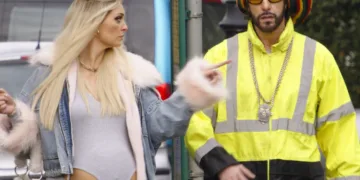
There is genuine invention within this vulgarity. A nightclub confrontation involving a dildo, a plunger and urine demands a degree of physical resourcefulness, however questionable the available equipment. A machine-gun-carrying clown DJ belongs comfortably to the film’s extravagant imagination.
The comedy weakens when fart noises and graphic remarks arrive to certify the absurdity of action that hardly needs assistance. The pastry passage permits a response to form between the images. These additions repeatedly supply the response themselves, leaving the spectator with little interpretive space beyond accepting the invitation to laugh.
Across 111 minutes, that insistence becomes tiring. Fights, pursuits, viewpoint changes and annotations compete for attention so continuously that individual encounters lose definition. The choreography can have force at the level of a blow or an evasive movement while the larger sequence becomes difficult to hold together. Sensory proximity carries a cost: the viewer has to keep reconstructing an event whose presentation is already demanding an immediate physical reaction. With few changes of register, anticipation gets squeezed between one attack and the next. The film keeps presenting emergencies, but it becomes harder to feel the arrival of a new one.
The later return to gangland retaliation and explanatory plotting exposes the cost of that sustained emphasis. Cheung begins asking for an investment in causes after spending so much time training attention on impacts. Ivan’s relationship to the dead man provides a tangible motive, and Karl’s missing history ought to make explanation consequential. Yet the procession of threats has given the mystery limited room to exert pressure between fights. The shift towards answers feels cumbersome because the action has established its own sufficient logic: escape this encounter, survive the next, register another successful improvisation.
An answer about Karl’s past could change the significance of everything his body has done. That possibility is present in the hotel room, where competence and innocence are visibly separate matters. By the later stages, the film has attached so many comic rewards to his competence that reopening the question requires a substantial change in our relationship to the images. The retaliation plot asks us to reconsider acts that the camera and graphics have already helped us enjoy.
Bad Day at the Office hits cinemas in the UK and Ireland via Action Xtreme on October 30, 2026, following its world premiere at the Edinburgh International Film Festival. Directed by Chee Keong Cheung and filmed entirely in an immersive first-person POV format, the high-octane action thriller follows an amnesiac man who wakes up in a wrecked hotel room with a dead body, forcing him and a hotel maid into a breathless fight for survival against a deadly conspiracy.
Where to Watch Bad Day at the Office (2026) Online

Full Credits
Title: Bad Day at the Office
Distributor: Action Xtreme
Release date: August 13, 2026 (EIFF), October 30, 2026 (UK & Ireland)
Rating: 15
Running time: 1 hour 46 minutes (106 minutes)
Director: Chee Keong Cheung
Writers: Chee Keong Cheung, Oliver Morran
Producers and Executive Producers: Andreas Roald, Ioanna Karavela, Chee Keong Cheung
Cast: John Hannah, Radha Mitchell, Tamer Hassan, Lana Parrilla, Tim Fellingham, Roxanne McKee, Branko Tomović, Victor Gardener
Director of Photography (Cinematographer): Edward Linard
Composer: Stuart Hancock
The Review
Bad Day at the Office
Chee Keong Cheung makes first-person violence physically persuasive, with inventive choreography and an enjoyably improbable action lead in John Hannah. The camera secures our allegiance before Karl’s identity can justify it. Yet comic scorekeeping simplifies that uncertainty, and sustained acceleration wears down the action’s impact. The late retaliation plot asks for an investment in motives that the preceding spectacle has given little room to develop.
PROS
- Forceful choreography and bodily immediacy.
- Hannah’s unexpectedly convincing action presence.
- Inventive use of absurd improvised weapons.
- Molly’s pastry interlude brings welcome comic contrast.
CONS
- Relentless stimulation blunts individual encounters.
- Graphics and crude sound gags overexplain the comedy.
- Late plot explanations lack sufficient dramatic investment.