















![Kingdom Hearts Collection [I-III] Review](https://gazettely.com/wp-content/uploads/2026/10/Kingdom-Hearts-Collection-I-III-1-360x180.webp "Kingdom Hearts Collection [I-III] Review: KHII Holds Steady as Newer Entries Fluctuate 40")


Uncle Frank talks to Bela as though she cannot understand as much as she plainly does. The creature pursuing her takes the opposite approach: it asks. Other Mommy wants permission to enter the little girl’s heart, presenting possession as protection and making Bela feel that her answer matters. Between these encounters, Rob Savage’s Other Mommy finds a disturbing possibility. A child accustomed to being underestimated might mistake a predator’s interest in her wishes for respect. The invitation sounds considerate. Everything surrounding it makes refusal increasingly difficult.
I initially read this as a simple competition between inadequate parents and a monster offering counterfeit affection. Then Russ’s melancholy little dance for his daughter complicated that reading. Jay Duplass gives the gesture an awkward tenderness, and Arabella Olivia Clark responds to him with the ease of a child who knows her father. There is love here. Treating the household as an emotional vacancy waiting to be occupied would erase precisely what makes its predicament painful: Bela has attachments worth protecting, alongside frustrations she cannot properly articulate.
Jessica Chastain plays both her mother, Ursula, and the entity seeking admission. Adapted by Nathan Elston from Josh Malerman’s Incidents Around the House, the film makes that resemblance immediately physical. In an early kitchen encounter, the apparent mother prepares food before Russ discovers her grotesquely folded beneath the furniture. A familiar domestic activity contains something anatomically impossible. The image works because the promise of care remains recognizable even after the body providing it has become horribly wrong.
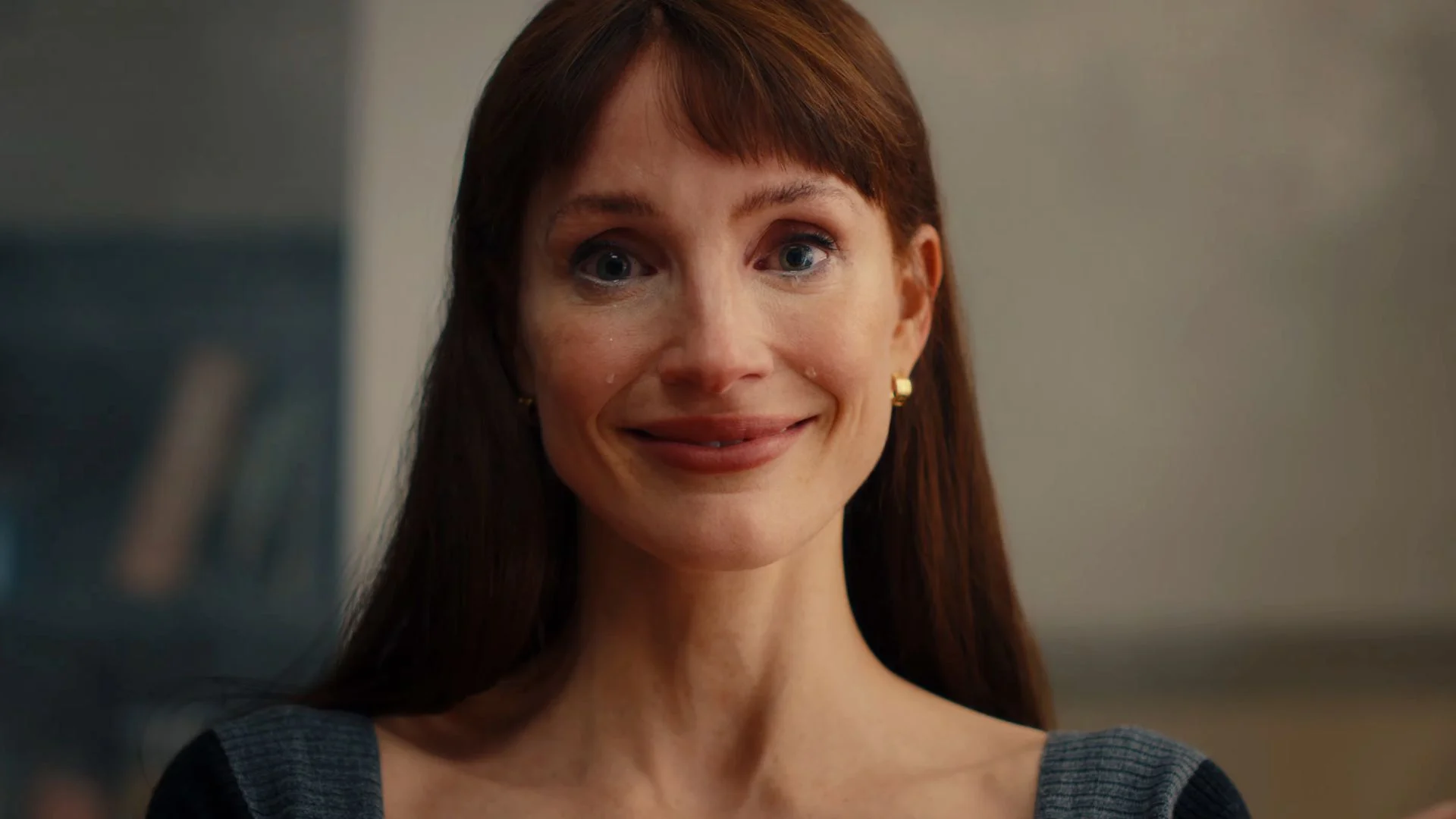
Chastain understands how little that wrongness initially requires. As the creature, she gives speech an excessive precision and movement an unnatural stiffness. Her fixed smile seems to have been learned without any understanding of the feeling it represents. A slight echo in the voice further separates this maternal imitation from Ursula. The effects can stretch her into improbable configurations, but her stillness in darkness is often creepier. Watching her face, I found myself waiting for an ordinary human adjustment that would never arrive.
Her flashes of sorrow and rage complicate the imitation. The opening epigraph establishes that demons covet the life humans possess; Chastain makes that deprivation feel like a grievance. Other Mommy wants Bela’s heart because existence is something she believes she should have. This gives her appeals an ugly emotional logic. She can experience rejection as suffering while remaining indifferent to what acceptance would cost the child. Her pain is genuine enough to explain her behavior. It gives her no claim on Bela. Being miserable does not confer custody.
The dual casting also puts pressure on Ursula, whose marital difficulties and emotional distance suggest an opening for the creature’s attention. Yet the resemblance risks making every maternal failure look like evidence for the prosecution. Chastain supplies tension beneath Ursula’s attempts at composure, but the screenplay withholds much of the family’s history until late. We can register that the marriage is troubled without acquiring a sufficiently developed sense of how its troubles have shaped Bela’s daily life. The demon receives an extensive repertoire of expressions and bodies; the woman it resembles receives fewer opportunities to become equally complicated.
Savage makes one useful decision early: the parents see the threat and believe in it. Bela is spared a lengthy campaign to convince adults that their own eyes work. Once the family starts fleeing, however, that efficiency becomes a problem of attention. Recognition should permit the film to explore how three people respond differently to a shared danger. Instead, escape and renewed attack keep interrupting the relationships that supposedly make Bela susceptible to it. The family moves through plenty of space while its emotional situation develops in brief, heavily burdened exchanges.
The camera’s freedom is impressive. It travels through walls and ceilings, making solid architecture feel incapable of holding a stable reality. A balloon-popping nightmare on the ceiling and the later proliferation of ball-pit balls turn the materials of childhood amusement into something oppressive. These images make sense beside Bela’s predicament: objects associated with pleasure cease to offer reliable reassurance. The world has become as difficult to read as the adults around her.
But the transformations keep coming. Limbs lengthen, bodies change scale, and another impossible apparition displaces the last. I admired individual inventions while gradually becoming less interested in what the creature could do. Its physical capacities seem so unrestricted that anticipation loses purchase.
The question shifts from what Bela might believe to what shape Chastain will occupy next. Even the séance led by Dichen Lachman’s Lois Anthony becomes another concentrated encounter with a monster whose appearances have grown familiar. Formal intervention is a reasonable response, though the entity seems unlikely to respect meeting procedure.
There are quieter resources available. Creaking floorboards and groaning fixtures sometimes emerge from near silence, letting a room become threatening before anything spectacular happens. Chastain’s unaltered stare can sustain the uncertainty that a sudden distortion resolves.
The difficulty is cumulative: the film repeatedly spends these possibilities on an immediate shock. Graphic violence is perfectly compatible with a child’s perspective. The weaker fit is between the attention lavished on bodily destruction and the limited development of what Bela understands afterward. Clark keeps her curiosity and distress credible, but the writing asks that credibility to survive too many abrupt changes without enough emotional consequence.
Ursula’s climactic monologue finally gives difficult parental feeling sustained space. Chastain makes the admission matter, and the screenplay resists treating love as an uncomplicated defense against harm. The scene also reveals how much earlier dramatic work has been deferred. A speech can disclose a hidden history; it cannot supply all the interactions through which that history should have acquired weight.
There is a further difficulty in the honesty itself. Bela has spent the film surrounded by adults who control what she is allowed to understand, and by a creature that flatters her capacity to choose. Giving her painful truth may correct that imbalance, but it also asks something of her. The scene leaves a harder parental responsibility hanging beyond the confession: helping a child live with knowledge an adult has finally decided to share.
Other Mommy was released in theaters by Universal Pictures on October 9, 2026. Based on Josh Malerman’s novel Incidents Around the House, the psychological horror film follows an eight-year-old girl who forms a terrifying connection with a malicious entity lurking in her closet that assumes the exact appearance of her mother.
Where to Watch Other Mommy Online

Full Credits
Title: Other Mommy
Distributor: Universal Pictures
Release date: October 9, 2026
Rating: R
Running time: 1 hour 33 minutes (93 minutes)
Director: Rob Savage
Writers: Nathan Elston, Josh Malerman
Producers and Executive Producers: James Wan, Jason Blum, Michael Clear, Judson Scott, Ryan Turek
Cast: Jessica Chastain, Arabella Olivia Clark, Jay Duplass, Dichen Lachman, Karen Allen, Arian Moayed, Sean Kaufman, Adam Silver
The Review
Other Mommy
Other Mommy finds a disturbing idea in a predator that makes possession sound like respect. Chastain gives that idea a face capable of tenderness, grievance, and menace, while Clark preserves the child caught beneath it. Savage’s visual imagination is considerable, but repeated transformations crowd out the family relationships that should give them weight. The late confession asks one speech to repair emotional development the film has repeatedly postponed.
PROS
- Chastain’s unsettling, emotionally legible dual performance.
- Clark’s credible curiosity and distress.
- Inventive imagery that destabilizes familiar childhood spaces.
CONS
- Repeated transformations weaken sustained dread.
- Family relationships receive insufficient development.
- Late exposition limits the confession’s emotional force.