















![Kingdom Hearts Collection [I-III] Review](https://gazettely.com/wp-content/uploads/2026/10/Kingdom-Hearts-Collection-I-III-1-360x180.webp "Kingdom Hearts Collection [I-III] Review: KHII Holds Steady as Newer Entries Fluctuate 40")
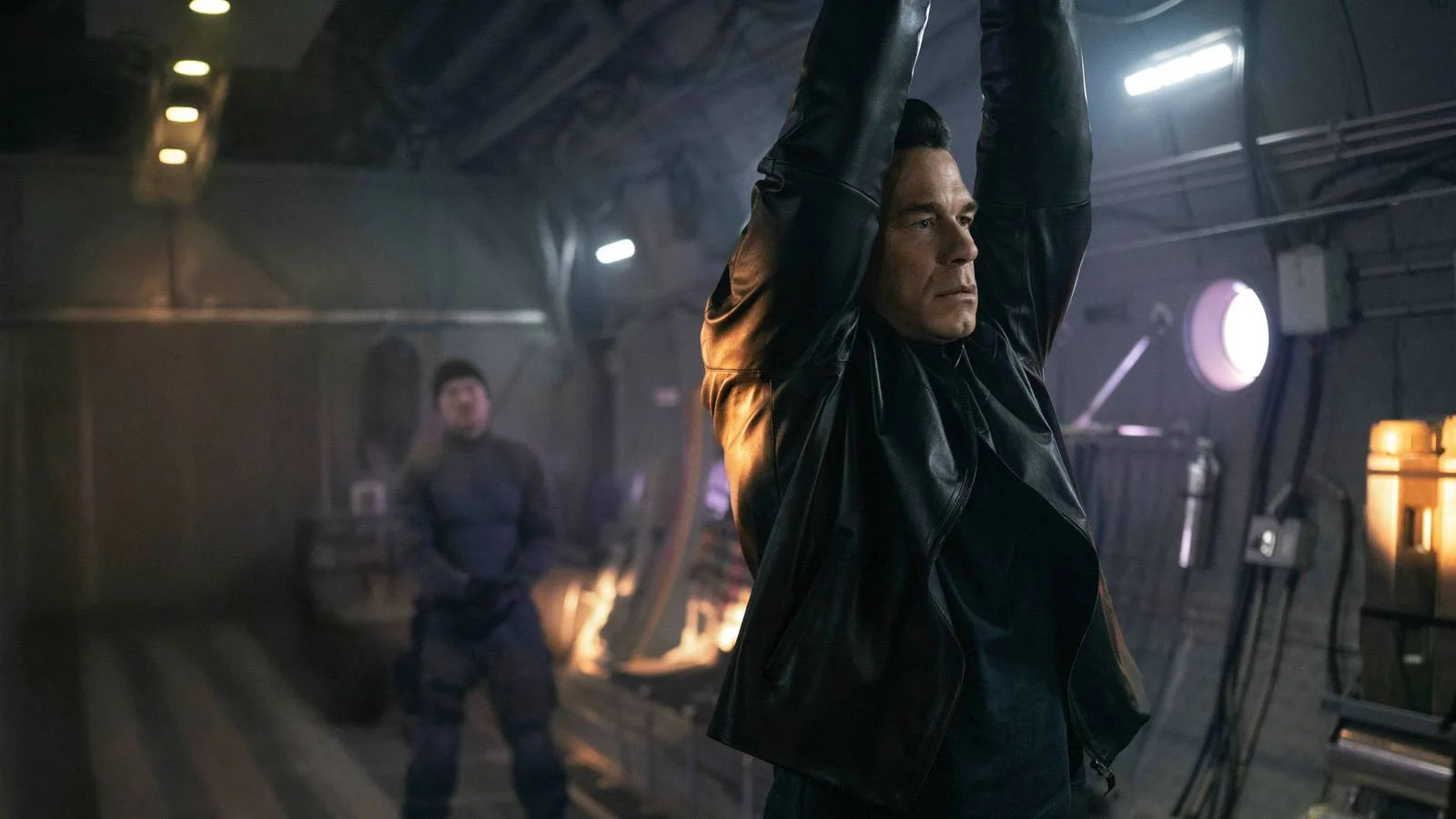

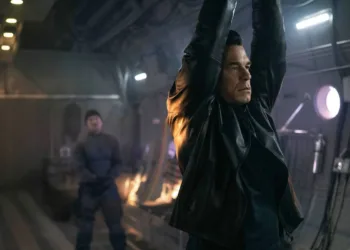
John Cena slides backward down a staircase, firing guns to propel himself, and the absurdity has a pleasing mechanical logic. Gravity, recoil, and a large man’s determination become cooperating forces. Sam Hargrave finds similar pleasures in a fire hose used to swing from a building and in the narrow refuge beneath a speeding truck. These situations give Matchbox: The Movie something tangible to work with: bodies occupying hazardous spaces, surviving through improbable adjustments. The staircase stunt scarcely needs dialogue. Sean Walker’s profession is written in the way he treats architecture as equipment.
During another action sequence, the film cuts to a child playing with Matchbox cars at an outdoor café. He looks up at the vehicles racing past. The insertion changes our position as spectators. Destruction acquires a miniature counterpart, and the chase becomes an apparent extension of harmless play.
It is an economical connection between the toy brand and the film’s spectacle, carrying an imaginative charge that the conspicuous product references struggle to achieve. It also offers reassurance. Whatever the adults are doing to one another, the child supplies an innocent way to watch.
That reassurance becomes awkward when the action involves people whose participation began with abduction. Sean, a covert CIA operative, returns to his Ohio hometown after the death of Smalley, the mechanic who gave his childhood friends a place to gather.
Their reunion ends with spiked drinks and an awakening aboard an aircraft, where Sean is being interrogated over a missing nuclear warhead. CIA official Mosier treats the others as accomplices. A familiar evening has become evidence against them. The premise has the unpleasant intimacy of an espionage thriller: Sean’s old friends discover that proximity to him can destroy their ordinary lives.
Hargrave makes escape an opportunity to demonstrate Sean’s competence, while David Coggeshall’s screenplay places its uncertainty around the agency rather than inside its hero. We may distrust officials and contacts, but Sean remains a dependable object of allegiance. Cena’s comparatively restrained performance helps.
His physical confidence coexists with the lingering awkwardness of his attachment to Aimee, played by Jessica Biel. The dangerous professional retains something of the boy who could not express his feelings. This continuity gives him an accessible softness, although it also protects him from the troubling implications of bringing his work home. His friends’ anger briefly presses against that protection.
Their decision to accompany him has a useful practical complication. Recovering the weapon will clear their names as well as help Sean, so loyalty operates alongside self-preservation. The film has the ingredients for an uneasy alliance, then rapidly turns them into an agreeable team.
Its betrayed-operative machinery produces obstacles with little lasting uncertainty about trust. An action comedy has no obligation to descend into noir pessimism, but suspicion needs time to affect behavior if it is to generate suspense. Here, the friends’ occupations soon become the stronger organizing force: the pilot flies, the machinery operator handles machinery, and the racing enthusiast drives.
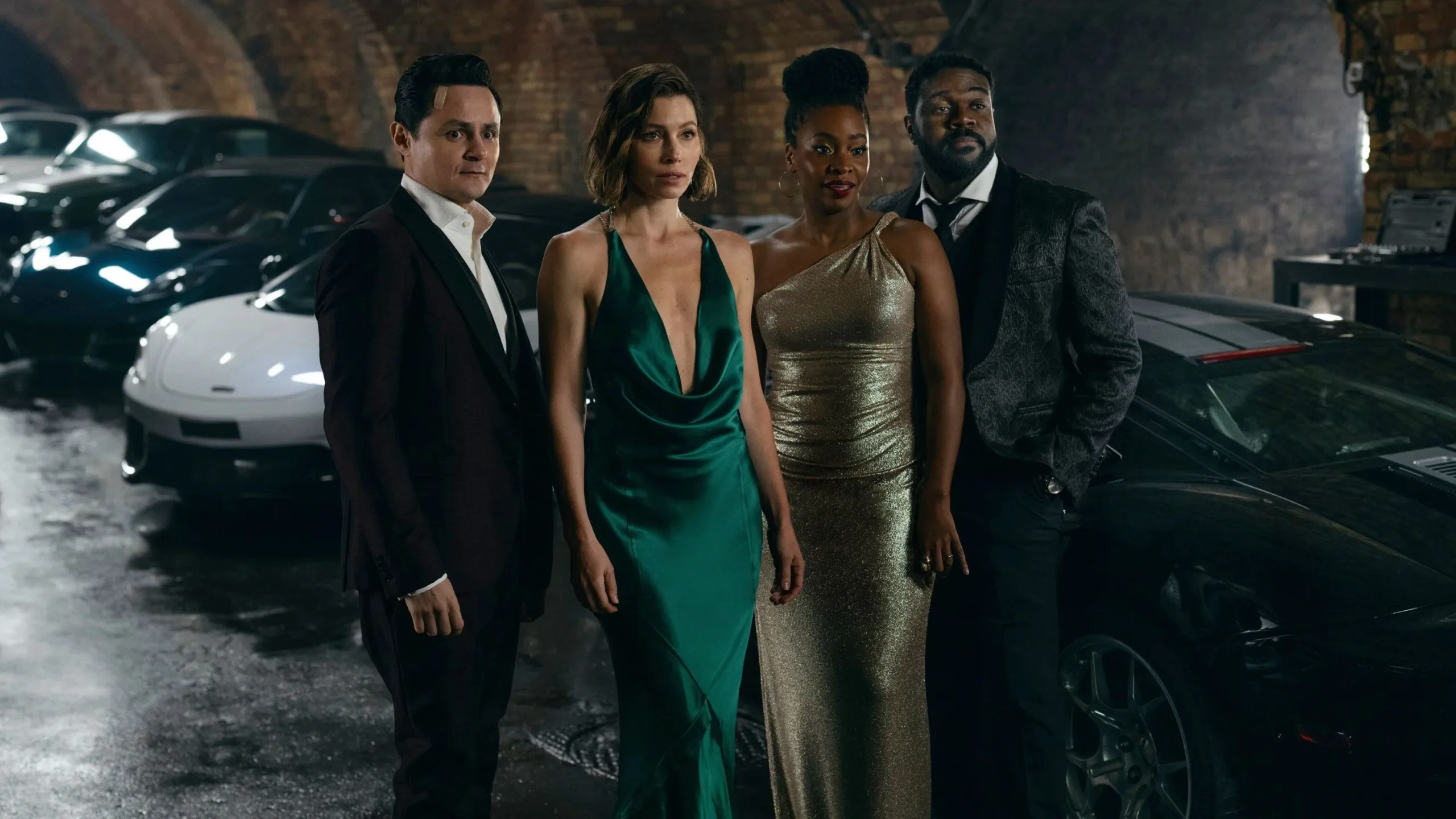
The extended vehicle chase gives that arrangement its most persuasive expression. When a box truck’s rear doors fly open with people inside, the vehicle becomes a precarious container rather than an anonymous projectile. Its occupants have a visible relationship to the danger around them.
Hargrave’s action is strongest in such situations, where an open door or the space beneath a truck makes vulnerability immediately intelligible. The weaker digital destruction loosens that relationship. Charmaine’s missile attack, accompanied by a dismissive quip, lets computer-generated chaos compete with Teyonah Parris’s delivery. The explosion consumes attention that might have belonged to the person making the joke.
Parris and Sam Richardson give the ensemble a more useful tension as Charmaine and Crosby, a helicopter pilot married to a heavy-machinery operator whose fear of flying constrains their shared possibilities. His alarm and her competence let the comedy express an existing marital imbalance.
Danger gives her room to act and forces him to recognize how much his caution has dictated. These are modest character pressures, but they create friction beyond astonishment at Sean’s abilities. Aimee’s racing likewise establishes her usefulness without fully developing the romance. Biel can make decisive driving credible; Sean’s long attachment to her leaves much of their emotional connection to be taken on trust.
Ted, the science teacher played by Arturo Castro, exposes a sharper problem with the civilian transformation. While firing a shotgun, he invokes Terminator 2, then later dispatches an opponent with a retirement joke before the man explodes. The movie reference places lethal action inside an already familiar entertainment vocabulary. We are invited to recognize the imitation and enjoy the civilian’s sudden fluency.
The transition from ordinary man to killer has scarcely any resistance. This need not become a solemn reckoning, but the speed of the conversion weakens the comic premise. Once everyone can perform the genre’s violence and supply its punchlines, their civilian identities lose some of the inconvenience that made them amusing.
The childhood material tries to preserve those identities through sentimental instruction. Bill Camp’s Smalley explains the origins of Matchbox, while the score encourages affection for the refuge he has provided. The emotional insistence feels heavy beside the café child, whose brief appearance establishes the connection through an act of looking.
The adult friends’ vehicle-related skills supply another connection, though a rather predetermined one. Childhood preferences seem to have issued career guidance. The brand becomes both a source of belonging and a diagram of who these people will grow up to be.
One early edit handles that inheritance with greater sensitivity. Young Sean has acquired the blue limited-edition Camaro Aimee wants, loses his nerve about giving it to her, and then learns he must move away. His frustrated toss of the toy cuts to a full-size car flipping during the adult desert chase.
The change in scale turns a failed gesture into violent motion, joining emotional helplessness to physical command. Adult Sean can manage hazards the boy could barely imagine, yet his attachment to Aimee still reaches back to that unfinished exchange. The cut allows the abandoned gift to persist beneath the spy’s spectacular competence.
Matchbox the Movie was released globally on Apple TV on October 9, 2026. Based on Mattel’s iconic die-cast toy line, the action-comedy film follows a group of former childhood friends who stumble into a dangerous international conspiracy during a reunion.
Where to Watch Matchbox the Movie (2026) Online


Full Credits
Title: Matchbox the Movie
Distributor: Apple TV
Release date: October 9, 2026
Rating: PG-13
Running time: 2 hours 6 minutes (126 minutes)
Director: Sam Hargrave
Writers: David Coggeshall
Producers and Executive Producers: David Ellison, Dana Goldberg, Don Granger, Robbie Brenner
Cast: John Cena, Jessica Biel, Sam Richardson, Arturo Castro, Teyonah Parris, Randeep Hooda, Danai Gurira, Kristoffer Hivju
Director of Photography (Cinematographer): Pedro Luque
Editors: Dirk Westervelt
Composer: Alex Belcher
The Review
Matchbox The Movie
Sam Hargrave gives Matchbox: The Movie ingenious physical action, and its best edits connect miniature play to adult danger with real imagination. Cena’s restraint and the Crosby–Charmaine dynamic lend the spectacle some human friction. Yet suspicion quickly becomes routine teamwork, civilian killing becomes a punchline, and nostalgic instruction carries emotional weight the relationships cannot sustain. The stunts make danger tangible; the film keeps reassuring us before that danger can trouble anyone.
PROS
- Inventive stunts with intelligible physical risks.
- Expressive connections between toys and adult action.
- Cena’s restrained blend of competence and awkwardness.
- Richardson and Parris’s productive marital tension.
CONS
- Spy intrigue produces little sustained uncertainty.
- Civilian killing weakens the fish-out-of-water comedy.
- Sean and Aimee’s romance remains underdeveloped.
- Digital destruction crowds out comic performance.
- Sentimental exposition overstates the childhood bond.