





















![Kingdom Hearts Collection [I-III] Review](https://gazettely.com/wp-content/uploads/2026/10/Kingdom-Hearts-Collection-I-III-1-360x180.webp "Kingdom Hearts Collection [I-III] Review: KHII Holds Steady as Newer Entries Fluctuate 40")
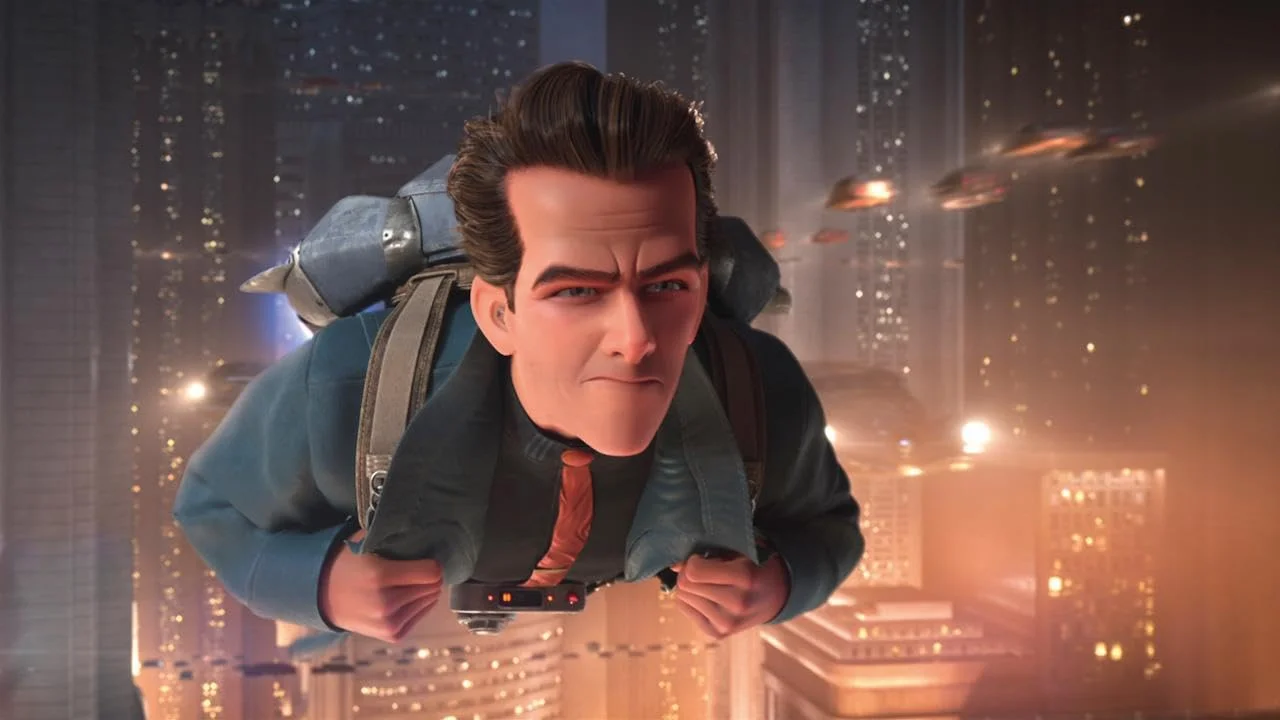

Ray and Venus get a little freedom when a nightclub switches off gravity. Their dance lifts them from the floor, turning an extravagant futuristic attraction into an unexpectedly tender encounter. For a private investigator and a singer whose life has become a public spectacle, floating together offers a brief escape from the demands of the case. Brad Bird’s Ray Gunn finds real sweetness here. The invention changes how two people can be close, and the romance becomes easier to feel.
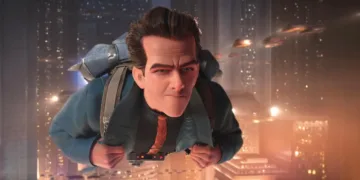
The surrounding city encourages that kind of pleasure. Metropia’s Art Deco towers, smoky clubs, and lilac-and-burgundy interiors make looking around an absorbing activity. Flying cars retain the rounded bodies of vintage automobiles; television screens display black-and-white images amid much flashier technology.
These familiar shapes give the future an inviting texture. Compared with the oppressive urban density of Blade Runner, this city leaves room for curiosity and leisure. Michael Giacchino’s brassy score contributes to that openness, lending the detective business some swagger and giving the romantic passages an old-fashioned softness.
Ray, voiced by Sam Rockwell, inhabits a considerably less comfortable corner of this beautiful place. His investigation business is failing, repossession workers are emptying the office, and his partnership with the one-eyed alien Eye-Ra attracts prejudice.
There is something immediately endearing about these two continuing to work together while their surroundings are being carried away. Their friendship has material consequences. Ray’s loyalty costs him business, yet the partnership survives the city’s disapproval and their dwindling resources. That shared predicament gives us a reason to care before the elaborate mystery demands our attention.
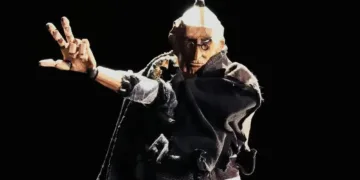
Tom Waits makes Eye-Ra particularly easy to grow fond of. His weary delivery suggests someone who has learned to expect disappointment without surrendering his sense of humor. Alongside Rockwell’s glib resilience, he gives the partnership a comfortable difference in temperament. Eye-Ra’s spider-like climbing abilities make him useful during the action, too, allowing his alien body to participate in the film’s inventiveness.
Then a hospital refuses him admission after a violent incident because it serves humans only. The exclusion hurts because we already know him as Ray’s friend and working partner. A rule governing this society becomes an obstacle to getting someone help.
That incident gives Ray’s decency a firmer emotional basis than the references to his troubled past. His former police career and dead parents suggest wounds, but the film gives those details limited room to shape our understanding of him. Rockwell supplies an appealing mixture of slyness and persistence, enough to keep Ray agreeable company through the case. Still, the present-tense friendship carries the character’s weight. Watching him remain committed to Eye-Ra tells us something we can feel immediately; the background information asks for sympathy that the narrative has less time to develop.
Venus Nova has the opposite problem: everyone knows her image, while access to the person is heavily managed. Her holographic advertisements occupy Metropia before Ray begins to understand the woman behind them. Scarlett Johansson gives her a sultry vocal presence, but the situation surrounding Venus makes attraction increasingly uneasy.
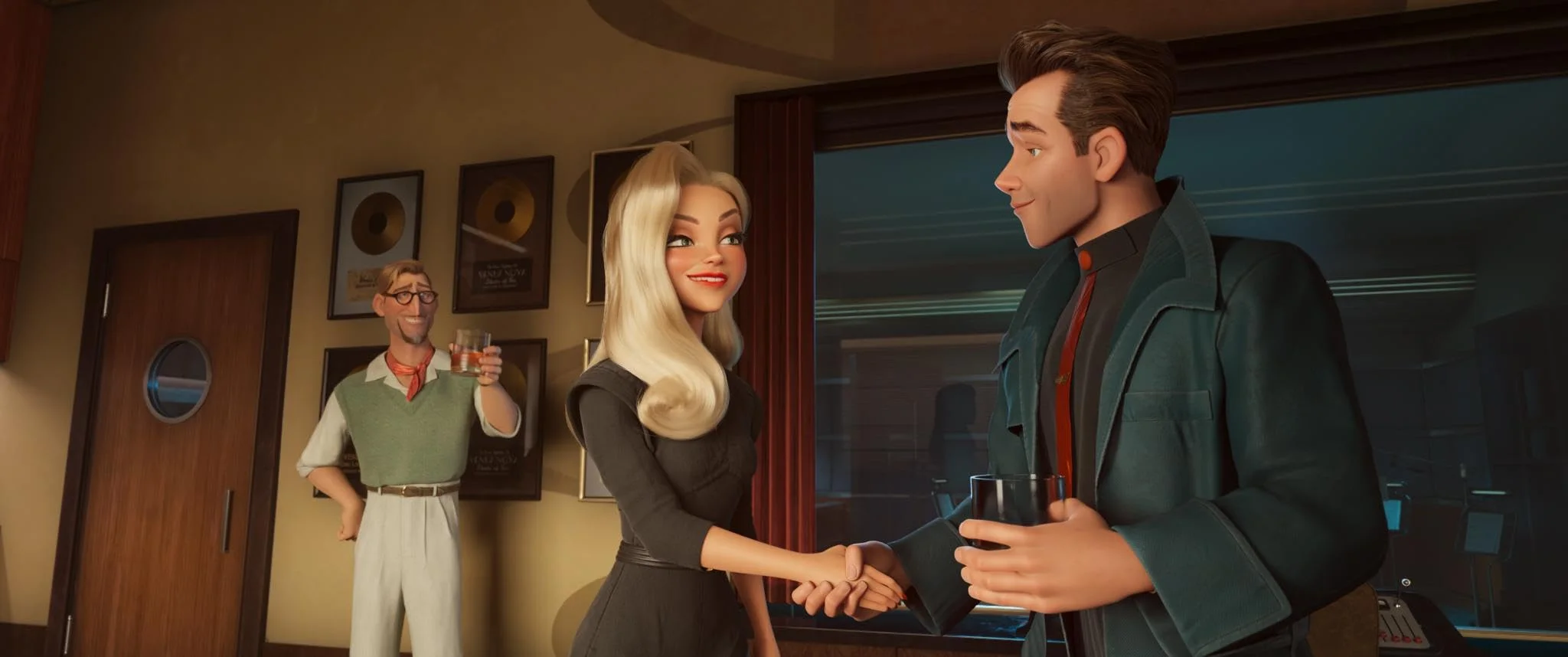
Her fourth husband, Arnold, uses her stand-in to manufacture evidence of an affair and pursue a profitable divorce. When Venus discovers the scheme and threatens him publicly, her understandable anger becomes something that can be used against her. The case turns on the gap between what happened and what other people can make her appear to have done.
Megamax extends that anxiety into her professional life. The entertainment corporation, run by her manager and first husband Barry Vogel, needs her popularity while treating her outbursts as a commercial liability. Her full holographic rendering, presented as a backup, makes the prospect of losing control over her image especially uncomfortable. Johansson’s singing provides a welcome change in our relationship with Venus.
Kimbra’s songs, including “Innocent,” let her occupy the film through expression rather than accusations and publicity. The modern pop sound sits somewhat awkwardly beside Giacchino’s period-inflected score, though the torch-song performance gives the film a particularly useful register for intimacy. Listening to Venus can bring us closer than another explanation of her celebrity troubles.
The mystery makes that closeness harder to sustain. At roughly two hours, the film spends a substantial stretch getting its central case into position, then prolongs suspicions that have already become fairly clear. Megamax’s manipulation is visible well before the complete scheme emerges. Waiting for the extent of its wrongdoing creates less tension than discovering how Venus experiences it. The investigation repeatedly asks us to remain uncertain about a threat whose basic shape we recognize, while the people affected by it still have emotional territory left unexplored.
There are pleasures within that delay. Ray’s particle weapon temporarily scrambles bodies, using animation’s physical freedom for a gag that would be grotesque in a harsher register. Such moments keep the caper buoyant and give its danger a playful elasticity. They also help explain why the film remains enjoyable even when the procedural machinery becomes tiring. A strange weapon or an airborne vehicle can renew curiosity about the world within seconds. Deepening concern for a character requires the next encounter to change something about our understanding, and the middle stretch achieves that less consistently.
Venus’s unexplained behavior offers a stronger reason to keep watching than the corporation’s conspicuous menace. There is a person here whom Ray wants to understand, and the eventual explanation matters to that relationship. Holding it back until late, however, places much of their time together under the demands of concealment.
Her moods become clues to decode while opportunities to sit with her vulnerability pass. Once the answers arrive, the film has less room to let Ray and Venus live with that knowledge, to develop the closeness suggested by their dance through the harder experience of being understood.
Ray Gunn premiered at the BFI London Film Festival on October 10, 2026, and is scheduled for a limited theatrical release on December 4, 2026, before streaming globally on Netflix on December 18, 2026. Set in Metropia—a retro-futuristic metropolis inspired by 1930s pulp vision—the animated neo-noir thriller follows private investigator Raymond Gunn as he takes on a high-stakes case involving murder, aliens, and a glamorous performer named Venus Nova.
Where to Watch Ray Gunn (2026) Online
Full Credits
Title: Ray Gunn
Distributor: Netflix
Release date: December 4, 2026 (Theaters), December 18, 2026 (Netflix)
Rating: PG
Running time: 1 hour 59 minutes (119 minutes)
Director: Brad Bird
Writers: Brad Bird, Matthew Robbins
Producers and Executive Producers: John Lasseter, Brad Bird, Lisa Beroud, David Ellison, Dana Goldberg
Cast: Sam Rockwell, Scarlett Johansson, Tom Waits, Matt Berry, Bobby Cannavale, Michelle Rodriguez, Matt Jones, Aasif Mandvi, Alan Tudyk, Kathryn Hunter
Editors: Darren T. Holmes, Karl Armstrong
Composer: Michael Giacchino
The Review
Ray Gunn
Ray Gunn is easiest to love when its inventions bring people closer: a floating dance, a friendship sustained through hardship, a singer finding room to express herself. Metropia makes delightful company, and Ray’s bond with Eye-Ra gives its injustices emotional weight. The prolonged mystery keeps Venus at a distance for too long, leaving less time for the intimacy its best scenes promise.
PROS
- Richly imagined, inviting retro-futuristic city
- Affecting friendship between Ray and Eye-Ra
- Tender zero-gravity dance sequence
- Expressive voice performances and singing
CONS
- Extended misdirection around obvious threats
- Limited development of Ray’s personal history
- Modern pop songs occasionally clash with the score