
















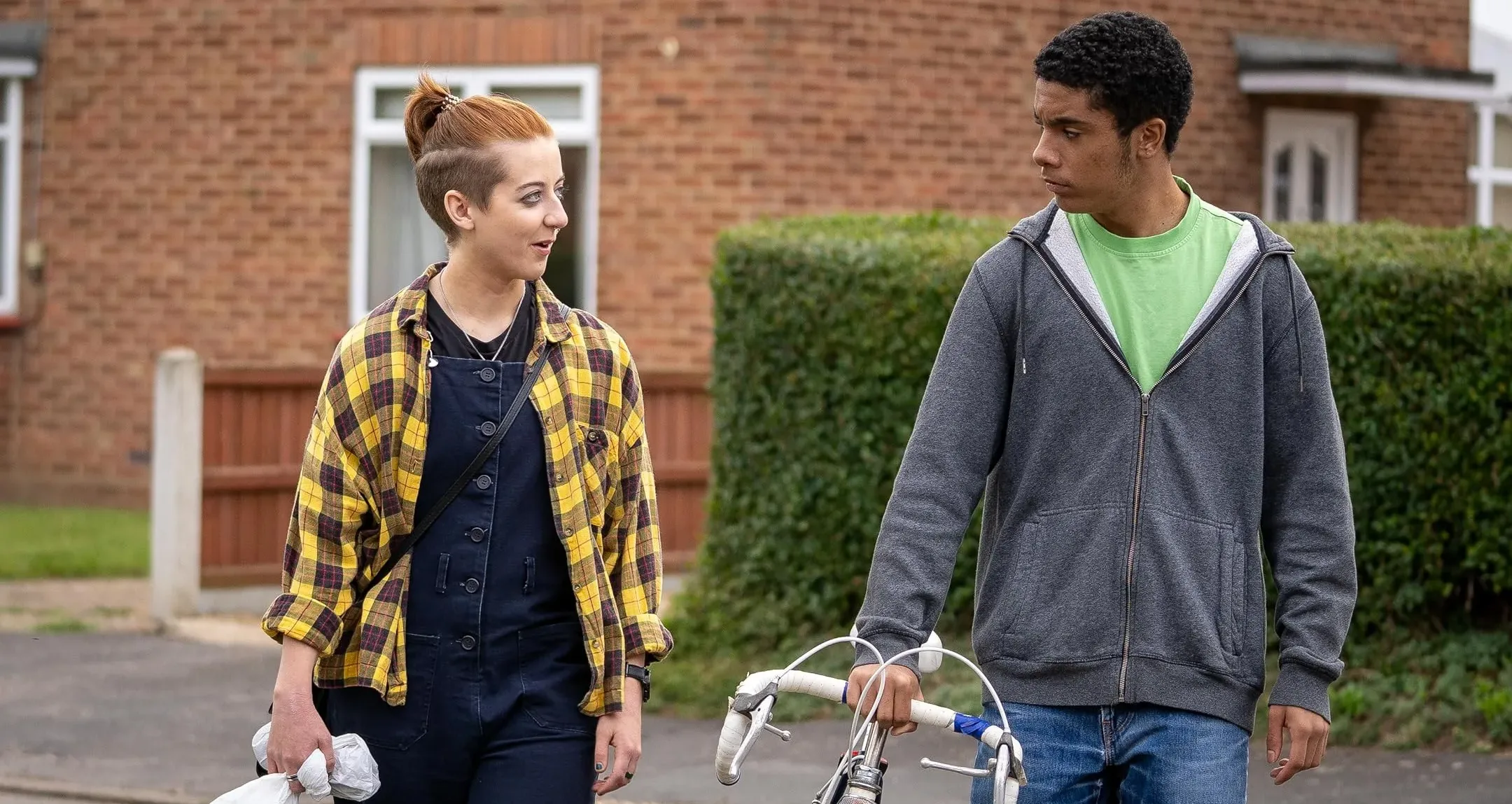

In the flat, unassuming landscape of the Fens, Chicken Town sets its stage for a story that feels both familiar and curiously off-kilter. The narrative begins with a classic setup: a young man, Jayce, played with quiet determination by Ethaniel Davy, is released from detention for a crime he did not commit.
His stated mission is to find the person responsible for the car crash that put him away, a straightforward objective that should provide a clear narrative engine. However, the film quickly diverges. Jayce’s path crosses with Kev (Graham Fellows), a retiree who has accidentally become the caretaker of a shed full of high-grade cannabis.
Along with their tech-minded schoolmate Paula (Amelie Davies), they form a small-time crew, and Jayce’s quest for justice is sidelined for a clumsy venture into drug dealing. The film presents itself as a low-stakes British crime comedy, a story more interested in its eccentric personalities than the mechanics of crime.
The Charm of the Central Crew
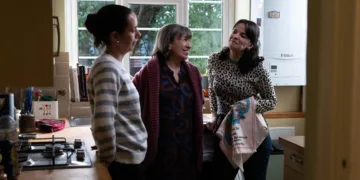
The film’s most solid foundation is the relationship between its central trio, a dynamic built on a mutual, unspoken need. The story finds its footing whenever Jayce, Kev, and Paula are simply sharing a room, their individual voids creating a strange, functional synergy.
Ethaniel Davy’s performance as Jayce is crucial; his quiet, watchful presence makes him an effective audience surrogate, a still point around which the film’s more eccentric elements can orbit. He is the anchor, and his seriousness prevents the story from floating away entirely on its own whimsy.
Counterbalancing him is Graham Fellows as Kev, whose comedic energy is the film’s main power source. Fellows taps into a familiar persona of bewildered but good-natured British eccentricity. Kev is a man defined by loneliness, and his fumbling entry into crime is as much about seeking connection as it is about money.
His attempts to be a tough criminal, like insisting on being called “Clint” during a deal, are layered with a touching pathos—a retiree’s grasp for relevance in a world that has moved on. The script gifts him the sharpest lines, from his misunderstanding of modern slang—confusing an Xbox with “egg-boxes”—to his deadpan delivery. Amelie Davies’ Paula provides the essential bridge between them.
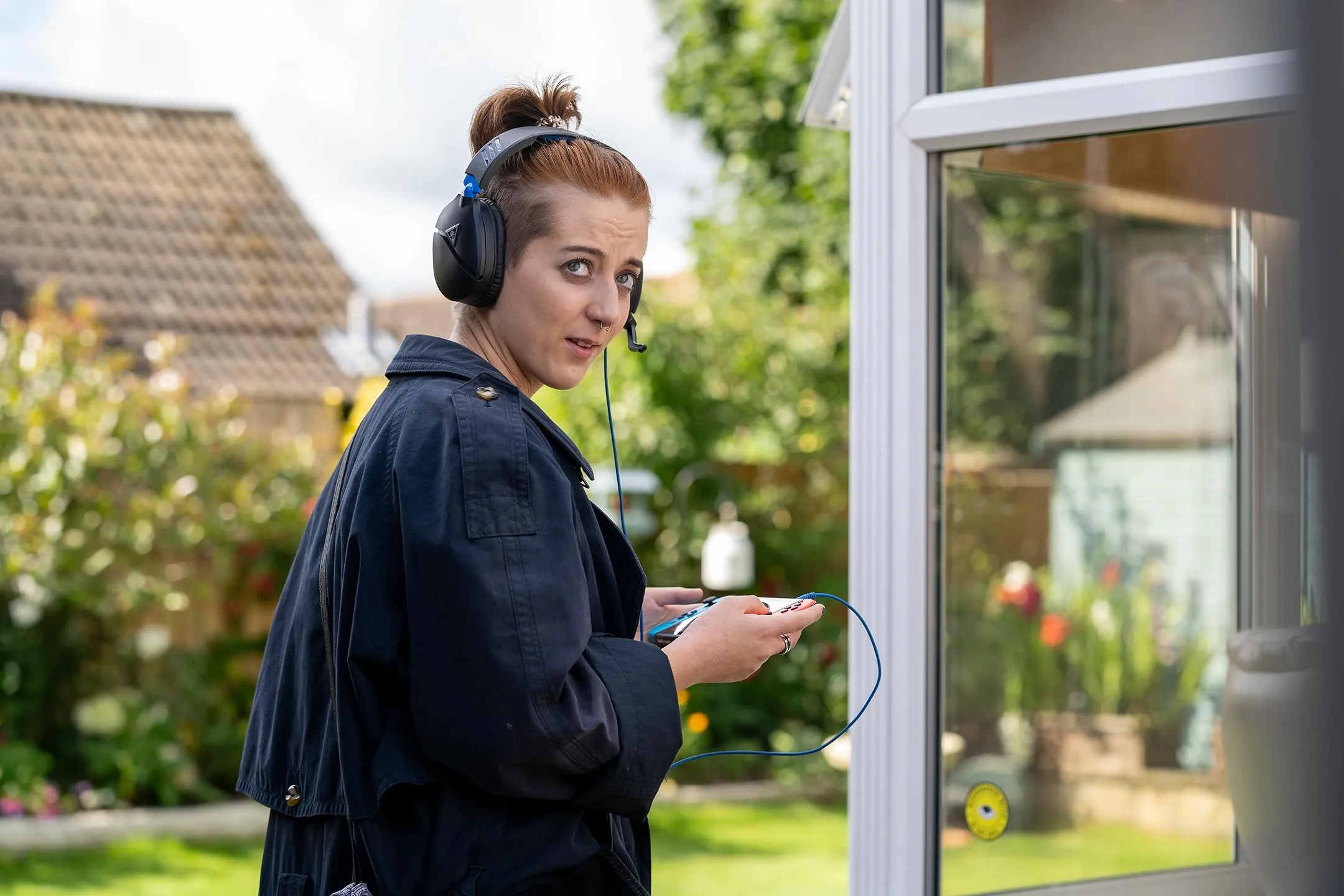
She is the pragmatic, tech-savvy operator who understands both Jayce’s world and Kev’s analog limitations, making their ill-conceived venture feel almost plausible. The generational humor lands effectively, particularly in a scene where Paula, genuinely curious, asks if Kev’s retirement carriage clock is “ironic,” only for him to respond with a plain, “No, it’s brass.” It’s in these small, sincere interactions that the film’s heart is most apparent.
A Narrative Adrift
For all the charm of its central performances, the film’s narrative structure is remarkably loose, treating its central plot as more of an inconvenience than a guide. The initial premise of Jayce’s investigation is not just sidelined; it’s a structural promise the script repeatedly breaks, bringing it up only to let it dissolve again.

This intentional or unintentional choice to prioritize character moments over plot progression ultimately leaves the audience adrift. Other narrative threads are introduced with the significance of a major development before vanishing entirely, like a local villain’s plan involving a 5G mast, which appears and disappears so quickly it feels like a hastily deleted paragraph from the script.
This creates a meandering pace that often works against the comedy. While the looseness occasionally contributes to a laid-back atmosphere, it frequently becomes sluggish, stretching scenes beyond their breaking point. A sequence in a phone shop, for instance, belabors its point about Kev’s technological ineptitude long after the joke has landed, killing the comedic momentum.
The humor itself is a mixed bag. For every clever, character-driven line, there are long stretches where gags fail to connect. The film also struggles mightily with its tone, shifting unsteadily between a whimsical Ealing-style comedy and brief, jarring moments of violence. These flashes of darkness lack the conviction to make an impact, suggesting a film that wants the edge of a dark comedy without committing to the bit, leaving the story caught in an awkward and unsatisfying middle ground.
An Unfulfilled Promise
Chicken Town is a movie of modest ambitions, a quality that is both a strength and a weakness. It operates in the same cinematic space as other beloved, small-scale British comedies, but it lacks the sharp insight or deep emotional resonance of its peers.
The production embraces its shoestring budget, wisely keeping major events like explosions and car crashes off-screen, a choice that reinforces its low-stakes charm. Yet, the film is haunted by its own missed opportunities. The most glaring is its title.
The chicken farming empire that gives the town its name is mentioned as the source of a villain’s wealth but is never explored, remaining a frustratingly peripheral detail. It promises a thematic depth or at least a flavorful setting that the story never delivers, making the film’s world feel thin and arbitrary.
This lack of curiosity extends to its supporting characters. Lee (Ramy Ben Fredj), the actual culprit of the original crime, is structurally critical as the story’s antagonist. However, he is rendered so toothless and juvenile that he poses no real threat, lowering the stakes of the entire narrative.
The absence of a credible obstacle for the heroes contributes directly to the story’s meandering feel. What remains is a likable but hollow film, a vehicle with a fantastic engine in its central performances but a faulty chassis and no clear destination. It is a sweet and gentle diversion, but one whose flimsy structure and unfocused story make it ultimately forgettable.
Chicken Town premiered at the Norwich University of the Arts on June 17, 2025. It was released in the United Kingdom on June 27, 2025.
Full Credits
Director: Richard Bracewell
Writers: Richard Bracewell, Patrick Dalton
Producers: Richard Bracewell, Patrick Dalton, Tom Wood
Cast: Ramy Ben Fredj, Ethaniel Davy, Graham Fellows, Amelie Davies, Laurence Rickard, Alistair Green, Richard Freeman, Michael Dalton, Hugo Carter, Everett Gaskin, Amy Keen, Gabriella Padula, George Potter, Georgina Shear, Stef White
Director of Photography (Cinematographer): Tansy Simpson
Editors: Charlotte Gage
Composer: Bernard Hughes
The Review
Chicken Town
Chicken Town is a film built on the undeniable charm of its central performances, with Graham Fellows delivering a wonderfully funny and touching turn as the bumbling retiree. The warm chemistry between the main trio and moments of sharp wit provide genuine enjoyment. However, these strengths cannot fully overcome a fundamentally weak and unfocused script. With abandoned plotlines, an inconsistent tone, and a narrative that meanders without purpose, the film feels like a pleasant but ultimately forgettable diversion that fails to capitalize on its own promising setup.
PROS
- The warm and funny dynamic between the three lead characters.
- A standout comedic performance from Graham Fellows.
- Features moments of genuinely clever, character-driven dialogue.
CONS
- An unfocused script with multiple abandoned plot threads.
- An inconsistent tone that struggles to balance comedy and drama.
- Underdeveloped supporting characters and narrative concepts.
- Sluggish pacing that dulls comedic impact.