



























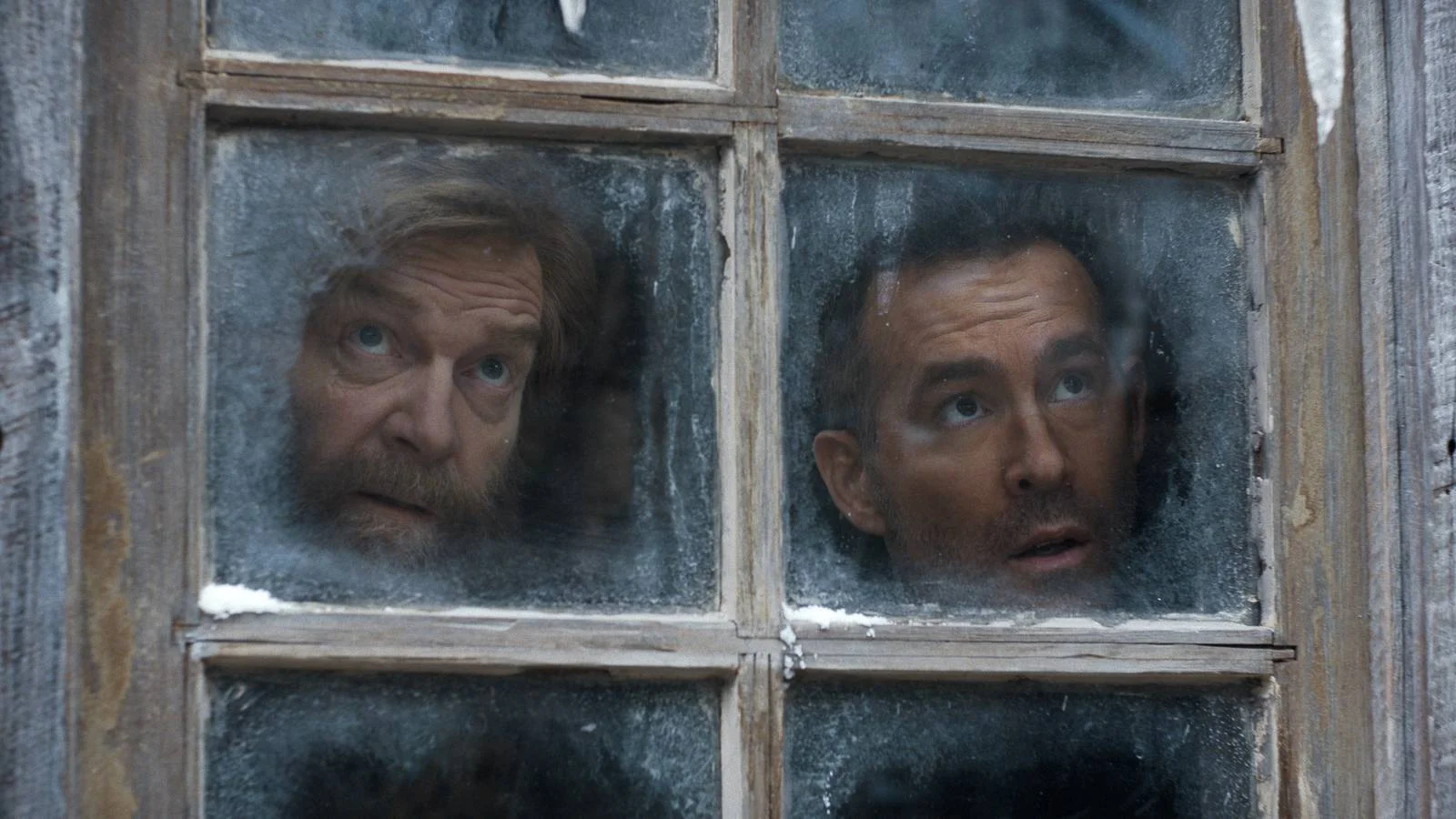

The Cold War was built on the idea that two nations could stare at each other for decades without ever truly seeing one another. Mayday takes that historical distance and turns it into a buddy comedy about two men who discover that the enemy looks strangely familiar once the propaganda fades.
Jonathan Goldstein and John Francis Daley’s latest film reaches back to 1987, a year when the cultural image of the heroic American pilot was still flying high. Ryan Reynolds plays Troy “Assassin” Kelly, a Navy fighter pilot whose confidence borders on ideology. He does not simply believe in his country. He believes in the story his country tells about itself. Then his plane crashes.
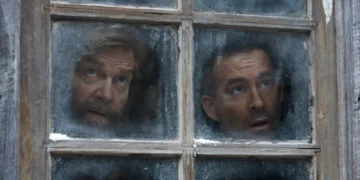
Stranded in Soviet territory after a failed covert mission, Troy wakes up in the care of Nikolai Ustinov (Kenneth Branagh), a former KGB operative who appears to be everything Troy was trained to distrust. The joke arrives quickly: Nikolai is obsessed with America. His cabin contains pieces of the culture Troy thinks belongs exclusively to his side of the world. He dreams of eating McDonald’s, driving across the United States, and experiencing the fantasy version of America that exists in his imagination.
The film’s central contradiction is its strongest idea. Troy believes he knows the Soviet Union because he has been told what it represents. Nikolai believes he knows America for the same reason. Both men are wrong.
That sounds like a heavy premise for a movie built around explosions and jokes, but Mayday understands that ideology often becomes easier to examine when people are forced into uncomfortable conversations. (A cabin in the Russian wilderness is apparently the perfect location for international diplomacy. The United Nations may need to update its facilities.)
The Enemy Who Loves Your Movies
Nikolai is where Mayday discovers its personality. Kenneth Branagh approaches the role with the energy of someone who has been waiting years for permission to become completely strange. The character could have easily become a collection of Russian stereotypes. The thick beard, the isolated cabin, the former intelligence background, the mysterious survival skills.
Instead, Branagh gives Nikolai a sense of loneliness beneath the humor. His excitement around American culture feels less like a joke about foreign obsession and more like the behavior of someone who spent years imagining another life.
The funniest parts of Nikolai often come from small details. His awkward attempts at friendship, his intense reactions, and his complete sincerity create a character who does not realize how unusual he appears. Branagh understands that the comedy works because Nikolai does not think he is funny.
Troy, meanwhile, represents a different kind of performance. Reynolds plays him with his familiar rhythm: the quick remarks, the confidence, the ability to turn discomfort into a punchline. The difference here is that Troy’s humor has a purpose. His jokes are armor. They protect him from admitting that his understanding of the world might be incomplete.
The casting creates an interesting reversal. Reynolds has built a career playing characters who seem smarter than everyone around them. Here, that attitude becomes the flaw. Troy is not unintelligent. He is simply trapped inside a version of reality that has been handed to him. The movie’s best scenes come from watching those two perspectives collide.
Nostalgia With a Complication
A lesser version of Mayday would have used the 1980s as decoration. The film has the soundtrack, the military imagery, the cultural references, and the obvious connection to Top Gun. Yet Goldstein and Daley are more interested in what those movies represented.
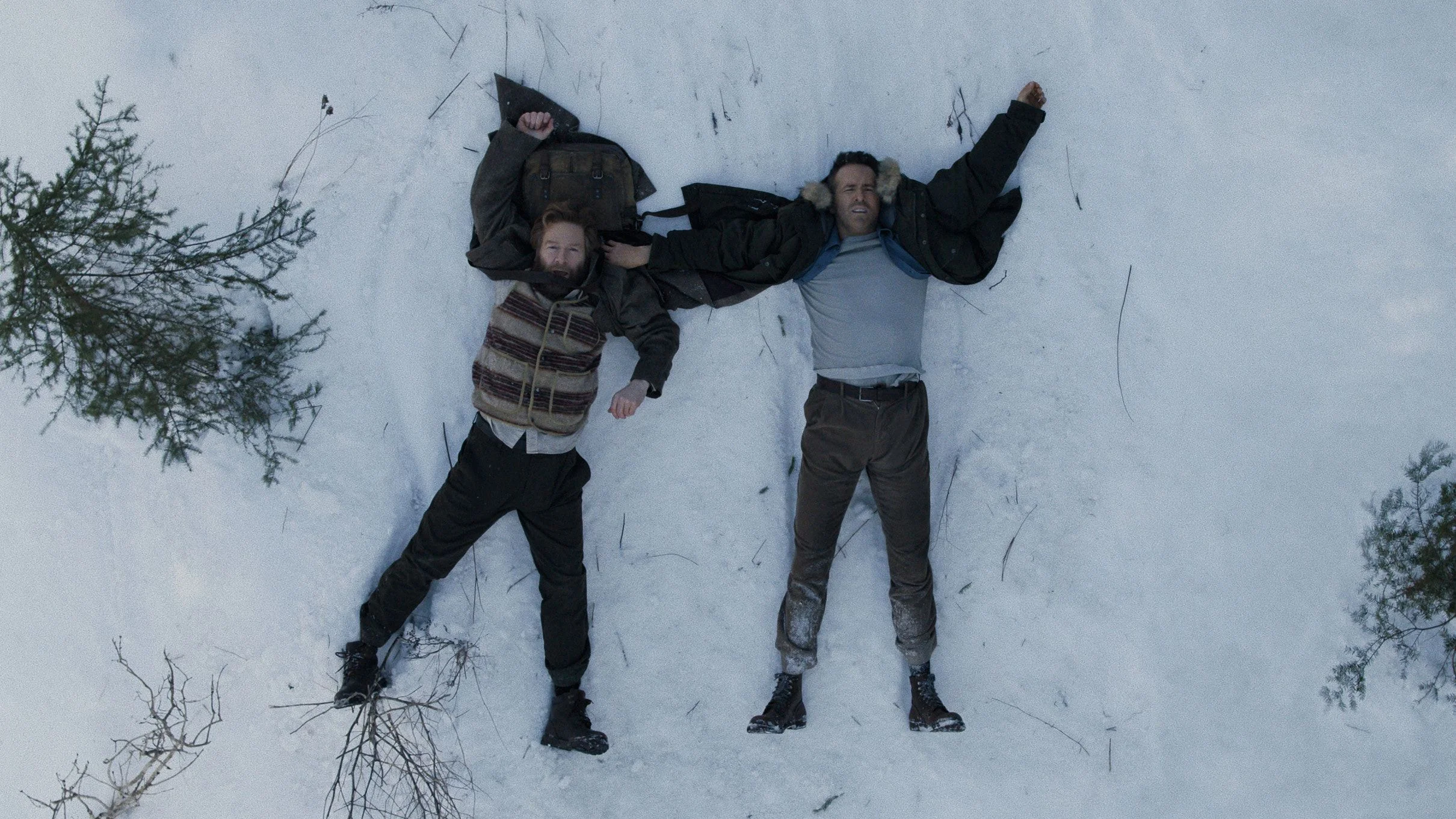
The 1980s action hero often operated in a world where moral certainty came easily. The good side was obvious. The enemy was distant. The mission rarely required self-reflection. Mayday places that kind of hero in a situation where certainty becomes a problem.
Troy begins as someone who sees the Soviet Union as a collection of enemies. His journey forces him to recognize individual people behind the political symbols. Nikolai is not a replacement for an entire nation, and Troy is not a perfect representative of his own.
The film also avoids making the Soviet system itself the only source of danger. Marcin Dorociński’s Alexander Volkov represents the forces that want conflict to continue. His threat comes from his desire to preserve division, even as political circumstances begin to change. The movie’s argument is simple: countries create narratives, but people create relationships.
Simple arguments can still work. The problem comes when Mayday occasionally underlines the point so heavily that it starts explaining its own lesson. The film trusts Troy and Nikolai’s relationship more than it trusts its dialogue.
Action Built Around Character
Goldstein and Daley have always been strongest when chaos pushes characters into revealing themselves. Game Night turned a simple gathering into a chain reaction of escalating disasters. Dungeons & Dragons: Honor Among Thieves found emotional stakes inside fantasy spectacle. Mayday follows the same instinct. The action exists because these two men are constantly being tested.
The opening flight sequence immediately establishes Troy’s confidence and the danger of his mission. The aircraft disaster is not only an exciting introduction. It removes Troy from the environment where he feels powerful. Once he reaches the ground, the movie changes. The fighter pilot becomes the person who needs saving.
The bar sequence where Nikolai reveals his combat ability is one of the film’s funniest shifts. Troy expects a helpless civilian or dangerous enemy. Instead, he discovers that the person he underestimated may be the most capable person in the room.
Later sequences continue that pattern. A train escape turns movement into comedy. A confrontation involving a closet finds humor in tight physical space. The final aircraft battle pushes the film toward the exaggerated energy of classic action adventures.
Barry Peterson’s cinematography keeps the movie moving. The camera often follows characters through complicated spaces, creating a feeling of constant momentum. Some transitions are impressive, particularly when action flows from one location into another without losing clarity.
There is a strange tension in the visual style, though. The film takes place during one of history’s most politically tense periods, yet much of it carries the clean brightness of modern streaming productions. The glossy look fits the comedy but sometimes works against the atmosphere of a Cold War thriller.
The Limits of Looking Back
The danger of nostalgia is that it can become a museum. A filmmaker can recreate the objects of the past without understanding why people cared about them. Mayday avoids that trap, but it does not escape it completely.
The film has moments where its references become louder than its characters. The repeated connection to Top Gun is intentional, yet the movie occasionally seems trapped by the shadow of the film it admires. It wants to honor the simplicity of older action movies while questioning that simplicity. Those goals are not always perfectly aligned.
The supporting characters also reveal some missed opportunities. Maria Bakalova’s Anna could have expanded Nikolai’s story by showing more of the personal cost behind his choices. David Morse’s storyline as Troy’s father introduces ideas about service, sacrifice, and national loyalty, but the film does not spend enough time developing them.
Still, the central pairing carries the movie through its weaker moments. Branagh gives the film its most surprising emotional weight, while Reynolds finds a way to make Troy’s confidence feel like something that needs to change. Mayday is a movie about two men who think they understand the world because they understand the stories surrounding it. Then reality interrupts. Reality usually does that. It has terrible timing.
The film does not reinvent the action comedy, and it does not need to. Its greatest achievement is finding a reason to revisit an old genre without pretending the old assumptions still work. The Cold War may have divided nations, but Mayday finds its humor in the awkward process of discovering that enemies are often just strangers waiting for a conversation.
Mayday premieres globally on Apple TV+ on September 4, 2026. The action-comedy follows a U.S. Navy pilot stranded behind enemy lines during the Cold War who forms an unexpected alliance with an eccentric former KGB agent.
Where to Watch Mayday (2026) Online


Full Credits
Title: Mayday
Distributor: Apple TV+
Release date: September 4, 2026
Rating: PG-13
Running time: 1 hour 51 minutes
Director: Jonathan Goldstein, John Francis Daley
Writers: Jonathan Goldstein, John Francis Daley
Producers and Executive Producers: David Ellison, Dana Goldberg, Don Granger, Ashley Fox, Johnny Pariseau, Jonathan Goldstein, John Francis Daley, Ryan Reynolds
Cast: Ryan Reynolds, Kenneth Branagh, Maria Bakalova, Marcin Dorociński, David Morse, Lovell Adams-Gray, Clark Johnson
Director of Photography (Cinematographer): Barry Peterson
Editors: Jamie Gross, John Lee
Composer: Colin Stetson
The Review
Mayday
Mayday understands that nostalgia works best when it questions the past instead of simply decorating itself with it. Goldstein and Daley use the Cold War setting to examine how nations create enemies, while Ryan Reynolds and Kenneth Branagh turn an expected rivalry into an unexpectedly warm partnership. The film stumbles when its ideas become too obvious, but its inventive action and strange emotional core keep it airborne.
PROS
- Branagh’s eccentric performance
- Reynolds and Branagh chemistry
- Creative action sequences
- Cold War commentary
CONS
- Predictable emotional beats
- Underused supporting characters
- Overloaded nostalgia