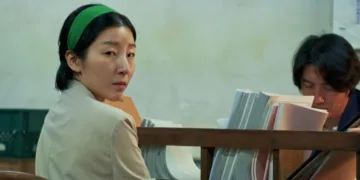































The most unsettling stories often begin not with a bang, but with a quiet, off-key note of social awkwardness. So it is with Hwang Wook’s psychological thriller, The Woman. We are introduced to Sun-kyung (Han Hye-ji), a young woman engaged in the familiar rituals of a fresh start: a new apartment, a new job at a local café. Her life is a portrait of unassuming solitude.
The narrative engine sputters to life through an act of modern thrift—acquiring a free vacuum cleaner via a neighborhood app. The exchange itself is where the film’s central unease is born.
The vacuum’s owner, a fidgety and nervous Young-hwan (Kim Hee-sang), receives her thank-you gift of strawberries not with gratitude, but with a flash of paranoia that transforms a simple gesture into a tense standoff. This bizarre, uncomfortable encounter is the film’s opening bid, a quiet transaction that hints at a terrifying hidden cost.
The Geometry of Fear
The film’s first act is a masterclass in building suspense from the ground up, using the raw materials of everyday vulnerability. Following the strange meeting, Sun-kyung learns that her old college friend, Ui-jin (Nam Yeon-woo), who had come to her aid during the strawberry dispute, is dead.
The reported cause is a poisoned drink, a detail that chills because it precisely echoes a paranoid tale Young-hwan had told about his own mother’s demise. This coincidence provides the foundation for Sun-kyung’s suspicion, and the film begins to assemble the components of a classic woman-in-peril story. Director Hwang Wook constructs this section with a patient, almost stark precision.
The camera’s gaze is steady, often holding static long takes that trap characters within the mundane confines of their apartments, amplifying their isolation. The pacing is deliberate, allowing a palpable sense of dread to accumulate in the silences between dialogue.
Han Hye-ji’s performance is key; her stillness and quiet observation turn Sun-kyung into a screen for our own anxieties about living alone. Opposite her, Kim Hee-sang’s Young-hwan is perfectly pitched between sympathetic oddball and genuine menace, his physical tics and tightly wound nervousness grounding the film’s mounting tension in the authentic fear of a stranger’s unpredictable nature. It’s a patient, architectural approach to suspense that has become a hallmark of a certain type of South Korean thriller, finding its horror not in monsters, but in the person next door.
When the Protagonist Becomes the Puzzle
Just as the viewer settles in for a familiar investigative thriller, the film executes a sharp narrative turn that pulls the rug out from under the entire story. Sun-kyung takes her credible suspicions to the police, who meet her story with a baffling mixture of amusement and annoyance. The detective’s dismissiveness feels like more than simple institutional indifference; it’s the first sign that the reality we have been shown may be incomplete.
It is here that The Woman abandons its conventional path and ventures into more disorienting territory. The story’s focus splinters, shifting away from the potential crime and toward Sun-kyung’s circle of old college friends, online rumor mills, and the distorting power of gossip. We see how amateur sleuths on message boards twist facts to fit their desired narratives, a digital noise that contrasts sharply with the quiet, personal dread of the first act.
The film’s structure, explicitly divided into chapters, signals a fundamental change in perspective. Sun-kyung is no longer simply the potential victim we first met. Her own actions become questionable, her motivations opaque. Her visits to the deceased’s apartment feel less like investigation and more like a private, unsettling ritual.
The narrative cleverly begins to reframe her behavior, making her obsessive quest for answers look less like righteous determination and more like something else entirely. The central question shifts from “Who is the killer?” to a much more complicated and unnerving one: “Who is the woman?” The film systematically dismantles our initial assumptions, transforming a whodunnit into a compelling psychological puzzle box with its main character at the very center.
An Unresolved Equation
Ultimately, The Woman is less interested in providing answers than it is in exploring a state of profound modern dislocation. The film is a moody character study about the impossibility of truly knowing another person, or even oneself, in an age of curated identities and rampant misinformation.
It uses the familiar language of a thriller—mystery, suspicion, a possible murder—to conduct a forensic examination of a deeply isolated individual. Hwang Wook employs a range of techniques to evoke this atmosphere of alienation. The cinematography is often stark, punctuated by moments of saturated color, like the deep red of the strawberry juice that becomes a recurring visual motif for potential danger.
Unsettling, off-center camera framing creates a creeping sense of being watched, suggesting a perspective just outside the frame that we are not privy to. The eerie musical score amplifies the psychological distress. The story refuses to tie up its threads, culminating in an abrupt and ambiguous final scene.
This lack of resolution is not a storytelling failure but the film’s primary aesthetic statement. It denies the audience the catharsis of a clean solution, forcing them to sit with the ambiguity. The film’s final argument seems to be that in a world of fractured information and closely guarded secrets, some equations are simply not meant to be solved.
The Woman premiered in South Korea in 2025.
Full Credits
Director: Hwang Wook
Writers: Han Hye-Ji
The Review
The Woman
The Woman is a sharp, disquieting psychological study disguised as a thriller. It deliberately trades plot resolution for a lingering atmosphere of dread and ambiguity. While its methodical deconstruction of suspense is masterful, those seeking clear answers will be left grasping at shadows. It succeeds as a challenging piece of filmmaking that prioritizes mood and thematic depth over narrative satisfaction, making for a truly unnerving and memorable character piece.
PROS
- Masterful construction of slow-burn tension in its first act.
- A compelling and nuanced central performance from Han Hye-ji.
- Intelligent subversion of familiar genre tropes.
- Stylish direction that creates a potent atmosphere of paranoia and isolation.
- Thought-provoking exploration of modern alienation and the nature of truth.
CONS
- The abrupt narrative shift may feel jarring to some viewers.
- An intentionally ambiguous ending that could be perceived as unsatisfying.
- The deliberate pacing might be too slow for audiences expecting a conventional thriller.







