































The film introduces us to Shrirenu Tripathi, a 42-year-old Sanskrit professor residing in the industrial city of Jamshedpur. His life is a quiet study in loneliness; a socially awkward man steeped in traditional values, he is a source of gentle mockery for his students and a subject of concern for his family, who are keen to see him married.
Shrirenu embodies a brand of Indian masculinity rooted in conservative ideals and a pronounced lack of confidence in the presence of women. His world is constructed from ancient texts and provincial expectations, leaving him ill-equipped for the complexities of contemporary romance.
His proposed counterpart is Madhu Bose, a younger, vivacious French teacher from the culturally rich city of Kolkata. She is presented as his complete opposite: modern, assertive, and a product of a liberal, artistic Bengali family. Their story begins through the very traditional channel of an arranged match, immediately establishing a dynamic of opposites.
Their initial courtship is filled with a certain charm—shared screenings of old films and intellectual discussions form the basis of their connection. Yet, beneath the surface of this sweet beginning, the film carefully plants the seeds of a fundamental ideological conflict, suggesting their disparate worldviews are on an inevitable collision course.
Two Halves of a Fractured Whole
Madhavan’s Shrirenu is a character of careful, almost symbolic, dualities. His profession as a Sanskrit teacher grounds him in the language of scriptures and ancient philosophy, a world that values order and tradition above all. This background explains his initial appeal; he possesses an “old-world charm,” a bumbling sincerity that Madhu, perhaps tired of more conventional men, finds endearing. However, this gentleness proves to be a fragile veneer for a rigid core.
His knowledge is archival, not adaptive. It has fostered deep-seated insecurities and a patriarchal worldview nurtured by his provincial upbringing. The film suggests that when his carefully ordered ideas are challenged by Madhu’s lived reality, this soft exterior cracks to reveal a man who is not simply old-fashioned, but deeply judgmental.
Also Read






As his foil, Fatima Sana Shaikh’s Madhu is designed with equal symbolic weight. A French teacher, she represents a different kind of classicism—one tied to European romance, existential thought, and a cosmopolitan perspective. She is spirited and unapologetic about her life choices, embodying a form of female agency that directly confronts Shrirenu’s narrow worldview. Their on-screen chemistry, however, feels more intellectual than visceral.
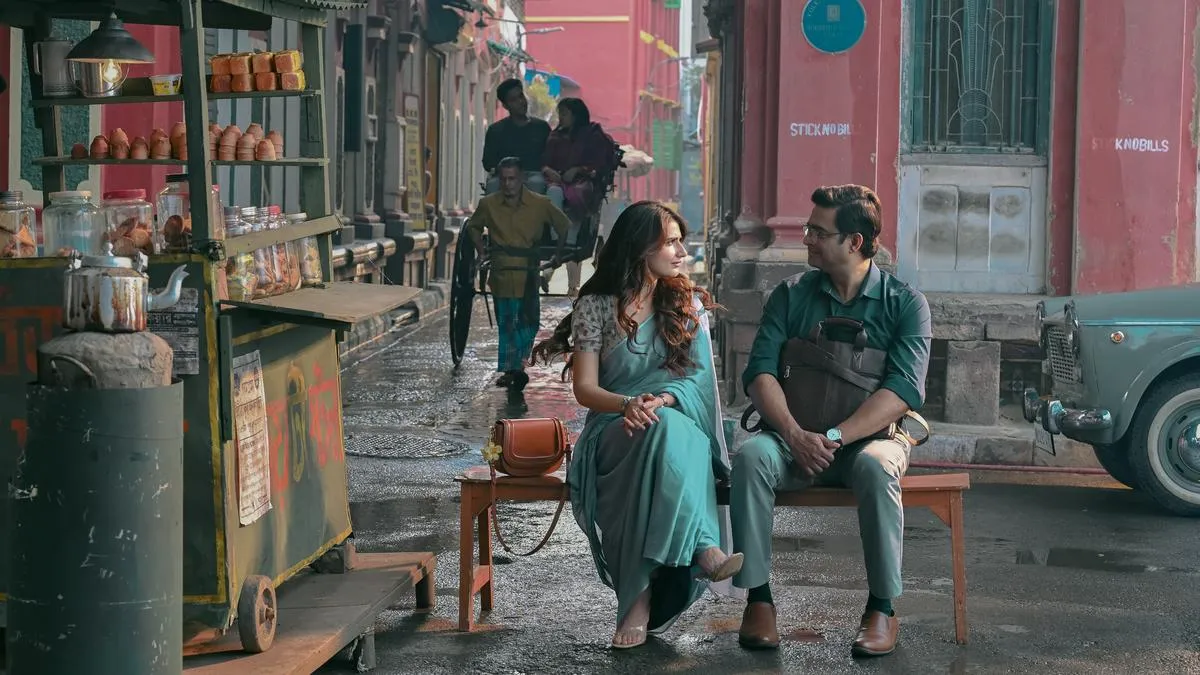
During their courtship, they trade sweet nothings—his in Sanskrit, hers in French—during idyllic walks through a rain-washed Kolkata. They bond over a screening of the classic Chalti Ka Naam Gaadi (1958), where Madhu’s admiration for the actor Ashok Kumar charms Shrirenu. Yet these moments feel polite and somewhat strained, like a theoretical attraction between two opposing ideas rather than an authentic emotional bond. The spark is faint, hinting at the fragility of a relationship built on admiration for symbols rather than an understanding of the person behind them.
The Ideological Battlefield of Romance
The film positions its romantic plot as a microcosm for the friction between ingrained patriarchy and female agency in modern India, a theme increasingly common in global cinema that uses genre to explore social issues. This central tension boils over in a pivotal sequence involving a sex-chat app, coincidentally named Aap Jaisa Koi.
When Shrirenu discovers Madhu has used such an app, his reaction is not one of curiosity or hurt, but of immediate moral judgment. This moment strips away his “simple man” persona to expose his hypocrisy. He is revealed as a gatekeeper of propriety, a man who believes he has the right to audit and approve of a woman’s past. The narrative acutely observes that for many men conditioned by a deeply patriarchal society, shedding these attitudes is an arduous, perhaps impossible, process. A courteous demeanor can easily hide coarse, possessive instincts.
This ideological clash is physically represented by the two family environments, a technique reminiscent of other Hindi films like 2 States (2014) and more recently, Rocky Aur Rani Kii Prem Kahaani (2023). The Tripathi household in Jamshedpur is a bastion of conservatism, ruled by Shrirenu’s domineering brother, Bhanu, who preaches about the proper, subservient conduct for women.
In stark contrast, the Bose family in Kolkata is a sprawling, artistic, and progressive unit, though their depiction veers into familiar stereotypes of Bengali culture—reducing their liberalism to shorthand signifiers like eating fish and hosting elaborate pujas.
The film is also saturated with Bollywood homages, from its opening scene set to a song from Kuch Kuch Hota Hai (1998) to its title’s reference to a famous Zeenat Aman song from Qurbani (1980). This self-referential quality, a hallmark of post-liberalization Hindi cinema, feels less like a charming enrichment of the story and more like a crutch, making the film feel derivative and its social commentary second-hand.
A Story Strained by its Own Ambition
The screenplay’s primary weakness is its structural integrity and pacing. The relationship between Shrirenu and Madhu accelerates at an unnatural speed; the narrative leaps from a few pleasant dates to a discussion of marriage, a jump that feels entirely unearned.
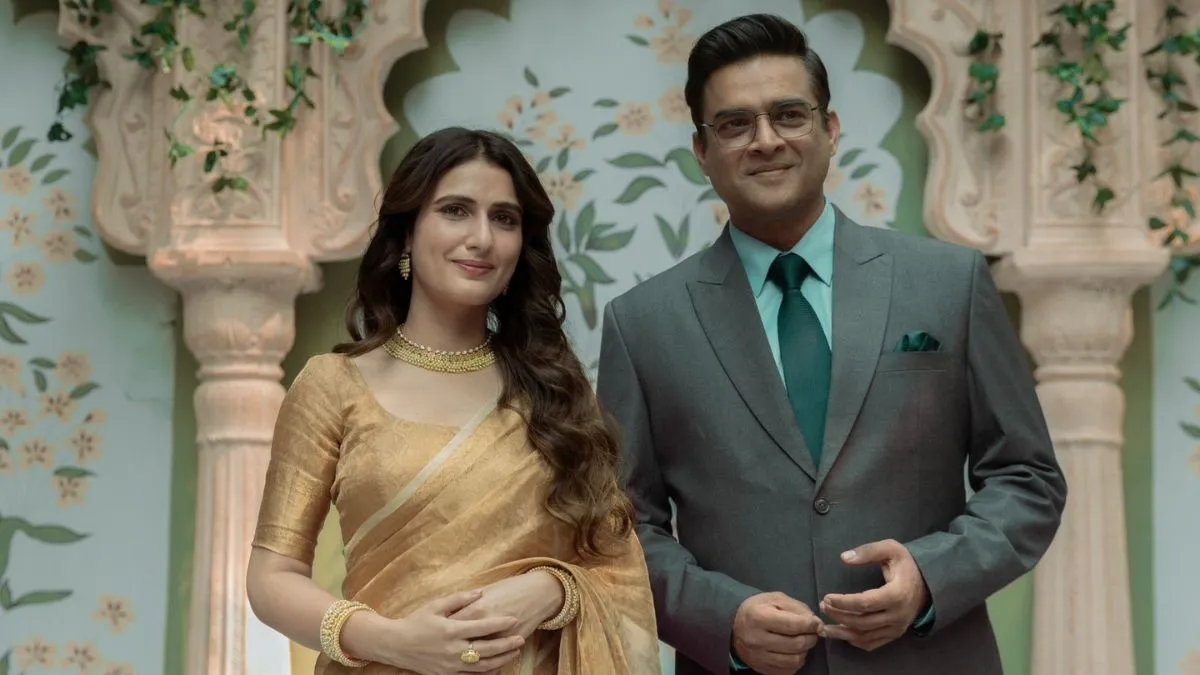
We are told of their deepening bond but are not given sufficient time to witness it, making it difficult to invest in the relationship before it inevitably shatters. Consequently, the central conflict, while thematically vital, feels engineered and abrupt.
It functions as a mechanical midpoint twist designed to propel the plot forward rather than an organic unraveling of character. The subsequent redemption arc is handled with similar impatience. Shrirenu’s change of heart is presented through monologues and grand gestures, bypassing the messy, difficult emotional work required for genuine transformation.
The titular app, Aap Jaisa Koi, serves its purpose as the catalyst for this conflict, but its use as a plot device feels thin. It is a modern tool employed to trigger an age-old ideological battle, but it lacks integration into the characters’ lives, appearing only when the script requires a shock. The film is further hampered by its multiple underdeveloped subplots, which hint at a richer, more complex world but are ultimately given short shrift.
The most significant missed opportunity lies with Kusum, Shrirenu’s sister-in-law. Her quiet, simmering rebellion against her oppressive husband is a powerful and relevant story of a woman seeking her own agency within a patriarchal home. Yet, her arc is resolved too hastily in the final act, a narrative shortcut that denies her the focus she deserves. The film gestures toward depth but repeatedly chooses to stay in the shallows.
Performances in Service of a Message
The lead actors work diligently within the confines of the script. R. Madhavan effectively uses his well-established screen persona to portray Shrirenu’s initial diffidence and social awkwardness, making his early scenes believable. However, when the character must pivot into a defensive chauvinist, the transition feels more theoretical than emotional, a change seemingly dictated by the plot’s demands.

His performance is sincere and carries a gentle warmth, yet it is ultimately stranded by the thin material that offers little room for a nuanced psychological shift. Fatima Sana Shaikh brings a commendable, spirited energy to Madhu, but her character often functions more as a mouthpiece for the film’s progressive message than a fully realized person. This reduces her to a symbol of modernity, and her performance consequently appears stilted in moments that require deeper emotional grounding.
The film’s most affecting and memorable performance comes from the supporting cast. Ayesha Raza, as the quietly observant sister-in-law Kusum, is a standout. With minimal dialogue, she conveys years of repressed ambition and quiet suffering, making her eventual act of rebellion the most earned emotional beat in the entire film.
She infuses the character with a potent blend of resignation and simmering dignity. On the other side of the ideological spectrum, Manish Chaudhary is suitably rigid as the overbearing brother, Bhanu, effectively embodying the unthinking conservatism the film seeks to critique. Namit Das provides some levity as Shrirenu’s loyal best friend, another pillar reinforcing the story’s patriarchal backdrop.
Visual Polish on a Familiar Form
The film’s cinematography is a clear strength, creating a visual language that underscores its thematic contrasts. Cinematographer Debojeet Ray successfully captures the distinct atmospheres of the two primary locations, a technique vital for a story about cultural divides.

The visuals of industrial, gritty Jamshedpur are rendered in muted tones, with compositions that emphasize Shrirenu’s hemmed-in, constrained existence. This stands in stark opposition to the depiction of Kolkata, which is presented as a romantic, rain-washed city full of life and color, reflecting Madhu’s more fluid and open world. The camera work is thoughtful, often using close-ups to capture fleeting emotional states and wider shots to establish the oppressive or liberating nature of the characters’ environments.
The music by Rochak Kohli and the background score by Justin Prabhakaran work in tandem to create a pleasant and gentle mood that aligns with the film’s rom-com aspirations. The songs are melodious and fit comfortably within montages that chart the course of the relationship, but they function more as aesthetic interludes than as narrative drivers.
While the soundscape is suitable and professionally executed, it is not particularly memorable. It complements the on-screen action without leaving a lasting sonic impression, reinforcing the overall feeling of the film itself: polished, competent, and agreeable, but lacking the powerful identity needed to make it truly resonant.
Full Credits
Director: Vivek Soni
Writers: Radhika Anand, Jehan Handa
Producers: Karan Johar, Adar Poonawalla, Apoorva Mehta, Somen Mishra
Cast: R. Madhavan, Fatima Sana Shaikh, Ayesha Raza Mishra, Manish Chaudhari, Namit Das, Karan Wahi, Shaheb Chatterjee, Beena Banerjee, Shriyam Bhagnani, Sachin Chaudhary
Director of Photography (Cinematographer): Debojeet Ray
Editors: Prashanth Ramachandran
Composer: Justin Prabhakaran, Rochak Kohli
The Review
Aap Jaisa Koi
Aap Jaisa Koi approaches the timely subject of modern love clashing with ingrained patriarchy with good intentions but falters in its execution. Despite polished cinematography and a genuinely affecting performance from Ayesha Raza, the film is hobbled by a rushed, underdeveloped screenplay. It gestures toward complexity but ultimately offers a superficial examination of its own potent ideas, leaving a sense of squandered potential. It is a pleasant but forgettable affair that prioritizes its message over compelling storytelling.
PROS
- A relevant and important central theme examining modern relationships and patriarchy.
- A standout, affecting performance from supporting actress Ayesha Raza.
- Polished cinematography that effectively contrasts the atmospheres of Jamshedpur and Kolkata.
- A well-intentioned premise that attempts to use the rom-com genre for social commentary.
CONS
- A weak, structurally flawed screenplay that rushes key emotional developments.
- Underdeveloped lead characters who often feel more like symbols than real people.
- A lack of authentic chemistry between the romantic leads.
- Reliance on familiar cinematic tropes and stereotypes.
- Significant subplots and character arcs are introduced but left underdeveloped.