




























The story of an ordinary person confronting a faceless corporation is a reliable template for documentary filmmaking. It provides clear stakes, an obvious antagonist, and a relatable hero. Oren Jacoby’s This Is Not a Drill adopts this framework, tripling down on the formula by presenting a trio of grassroots activists fighting the monolithic oil and gas industry.
The film introduces us to Justin J. Pearson in Memphis, a community organizer working to block a crude oil pipeline from being routed through a historic Black neighborhood. We meet Roishetta Ozane in Louisiana, a mother of six galvanized into action after back-to-back hurricanes decimate her community, which sits in the shadow of numerous refineries.
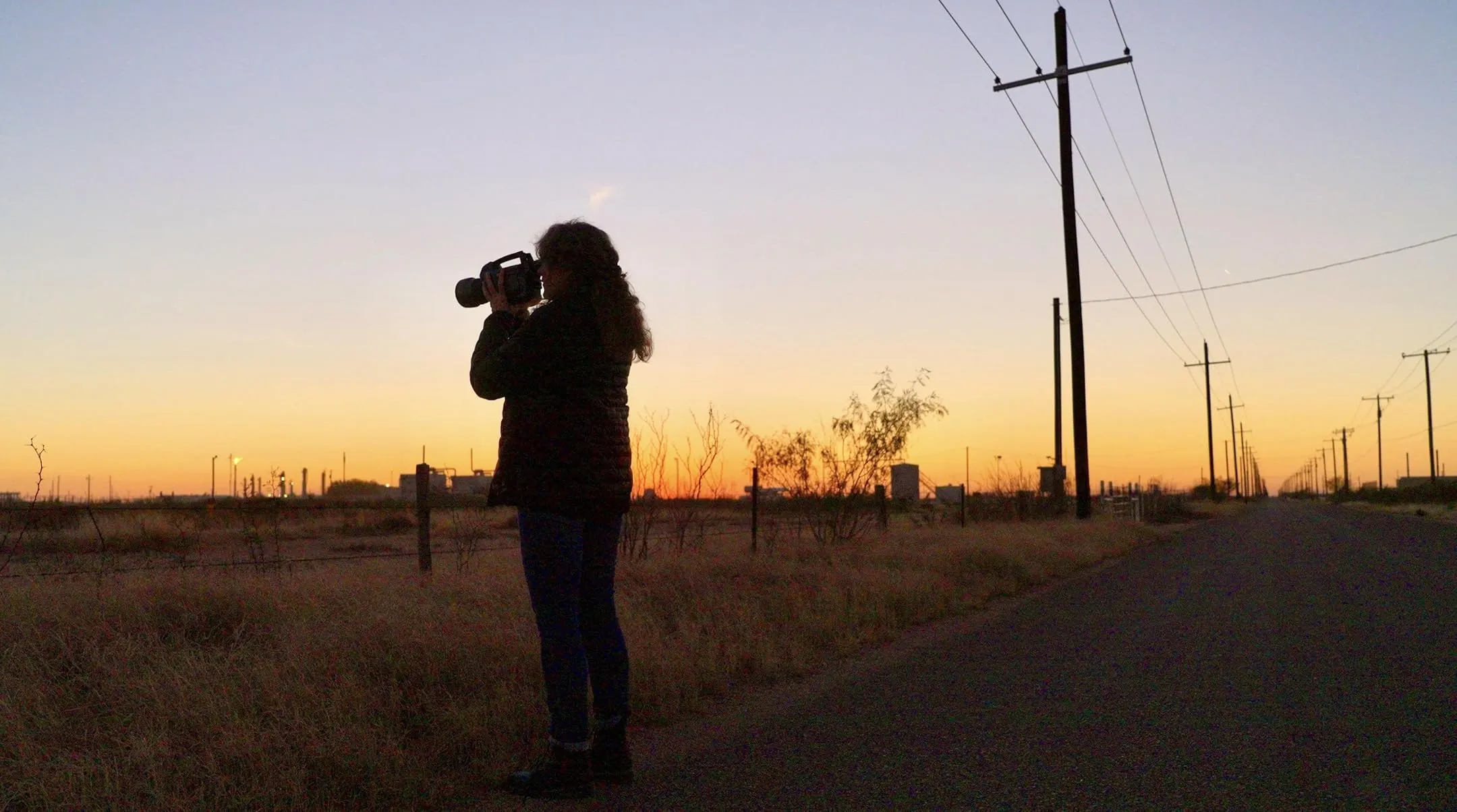
Finally, there is Sharon Wilson, a former industry insider in Texas who now uses an infrared camera to expose the toxic realities of local fracking operations. The documentary presents these three as frontline soldiers in a war being fought not in boardrooms, but in backyards, church basements, and town hall meetings.
The Anatomy of Activism
The film finds its footing when it trusts its subjects to carry the narrative, and it is in these individual portraits that the documentary succeeds. Each profile reveals a different facet of modern activism, captured with a patient camera that allows their distinct personalities to emerge. Justin Pearson, with a background steeped in preaching and teaching, is presented as a natural orator.
The film frames him at podiums and in community halls, capturing an eloquence that connects the pipeline threat to the long history of civil rights struggles in Memphis. His story is one of righteous anger, sparked by a pipeline representative’s chilling admission that his community was chosen as the “path of least resistance,” and then expertly channeled into strategic, disciplined organization. Roishetta Ozane’s arc is a compelling transformation from victim to advocate.
Jacoby visually contrasts the storm-ravaged landscapes of her home with the cold industrial geometry of the nearby refineries. Her journey from uncertainty to confident leadership is palpable; we see her evolve from a resident asking basic questions to an organizer who educates her neighbors about the complex links between industry and climate.
Then there is Sharon Wilson, the tenacious whistleblower. Her story is told through the eerie, ghost-like footage from her infrared camera, which makes invisible methane plumes visible. This technique lends her segments an urgent, almost vérité quality, grounding the film’s arguments in undeniable proof.
A Story in Search of a Structure
For all the strength of its individual characters, the film’s narrative architecture is surprisingly unsteady. Director Oren Jacoby opts to intercut the three stories, a structural choice that consistently hobbles the film’s potential. Just as we become invested in the tense zoning board meetings in Memphis, we are abruptly shifted to a hurricane recovery effort in Louisiana or a lonely stakeout at a fracking site in Texas.
This constant cross-cutting prevents any single storyline from developing the sustained tension it needs to land with full impact. It breaks the implicit contract a storyteller makes with an audience for deep emotional investment. The stakes feel diffused; instead of one high-stakes battle, we witness three medium-stakes skirmishes that never coalesce into a unified front.
This fragmentation is compounded by the inclusion of underdeveloped subplots that detract from the main action. A narrative thread about the Rockefeller family descendants funding environmental causes is introduced but never properly explored, leaving it feeling like a missed opportunity to examine the role of privilege and legacy in the movement.
Even more jarring is the late-film appearance by Al Gore. His presence feels less like a vital endorsement and more like a celebrity cameo in a story that did not require one, a moment that suggests a lack of confidence in the power of the film’s own subjects.
An Artifact of a Different Time
A documentary is a product of its time, but This Is Not a Drill feels particularly captive to the moment of its creation. Filmed largely in the early 2020s, its narrative is infused with a cautious optimism, framing small but significant victories as powerful proof that citizen-led change is possible.
Released into the profoundly different political climate of 2025, where environmental protections face widespread rollbacks, that optimism now appears fragile and profoundly dated. The film’s message has been inadvertently time-stamped by external events. The very triumphs it documents, which might have felt like turning points a few years ago, now feel like holding actions in a battle where the strategic landscape has dramatically shifted. This dissonance creates a strange viewing experience.
The film builds its audience up with inspiring stories of local success, only to deliver a sobering dose of reality through text cards just before the credits. This choice is a purely informational tool used to solve a deep narrative problem.
It acknowledges a changed world without truly engaging with what that change means, leaving the audience with a sense of futility that feels unintentional. The film succeeds as an inspiring portrait of individual resolve, yet it unintentionally functions as a historical document: a snapshot of a hopeful moment before the ground moved beneath everyone’s feet.
The Review
This Is Not a Drill
While This Is Not a Drill shines in its intimate and inspiring portraits of three dedicated activists, its fragmented structure prevents their powerful individual stories from coalescing into a cohesive whole. The film's cautious optimism, a product of the time it was made, feels tragically out of step with current realities, leaving it more a poignant historical artifact than a resonant call to action. Its compelling subjects deserved a more focused and durable film.
PROS
- Features three compelling, inspiring, and authentic central subjects.
- Effectively captures different forms of grassroots activism in action.
- The individual character arcs of the activists are well-documented and engaging.
CONS
- A fragmented narrative structure that lacks focus and sustained momentum.
- Underdeveloped subplots and cameos detract from the main stories.
- The film's hopeful message has been rendered dated by political events, limiting its impact.
- Fails to build the sense of a larger, unified movement.