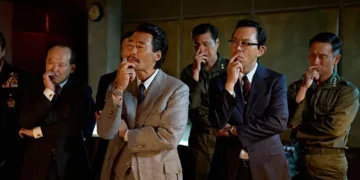





























Director Byun Sung-hyun opens “Good News” with a wink to his audience, essentially confessing that historical accuracy will take a backseat to narrative convenience. This March 1970 hijacking of Japan Airlines flight 351 becomes raw material for a satirical experiment that treats real events as malleable clay. Nine members of the Red Army Faction, armed with makeshift weapons and revolutionary fervor, commandeer the aircraft and demand passage to North Korea. Their plan, predictably, goes sideways from the start.
Enter Nobody (Sul Kyung-gu), a shadowy Korean operative whose very name suggests his fluid relationship with identity and truth. Tasked with resolving this international crisis, he recruits Lt. Seo Go-myung (Hong Kyung), an ambitious radar operator whose dreams of promotion make him perfect bait for a scheme that will likely destroy his career. The film establishes its comedic premise early: what happens when idealistic terrorists meet bureaucratic incompetence across multiple governments? The answer involves a complex web where Japanese officials panic, Korean intelligence schemes, American interests lurk offscreen, and North Korean destinations become elaborate theatrical sets.
Byun structures his narrative in chapters, employing fourth-wall-breaking narration that guides viewers through the labyrinthine politics while maintaining an irreverent tone. This approach signals the director’s intent to prioritize storytelling audacity over historical reverence, setting up a satirical framework that will either soar or crash depending on execution.
Narrative Mechanics and Tonal Juggling
The chapter-based structure serves Byun well initially, allowing seamless transitions between the claustrophobic airplane cabin, bustling Korean intelligence offices, and various governmental war rooms. This format enables perspective shifts that reveal how each faction misunderstands the others while pursuing their own agendas. The fourth-wall narration functions as both exposition device and satirical commentary, with Nobody occasionally addressing the audience directly to explain political machinations that might otherwise confuse international viewers.
Byun demonstrates considerable skill in balancing comedy against the inherent tension of a hostage crisis. His most successful sequences transform potential violence into absurdist theater. The Wild West fantasy sequence, where radio frequency hacking becomes a cowboy duel complete with spurs and ten-gallon hats, exemplifies this approach. These moments work because they acknowledge the artificiality of the situation while maintaining internal logic within their heightened reality.
The film’s willingness to break conventional narrative boundaries through dream sequences, philosophical interludes, and elaborate sound bridges creates a playful atmosphere that distinguishes it from straightforward political thrillers. However, this experimental approach becomes problematic in the third act, where the story continues past its natural resolution point. The pacing, which maintains strong momentum through the first two acts, begins to falter as scenes of bureaucratic finger-pointing become repetitive rather than satirically pointed.
Also Read





The structural choice to extend beyond what feels like the climactic resolution creates a sense of narrative bloat that undermines the tight construction of earlier sequences. This suggests either editorial indecision or a misunderstanding of when satirical points have been sufficiently made.
Character Construction and Performance Dynamics
Sul Kyung-gu crafts Nobody as a masterclass in calculated ambiguity. His physical performance, full of seemingly clumsy movements and distracted mannerisms, masks a character whose every action serves hidden purposes. Sul bobs and weaves through scenes, satchel perpetually at his side, appearing bumbling while orchestrating complex manipulations.

The performance works because it maintains mystery around Nobody’s true motivations while making him simultaneously sympathetic and potentially dangerous. This character represents the film’s central theme about truth as a flexible tool rather than fixed reality.
Hong Kyung provides essential grounding as Lt. Seo Go-myung, the film’s moral anchor in a world of shifting loyalties. His straightforward portrayal of ambition and idealism creates necessary contrast against the duplicity surrounding him. Seo’s desire to earn recognition that would elevate him beyond his war veteran father’s circumstances makes him vulnerable to manipulation, and Hong plays this vulnerability without sentimentality. The character’s sincerity becomes both his strength and his tragic flaw, highlighting how institutions exploit genuine patriotism for cynical purposes.
Ryoo Seung-bum delivers the film’s most energetic performance as KCIA Director Park Sang-heyon, embodying bureaucratic opportunism with manic intensity. His character oscillates wildly between claiming credit for potential successes and preparing escape routes when situations deteriorate. Ryoo’s performance adds necessary comedic energy while illustrating the satirical target: officials who prioritize personal advancement over public service.
The Red Army Faction hijackers function as collective character study rather than individual portraits. Their zealous commitment to revolutionary ideals contrasts sharply with their practical incompetence, creating comedy through the gap between their self-perception and reality. The impulsive second-in-command and barely-controlling leader Denji represent how ideological purity often crumbles under operational pressure. Their running “Ashita no Joe” catchphrase becomes a comedic refrain that underscores their disconnection from the gravity of their situation.
The supporting cast of absent presidents, calculating Americans, and panicking Japanese officials rounds out a world where everyone avoids responsibility while maneuvering for advantage.
Satirical Targets and Cultural Commentary
Byun’s satirical lens focuses most sharply on bureaucratic dysfunction across national boundaries. The film presents government officials as fundamentally similar regardless of their political systems: self-serving, risk-averse, and willing to sacrifice subordinates to protect their positions.
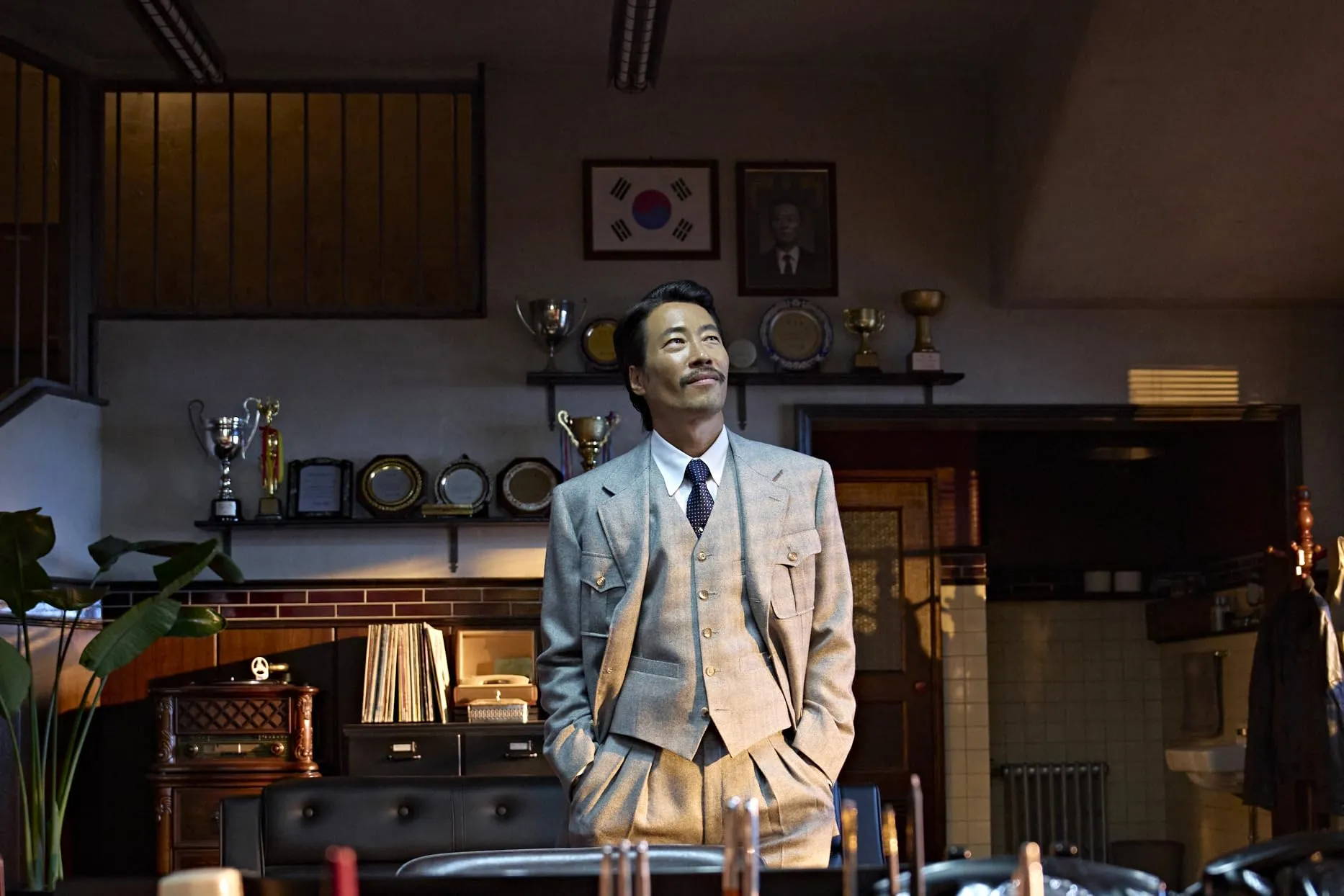
The South Korean president’s decision to send his wife as proxy rather than make difficult decisions himself exemplifies this cowardice, while American officials’ preference for letting Korean soldiers take operational risks reveals the callous calculations behind international cooperation.
The film’s treatment of political opportunism extends beyond individual character flaws to examine systemic issues. Park’s hope that success will improve Korea’s standing with America while putting Japan in their debt illustrates how smaller nations navigate between larger powers. This dynamic reflects Cold War realities where regional allies competed for superpower attention and support, often at the expense of regional cooperation.
The portrayal of the Red Army Faction serves a dual satirical purpose. Their genuine revolutionary commitment contrasts with their operational incompetence, suggesting that ideological purity provides poor preparation for practical action. Their internal debates about majority rule versus leadership authority mirror the governmental dysfunction they oppose, implying that revolutionary movements often replicate the hierarchical problems they claim to solve.
The film’s opening acknowledgment that historical accuracy matters less than narrative truth becomes a recurring theme. Characters throughout the story manipulate information to serve their immediate needs, from Nobody’s elaborate deceptions to governmental cover-ups designed to minimize blame. This approach to truth as a malleable resource rather than fixed reality reflects broader concerns about how political narratives are constructed and maintained.
“Good News” uses its 1970 setting to comment on persistent patterns in international relations, particularly how East Asian nations navigate complex relationships forged during the Cold War period. The film suggests that these dynamics continue to influence regional politics, making historical satire a vehicle for contemporary commentary.
The film “Good News” premiered at the Toronto International Film Festival on September 5, 2025. This South Korean disaster thriller is scheduled for release on the streaming platform Netflix on October 17, 2025.
Full Credits
Director: Byun Sung-hyun
Writers: Byun Sung-hyun, Lee Jin-seong
Producers: Star Platinum
Cast: Sul Kyung-gu, Hong Kyung, Ryoo Seung-bum, Yamada Takayuki, Shiina Kippei, Kim Seung-o, Show Kasamatsu, Nairu Yamamoto
Director of Photography: Cho Hyoung-rae
Editors: Kim Sang-beom
Composer: Kim Hong-jip, Lee Jin-hee
The Review
Good News
Byun Sung-hyun's "Good News" succeeds as ambitious satirical comedy despite structural stumbles. The director's willingness to blend genres and experiment with narrative techniques creates genuinely entertaining moments, particularly in the first two acts where political incompetence meets revolutionary idealism. Sul Kyung-gu's performance anchors the chaos with calculated mystery, while the ensemble cast commits fully to the absurdist premise. However, pacing issues and third-act repetition prevent the film from achieving its full satirical potential.
PROS
- Sharp satirical commentary on bureaucratic dysfunction
- Strong ensemble performances, especially Sul Kyung-gu
- Creative narrative techniques and tonal balance
- Effective blend of historical events with comedic elements
CONS
- Third-act pacing problems and narrative bloat
- Repetitive scenes that dilute satirical impact
- Overly complex plot threads in later sections