




























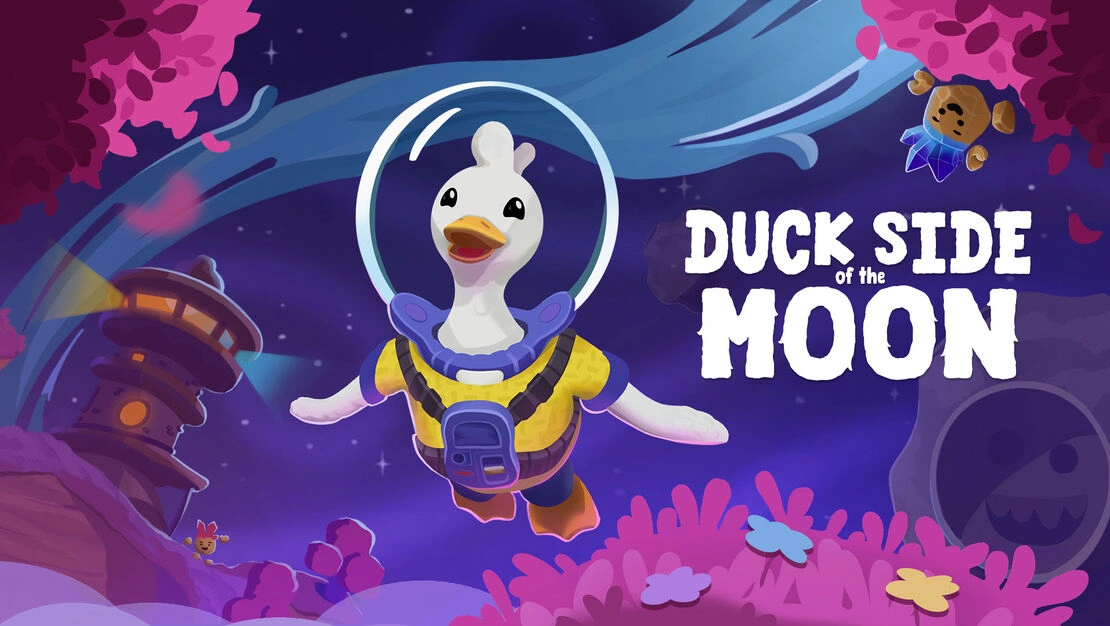

Duck Side of the Moon has the kind of premise that sounds like a joke scrawled on a napkin, then somehow grows into a sincere little adventure. Developed by Starbrew Games, it casts you as Doug, an overworked duck astronaut who dozes off, crashes his ship, and finds himself stranded on a planet populated by friendly geode-like aliens. The goal is simple at first: repair the ship, gather materials, follow Chippy’s instructions, and get back to the life Doug left behind.
The game is less interested in danger than discovery. There is no combat, no real failure state, and no mechanical pressure pushing you forward. Instead, it sits somewhere between a cozy sim, a compact collectathon, and a light third-person exploration game. Think A Short Hike filtered through soft sci-fi whimsy, with a touch of old-school platformer cleanup for players who enjoy treasure chests, costumes, and hidden upgrades.
It is also brief, usually landing between two and five hours depending on how thoroughly you explore. That small scale suits its mood. Duck Side of the Moon is built for gentle progress, silly quacks, and the gradual realization that getting home may not be the only thing that matters.
Floating, Mining, Crafting, Repeating
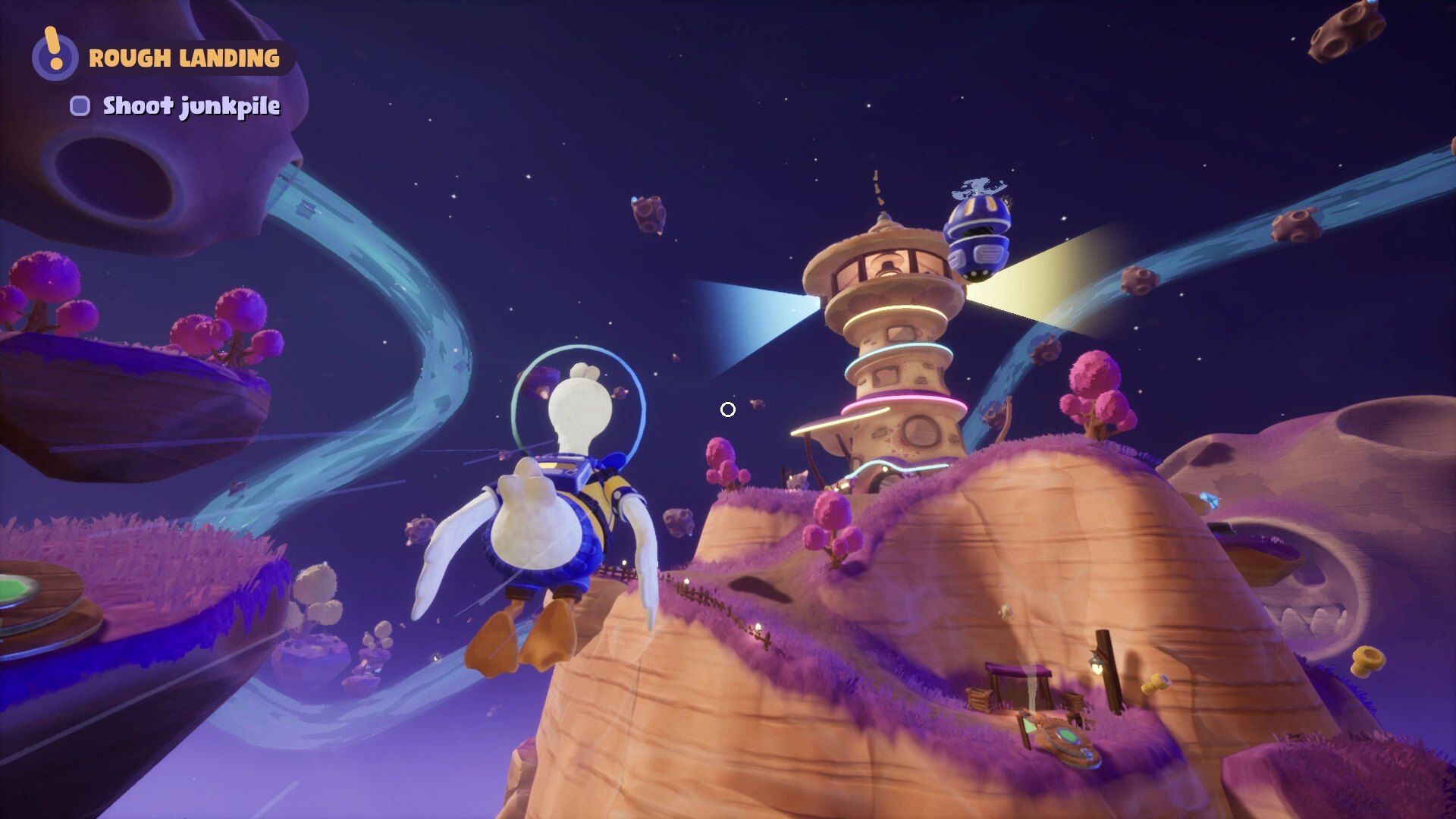
The game’s strongest idea is movement. Doug can waddle around like a tiny feathered explorer, but the real pleasure comes from flight. You lift off, drift between floating rocks, descend onto a glowing platform, spot a cave, then glide toward another mineral cluster. There is no stamina meter nagging at you, which gives exploration a looseness that many cozy games aim for and miss. It feels light without feeling empty.
That movement supports a familiar but satisfying loop. Doug collects ferrite, vibe stones, rubber, bolts, and quest items, then feeds those materials back into ship repairs and gadget upgrades. Early on, the mining laser lets you break mineral deposits for crafting supplies.
Later tools give the world more shape: boosters improve movement speed, extra pockets expand inventory space, the gravity pull gadget lets you move objects, and explosive tools open blocked passages. The design has a mild Metroidvania flavor, since new routes and secrets become available once you have the right gear, but it never turns into a hard gating puzzle.
The ship works as a compact home base, and that matters. Repairing the crafting station, unlocking storage, fixing the jukebox, adding a wardrobe, opening a trophy cabinet, or putting in little comfort features makes each return feel useful. It is the kind of hub that quietly measures your progress without turning into a spreadsheet. Bolts become repairs, repairs become convenience, and convenience makes the planet feel friendlier.
Collectibles add another layer of motivation. Treasure chests hide outfits and useful items, music discs can be played through the jukebox, and costumes let Doug wander around in chef clothes, frog gear, or other absurd little ensembles. The quack button begins as a gag, then gains a practical sonar function for finding secrets. That is a very good use of a quack button. Game design, at last, has peaked.
There are points of friction. Navigation is weaker than the movement deserves. Without a proper map or minimap, simple objectives can become longer searches than intended, especially when markers appear only after you are already near the target. Completionists may also be irritated by areas that are difficult or impossible to revisit for cleanup, including the starting zone. In a game so focused on frictionless wandering, those rough edges stand out.
Rock Friends, Duck Puns, and a Surprisingly Tender Arc
Doug’s story is framed as a crash-landing adventure, but its emotional shape is closer to a coming-of-age tale. He is a duck astronaut trying to locate his place in the universe after being separated from the structures that used to guide him.
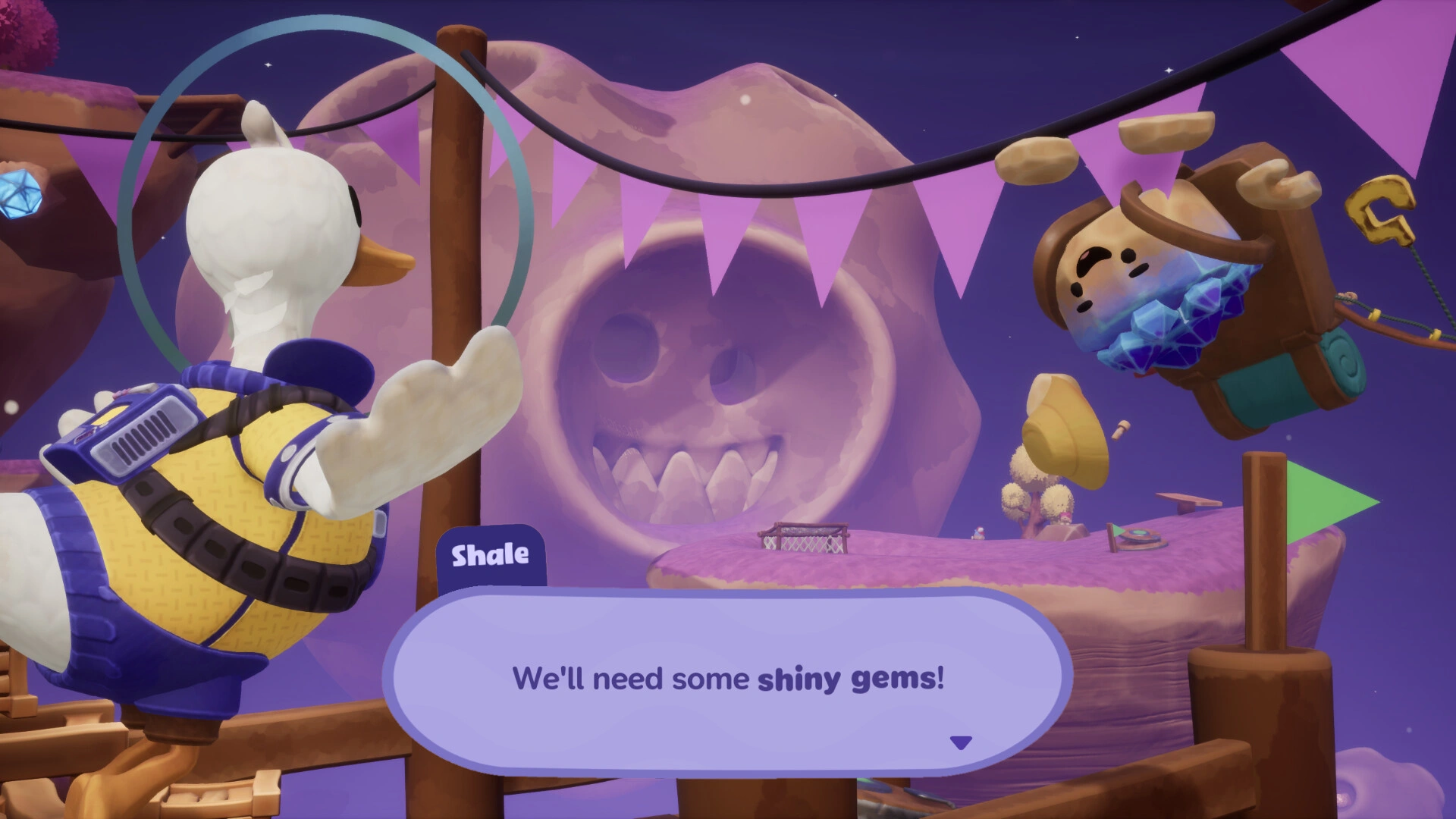
Chippy, the ship’s computer, becomes the main voice of control and caution, often limiting Doug’s movement for his own safety. That protectiveness has a narrative function, turning early restrictions into part of the game’s larger idea about dependence, fear, and growing beyond old systems of protection.
The geode-like locals give the planet its personality. Billy, the tinkerer, introduces the game’s fondness for half-brilliant, half-reckless problem solving. Dozy the gardener brings a softer comic rhythm, asking for help with crystal crops and a gem cake. Other residents send Doug into errands, races, repairs, deliveries, and small mysteries, from love letters to missing engines. These tasks rarely demand much mechanically, yet they work because the world treats help as connection.
The writing is silly by design. There are duck puns, duck tape, quacks, talking rocks, and enough soft-edged humor to make the whole thing feel like a bedtime story that learned how to operate a crafting menu. It avoids becoming too sugary because the jokes are grounded in activity. You are always fixing something, carrying something, mining something, or helping someone with a tiny problem that feels important to them.
The found-family theme lands cleanly. Doug arrives with escape on his mind, then slowly becomes attached to the planet through repeated acts of care. The burnout angle, tied to Doug’s overworked astronaut backstory, is less developed. It gives the premise a lightly adult texture, but the game handles belonging with much sharper focus. Its best emotional beats come from small gestures rather than grand speeches.
A Soft Sci-Fi Playground with a Few Short Edges
Visually, Duck Side of the Moon understands readability. Its planet is soft, colorful, and easy to parse, with purple skies, glowing minerals, floating landmasses, and friendly alien designs that give every area a handmade charm. Doug’s own design does plenty of heavy lifting. He is cute in the way a cozy mascot needs to be cute, expressive enough to carry the mood and ridiculous enough that a frog costume feels like an artistic necessity.
The soundtrack supports the same low-stress approach. It is pleasant, warm, and light, while the jukebox gives collected music discs a purpose beyond checklist filling. Small audio details, including the quack, help keep the mood playful without overwhelming the exploration.
The second major area broadens the experience with carnival-style distractions. Bowling, minecart or shooting-gallery challenges, hammer-pole games, races, tokens, vendors, high scores, and achievements give players reasons to pause the main repair quest and mess around. None of these minigames are deep, but depth is not really the promise. They are short, readable diversions that fit the game’s toy-box structure.
The target audience is clear: cozy game fans, younger players, collectathon enthusiasts, and adults who want something kinder after heavier games. It shares some DNA with A Short Hike and Lil Gator Game, especially in its interest in low-stakes movement and emotional simplicity, while its resource loop gives it a slightly more structured rhythm.
Its main limitation is length. The upgrade cycle is rewarding enough that the game feels ready for another area, another batch of ship systems, or a few more meaningful uses for its tools. Minor issues, such as endgame jukebox trouble and cleanup restrictions, add small frustrations. Still, the compactness also preserves its sweetness, keeping Doug’s strange little space detour from overstaying its welcome.
The Review
Duck Side of the Moon
Duck Side of the Moon is a brief, charming cozy adventure with a strong sense of movement and an easygoing collectathon rhythm. Its free flight, readable world, gentle quests, and sweet character work make Doug’s crash landing feel inviting from start to finish. Thin navigation tools, light thematic development, and a short runtime keep it from greatness, yet the core loop remains warm and satisfying.
PROS
- Joyful free-flight movement
- Cute, readable art style
- Warm found-family story
- Fun ship upgrades and collectibles
- Stress-free cozy pacing
CONS
- Very short runtime
- No proper map or minimap
- Some cleanup issues for completionists
- Burnout theme feels underdeveloped
- Minigames are fun but simple