




























Peter Warren’s Kill Me builds a murder mystery out of a question that most people around its hero think has already been answered. Jimmy, played by Charlie Day, wakes in a bathtub filled with blood, his wrist cut, his memory fractured, and his first instinct is to insist that he did not try to die. The premise is grim, yet the film treats it with the crooked logic of a detective story. What if the victim, suspect, witness, and investigator were all the same man?
That hook gives Warren’s feature debut its sharpest identity. Kill Me operates as a dark comedy, a psychological drama, and a mystery about depression’s talent for disguising itself as certainty. Allison Williams plays Margot, the 911 operator who keeps Jimmy alive on the phone, then becomes the one person he believes can help him reconstruct the night. Their connection gives the film its strange pulse, somewhere between emergency contact, investigative partnership, and fragile romance.
Depression as Detective Story
The film’s cleverest move is turning a private mental collapse into an external case file. Jimmy refuses the explanation everyone else accepts. His sister Alice, his mother, the police, and his therapist Dr. Singer all see a man with a history of depression and a previous attempt. Jimmy sees a locked-room crime scene. The audience is placed in the uncomfortable gap between those readings, which gives Kill Me its real tension.
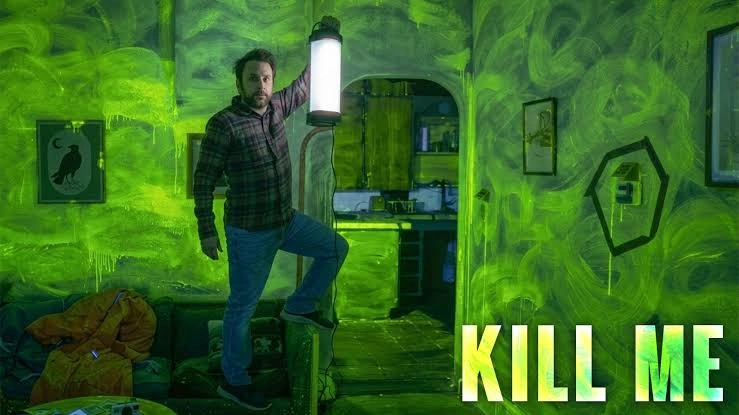
That structure draws from American crime procedurals, true-crime obsession, and the kind of self-help suspicion that thrives online. Jimmy treats his apartment like a forensic lab, buying caution tape, photographing evidence, and searching for clues in his own mess. In a culture trained to turn every trauma into content, his amateur investigation feels funny, sad, and very contemporary. His dirty apartment becomes “evidence.” His missing sauce on Cuban rice becomes a possible clue. His own body becomes the crime scene he cannot bear to understand.
The comedy works because it rarely treats mental illness as the punchline. Jimmy worrying that his blood might stain the bathtub, Siri bungling his emergency call, or his panicked phrase “attempted self-murder” all come from terror colliding with absurd bureaucracy. The film understands how institutions can flatten suffering into categories, diagnoses, and reports. Still, the mystery loses some electricity later, once its possible answers narrow. The early uncertainty has a dangerous spark that the final stretch cannot fully sustain.
Two Frayed Lifelines
Charlie Day’s performance is the film’s most persuasive argument for the concept. He brings the high-strung comic rhythm audiences know, then lets it curdle into fear, shame, and exhaustion. Jimmy is often ridiculous, especially when he tries to become the detective of his own near-death, yet Day never lets him become a cartoon. His eyes carry the dread of a man who wants proof that someone else hurt him because the alternative is too intimate to face.
That tension gives Kill Me an unexpected cross-media quality. Like a point-and-click mystery game, Jimmy advances through objects, clues, suspects, and theories. Yet each discovery loops back to character rather than plot mechanics alone. The investigation does not grant mastery. It exposes how little control Jimmy has over his memory, his relationships, and his own self-image.
Williams gives Margot a quieter, colder fatigue. She looks like someone drained by other people’s worst moments, a professional listener whose own life has become background noise. Her bond with Jimmy starts in a place of protocol, then shifts into something messier. Their chemistry is charming because it never feels clean. These are two isolated people clinging to usefulness as a substitute for stability.
The supporting cast adds sharper edges. Alice carries the trauma of Jimmy’s earlier attempt, and Aya Cash plays her anger as a form of exhausted love. Dr. Singer, played by Giancarlo Esposito, brings professional calm with a faint chill underneath. Jimmy’s family care about him, but their concern can sound like accusation. That emotional ambiguity is one of the film’s most honest instincts.
Suspicion, Space, and the Limits of Ambiguity
Warren directs with a strong sense of physical unease. The bathroom has a grimy, trapped quality, while Jimmy’s apartment becomes a cluttered map of possible guilt. Close-ups press faces into the frame, making every conversation feel like an interrogation. The use of blacklight, wiped surfaces, and mundane household details gives the film a tactile detective texture, while the dinginess keeps it far from slick thriller fantasy.
There is a specifically American anxiety running beneath the film: emergency calls, therapy sessions, police reports, family interventions, and pop-culture-fed paranoia all collide in one man’s search for a livable narrative. In that sense, Kill Me sits near other modern dark comedies about damaged men trying to turn pain into a system they can solve. It shares some DNA with indie psychological mysteries and crime farces, yet its emotional focus makes it harsher than a simple puzzle movie.
The pacing is strongest in the setup and middle act, where Jimmy and Margot’s search gives the film comic motion and emotional pressure. The ending is less secure. Its ambiguity fits the premise, but the mystery and the emotional release do not arrive with equal force.
Still, Kill Me remains a confident debut, powered by two strong leads and a premise that turns survival into an investigation. It is strongest as a dark comedy about doubt, damage, and the strange human need to find proof that staying alive still matters.
The dark comedy-mystery film Kill Me premiered at the SXSW Film & TV Festival on March 12, 2026. The movie follows a man named Jimmy who wakes up in a bloody bathtub with no memory of attempting suicide, leading him to team up with a 911 operator to solve whether someone is trying to murder him or if he is struggling with his own mental health. Following its festival circuit run handled by XYZ Films, distribution and streaming platform availability updates are expected later in the year.
Where to Watch Kill Me (2026) Online
Full Credits
Title: Kill Me
Distributor: XYZ Films
Release date: March 12, 2026
Running time: 104 minutes
Director: Peter Warren
Writers: Peter Warren
Producers and Executive Producers: Charlie Day, Keith Goldberg, Natalie Metzger, Maxime Cottray, Mike Richardson, Peter Warren, Nate Bolotin, Ronnie Exley, Oli Strong, Jeremy Ross, Eric Bromberg, Matthew Lee Miller, Allison Williams, Paul Schwake, Kasey Adler, Timo Argillander, Andrea Scarso, Giancarlo Esposito, Paul Schwake
Cast: Charlie Day, Allison Williams, Giancarlo Esposito, Aya Cash, Jessica Harper, David Krumholtz, Tony Cavalero, Sam Rothermel
Director of Photography (Cinematographer): Conor Murphy
Editors: Todd Zelin, Brett W. Bachman
Composer: Bill Sherman, Zach Marsh
The Review
Kill Me
Kill Me is a sharp, uneasy dark comedy that turns depression into a mystery without reducing its pain to a gimmick. Charlie Day and Allison Williams give the film its emotional charge, while Peter Warren’s direction keeps the premise tense, funny, and claustrophobic. The ending lacks the same precision as the setup, but the film remains a strong debut with a memorable central idea.
PROS
- Strong lead performances from Charlie Day and Allison Williams
- Clever mystery structure built around mental health and self-doubt
- Dark humor lands without cheapening the subject
- Claustrophobic visual style supports Jimmy’s paranoia
- Jimmy and Margot’s dynamic gives the film warmth
CONS
- Mystery becomes easier to read in the later stretch
- Ending may feel emotionally underdeveloped
- Margot’s inner life could use deeper attention
- Some tonal shifts are sharper than intended