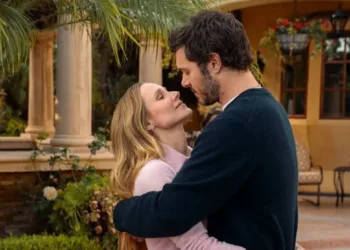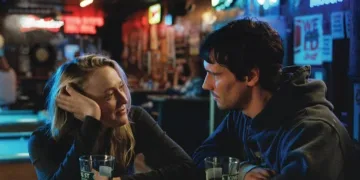














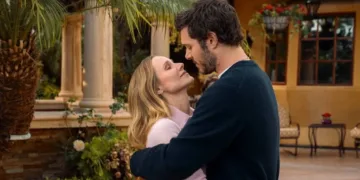
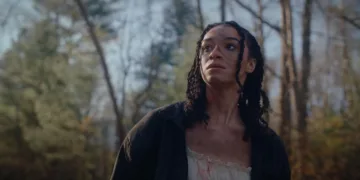












The Sun Never Sets places romance under a strange Alaskan glow, where daylight lingers long enough to make every uncertainty visible. Joe Swanberg’s film follows Wendy, played by Dakota Fanning, a construction site manager whose life appears steady until the future begins pressing against her with quiet violence. Her relationship with Jack, played by Jake Johnson, has warmth, routine, and the comfort of his two children from a previous marriage. It also has limits.
Jack is older, divorced, and finished with certain dreams that Wendy may still want. Marriage. Children. A life that belongs fully to her rather than one she has been carefully folded into. After Wendy’s friend announces a pregnancy, that old existential clock starts ticking in a room no one wants to enter. Jack, sensing the fracture, suggests a six-month break so Wendy can discover what she wants before choosing him for good. It sounds rational. It is also chaos wearing a sensible coat.
The Horror of Wanting Clearly
The film’s romantic conflict begins with a plan that pretends to be generous. Jack thinks he is giving Wendy freedom, yet the gesture quickly curdles into panic once Chuck, her former boyfriend, returns to Anchorage. Chuck is an air-taxi pilot, seductive in the way old mistakes can be seductive, carrying the promise of a life less managed and less domesticated. His arrival turns Jack’s experiment into a wound.

Swanberg is too perceptive to reduce Wendy’s dilemma to stability versus passion. Jack offers family, security, and a love that has already built a shape around her. He can also be controlling, wounded, and frightened by the consequences of his own supposed maturity. Chuck offers heat, wilderness, and the fantasy of beginning again, though his instability makes that fantasy tremble. Wendy’s real choice is stranger and lonelier. She is choosing between possible selves.
That is where The Sun Never Sets finds its philosophical ache. The film is about commitment, parenthood, timing, and the terrifying gap between desire and identity. People say they want love, then flinch at its terms. They say they want freedom, then panic at its emptiness. Wendy’s indecision can be maddening, yet it feels recognizably human. She does not lack feeling. She has too many futures speaking at once.
There is humor in all this circling, sometimes bitter, sometimes tender. The characters reverse themselves, contradict themselves, and return to the same emotional rooms with different excuses. The repetition occasionally strains the film, yet it also captures the purgatory of adulthood, where clarity often arrives late and charges interest.
Faces in the Half-Light
Dakota Fanning gives the film its pulse. Wendy could have become an exercise in frustration, a woman suspended between two men while the story waits for her to decide. Fanning makes that suspension active. She plays Wendy as open and guarded, bright and exhausted, funny in one breath and bruised in the next. A glance can shift from delight to calculation. A smile can look like an apology to herself.
It may be one of Fanning’s strongest adult performances because she refuses to flatten Wendy into a symbol of confusion. There is intelligence in her hesitation. There is dignity in her mess. She seems aware that every choice will cost her something, which gives the performance a faint tragic pressure beneath its casual surface.
Jake Johnson brings Jack a nervous charm that keeps him sympathetic, even when he behaves like a man trying to win an argument he created in his sleep. His comic timing gives Jack’s insecurity a human texture. He can be sweet, foolish, petulant, and painfully self-aware, sometimes in the space of one scene.
Cory Michael Smith’s Chuck is attractive, believable, and faintly underwritten. He has enough presence to make Wendy’s pull toward him credible, yet he often functions as the ghost of another life rather than a fully equal force. Still, that ghost matters.
Swanberg’s improvisational method gives these performances their lived-in grain. The dialogue drifts, overlaps, stalls, and sparks. Meaning hides in pauses, jokes, eye contact, and the body language of people who know each other too well.
Alaska and the Shape of Restlessness
Swanberg’s direction has a quiet confidence here. The film carries the naturalism associated with his earlier work, yet it has a broader visual elegance. Eon Mora’s 35mm cinematography gives Anchorage a tactile beauty: pale mountains, dark water, cabins, blond wood interiors, bars glowing with small social rituals, work sites where Wendy’s practicality meets her private disorder.
The Alaskan setting matters. Its openness does not liberate Wendy exactly. It exposes her. The long daylight creates a world without sufficient darkness, a place where people cannot easily hide from themselves. Mountains suggest grandeur, yet they also make human indecision look absurdly small. That tension gives the film its best visual idea: a landscape of possibility that can feel like a trap.
Swanberg’s editing favors a relaxed, slightly uneven rhythm. Scenes begin after life has already started and end before life has resolved. That looseness helps the film breathe. It also reveals the central weakness. The repeated romantic reversals can grow tiring, and some viewers may feel trapped inside the same conversation with better scenery.
Still, The Sun Never Sets remains warm, sad, and observant. It understands that adulthood is often less about finding the perfect life than accepting the grief hidden inside every possible one. Under its endless Alaskan light, love becomes a question nobody can answer without losing something.
The Sun Never Sets is an American independent romantic drama film that celebrated its world premiere at the South by Southwest (SXSW) Film & TV Festival on March 13, 2026. The storyline centers on a 31-year-old construction worker in Anchorage whose relationship hits a volatile rough patch when her older, divorced boyfriend suggests they take a temporary break to evaluate their future. Her emotional landscape grows far more chaotic when she unexpectedly crosses paths with an adventurous ex-boyfriend, pulling her into a complicated and emotionally messy love triangle set against the vast Alaskan wilderness. Following its successful festival premiere, the distribution rights were acquired by Independent Film Company and Sapan Studio for a planned commercial theatrical rollout later this year, meaning audiences can currently look for it on the global film festival circuit and upcoming independent cinema schedules.
Where to Watch The Sun Never Sets (2026) Online






Full Credits
Title: The Sun Never Sets
Distributor: Independent Film Company, Sapan Studio
Release date: March 13, 2026
Running time: 102 minutes
Director: Joe Swanberg
Writers: Joe Swanberg
Producers and Executive Producers: Joe Swanberg, Dakota Fanning, Jake Johnson, Cory Michael Smith, Ashleigh Snead
Cast: Dakota Fanning, Jake Johnson, Cory Michael Smith, Debby Ryan, Anna Konkle, Lamorne Morris, Karley Sciortino, Brandon Daley
Director of Photography (Cinematographer): Eon Mora
Editors: Joe Swanberg
The Review
The Sun Never Sets
The Sun Never Sets is a tender, restless relationship drama that turns romantic indecision into an existential weather system. Dakota Fanning anchors the film with remarkable warmth and ache, while Joe Swanberg uses Alaska’s endless light to expose the fears people carry into love, commitment, and adulthood. Some repeated reversals dull the impact, and Chuck remains thinner than he should be, yet the film’s emotional honesty lingers.
PROS
- Excellent Dakota Fanning performance
- Strong chemistry between the leads
- Beautiful Alaskan setting and 35mm cinematography
- Honest treatment of adult uncertainty
- Warm humor with melancholy undertones
CONS
- Romantic reversals can feel repetitive
- Chuck is less developed than Wendy and Jack
- Loose pacing may test some viewers
- The central conflict occasionally circles familiar ground