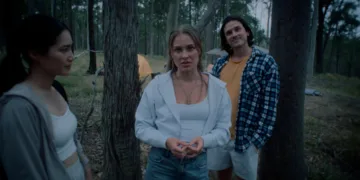



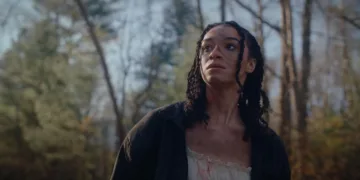




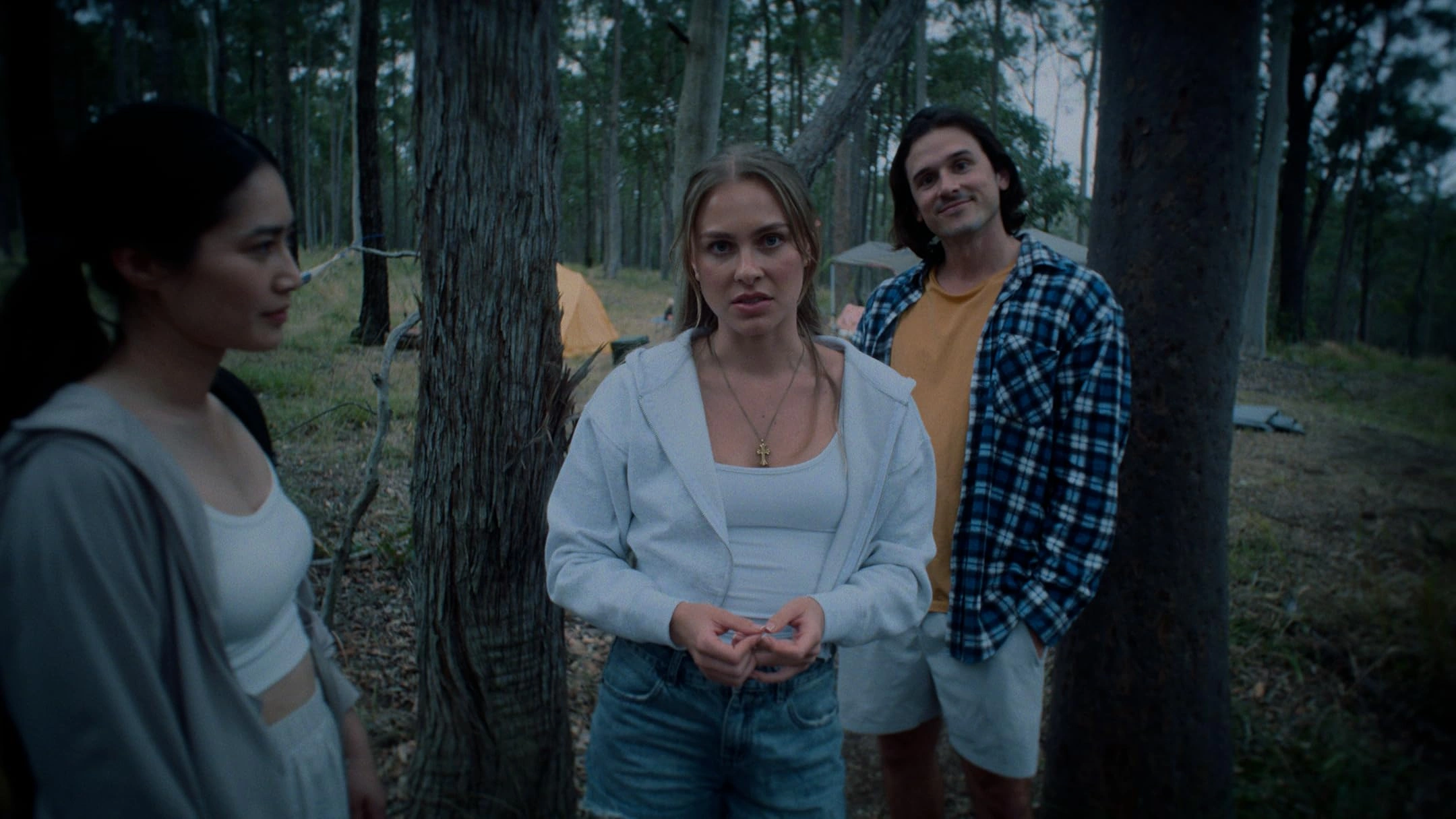

Dead Eyes enters the woods with a clever formal trap: the audience sees everything through Sean’s eyes, with no escape hatch into the usual safety of third-person observation. Richard E. Williams’ feature debut follows Sean, his fiancée Grace, his friend Eric, and Eric’s girlfriend Kate as they travel into a remote Australian forest to search for Sean’s missing father, Paul. The mission is personal from the start. Paul’s disappearance is tied to the death of Sean’s younger sister Lily, a childhood tragedy that has hardened into family myth, psychological damage, and dread.
The film wants to be a grief chamber with teeth. Its ingredients are rich: dead children who may not be dead, cloning experiments, hallucinogenic panic, cannibal doubles, and a forest that behaves like a haunted archive. The ambition is easy to admire. The cohesion is harder to defend. Dead Eyes keeps reaching for metaphysical horror, then occasionally trips over a log labeled “script problems.” Horror, at least, has always loved a humiliating pratfall.
The Family Wound Becomes a Specimen
Sean’s return to the forest functions like an excavation of old damage. Lily’s death has not passed into memory cleanly. It lingers as guilt, estrangement, and repetition, the holy trinity of dysfunctional family horror. Paul, the absent father and scientist, gives the movie its most disturbing symbolic charge. His cloning experiments turn grief into procedure. Mourning becomes a lab protocol. Resurrection becomes manufacturing.
That idea has sharp historical teeth. From Frankenstein onward, horror has often asked what happens when human loss is treated as a technical inconvenience. Dead Eyes updates that anxiety for an age obsessed with optimization, replication, and biological control. Paul does not heal his family. He produces copies. The cloned Lilys become a grotesque parody of parental refusal: a father so incapable of accepting death that he creates a swarm of living accusations.
The result is the film’s strongest concept, a kind of soul-accounting nightmare. If a body can be copied, what has actually returned? A face? A hunger? A memory with no rightful owner?
The screenplay cannot always carry those questions. It moves from PTSD to genetics, mushrooms, cannibal children, and family collapse with the energy of someone opening too many cursed drawers. Some ambiguity feels purposeful. Some feels like the film misplaced its own map.
The Camera as Trap
The first-person perspective is the film’s defining gamble. At its best, it turns the screen into Sean’s skull. The viewer hears branches shift, sees movement flicker at the edge of vision, and absorbs the awkward intimacy of people speaking straight toward the lens. The format creates a claustrophobic empathy. Sean cannot look away, so neither can we.
Williams finds inventive ways to make the device feel fluid. Sean losing consciousness, covering his face, turning his gaze, or moving through flashlight-lit darkness gives the film a strange continuity, as if the whole story is one long panic response. The technique borrows from survival-horror games, body-cam immediacy, and nightmare logic, then folds those influences into a woodland setting where orientation is already fragile.
Still, the method has visible seams. Actors sometimes seem to perform toward a camera rather than a person, which gives certain exchanges a staged quality. Sean’s voice also carries a faint dislocation, as if it belongs to a cleaner audio space than the mud, leaves, and fear around him. That mismatch can be fascinating in theory. In practice, it sometimes turns emotional distress into haunted podcasting.
The polished high-definition look creates another tension. The film is handsome, perhaps too handsome. Woodland POV horror often thrives on grime, blur, and visual uncertainty. Dead Eyes shows too much too clearly, which makes its handmade horrors easier to inspect and harder to fear.
Monsters, Mushrooms, and Misfires
The horror works in flashes. A flashlight cuts through the woods. A body jerks into frame. A basement image lands with nasty, biological force. The cloned Lilys, feral and cannibalistic, give the film its most memorable nightmare image: childhood innocence reproduced until it curdles into predation. It is a grim little metaphor for inherited trauma, with teeth.
The scare craft is less consistent. Some jump scares rely on volume and sudden entry rather than sustained dread. The creature work can feel cheap, especially when the film’s clean visual texture gives every costume and gesture too much exposure. The mushroom-trip device is another mixed blessing. It permits surreal imagery and fractured perception, yet it also gives the audience an easy explanation for the inexplicable. Once hallucination enters the room, fear starts asking for receipts.
The cast works hard within a difficult formal cage. Ana Thu Nguyen, Charles Cottier, and Alea O’Shea help define Sean through their reactions, while Rijen Laine carries much of the protagonist’s burden through voice and physical implication. The script gives them uneven support, particularly in dialogue and responses to death.
Dead Eyes is messy, strange, sometimes scary, sometimes silly. It may earn a place in cult-horror discussion through sheer formal audacity. A flawed debut, yes, yet one with the confidence to stare through its own experiment until the experiment stares back.
Dead Eyes premiered on March 12, 2026, at the SXSW Film Festival in Austin, Texas, where it screened in the Visions section. The Australian independent feature is handled by regional distributor Umbrella Entertainment and international sales agent Alliance Media Partners (AMP), though a wide streaming platform release has not been finalized yet. The plot follows a young man named Sean and his fiancée who venture into a remote forest to search for his missing father, only to discover a horrifying cloning experiment that brings their deepest grief to life.
Full Credits
Title: Dead Eyes
Distributor: Umbrella Entertainment, Alliance Media Partners (AMP) International
Release date: March 12, 2026
Running time: 1 hour 21 minutes
Director: Richard E. Williams
Writers: Richard E. Williams
Producers and Executive Producers: Richard E. Williams, Tristan Barr, Ari Harrison, Jeff Harrison
Cast: Ana Thu Nguyen, Mischa Heywood, Rijen Laine, Charles Cottier, Alea O’Shea, Stephen Phillips, Freya Callaghan
Director of Photography (Cinematographer): Julian Panetta
Editors: Richard E. Williams
Composer: Matt Sofo
The Review
Dead Eyes
Dead Eyes is a bold, uneven horror debut that uses first-person perspective to pull viewers into Sean’s grief-soaked panic. Its cloning nightmare has strong symbolic bite, and the woodland setting gives the film a few sharp jolts. The script, dialogue, and creature execution often lag behind the ambition, leaving major ideas half-shaped. Still, Richard E. Williams shows real formal nerve, making this a flawed experiment worth discussing.
PROS
- Inventive first-person POV concept
- Strong themes of grief, guilt, and failed resurrection
- Effective woodland atmosphere
- Memorable cloning horror premise
- Ambitious debut from Richard E. Williams
CONS
- Uneven script and dialogue
- Some scares feel repetitive
- Creature work can look cheap
- Psychedelic elements weaken tension at times
- Ending leaves too much unresolved