

























![Kingdom Hearts Collection [I-III] Review](https://gazettely.com/wp-content/uploads/2026/10/Kingdom-Hearts-Collection-I-III-1-360x180.webp "Kingdom Hearts Collection [I-III] Review: KHII Holds Steady as Newer Entries Fluctuate 37")



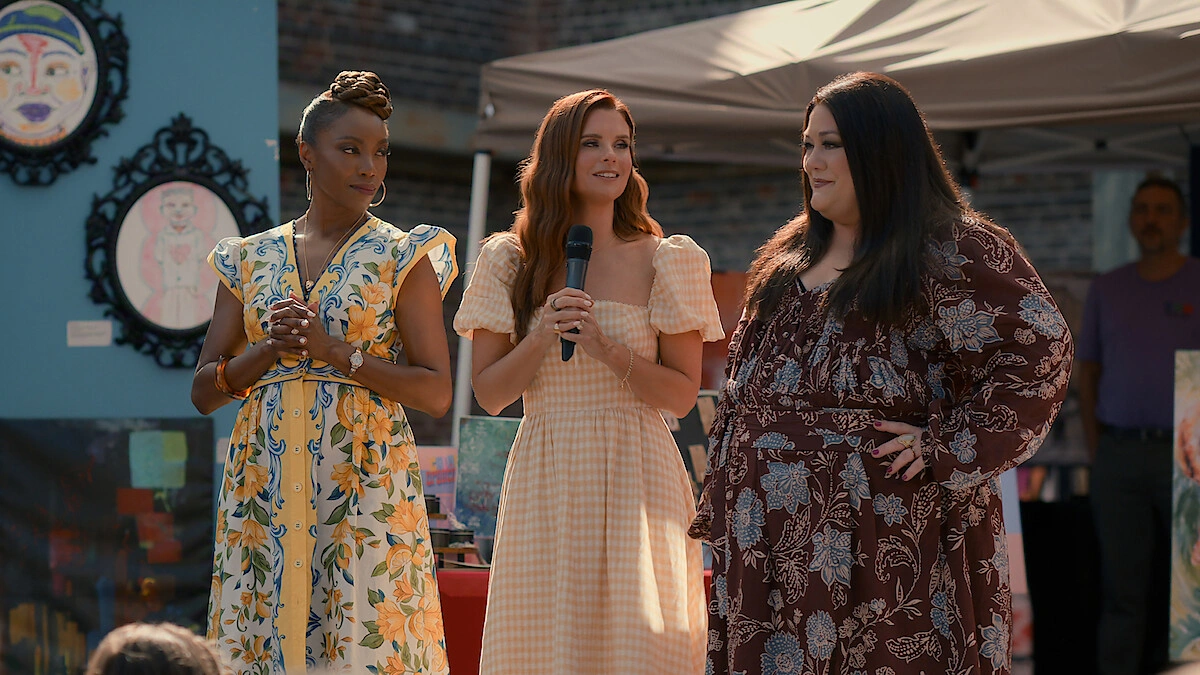

Sweet Magnolias Season 5 returns to Netflix with its familiar promise intact: friendship can steady almost any crisis, romance can survive poor communication if everyone speaks in polished life lessons, and Serenity, South Carolina remains the kind of town where gossip travels faster than broadband. Based on Sherryl Woods’ book series, the show has long occupied a cozy corner of streaming television, built on family, faith, heartbreak, forgiveness, and the ritual power of margarita nights.
This season briefly leaves Serenity behind, placing Maddie in Manhattan after six months in a publishing job. Dana Sue and Helen arrive for a weekend of sightseeing, wedding dress browsing, Central Park strolling, and rooftop drinks. The change of scenery gives the premiere a welcome jolt. The city adds movement, scale, and a hint of reinvention before the series returns to its porch-lit comfort zone.
From there, Season 5 becomes a study in transition. Maddie faces career uncertainty, Helen and Erik hit wedding turbulence, Dana Sue and Ronnie confront marital strain, Annie prepares for college, and the town gathers around art, food, books, and local ambition. The season is warm, safe, and sincere, with a little extra romantic heat and the same habit of turning ordinary dialogue into embroidered throw-pillow wisdom.
The Core Trio Remains the Show’s Most Reliable Social Contract
The strongest case for Sweet Magnolias has always been Maddie, Helen, and Dana Sue. Season 5 understands that their friendship is the show’s emotional infrastructure. Streaming television often sells “community” as a brand-friendly idea, yet this series keeps returning to the daily labor behind it: showing up, listening, disagreeing gently, feeding people, and refusing to let shame isolate anyone for too long.
Maddie’s story begins with professional promise in New York, then pivots after her publishing job falls apart. The firing could have been framed as humiliation, yet the season treats it as redirection. Maddie carries the skills and confidence she gained in the city back to Serenity, where her love of books and writing feeds into a larger celebration of creativity. It is a smart arc for a character who has often been defined by family recovery and romantic repair. Here, she is still gentle and loyal, though the season lets her be professionally restless too.
Cal’s support gives Maddie room to question herself without turning the relationship into a disaster zone. In a TV culture addicted to romantic sabotage, this feels almost radical. Imagine that: a couple dealing with adult change through patience and encouragement. Somewhere, a writers’ room whiteboard marked “third-act breakup” just fainted.
Helen’s arc carries greater emotional pressure. Her wedding plans with Erik should feel like a reward after years of pain, yet family concerns and unspoken fears create distance between them. Erik’s hesitation gives him greater complexity, shifting him from near-perfect romantic figure into someone shaped by obligation, insecurity, and old wounds. Helen’s anxiety feels earned. The mirror scene, where she confronts her own fear, gives the season one of its clearest emotional images. Heather Headley plays the moment with restraint, letting silence do much of the work.
Dana Sue receives the heaviest domestic material. Ronnie’s e-bike business consumes him, his partnership with Courtney creates unease, and his absence from home leaves Dana Sue carrying too much emotional weight. Her dream of a teaching kitchen and her desire to savor Annie’s final stretch before college make Ronnie’s distraction sting harder. The house fire turns that strain into physical damage. Their home becomes a visual record of a marriage that may still be rebuilt, if both people finally stop mistaking guilt for growth.
Romance, Family, and the Problem of Repeating Old Arguments
Season 5 gives Helen and Erik the richest romantic conflict. Their tension comes from trust, communication, and the pressure of family expectation. Erik’s extended family adds texture to his world, especially through Jessica, and the season benefits from seeing him as a man with history beyond his devotion to Helen.

The postponed wedding works because it grows from emotional avoidance rather than cheap shock. Helen does not panic for no reason. Erik does not become suddenly cruel. They stumble because love, in this show’s softer moral universe, still requires clarity.
Dana Sue and Ronnie are a tougher case. Their conflict has the recognizably exhausting rhythm of a long marriage in which one partner keeps promising change while repeating the same mistakes. Ronnie’s stubbornness, work obsession, and self-pity make him frustrating in ways that feel intentional.
His addictive tendencies bleed into business, marriage, and fatherhood, leaving Dana Sue and Annie to deal with the fallout. The writing understands the pain of loving someone who wants to be better, then keeps choosing the wrong doorway.
The issue is repetition. After previous seasons already tested this marriage, Season 5 risks making Dana Sue and Ronnie feel stuck in an emotional loop. The finale leaves their tension open for future drama, though the show will need to find a sharper path if it returns. There are only so many times an audience can watch Ronnie walk toward a bad decision with the confidence of a man entering a pie-eating contest.
Maddie and Cal provide balance. Cal’s coaching ambitions and interest in managing a new baseball team connect neatly with Maddie’s publishing and community-building interests. Their relationship has a steadier rhythm this season, which gives the show some much-needed warmth between heavier arcs. Justin Bruening’s Cal is supportive and charming, though the season sometimes leaves him hovering near the edge of Maddie’s story rather than giving him enough interior life of his own.
The younger generation is mixed. Annie’s attempt to move past Ty through two new romantic prospects never fully works because neither suitor deepens her character. Ty’s absence hangs over her arc, especially after earlier seasons invested so heavily in that bond. Kyle fares better, with his romance with Lily and involvement in the town play giving him a natural step toward maturity.
Isaac’s first serious relationship with Michael is sweet and welcome, bringing gentle LGBTQ+ representation into Serenity’s domestic fabric without turning it into a Very Special Lesson. The “Mini Magnolias” idea also has promise, suggesting that friendship across generations may become one of the show’s quieter legacies.
Creativity, Vulnerability, and the Town as Cultural Shelter
The Manhattan opening introduces the season’s main idea: life can tilt without warning. The Central Park Alice in Wonderland statue gives that idea a visual cue, inviting the characters to imagine change as a fall into strange territory.

Maddie’s career reversal, Helen’s wedding doubts, Dana Sue’s marital crisis, and Annie’s looming departure all echo that sense of instability. Season 5 is strongest when it treats vulnerability as something communal, not private. Nobody has to be brave alone in Serenity, which is both the show’s fantasy and its social argument.
That argument matters in the current streaming climate. Many platforms chase scale, shock, and algorithm-friendly spectacle. Sweet Magnolias chooses local attachment instead. Its stakes are domestic and civic: a marriage under strain, a young woman leaving home, a town deciding that art deserves space.
In a media era shaped by fragmentation and automated content, the season’s emphasis on books, cooking, performance, and the Art Guild feels pointed. The Magnolias are building a small cultural commons, one romance novel, kitchen lesson, and community project at a time.
The arts storyline is one of Season 5’s freshest ideas. Maddie’s love of publishing, Dana Sue’s teaching kitchen, and Helen’s work with the Art Guild move the trio beyond crisis response. They start thinking about legacy. This gives Serenity a sense of movement. The town is not frozen in its own charm. It can still make space for new dreams.
The season also benefits from its visual contrasts. New York brings skyline energy, crowds, and speed. Serenity brings warm homes, family tables, town meetings, and quiet rituals. The show probably should have stayed in Manhattan longer, since the premiere’s change of pace gives the characters new texture. Still, Serenity remains the series’ identity. The burned kitchen in Dana Sue’s house stands out as the season’s most potent image: charred, dark, fragile, and caught between renewal and ruin.
Comfort, Representation, and the Limits of Playing Safe
Sweet Magnolias Season 5 remains a comfort watch by design. It avoids brutal shocks and grim twists. Its problems can usually be softened through friendship, prayerful patience, community effort, and the sacred civic institution known as “pour it out.” That softness is part of its appeal. Television does not always need to arrive armed with trauma and prestige gloom. Sometimes viewers want a show where people apologize in full sentences and bring casseroles before being asked.
Still, comfort can become a creative ceiling. The season slows after the New York premiere, and some arcs circle familiar territory. Dana Sue and Ronnie’s marriage is the clearest example. Annie’s romantic subplot also feels like filler, partly because Ty’s absence remains unresolved. The show wants to honor change, then often retreats into the safest version of it.
The dialogue has the same tension. It is sincere, poetic, and occasionally too polished to sound like human speech. Characters often speak as if they have had several hours to workshop their feelings with a motivational calendar. Yet Season 5 earns some of that heightened language better than earlier entries because the fears are clearer. Helen’s doubt, Maddie’s professional uncertainty, and Dana Sue’s exhausted hope give the emotional speeches firmer ground.
The performances carry much of the season. JoAnna Garcia Swisher keeps Maddie soft without making her passive. Brooke Elliott gives Dana Sue anger, hurt, and stubborn pride. Heather Headley is the standout, especially in Helen’s quiet collapses and careful recoveries. Dion Johnstone gives Erik warmth shaded by fear, while Justin Bruening makes Cal an easy source of steadiness, even when the writing underuses him.
As representation, the season is modest yet meaningful. Isaac and Michael’s relationship is folded into the fabric of Serenity, and the show’s focus on women’s friendship, middle-aged desire, career reinvention, and chosen community still has cultural value. Sweet Magnolias may never become formally daring television, yet Season 5 shows why its gentleness has endurance. It offers familiar pleasures, uneven pacing, stronger emotional grounding, and a hopeful sense that Serenity still has room to grow.
Sweet Magnolias Season 5 is an American romantic drama television series that premiered all ten episodes simultaneously on Netflix on June 11, 2026. Developed by showrunner Sheryl J. Anderson based on the beloved novel series by Sherryl Woods, the season shifts away from the familiar streets of Serenity, South Carolina, as the lifelong friend trio navigates major life disruptions, wedding arrangements, and career changes. Audiences looking to watch the new chapter unfold can stream the entire season exclusively on the Netflix digital application.
Where to Watch Sweet Magnolias Season 5 Online


Full Credits
Title: Sweet Magnolias Season 5
Distributor: Netflix
Release date: June 11, 2026
Rating: TV-14
Running time: 43–54 minutes per episode
Director: Lauren Petzke, Christine Swanson, Norman Buckley, Matt Drake, JoAnna Garcia Swisher
Writers: Sheryl J. Anderson, Caron Tschampion, Francesca Butler, Shani Am. Moore, Anthony Epling, Barret Helms, Kale Futterman, Bianca Sams, Alex Rubin
Producers and Executive Producers: Dan Paulson, Sheryl J. Anderson, Sherryl Woods, Matt Drake, Norman Buckley
Cast: JoAnna Garcia Swisher, Brooke Elliott, Heather Headley, Logan Allen, Annaliese Judge, Carson Rowland, Justin Bruening, Chris Klein, Jamie Lynn Spears, Dion Johnstone, Brandon Quinn, Chris Medlin
Director of Photography (Cinematographer): John Smith, Brian Ames
Editors: Paul Dixon, Nicole Votta
Composer: James Jandrisch
The Review
Sweet Magnolias Season 5
Sweet Magnolias Season 5 remains a gentle, emotionally sincere comfort watch, strongest whenever Maddie, Helen, and Dana Sue lean on each other through change. Its Manhattan opening brings fresh energy, and the season’s focus on art, books, food, and community gives Serenity renewed purpose. Still, slow pacing, polished dialogue, and recycled marital tension keep it from feeling fully refreshed. Warm, familiar, and occasionally too safe, it proves this small-town drama still has charm left.
PROS
- Strong central friendship between Maddie, Helen, and Dana Sue
- Heather Headley delivers the season’s standout performance
- Manhattan opening gives the season fresh visual energy
- Arts and community storyline adds meaningful texture
- Maddie and Cal provide a warm, steady romantic thread
- Isaac and Michael’s relationship brings sweet, understated representation
- Dana Sue’s house fire creates strong visual symbolism
CONS
- Pacing often feels slow after the New York premiere
- Dana Sue and Ronnie’s marital conflict feels repetitive
- Annie’s new romance subplot lacks depth
- Ty’s absence weakens Annie’s arc
- Dialogue can sound too polished and inspirational
- Cal is charming, yet underused
- The season rarely takes major creative risks